Beneteau Oceanis 40 CC, the Center Cockpit Oceanis 400 for Liveaboards
Groupe Finot's 1995 center cockpit cruiser, a 41 footer with an aft owner's suite, two heads and a big engine room that suits couples who live aboard.
- Length
- 41 ft12.5 m
- Beam
- 12.8 ft3.89 m
- Draft
- 5.5 ft1.68 m
- Cabins
- 2
- Used price
- $70K to $120K
On this page
- Overview
- Fall 1995, when Beneteau moved the cockpit amidships
- Oceanis 400 CC, Clipper 40 CC or Beneteau 40CC
- What changes when the cockpit moves amidships
- An aft suite, a forward guest cabin and two heads
- An engine room built for a generator
- Keel-stepped mast, furling main and how it sails
- Tom Neale's quibbles, three decades later
- Prices and how it compares
- Specifications
- Price and value
- Strengths and weaknesses
- Used buyer checklist
- Rivals
- Our verdict
- FAQ
The Beneteau Oceanis 40 CC, also called the Oceanis 400 CC, Oceanis Clipper 40 CC and Beneteau 40CC, is a 41 ft center cockpit cruiser on the Groupe Finot Oceanis 400 hull, introduced in fall 1995 with an aft owner's cabin and two heads.
- Liveaboard couples
- Long-season coastal and island cruising
- Owners who want a private aft cabin with its own head
Beneteau Oceanis 40 CC by the numbers
- Sail area to displacement
- 15.6A cruising rig sized for comfort, so expect to motor in very light air.
- Displacement to length
- 169Light displacement for its length, quick but sensitive to added cruising weight.
- Theoretical hull speed
- 8.1 knThe practical top speed of a displacement monohull under normal sailing, based on waterline length.
- Ballast ratio
- 28%Relatively low ballast, form stability does more of the work.
- Capsize screening
- 1.92Below 2.0, the traditional threshold for offshore suitability.
- Motion comfort ratio
- 25.7Moderate motion comfort, typical of modern cruisers.
- Length to beam ratio
- 3.22 : 1Moderate proportions.
Fall 1995, when Beneteau moved the cockpit amidships
In the mid 1990s the big production builders began offering center cockpit versions of their best-selling aft cockpit boats. As Tom Neale put it in Cruising World, you take a proven hull, tool a new deck, redistribute the weight and gain a smooth-sailing cruiser with a new look and much more interior volume. Beneteau did exactly that with the Groupe Finot Oceanis 400, and the center cockpit version was introduced in the fall of 1995.
PBO notes that the center cockpit boat was built on the same hull as the Oceanis 400 and later 411, and that it sold in much smaller numbers; about 1,000 boats in total were built on that hull before the 393 and 423 arrived in 2002. Beneteau's heritage archive groups the 40 CC with its Oceanis center cockpit range of 1994 to 2003, and the Oceanis 42 CC, which sailboatdata dates to 2003, took over.
Oceanis 400 CC, Clipper 40 CC or Beneteau 40CC
Brokers list this boat under several names. Cruising World's test and sailboatdata call it the Oceanis 400 CC. Beneteau France sold it as the Oceanis Clipper 40 CC, and Beneteau USA's later website called it the Beneteau 40cc. Sailboatdata also records a charter version, the Moorings 402CC, first built in 1996.
Whatever the badge, the key facts are the same: a 41 ft center cockpit sloop with a 36 ft 9 in waterline, an aft owner's cabin and two heads. Do not confuse it with the aft cockpit Oceanis 400 or with the larger Oceanis 42 CC that followed.
What changes when the cockpit moves amidships
The trade for the extra volume is on deck. Neale found the side decks narrow for a 40 footer, a compromise to make room below, and the cockpit backrests low, which keeps the profile sleek and makes it easier to step out of the cockpit. Beneteau USA's equipment list adds a teak-capped bulwark around the deck, four Dorade vents, side deck lockers with one for propane bottles, liferaft attachment points on the aft coachroof and a forward cockpit coaming designed to take a windscreen, a rigid top or a sprayhood.
Steering is hydraulic, with the wheel on a pedestal or, as an option, mounted on the aft face of the cabin behind a spray shield, which Neale said pushed the boat toward motorsailer territory. The sugar-scoop stern has a swim ladder, a transom shower and lockers for fenders and lines, and a stainless rub rail protects the topsides, a cruising detail he said many builders omitted.
An aft suite, a forward guest cabin and two heads
The aft owner's cabin is the reason most people buy this boat. Beneteau USA describes a central double berth about 6 ft 7 in by 4 ft 11 in with steps on both sides, two hanging lockers, a vanity with mirror and plenty of opening ports, one of them in the transom. Neale called the berth very low and wide, easy to get into from either side. Its own head with a stall shower sits forward of the cabin beside the engine space.
Forward there is a guest cabin with a double berth to starboard, drawers beneath, a hanging locker and a small settee to port, plus a second head with shower right in the bow. The saloon has a raised U-shaped settee and table to starboard for a view out, and a navigation station with chart table and hinged electrical panel to port. The galley runs along the port passageway toward the aft cabin, close to both cockpit and saloon, with a gimbaled oven, a top-loading 12 volt refrigerator and twin sinks; the test boat had a three burner stove positioned so that cooking heat and smells are channeled up and out of the companionway.
Headroom is about 6 ft 3 in, and the joinery is cherry-stained.
An engine room built for a generator
The test boat in 1996 had a 60 hp Yanmar, and Neale called engine access terrific, with the companionway steps lifting on struts, a hatch in a galley cabinet for side access and easy reach to the stuffing box and transmission aft. Beneteau USA's later list gives a 56 hp diesel and a 46 gallon fuel tank, against 53 gallons in the Cruising World spec box, so check what the boat carries.
Beneteau designed a space aft of the engine for a generator. That suits liveaboards, but Neale warned that a generator there could limit access to the engine and stuffing box. Water capacity is a generous 132 gallons, the standard windlass on later US boats was a 1,000 watt electric unit, and the shaft is protected by a small skeg.
Keel-stepped mast, furling main and how it sails
Unlike the deck-stepped Oceanis 361, 381 and 393, the 40 CC has its mast stepped on the keel. The masthead rig has two sets of spreaders angled aft, discontinuous rigging to the first spreaders, two backstays, an in-mast furling main and a 140 percent furling genoa, with a spinnaker pole track on the mast. Cruising World quoted 687 sq ft of sail on the 100 percent foretriangle and a mast 52 ft 8 in above the water.
Neale sailed it out of Newport in six to eight knots and flat water. He found the Finot hull slippery and well engineered but said the furling main did the boat no favors and that the volume and payload of this big 40 footer limit ultimate speed. For a dedicated sailor he suggested a conventional, higher performance main. The ratios agree: a sail area to displacement ratio of 15.6 and a displacement to length ratio of 169 describe a comfortable cruiser, not a racer.
Tom Neale's quibbles, three decades later
Neale's 1996 inspection flagged details that are worth checking on any boat today. The windlass foot switch sits inside the anchor locker, so the lid must be open to use it, which he thought was a safe arrangement. The chain opening in the deck was rectangular with square corners, and he would have preferred a rounded hawse that is less likely to jam. Through-hulls were well placed but not labeled, and the emergency tiller on the test boat was a loose-fitting pipe that wobbled.
He was more positive about the structure: hand-laid solid glass, an isophthalic gelcoat against osmosis, a bonded fiberglass grid, a balsa-cored deck and a hull-to-deck joint fastened every six inches and sealed with 3M 5200.
- Label every through-hull and check the valves
- Test the emergency tiller fit before going offshore
- Inspect the chain deck opening for chafe and jamming
- Check the hydraulic steering for leaks and air
Prices and how it compares
Center cockpit boats appeal to a narrower but loyal group of buyers, mostly couples who live aboard or cruise for months at a time. In 2026 we expect a Beneteau Oceanis 40 CC for sale in the US to ask about $70,000 to $120,000, with generator, air conditioning, enclosure and recent rigging pushing values up. European listings we reviewed ranged from about 73,000 to 120,000 euros.
Running costs are about $10,000 to $19,000 a year in the US. If you are choosing between this and an aft cockpit Oceanis 400 or 411, the CC gives you the private aft suite and a drier, more protected cockpit; the aft cockpit boats sail a little better and are easier to find.
Beneteau Oceanis 40 CC specifications
| Length overall | 41 ft12.5 m |
|---|---|
| Waterline length | 36.8 ft11.2 m |
| Beam | 12.8 ft3.89 m |
| Draft | 5.5 ft1.68 m |
| Air draft | 52.7 ft16.05 m |
| Displacement | 18,74 lbs8,5 kg |
| Ballast | 5,3 lbs2,404 kg |
| Sail area | 687 sq ft63.8 m² |
| Fuel capacity | 53 gal2 L |
| Fresh water | 132 gal5 L |
| Cabins | 2 |
| Berths | 4 in cabins, plus saloon |
| Heads | 2, each with shower |
| Standard engines | Yanmar 60 hp diesel (Cruising World 1996 test boat); later Beneteau USA lists show 56 hp |
| Hull type | Fin keel monohull with spade rudder and center cockpit |
| Keel | Cast iron winged bulb keel, about 5 ft 6 in to 5 ft 8 in; shoal version about 4 ft 8 in |
| Rig | Masthead sloop on a keel-stepped mast, two sets of aft-angled spreaders, in-mast furling main and 140 percent genoa |
| Hull construction | Hand-laid solid fiberglass with isophthalic gelcoat and bonded fiberglass grid; balsa-cored deck |
| CE design category | A / B |
| Builder | Beneteau, France |
| Naval architect | Groupe Finot (Jean-Marie Finot) |
| Other design credits | Armel Briand (styling and interior) |
| Production | 1995 to present |
| Status | Discontinued |
Figures come from builder documentation and independent tests where available. Displacement is usually quoted light, so a loaded cruising boat will weigh more. Compare these specs with another model.
How much does a Beneteau Oceanis 40 CC cost?
Base price in September 1996 was $179,280 FOB South Carolina, according to Cruising World. Center cockpit cruisers hold value with liveaboard buyers, and boats with a generator, air conditioning, a hard dodger or bimini and recent rigging sit at the top. European Oceanis 40 CC listings we saw ranged from about 73,000 to 120,000 euros for 1996 to 2001 boats.
Estimate your yearly cost
A planning estimate using common rules of thumb: insurance near 1.5 percent of value, maintenance near 3 percent, haul out and bottom paint by length. Your marina, region and use will move these numbers. Open the full cost calculator.
Versions and options
- Oceanis 400 CC / Beneteau 40CC (US)
- Yanmar 60 hp in 1996, later listed at 56 hp; hydraulic steering on a pedestal or forward bulkhead.
- Oceanis Clipper 40 CC (Europe)
- European designation; 12.50 m overall, 8,500 kg, CE A/B.
- Shoal keel
- About 4 ft 8 in draft according to sailboatdata.
- Moorings 402CC
- Charter version first built in 1996.
Beneteau Oceanis 40 CC timeline
- 1995Introduced in the fall as a center cockpit version of the Oceanis 400
- 1996Base price $179,280 FOB South Carolina; Moorings 402CC charter version
- 2002Still listed by Beneteau in Europe as the Oceanis Clipper 40 CC
- 2003The Oceanis 42 CC takes over as Beneteau's center cockpit cruiser
Strengths and weaknesses
What owners like
- Private aft owner's cabin with en suite head
- Two heads and big water capacity
- Excellent engine access and space for a generator
- Keel-stepped mast
- Protected cockpit that takes a windscreen or hard top
What to weigh up
- Narrow side decks
- Furling main and high volume limit sailing speed
- Generator installation can block engine access
- Smaller resale market than aft cockpit boats
- Original details such as unlabeled through-hulls need sorting
Used Beneteau Oceanis 40 CC buyer checklist
Take this list to a viewing. Your ticks are saved in this browser so you can come back to it.
Always commission an independent marine survey and an engine survey before you buy. How a marine survey works.
Rivals to consider
Beneteau Oceanis 400
Aft cockpit version of the same Finot hull, easier to find and a little quicker.
Compare side by sideJeanneau Sun Odyssey 42 CC
French center cockpit rival from the same era.
Island Packet 380
Heavier, full-keel American cruiser for buyers who prioritize offshore motion over space.
Compare side by sideOur verdict on the Beneteau Oceanis 40 CC
The Oceanis 40 CC is a liveaboard's boat dressed as a 40 footer. Moving the cockpit amidships gave it a private aft suite with its own head, a second cabin and head forward, a deep, protected cockpit and an engine room with space for a generator, all on a proven Finot hull. The price is narrow side decks and modest sailing speed, especially with the standard furling main. For a couple who will spend months aboard, a well-maintained 40 CC with sorted systems is one of the most comfortable 40 footers you can buy for the money.
Beneteau Oceanis 40 CC questions answered
Is the Oceanis 40 CC the same as the Oceanis 400 CC?
Yes. Oceanis 400 CC, Oceanis Clipper 40 CC and Beneteau 40cc are names for the same Groupe Finot center cockpit boat introduced in 1995.
What engine does the Beneteau 40CC have?
Cruising World's 1996 test boat had a 60 hp Yanmar; later Beneteau USA lists show a 56 hp diesel.
What is the draft of the Beneteau Oceanis 40 CC?
About 5 ft 6 in to 5 ft 8 in with the standard keel, or about 4 ft 8 in with the shoal keel.
How much is a Beneteau 40CC for sale?
About $70,000 to $120,000 in the US in 2026, depending on equipment and condition.
What replaced the Oceanis 40 CC?
The Oceanis 42 CC, which sailboatdata dates to 2003.
Photos from the Beneteau range
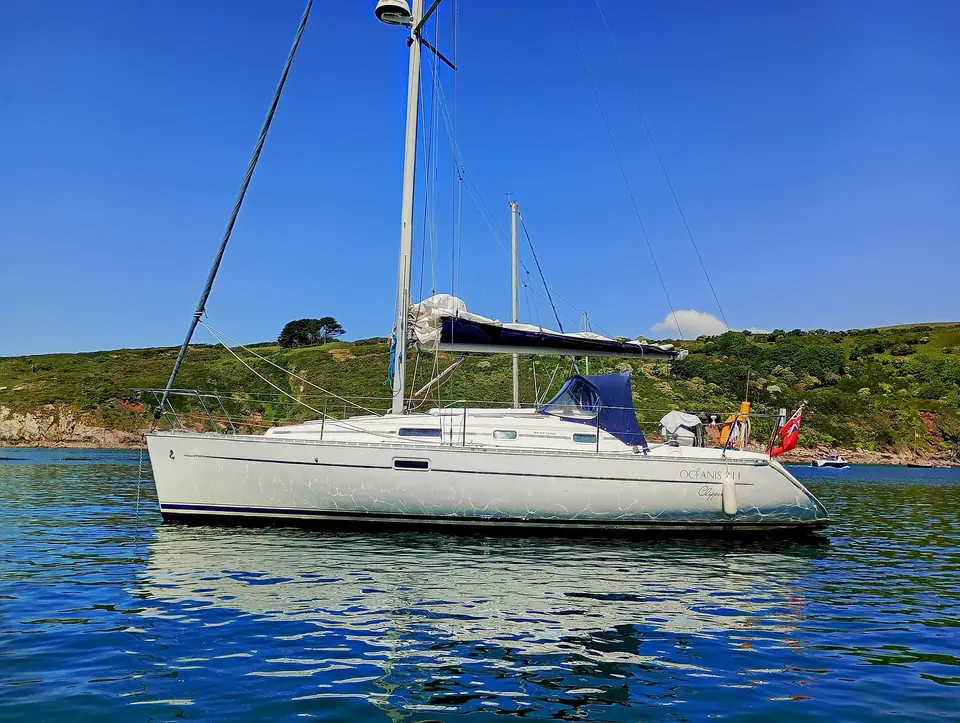
We have not found a freely licensed photo of the Beneteau Oceanis 40 CC yet, so these show other Beneteau boats, each captioned with the boat pictured.
More cruising sailboats to explore
Beneteau Oceanis 41
Cruising Sailboats, 41 ft
Used $165K to $235K
Beneteau Oceanis 41.1
Cruising Sailboats, 41 ft
Used $215K to $310K
Bavaria C42
Cruising Sailboats, 41 ft
Used $220K to $380K
Bavaria Cruiser 40
Cruising Sailboats, 41 ft
Used $88K to $135K
Other Beneteau models
- Beneteau 49
- Beneteau 50
- Beneteau 57
- Beneteau 343
- Beneteau Antares 5.80
- Beneteau Antares 6
- Beneteau Antares 6.80
- Beneteau Antares 7
- Beneteau Antares 7.30
- Beneteau Antares 7.60
- Beneteau Antares 7.80
- Beneteau Antares 8
- Beneteau Antares 8.00
- Beneteau Antares 8.05
- Beneteau Antares 8.60
- Beneteau Antares 8.80
- Beneteau Antares 9
- Beneteau Antares 9.80
- Beneteau Antares 10.80
- Beneteau Antares 11
- Beneteau Antares 12
- Beneteau Antares 13.80
- Beneteau Antares 30
- Beneteau Antares 32
- Beneteau Antares 36
- Beneteau Antares 42
- Beneteau Antares 620 HB
- Beneteau Antares 650 HB
- Beneteau Antares 750 HB
- Beneteau Cyclades 39.3
- Beneteau Cyclades 43.3 and 43.4
- Beneteau Cyclades 50.5
- Beneteau First 18 SE
- Beneteau First 20
- Beneteau First 21.7
- Beneteau First 24
- Beneteau First 25
- Beneteau First 25.7
- Beneteau First 27
- Beneteau First 27.7
- Beneteau First 30
- Beneteau First 31.7
- Beneteau First 35
- Beneteau First 36
- Beneteau First 36.7
- Beneteau First 38
- Beneteau First 40
- Beneteau First 40.7
- Beneteau First 44
- Beneteau First 45
- Beneteau First 47.7
- Beneteau First 53
- Beneteau First 211
- Beneteau First 235
- Beneteau First 285
- Beneteau First 305
- Beneteau First 310
- Beneteau First 345
- Beneteau Flyer 6
- Beneteau Flyer 7
- Beneteau Flyer 8
- Beneteau Flyer 9
- Beneteau Flyer 10
- Beneteau Flyer 12
- Beneteau Flyer 500
- Beneteau Flyer 550
- Beneteau Flyer 650
- Beneteau Flyer 701
- Beneteau Flyer 750
- Beneteau Grand Trawler 62
- Beneteau Gran Turismo 32
- Beneteau Gran Turismo 36
- Beneteau Gran Turismo 40
- Beneteau Gran Turismo 41
- Beneteau Gran Turismo 44
- Beneteau Gran Turismo 45
- Beneteau Monte Carlo 6
- Beneteau Oceanis 30.1
- Beneteau Oceanis 31
- Beneteau Oceanis 34
- Beneteau Oceanis 34.1
- Beneteau Oceanis 35
- Beneteau Oceanis 35.1
- Beneteau Oceanis 36 CC
- Beneteau Oceanis 37
- Beneteau Oceanis 38
- Beneteau Oceanis 38.1
- Beneteau Oceanis 40
- Beneteau Oceanis 41
- Beneteau Oceanis 41.1
- Beneteau Oceanis 42
- Beneteau Oceanis 42 CC
- Beneteau Oceanis 43
- Beneteau Oceanis 44 CC
- Beneteau Oceanis 45
- Beneteau Oceanis 46
- Beneteau Oceanis 46.1
- Beneteau Oceanis 48
- Beneteau Oceanis 50
- Beneteau Oceanis 51.1
- Beneteau Oceanis 54
- Beneteau Oceanis 55
- Beneteau Oceanis 58
- Beneteau Oceanis 311
- Beneteau Oceanis 320
- Beneteau Oceanis 321
- Beneteau Oceanis 323
- Beneteau Oceanis 331
- Beneteau Oceanis 350
- Beneteau Oceanis 351
- Beneteau Oceanis 370
- Beneteau Oceanis 390
- Beneteau Oceanis 400
- Beneteau Oceanis 411
- Beneteau Oceanis 423
- Beneteau Oceanis 430
- Beneteau Oceanis 440
- Beneteau Oceanis 461
- Beneteau Oceanis 473
- Beneteau Oceanis 500
- Beneteau Oceanis 510
- Beneteau Oceanis Clipper 361
- Beneteau Oceanis Clipper 373
- Beneteau Oceanis Clipper 381
- Beneteau Oceanis Clipper 393
- Beneteau Oceanis Yacht 54
- Beneteau Oceanis Yacht 60
- Beneteau Oceanis Yacht 62
- Beneteau Sense 43
- Beneteau Sense 46
- Beneteau Sense 50
- Beneteau Sense 55
- Beneteau Swift Trawler 30
- Beneteau Swift Trawler 34
- Beneteau Swift Trawler 35
- Beneteau Swift Trawler 41
- Beneteau Swift Trawler 44
- Beneteau Swift Trawler 48
- All Beneteau models