Com-Pac Yachts Cruising Sailboats
Com-Pac 23 Pocket Cruiser Guide, From Mark I to 23/IV
Clark Mills drew a salty little shoal-keel cruiser in 1978, and the Hutchins family kept refining it for more than four decades.
- Length
- 23.9 ft7.3 m
- Beam
- 8 ft2.45 m
- Draft
- 2.3 ft0.7 m
- Cabins
- 1 forward cabin plus main cabin (factory describes a two-cabin layout)
- Used price
- $6K to $32K
On this page
- Overview
- A compact sailboat with a real keel and a ramp-friendly draft
- Mark I, II, III, IV and the Pilothouse: telling them apart
- What the numbers say about how it sails
- Trailering, launching and the realities of 3,000 pounds
- Inside: sitting headroom, teak and a hideaway galley
- Outboard bracket or the rare inboard Yanmar
- Buying after Com-Pac Yachts closed
- Com-Pac 23 or a bigger Com-Pac
- Specifications
- Price and value
- Strengths and weaknesses
- Used buyer checklist
- Rivals
- Our verdict
- FAQ
The Com-Pac 23 is a Clark Mills designed, trailerable shoal-draft pocket cruiser built by Com-Pac Yachts in Clearwater, Florida, from 1978 until the company closed on May 1, 2025, in four marks plus a Pilothouse version.
- Shallow-water cruising in Florida, the Gulf and the Chesapeake
- Couples wanting a weekender that can be trailered
- Retirees downsizing from a larger keelboat
- Sailors who value a traditional look in a small boat
Com-Pac 23 by the numbers
- Sail area to displacement
- 19.2Balanced power for coastal and offshore cruising.
- Displacement to length
- 163Light displacement for its length, quick but sensitive to added cruising weight.
- Theoretical hull speed
- 6.0 knThe practical top speed of a displacement monohull under normal sailing, based on waterline length.
- Ballast ratio
- 45%A high ballast ratio, so the boat stands up well to a breeze.
- Capsize screening
- 2.22Above 2.0, so this hull leans toward coastal stability over ultimate offshore resistance.
- Motion comfort ratio
- 13.6A quicker motion in waves, typical of light, beamy hulls.
- Length to beam ratio
- 2.99 : 1A beamy hull with lots of volume for its length.
A compact sailboat with a real keel and a ramp-friendly draft
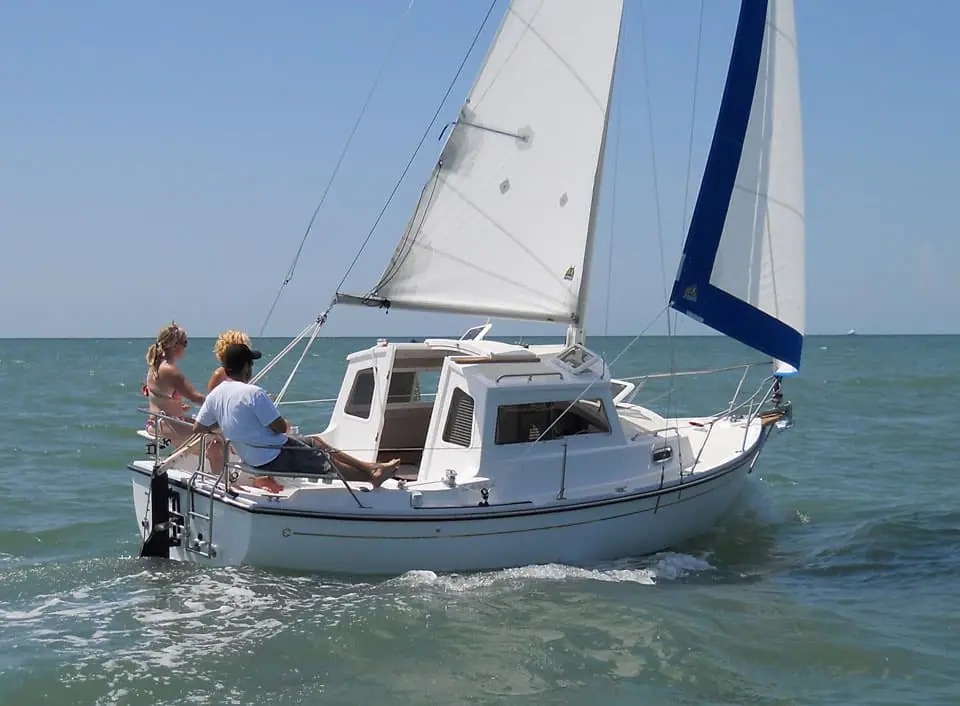
The Com-Pac 23 answers a question many small-boat sailors ask: can a compact sailboat that tows behind an ordinary vehicle still feel like a proper little yacht? Clark Mills, the Florida designer behind the Optimist dinghy and the earlier Com-Pac 16, drew it for Les Hutchins's company in 1978. Instead of a swing keel or centerboard, it has a long, shallow fixed keel drawing just 2 ft 3 in. That makes it launchable from many public ramps while leaving the cabin free of a centerboard trunk.
Com-Pac Yachts, the boatbuilding arm of the Hutchins Co. in Clearwater, Florida, built the 23 in four marks and later added a Pilothouse version. In 2008 John Kretschmer, writing in Sailing magazine, put its appeal down to looks as much as practicality: a sweeping sheer, a short bowsprit, a box cabin trunk with bronze ports, and a profile that looks bigger than 23 feet from a distance. That traditional look is still why people search for a compac 23 sailboat today.
Mark I, II, III, IV and the Pilothouse: telling them apart
The hull stayed the same throughout, but the boat evolved. Sailboatdata and Steve Henkel's 2010 review let you date most boats by their details:
- Mark I (from 1978): about 22 ft 9 in long, 2,900 lb displacement, no bowsprit, round ports, a 5 gallon water tank.
- Mark II (sailboatdata dates it to 1984): a bowsprit added for more sail area and to move the center of effort forward, cutting weather helm, a hideaway galley, 3,000 lb displacement and a 14 gallon water tank. Length with the sprit became 23 ft 11 in.
- Mark III (from about 1991): tooling upgrades including oval rather than round ports. Com-Pac began offering an optional 9 hp Yanmar inboard diesel around this time, fitted to about 35 boats.
- 23/IV (sailboatdata dates it to 1997): all stainless hardware and ports, a rigid PVC rubrail with a stainless striker, a foil rudder in place of the old flat plate, a NACA-section keel, and interior changes that make wiring instruments, radios and shore power easier.
- CP 23 Pilothouse (from 2011): same hull with an enclosed steering station and wheel, 3,500 lb displacement, a dinette that converts to a double, enclosed head and shower, and a diesel engine. SAIL gave it a 2012 Best Boats award for accommodations.
What the numbers say about how it sails
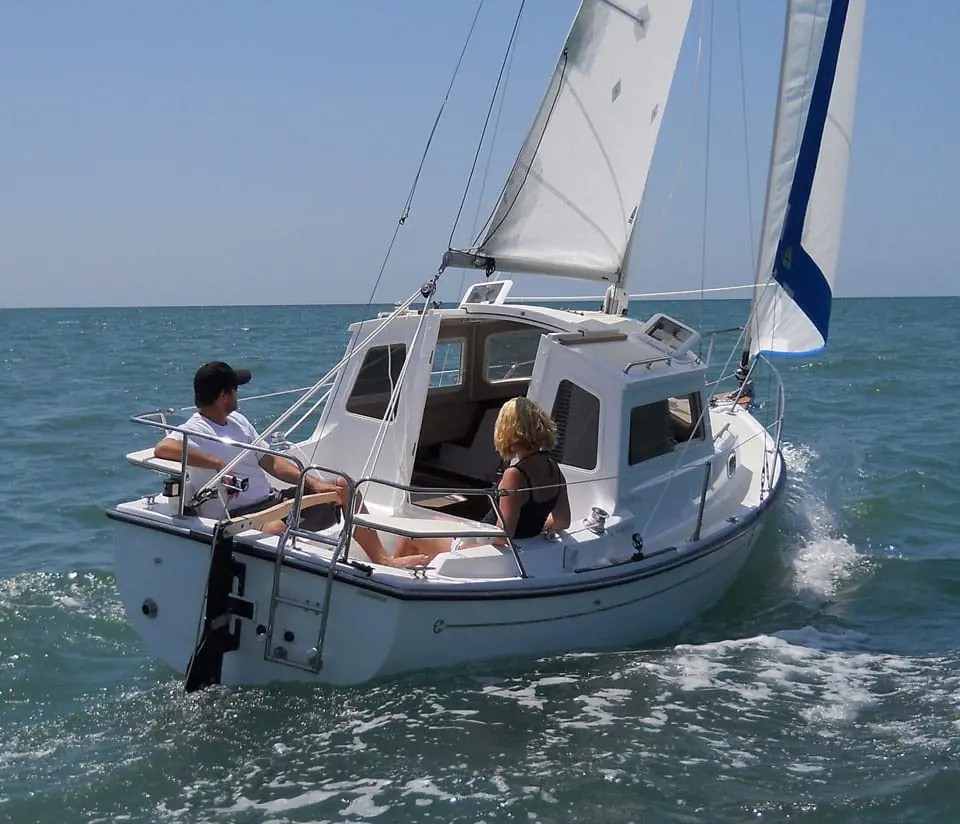
On a 20 ft 2 in waterline the 23 carries 1,340 pounds of ballast in a 3,000 pound boat, a ballast ratio around 45 percent. Reported sail area for the bowsprit boats is 250 square feet, a sail area to displacement ratio near 19, so the boat is not slow in light air for its type. Hull speed is about 6 knots and its PHRF average is around 260.
The masthead rig is unusually robust for a trailer sailer. Com-Pac called the 23/IV and Pilothouse full masthead, eight-stay rigs, and the company pointed to owners' Gulf of Mexico crossings and long Bahamas cruises. That is a builder's claim, but the stout rig and fixed ballast do make the 23 more forgiving in a short chop than many water-ballast pocket cruisers.
The trade-off is pointing. Henkel singled out the 2 ft 3 in draft with no centerboard as the boat's main weakness, because it limits how close to the wind it can sail. Expect to tack through wider angles than a fin-keel 23 footer and to give up some ground on a beat. The bowsprit on the Mark II and later helps balance, so earlier boats tend to carry more weather helm.
Trailering, launching and the realities of 3,000 pounds
Com-Pac sold the 23/IV and Pilothouse with an optional custom trailer and stressed that both could go over the road for vacations or winter storage. With the boat around 3,000 pounds before gear, plus the trailer, outboard, water and stores, you need a tow vehicle with a generous margin over the combined weight and good trailer brakes. A shallow, gently sloped ramp makes launching easy because the keel is so shallow, but the boat is not designed to float off a short trailer at a steep ramp the way a swing-keel boat can.
Mast stepping is a manual job on the 23, unlike the company's later cat boats with the Mastendr folding system. Owners who trailer often add a gin pole or a tabernacle-style hinge and leave the shrouds attached. The mast stands roughly 30 feet above the waterline, so check bridge clearances on inland cruising routes.
Inside: sitting headroom, teak and a hideaway galley
Do not expect standing headroom. Cabin headroom is about 52 inches, so the 23 is a sit-down boat. Within that, the layout is well used. A V-berth in the bow cabin sleeps two, with a portable head between the bunks. Two straight settees in the main cabin double as berths, giving four in all. From the Mark II onward the galley is a hideaway unit near the companionway with a two-burner stove and a sink.
Henkel rated the finish above average for the class, with a lot of teak below and a teak and holly sole. Ventilation and light depend on the port style and hatch, and many owners add a solar vent and LED lighting. With a 14 gallon water tank and a cooler, a couple can comfortably spend a long weekend aboard, and committed owners have done much longer cruises.
Outboard bracket or the rare inboard Yanmar
Most Com-Pac 23s use a small outboard of roughly 3 to 9 hp on a transom bracket. That keeps the bilge free, and a modern four-stroke or electric outboard is an easy upgrade. The weaknesses are typical of outboard-powered keelboats: the prop can cavitate in a short chop and the motor sits awkwardly far aft for maintenance.
The optional 9 hp Yanmar inboard diesel, introduced around the Mark III era, makes the boat feel more like a small yacht under power, but only about 35 inboard boats were built. Because they are rare, they command a premium. Inspect the engine bed, shaft log and cooling system carefully, as the installation is tight in a hull this size.
Buying after Com-Pac Yachts closed
In 2025 the company posted a notice that Hutchins Co. and Com-Pac Yachts would cease operations effective May 1, 2025, following the death of Gerry Hutchins and the retirement of Richard Hutchins, after 51 years in business. The notice listed dealers who could still help with service. Com-Pac had its hulls and spars built by subcontractors and had kept the 23/IV and CP 23 Pilothouse in its range of 12 models into the 2020s.
For buyers, that means every compac boat for sale is now used, and factory parts such as rudders, bowsprits and Com-Pac trailers come only from dealer stock, other owners or fabrication. Owner forums and the shared hardware with other Com-Pac models help, but budget for custom work if a bowsprit, rudder or keel casting is damaged. Prioritize complete boats with trailers, original manuals and good sails.
Com-Pac 23 or a bigger Com-Pac
Buyers who search for a com-pac 33 or other larger Com-Pac usually end up looking at the Com-Pac 27 series (the 27/3 was the only bigger sloop left in the 2021 range) or the Charley Morgan designed Com-Pac 35 of 1990, both boats you moor rather than tow. The 23 remains the sweet spot of the line: big enough for a weekend for two, small enough to tow and launch, and simple enough to maintain on a tight budget. Annual costs of $2,000 to $6,000 cover trailer storage or a mooring, insurance, bottom paint, outboard service and small parts.
Com-Pac 23 specifications
| Length overall | 23.9 ft7.3 m |
|---|---|
| Waterline length | 20.2 ft6.15 m |
| Beam | 8 ft2.45 m |
| Draft | 2.3 ft0.7 m |
| Air draft | 30 ft9.14 m |
| Displacement | 3, lbs1,365 kg |
| Ballast | 1,34 lbs608 kg |
| Sail area | 25 sq ft23.2 m² |
| Fresh water | 14 gal53 L |
| Cabins | 1 forward cabin plus main cabin (factory describes a two-cabin layout) |
| Berths | 4 (V-berth and two settee berths) |
| Heads | Portable head forward |
| Standard engines | Outboard of roughly 3 to 9 hp on a transom bracket |
| Optional engines | Yanmar 9 hp inboard diesel (fitted to about 35 boats from the Mark III era) |
| Hull type | Shoal-draft full-length keel monohull with transom-hung rudder |
| Keel | Fixed long shoal keel, 2 ft 3 in draft, no centerboard |
| Rig | Masthead sloop on a short bowsprit (Mark II onward), eight-stay rig, about 30 ft mast height above the waterline |
| Hull construction | Fiberglass with encapsulated ballast in a long shoal keel |
| Builder | Com-Pac Yachts (Hutchins Co.), United States |
| Naval architect | Clark Mills |
| Other design credits | Hutchins family (later Mark revisions and the Pilothouse) |
| Production | 1978 to 2025 |
| Status | Discontinued |
Figures come from builder documentation and independent tests where available. Displacement is usually quoted light, so a loaded cruising boat will weigh more. Compare these specs with another model.
How much does a Com-Pac 23 cost?
With Com-Pac closed since May 2025 there are no new boats, and the 23 now trades only on the used market. These figures are estimates for typical US asking prices rather than an index built from many verified sales. Early Mark I and Mark II boats with tired outboards sit at the bottom; late 23/IVs with a matching trailer, newer sails and the rare Yanmar inboard sit at the top. The trailer is a major value item, often worth several thousand dollars on its own, and the closure of the builder has made original Com-Pac parts and trailers more sought after.
Estimate your yearly cost
A planning estimate using common rules of thumb: insurance near 1.5 percent of value, maintenance near 3 percent, haul out and bottom paint by length. Your marina, region and use will move these numbers. Open the full cost calculator.
Versions and options
- Com-Pac 23 Mark I
- 1978 original, about 22 ft 9 in, no bowsprit, round ports.
- Com-Pac 23 Mark II
- Bowsprit, hideaway galley, 3,000 lb displacement, 14 gallon water tank.
- Com-Pac 23 Mark III
- Oval ports and other tooling upgrades; optional 9 hp Yanmar inboard on about 35 boats.
- Com-Pac 23/IV
- Stainless hardware, PVC rubrail, foil rudder, NACA keel section and easier wiring.
- CP 23 Pilothouse
- 2011 version with an inside helm, diesel engine and 3,500 lb displacement.
Com-Pac 23 timeline
- 1978Clark Mills designed Com-Pac 23 enters production in Clearwater, Florida
- 1984Mark II adds the bowsprit and hideaway galley (sailboatdata date)
- 1991Mark III introduced with oval ports; a 9 hp Yanmar inboard becomes optional
- 1997Com-Pac 23/IV introduced with foil rudder and stainless hardware (sailboatdata date)
- 2011CP 23 Pilothouse launched, winning a SAIL Best Boats award in 2012
- 2025Com-Pac Yachts ceases operations on May 1
Strengths and weaknesses
What owners like
- Only 2 ft 3 in draft with a fixed keel and no centerboard trunk
- Traditional looks with a bowsprit and bronze or stainless ports
- Stout masthead rig and roughly 45 percent ballast ratio
- Trailerable for winter storage and road trips
- Above-average teak finish for a small production boat
- Simple systems that are cheap to maintain
What to weigh up
- Shoal keel limits pointing ability
- About 52 inches of headroom, so no standing room
- Builder closed in 2025, so factory parts are gone
- Too heavy to float off at steep ramps like a swing-keel boat
- Inboard diesel versions are rare
Used Com-Pac 23 buyer checklist
Take this list to a viewing. Your ticks are saved in this browser so you can come back to it.
Always commission an independent marine survey and an engine survey before you buy. How a marine survey works.
Rivals to consider
Rhodes 22
Another trailerable 22 footer with a centerboard and a more open cockpit, built in much smaller numbers.
Compare side by sideCatalina 22
The default American trailer sailer, with a swing keel, pop-top headroom and a huge racing class.
Compare side by sidePacific Seacraft Flicka 20
A heavier, far more expensive bluewater pocket cruiser with standing headroom and a cult following.
Compare side by sideMacGregor 26X
Water-ballasted motorsailer that trades sailing quality for speed under power and easy towing.
Compare side by sideOur verdict on the Com-Pac 23
The Com-Pac 23 is the pocket cruiser for sailors who want shoal draft without a centerboard and a boat that looks like a small yacht rather than a trailer toy. It will not point with a fin-keel 23 footer and you cannot stand up below, but it is stout, simple and well finished, and its 2 ft 3 in draft opens up water most keelboats cannot reach. With the builder closed since 2025, buy a complete, well-kept 23/IV or late Mark III with a good trailer, and expect it to hold its value well among a loyal owner community.
Com-Pac 23 questions answered
Is the Com-Pac 23 still being built?
No. Com-Pac Yachts ceased operations on May 1, 2025, so all Com-Pac 23s for sale are used boats.
What is the draft of a Com-Pac 23?
About 2 ft 3 in with a fixed shoal keel. There is no centerboard.
Can you trailer a Com-Pac 23?
Yes. Com-Pac offered a custom trailer and promoted the 23/IV and Pilothouse as trailerable cruisers, but at around 3,000 pounds plus trailer you need a capable tow vehicle.
Does the Com-Pac 23 have standing headroom?
No. Cabin headroom is about 52 inches, so it is a sitting-headroom boat.
What is the difference between the Com-Pac 23 Mark III and 23/IV?
The 23/IV added stainless hardware and ports, a PVC rubrail, a foil rudder, a NACA-section keel and easier wiring for instruments and shore power.
Who designed the Com-Pac 23?
Clark Mills, the Florida designer also known for the Optimist dinghy and the Com-Pac 16.