Bavaria Yachts Cruising Sailboats
Bavaria 32 Cruiser Review, Specs and Used Buying Guide
The little Farr design that sold 300 hulls in its first year and taught Bavaria that a family 32 could also sail properly.
- Length
- 32.8 ft9.99 m
- Beam
- 11.2 ft3.42 m
- Draft
- 6.4 ft1.95 m
- Cabins
- 2 (V-berth forward, double aft)
- Used price
- $52K to $84K
On this page
- Overview
- The Bavaria 32 that closed the J&J chapter
- Two boats answer to the name Bavaria 32
- A heavier hull than most 32-footers, and why that is fine
- Mainsheet on the table, platform on the stern
- Below decks, the head is the star
- What the test boats actually clocked
- Keel, furling main and the Avantgarde box
- Buying a Bavaria 32 in 2026
- Specifications
- Price and value
- Strengths and weaknesses
- Used buyer checklist
- Rivals
- Our verdict
- FAQ
The Bavaria Cruiser 32 is a Farr Yacht Design family cruiser built in Germany from late 2009 to 2013, with two cabins, a big head and a fold-down transom. It was restyled and renamed Cruiser 33 in 2013.
- Couples stepping up from a daysailer
- Young families on a budget
- Coastal weekend cruising
- Buyers who value a big head over a big chart table
Bavaria Cruiser 32 by the numbers
- Sail area to displacement
- 17.3Balanced power for coastal and offshore cruising.
- Displacement to length
- 210Moderate displacement, a classic cruising balance between load carrying and speed.
- Theoretical hull speed
- 7.2 knThe practical top speed of a displacement monohull under normal sailing, based on waterline length.
- Ballast ratio
- 25%Relatively low ballast, form stability does more of the work.
- Capsize screening
- 1.99Below 2.0, the traditional threshold for offshore suitability.
- Motion comfort ratio
- 23.5A quicker motion in waves, typical of light, beamy hulls.
- Length to beam ratio
- 2.93 : 1A beamy hull with lots of volume for its length.
The Bavaria 32 that closed the J&J chapter
For two decades a Bavaria sailboat meant a J&J Design hull: sensible, roomy and a little dull to sail. The Bavaria 32 changed that. Announced in June 2009 and scheduled for factory completion that September, the Cruiser 32 was drawn by Farr Yacht Design in Annapolis, with styling and interior work by BMW Group DesignworksUSA, the industrial design arm of the car maker. According to Cruising World, Farr was first commissioned for the Cruiser 55 and the 32 came next, ahead of the 36, 40, 45 and 50 that filled out the range.
The timing was brutal. Bain Capital had bought Bavaria at the top of the market in 2007, reportedly for 1.3 billion euros, and the recession hit the yard hard. The new Cruiser line was the yard's answer, and the smallest boat carried a lot of the weight. Yachting World reported in 2010 that the Cruiser 32 had sold around 300 boats since its launch the previous September, which made it one of the quickest-selling small cruisers of its day in Europe.
Searches for a Bavaria 32 today usually mean this boat, built from 2009 until 2013, when a restyled version arrived as the Cruiser 33. It is a two-cabin coastal cruiser for a couple or a young family, and it is now one of the more affordable ways into a modern, Farr-drawn hull.
Two boats answer to the name Bavaria 32
Brokers and listing sites use Bavaria 32 for two unrelated designs, and their specs should never be mixed. The older one is the J&J Design Bavaria 32 of 2000. SAIL tested it in 2003, quoting 32 ft 6 in overall, 8,250 lb displacement, a 19 hp Volvo and a base price of $95,200 FOB Annapolis. Its tankage was modest at 20 gallons of fuel and 35 of water.
The Farr Cruiser 32 is a different animal: about 3,200 lb heavier, with a near-vertical stem, a low coachroof pierced by slot windows and a full-width transom that folds down. The J&J boat has a more traditional profile with overhangs and a mainsheet traveler on the cabin top. If the listing says 2009 or later and shows a grey hull or a plumb bow, you are looking at the Farr boat.
- J&J Bavaria 32 (2000 era): 8,250 lb, 19 hp Volvo, overhanging ends, cabin-top traveler
- Farr Cruiser 32 (2009 to 2013): 11,464 lb, D1-20 saildrive, plumb bow, fold-down transom
- Cruiser 33 (2013 onward): the same Farr hull with bigger windows and a reworked cockpit
A heavier hull than most 32-footers, and why that is fine
Yachting Monthly's Rachael Sprot noted that the Cruiser 32 is about 10 percent heavier than several rival 32-footers. The published lightship figure is 5,200 kg (11,464 lb) with 1,300 kg (2,866 lb) of cast iron in the bulbed keel, on a 29 ft waterline and an 11 ft 2 in beam. That beam is carried well aft, which is where the space for the big aft cabin and the generous cockpit comes from.
Construction is conventional for Bavaria at the time: hand-laid glass, solid below the waterline and foam-cored above and in the deck, with a laminated grid bonded into the bilge to take keel and rig loads. Germanischer Lloyd certification was part of the launch pitch. The extra weight shows up as a steadier motion and less slamming than lighter French rivals, and it costs a little light air sparkle.
Mainsheet on the table, platform on the stern
Farr and Bavaria made a bold call on deck: there is no traveler. The mainsheet is anchored to a stainless base at the cockpit table, just forward of the single wheel. Cruising World's Herb McCormick liked it because the helmsman can actually reach the main, and Yachting Monthly argued that a powerful purchase plus a reef is all most cruisers need. Racers will miss the traveler; families will not.
The cockpit seats are long enough to sleep on, the coamings are high, and the port locker is deep enough to swallow a deflated dinghy or paddleboards, although its hatch is small. Aft, the transom drops on a counterbalanced hinge to form a bathing platform, and the boarding ladder slots in. One complaint carried over into the redesign: the seats run straight to the stern, so you clamber over them to get round the wheel.
Watch your footing forward. Chainplates are on the hull, so the lower shrouds cut diagonally across the side deck, and Yachting Monthly's test boat had jackstays that stopped short of the bow.
Below decks, the head is the star
The interior is a simple two-cabin plan: a V-berth forward, a big double aft under the cockpit, a long straight settee to port whose aft end serves the small aft-facing chart table, an L-settee to starboard and a galley at the foot of the companionway. Saloon headroom is just over 6 ft (1.84 m). Joinery came in mahogany, oak or walnut with 11 upholstery choices on US boats.
The head is the surprise. SAIL said stepping into it would convince you that you were on a much bigger boat, with room to shower and a dedicated wet locker. Yachting Monthly praised the holding tank installation, which sits in a waist-height locker with the outlet seacock reachable under the sink.
The compromises are typical of a boat built to a price. Narrow slot windows make the saloon darker than the Cruiser 33 that replaced it. Hull linings are thin plastic panels with a wood look, some plywood edges were left unsealed, and the berths are short on vertical clearance aft and pinched at the foot forward. None of this matters much on a weekend, but it shows on a tired ex-charter boat.
What the test boats actually clocked
SAIL's 2012 test boat was a worst case, with a shoal keel and in-mast furling, yet in 5 to 10 knots on the Chesapeake it made 4.7 knots at 35 degrees apparent and 5.2 knots cracked off to 40 degrees. Downwind without an asymmetric it managed only 2.5 to 3.5 knots, so budget for a gennaker on the optional sprit. Cruising World saw a little over 6 knots upwind in 12 to 14 knots of breeze and high fives when it eased to 10.
Yachting Monthly sailed an owner's deep-keel boat in Plymouth Sound and logged 4 knots at 35 degrees apparent in 5 to 6 knots of wind. Practical Boat Owner's David Harding sailed the 32 in 20 to 25 knots and called it a revelation compared with earlier Bavarias.
Under power, the SAIL boat made 6.4 knots at 2,300 rpm and 7.4 knots at 2,900 rpm in flat water. An owner's boat with the optional 30 hp engine cruised at 5 knots at 2,000 rpm and 5.8 knots at 2,500 rpm in Yachting Monthly's test. The standard engine is an 18 hp Volvo Penta D1-20 on a saildrive.
Keel, furling main and the Avantgarde box
Two original options decide how a Cruiser 32 sails. The deep fin draws 6 ft 5 in and the shoal version 4 ft 11 in; the shoal boat is heavier and less weatherly, so think about your home waters before you fall for a cheap shoal-draft hull. In-mast furling was standard in the US and makes the boat easy, but every tester who sailed one recommended a battened, slab-reefed main if you care about pointing.
In Europe many boats were ordered with the Avantgarde pack, which on Yachting Monthly's test boat included Webasto heating, the 30 hp engine in place of the 18 hp unit and an electric windlass. Those boats are worth a premium, because factory installs are usually neater than retrofits.
Buying a Bavaria 32 in 2026
Prices are driven more by history than by year. Ex-charter boats from the Mediterranean, Croatia or the Caribbean are plentiful and cheap; one-owner private boats are rarer and worth a 15 to 20 percent premium. In the US, a good Cruiser 32 typically asks $52,000 to $84,000, which is less than many 20-year-old American 32-footers with far less interior volume.
Running costs are modest. Plan on $7,000 to $14,000 a year for a slip, insurance, a haul-out with bottom paint, saildrive service and sail care. The saildrive needs its diaphragm and seals replaced on Volvo's schedule, and the raw water seacock sits behind the engine, which Yachting Monthly found awkward to reach when the engine is hot.
Bavaria Cruiser 32 specifications
| Length overall | 32.8 ft9.99 m |
|---|---|
| Waterline length | 29 ft8.85 m |
| Beam | 11.2 ft3.42 m |
| Draft | 6.4 ft1.95 m |
| Air draft | 48.6 ft14.81 m |
| Displacement | 11,464 lbs5,2 kg |
| Ballast | 2,866 lbs1,3 kg |
| Sail area | 549 sq ft51 m² |
| Fuel capacity | 4 gal15 L |
| Fresh water | 4 gal15 L |
| Cabins | 2 (V-berth forward, double aft) |
| Berths | 4 in cabins plus saloon settees |
| Heads | 1, with separate shower area and wet locker |
| Standard engines | Volvo Penta D1-20 (18 hp) with saildrive |
| Optional engines | Larger Volvo Penta of about 30 hp on many boats, including the Avantgarde package |
| Cruise speed | 6.4 knots |
| Top speed | 7.4 knots |
| Hull type | Moderate displacement monohull with fine entry and beam carried well aft |
| Keel | Cast iron fin with bulb, 6 ft 5 in (1.95 m) deep or 4 ft 11 in (1.50 m) shoal |
| Rig | Fractional sloop, deck-stepped double-spreader Selden mast, swept spreaders, non-overlapping jib; in-mast furling standard on US boats |
| Hull construction | Hand-laid GRP, solid below the waterline and foam-cored above, with a bonded structural grid |
| Builder | Bavaria Yachtbau GmbH, Giebelstadt, Germany |
| Naval architect | Farr Yacht Design |
| Other design credits | BMW Group DesignworksUSA (styling and interior) |
| Production | 2009 to 2013 |
| Status | Discontinued |
Figures come from builder documentation and independent tests where available. Displacement is usually quoted light, so a loaded cruising boat will weigh more. Compare these specs with another model.
Performance data
| Condition | Speed (kn) | Source |
|---|---|---|
| Motoring, 2,300 rpm, flat water | 6.4 | SAIL 2012 |
| Motoring, 2,900 rpm (max) | 7.4 | SAIL 2012 |
| Motoring, 2,000 rpm, 30 hp option | 5.0 | Yachting Monthly |
| Close-hauled 35 deg apparent, 5 to 10 kn true | 4.7 | SAIL 2012 |
| Upwind, 12 to 14 kn true | 6+ | Cruising World |
Published test figures; SAIL's boat had a shoal keel and in-mast furling main.
How much does a Bavaria Cruiser 32 cost?
Bavaria Yachts USA listed the Cruiser 32 at $126,082 delivered in 2012, and the Australian importer offered it from A$170,637 at launch in 2009. Most boats on the market today came out of European charter fleets, which keeps asking prices low, while privately owned boats with the deep keel, a slab-reefed main and the bigger engine command the top of the range. US-commissioned boats are scarce, so expect to look in the Caribbean or Europe and budget for import costs.
Estimate your yearly cost
A planning estimate using common rules of thumb: insurance near 1.5 percent of value, maintenance near 3 percent, haul out and bottom paint by length. Your marina, region and use will move these numbers. Open the full cost calculator.
Versions and options
- Standard deep keel
- Cast iron fin with bulb, 1.95 m (6 ft 5 in) draft. The better choice for windward work.
- Shoal keel
- 1.50 m (4 ft 11 in) draft for thin water, at the cost of pointing ability.
- Avantgarde pack (Europe)
- Factory bundle that on tested boats included heating, a 30 hp engine and an electric windlass.
Bavaria Cruiser 32 timeline
- 2009Cruiser 32 announced in June; first boats completed from September
- 2010Yachting World reports about 300 sold in the first year
- 2011First US imports sailed by SAIL and Cruising World in Annapolis
- 2012Bavaria Yachts USA lists the boat at $126,082 delivered
- 2013Restyled and relaunched as the Bavaria Cruiser 33
Strengths and weaknesses
What owners like
- Farr hull that sails well upwind for a family 32
- Huge head with shower space and wet locker
- Mainsheet within reach of the helmsman
- Deep cockpit locker and fold-down bathing platform
- Low used prices thanks to a large charter fleet
What to weigh up
- Slot windows make the saloon dark
- Cockpit seats block the walk around the wheel
- Thin hull linings and some unsealed joinery edges
- Poor deep downwind speed without a gennaker
- Many boats carry hard charter mileage
Used Bavaria Cruiser 32 buyer checklist
Take this list to a viewing. Your ticks are saved in this browser so you can come back to it.
Always commission an independent marine survey and an engine survey before you buy. How a marine survey works.
Rivals to consider
Jeanneau Sun Odyssey 33i
Yachting Monthly called it the direct competitor; lighter, more sail area and an athwartships aft berth.
Beneteau Oceanis 31
Finot-Conq and Nauta design launched in 2008 for the same family market.
Compare side by sideDufour 325 Grand Large
Sleeker Felci design with a bigger chart table and galley, built 2006 to 2011.
Hanse 325
Hanse's trademark self-tacking jib makes short-handed sailing simpler; compare head and cockpit space aboard.
Our verdict on the Bavaria Cruiser 32
The Bavaria Cruiser 32 is the boat that proved a German mass-production yard could sell a small cruiser on sailing ability as well as space. It points better than its boxy profile suggests, motors briskly and offers a head and cockpit that embarrass some 36-footers. Its weaknesses are cosmetic and ergonomic rather than structural: dark saloon, budget linings, a cockpit you climb over. Buy a deep-keel boat with a decent main and documented saildrive service, ideally one that left charter early or never joined it, and you get one of the best value 32-footers on the used market.
Bavaria Cruiser 32 questions answered
Who designed the Bavaria 32 Cruiser?
Farr Yacht Design drew the hull and structure, and BMW Group DesignworksUSA styled the deck and interior. The older Bavaria 32 of 2000 was a J&J Design boat.
What years was the Bavaria Cruiser 32 built?
From late 2009 until 2013, when Bavaria restyled it and renamed it the Cruiser 33.
How much is a used Bavaria 32 worth?
Most Farr-designed Cruiser 32s ask between $52,000 and $84,000 in 2026, depending on year, keel and charter history.
What engine does the Bavaria 32 have?
The standard engine is an 18 hp Volvo Penta D1-20 on a saildrive. Many European boats have an optional engine of about 30 hp.
Is the Bavaria 32 good for offshore sailing?
It is designed as a coastal cruiser. Yachting Monthly met a crew who took one to Greenland, but tankage, stowage and the large saloon make it best suited to coastal and short offshore passages.
How many cabins does the Bavaria 32 have?
Two, a V-berth forward and a large double aft, plus one big head with a shower and wet locker.
Photos from the Bavaria Yachts range
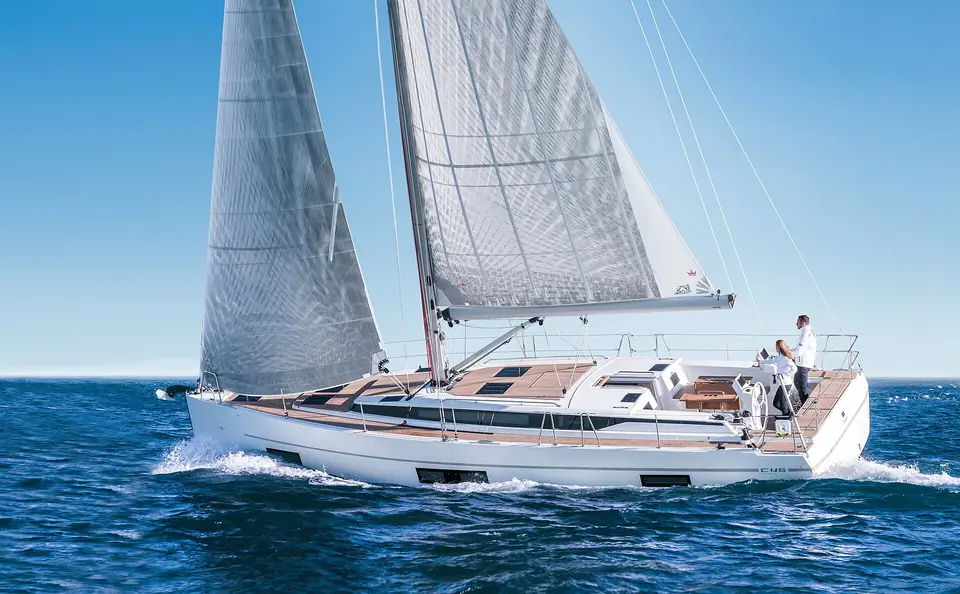
We have not found a freely licensed photo of the Bavaria Cruiser 32 yet, so these show other Bavaria Yachts boats, each captioned with the boat pictured.
More cruising sailboats to explore
Bavaria Cruiser 33
Cruising Sailboats, 33 ft
Used $68K to $105K
Bavaria Cruiser 34
Cruising Sailboats, 33 ft
Used $95K to $175K
Beneteau Oceanis 323
Cruising Sailboats, 33 ft
Used $45K to $75K
Beneteau Oceanis 321
Cruising Sailboats, 33 ft
Used $30K to $55K
Other Bavaria Yachts models
- Bavaria 30 Cruiser
- Bavaria 31 Cruiser
- Bavaria 33 Sport
- Bavaria 35 Cruiser
- Bavaria 35 Match
- Bavaria 38 Cruiser
- Bavaria 39 Cruiser
- Bavaria 42 Cruiser
- Bavaria 43 Cruiser
- Bavaria 44
- Bavaria 47 Ocean
- Bavaria 49
- Bavaria 50 Cruiser
- Bavaria 340
- Bavaria 820
- Bavaria C38
- Bavaria C42
- Bavaria C50
- Bavaria C57
- Bavaria Cruiser 33
- Bavaria Cruiser 34
- Bavaria Cruiser 36
- Bavaria Cruiser 37
- Bavaria Cruiser 40
- Bavaria Cruiser 41
- Bavaria Cruiser 45
- Bavaria Cruiser 46
- Bavaria Cruiser 51
- Bavaria Cruiser 55
- Bavaria Cruiser 56
- Bavaria Ocean 38
- Bavaria R40
- Bavaria R55
- Bavaria S29
- Bavaria S33
- Bavaria S36
- Bavaria S40
- Bavaria Sport 32
- Bavaria Sport 34
- Bavaria Sport 35 HT
- Bavaria Sport 39
- Bavaria Sport 43
- Bavaria SR41
- Bavaria Vision 42
- Bavaria Vision 44
- Bavaria Vision 46
- All Bavaria Yachts models