Hanse Yachts Cruising Sailboats
Hanse 470 and 470e, a Used Buyer's Review
A 47 foot German cruiser with a self-tacking jib, a flush foredeck and, in its 470e form, an epoxy hull at a production price.
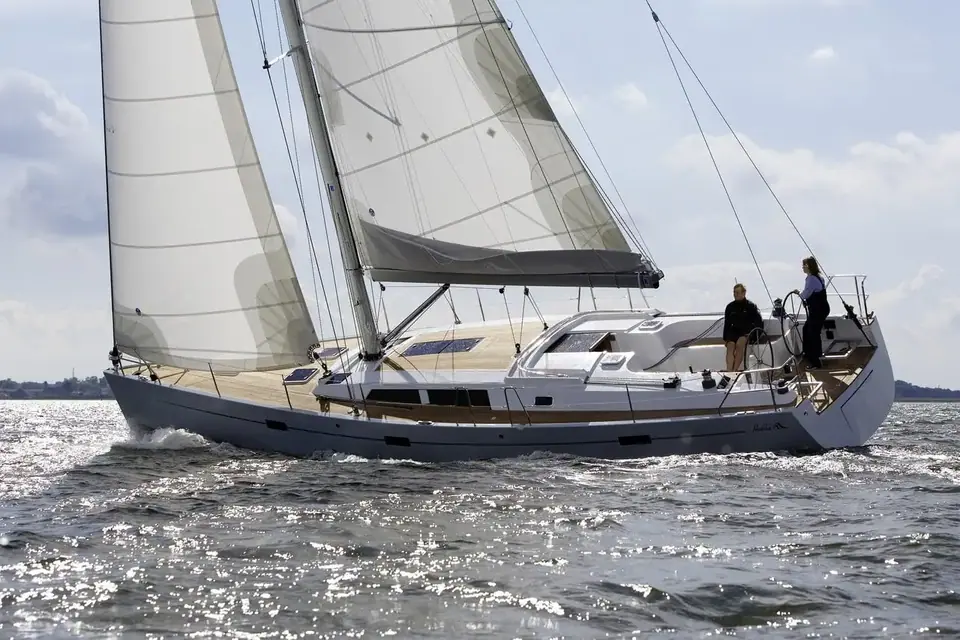
- Length
- 47 ft14.31 m
- Beam
- 14.6 ft4.46 m
- Draft
- 7.7 ft2.35 m
- Cabins
- Multiple layouts under Hanse's modular cabin concept; 3 cabins most common
- Used price
- $150K to $265K
On this page
- Overview
- The Hanse 470 is not the Olympic 470
- The e stands for epoxy
- A deck designed for a couple
- What the numbers say about speed
- Deep, standard or shoal keel
- Modular interior and the cabin choices
- Yanmar power and tankage
- End of the line and what replaced it
- Specifications
- Price and value
- Strengths and weaknesses
- Used buyer checklist
- Rivals
- Our verdict
- FAQ
The Hanse 470 is a Judel/Vrolijk designed 47 ft performance cruiser built by Hanse Yachts in Greifswald, Germany, from about 2005 to 2011, including the epoxy-hulled 470e from 2007. The Hanse 495 replaced it.
- Cruising couples who want easy tacking
- Owners moving up from a 40 footer
- Mediterranean or Caribbean cruising
- Buyers who value sailing performance over maximum volume
Hanse 470 and 470e by the numbers
- Sail area to displacement
- 21.1Plenty of sail for the weight, the boat should feel lively in light air.
- Displacement to length
- 170Light displacement for its length, quick but sensitive to added cruising weight.
- Theoretical hull speed
- 8.6 knThe practical top speed of a displacement monohull under normal sailing, based on waterline length.
- Ballast ratio
- 29%Relatively low ballast, form stability does more of the work.
- Capsize screening
- 1.95Below 2.0, the traditional threshold for offshore suitability.
- Motion comfort ratio
- 27.1Moderate motion comfort, typical of modern cruisers.
- Length to beam ratio
- 3.21 : 1Moderate proportions.
The Hanse 470 is not the Olympic 470
Searches for a 470 sailboat or a 470 class sailboat usually mean the Olympic 470, a two-person racing dinghy just 4.70 m long. This page is about something else entirely: the Hanse 470, a 47 foot cruising yacht from one of the world's largest sailboat builders. If you want the trapeze dinghy, look for 470 class associations; if you want a fast, roomy cruiser for a couple that can sail itself through a tack, read on.
Hanse Yachts was founded in Greifswald on the Baltic in 1990 by Michael Schmidt, an Admiral's Cup winner, and began a long collaboration with designers Judel/Vrolijk in the late 1990s. The 470 joined the range in the mid-2000s, sailboatdata dates the first boats to 2005, and it came at a time when Hanse was building a reputation for crisp styling, simple sail handling and good speed.
The e stands for epoxy
In 2007 Hanse launched updated e versions of its larger models, and Cruising World described the 470e as the second model in the series. SAIL's 2008 Best Boats coverage explained the letter plainly: the e stands for epoxy, with the hulls built using epoxy resin. Practical Sailor, reviewing the sister 430e, said Hanse widely presented the epoxy version as an upgrade, lighter than the standard laminate and more resistant to the water absorption that leads to blistering.
Practical Sailor added a warning that applies directly to the 470e: any structural repair must be done with epoxy, because polyester does not bond reliably to cured epoxy. Make sure your surveyor and yard know which version they are working on. Listings are inconsistent, using 470, 470e and 470 E interchangeably, and some European boats are described as epoxy owners' versions, so confirm the build from the hull identification number and the builder's documentation rather than the listing title.
A deck designed for a couple
Jeremy McGeary's 2007 Cruising World review picked out the features that still define the boat. The flush foredeck gives it a big-boat look and hides the anchoring gear under a hatch. The sole foresail is a self-tacking jib, so tacking is simply a matter of turning the wheel. Twin wheels frame the cockpit, all control lines run under the deck to winches on each side, and a molded channel around the companionway houses the folded dodger.
That arrangement is the main reason couples buy a 470 over a French rival of the same era. The trade is the usual one for a self-tacker: less sail area forward than a big overlapping genoa and less power in light air. Many owners add a code zero or gennaker for reaching and running, which makes the most of the 1,186 square feet of upwind sail area on a tall fractional rig whose masthead sits about 80 feet above the water.
What the numbers say about speed
On a 41 ft 4 in waterline and 26,896 pounds, the 470 has a sail area to displacement ratio around 21, a displacement to length ratio near 170 and a ballast ratio of about 29 percent, with the lead concentrated in a bulb. Those are performance cruiser numbers: quick in moderate breeze, needing an early reef as it builds. Hull speed is about 8.6 knots, and well-sailed boats exceed it on a reach.
No independent speed and fuel table for the 470 has been published that we could verify, so treat dealer claims with caution and sea trial any boat you are serious about in a decent breeze.
Deep, standard or shoal keel
Hanse offered three drafts. The standard keel draws 2.35 m (7 ft 9 in), the deep keel 2.60 m (8 ft 6 in) and the shoal keel 1.95 m (6 ft 5 in). The deep keel suits racing and windward work, but at 8 ft 6 in it excludes much of the US East Coast, the Bahamas and Florida. For American cruising the shoal or standard keel is the sensible choice, and boats with them are easier to resell in the US.
Modular interior and the cabin choices
Hanse marketed its Individual Cabin Concept, a system of interior modules that let buyers compose the accommodation to suit their use. The result is that two 470s can be quite different below. Most boats on today's market are three-cabin layouts, the format charter fleets and families favored, while owner versions with fewer, larger cabins exist and are worth seeking out for couples.
Expect light, modern joinery for its era, a large saloon and good headroom. Before buying, walk through the actual boat: check which cabins have their own heads, where the galley sits and how much stowage the layout leaves. On older Hanses, inspect hinges, latches and cabin door alignment, which wear faster on charter boats.
Yanmar power and tankage
Cruising World's 470e specification lists a 54 hp Yanmar, while sailboatdata and most boats now for sale show a 75 hp Yanmar, typically a 4JH4 series turbo diesel. If you are comparing boats, the larger engine is worth having on a 27,000 pound boat that will spend time motoring into a head sea. Fuel capacity is 66 gallons (250 liters). Water capacity is listed as 100 gallons by sailboatdata and 116 gallons by Cruising World, so confirm the tanks on the boat you buy.
End of the line and what replaced it
By Hanse's 2012 model line the 470 had gone, with the Hanse 495, first built in 2011, filling the slot. Hanse's later history included the 2009 purchase of Dehler, the 2011 sale of founder Michael Schmidt's stake to the investment group Aurelius, and the addition of Moody, Fjord and Sealine. Parts and dealer support for the 470 come through the HanseYachts network, which remains active in the US, though many owners rely on general marine suppliers for hardware.
Annual running costs for a 47 footer in the US are roughly $16,000 to $36,000, depending on slip location, insurance for coastal or offshore use, haul-out, engine service and a reserve for sails and rigging.
Hanse 470 and 470e specifications
| Length overall | 47 ft14.31 m |
|---|---|
| Waterline length | 41.3 ft12.6 m |
| Beam | 14.6 ft4.46 m |
| Draft | 7.7 ft2.35 m |
| Air draft | 80.2 ft24.43 m |
| Displacement | 26,896 lbs12,2 kg |
| Ballast | 7,826 lbs3,55 kg |
| Sail area | 1,186 sq ft110.2 m² |
| Fuel capacity | 66 gal25 L |
| Cabins | Multiple layouts under Hanse's modular cabin concept; 3 cabins most common |
| Standard engines | Yanmar diesel; Cruising World lists 54 hp for the 470e, and most boats on the market carry a 75 hp Yanmar 4JH4 |
| Optional engines | Yanmar 75 hp (4JH4-TE) |
| Maximum power | 75 hp |
| Hull type | Performance cruiser monohull with bulb fin keel and spade rudder |
| Keel | Lead bulb fin: standard 2.35 m (7 ft 9 in), deep 2.60 m (8 ft 6 in) or shoal 1.95 m (6 ft 5 in) |
| Rig | Fractional sloop with self-tacking jib, mast about 80 ft above the waterline |
| Hull construction | GRP; 470e versions built with epoxy resin; lead keel |
| Builder | Hanse Yachts (HanseYachts AG), Germany |
| Naval architect | Judel/Vrolijk & Co |
| Production | 2005 to 2011 |
| Status | Discontinued |
Figures come from builder documentation and independent tests where available. Displacement is usually quoted light, so a loaded cruising boat will weigh more. Compare these specs with another model.
How much does a Hanse 470 and 470e cost?
Most Hanse 470s are in Europe. In 2026, European asking prices for 2006 to 2011 boats range from about 138,000 euros for a 2008 470e in Croatia to about 240,000 euros for a well-equipped 2008 boat in Greece, with most between 160,000 and 200,000 euros. In the US the few boats on the market follow that band once shipping is factored in. Epoxy 470e hulls, the deep keel, newer sails, a recent rig survey and upgraded electronics push a boat to the top; tired ex-charter boats sit at the bottom.
Estimate your yearly cost
A planning estimate using common rules of thumb: insurance near 1.5 percent of value, maintenance near 3 percent, haul out and bottom paint by length. Your marina, region and use will move these numbers. Open the full cost calculator.
Versions and options
- Hanse 470 (from about 2005)
- Original polyester-laminate version of the Judel/Vrolijk design.
- Hanse 470e (from 2007)
- Updated e series model with epoxy resin hull; requires epoxy-compatible repairs.
- Standard keel
- 2.35 m draft, the all-round option.
- Deep keel
- 2.60 m draft for performance, limiting in shallow cruising grounds.
- Shoal keel
- 1.95 m draft, the most practical for the US East Coast.
Hanse 470 and 470e timeline
- 1990Michael Schmidt founds the yard in Greifswald that becomes Hanse Yachts
- 2005First Hanse 470s built, per sailboatdata
- 2007Hanse 470e introduced as part of the epoxy e series
- 2008SAIL lists the 430e and 470e among its Best Boats nominees
- 2011Hanse 495 enters production and the 470 leaves the range
Strengths and weaknesses
What owners like
- Self-tacking jib and lines led aft make it easy for two
- Quick performance cruiser numbers with a tall rig
- Epoxy 470e hulls resist osmotic blistering
- Three keel depths to suit different waters
- Flush foredeck with hidden anchor gear
- Strong value against newer 47 footers
What to weigh up
- Self-tacker gives up power in light air without a code sail
- Deep keel draws 8 ft 6 in
- Most boats are in Europe, so US purchases often involve import
- Epoxy hulls need epoxy-compatible repairs
- Interiors vary widely between boats
Used Hanse 470 and 470e buyer checklist
Take this list to a viewing. Your ticks are saved in this browser so you can come back to it.
Always commission an independent marine survey and an engine survey before you buy. How a marine survey works.
Rivals to consider
Beneteau Oceanis 46
French contemporary with a larger dealer network in the US and a more conventional genoa rig.
Compare side by sideDufour 455 Grand Large
Similar size and era, with a deck saloon feel and an emphasis on volume.
Compare side by sideBavaria 47 Cruiser
German rival usually priced lower, with heavier charter use in its history.
Hanse 460
Hanse's much newer 46 footer for buyers who want the same easy handling in a current design.
Compare side by sideOur verdict on the Hanse 470 and 470e
The Hanse 470 is a good choice for a couple who want a 47 foot cruiser that sails well and tacks itself. The self-tacking jib, flush foredeck and lines led aft make it easy to handle, the hull is quick for a cruiser, and the epoxy 470e adds construction quality you rarely find at this price. Choose the keel to suit your cruising grounds, budget for a light-air headsail, and check whether the boat is polyester or epoxy before agreeing a price. A well-kept example is better value than many newer, boxier boats.
Hanse 470 and 470e questions answered
Is the Hanse 470 the same as the 470 class sailboat?
No. The 470 class is a two-person Olympic racing dinghy. The Hanse 470 is a 47 ft cruising yacht built in Germany.
What does the e in Hanse 470e mean?
It stands for epoxy. The 470e, introduced in 2007, has a hull built with epoxy resin, which is lighter and more resistant to blistering.
How much is a used Hanse 470 worth?
Most trade between about $150,000 and $265,000. European asking prices in 2026 run from roughly 138,000 to 240,000 euros.
Who designed the Hanse 470?
Judel/Vrolijk & Co, Hanse's long-term design partner.
What replaced the Hanse 470?
The Hanse 495, first built in 2011, took its place in the range.
What is the draft of a Hanse 470?
2.35 m (7 ft 9 in) standard, 2.60 m (8 ft 6 in) deep or 1.95 m (6 ft 5 in) shoal.
Hanse 470 and 470e photos
More cruising sailboats to explore
Beneteau Oceanis 473
Cruising Sailboats, 47 ft
Used $115K to $210K
Bavaria Cruiser 45
Cruising Sailboats, 47 ft
Used $135K to $200K
Bavaria Cruiser 46
Cruising Sailboats, 47 ft
Used $175K to $340K
Beneteau Oceanis 46
Cruising Sailboats, 47 ft
Used $160K to $250K