Nauticat 33 Motorsailer Guide, Specs and What to Pay
A Finnish double-ended ketch with an inside steering wheelhouse that turned Siltala into Nauticat and won a loyal liveaboard following.
- Length
- 33.2 ft10.11 m
- Beam
- 10.7 ft3.25 m
- Draft
- 5.1 ft1.55 m
- Cabins
- 2 (aft double cabin, forward V or twin cabin) plus wheelhouse and saloon
- Used price
- $30K to $95K
On this page
- Overview
- The Nauticat 33, the boat that gave a Finnish yard its name
- Mk I or Mk II, wooden wheelhouse or GRP, long keel or fin
- Life in the wheelhouse and below
- Sailing a 17,000 lb ketch: what to expect
- Tankage, range and the liveaboard upgrades owners make
- Where a Nauticat 33 survey earns its fee
- Buying and running one in the US
- Specifications
- Price and value
- Strengths and weaknesses
- Used buyer checklist
- Rivals
- Our verdict
- FAQ
The Nauticat 33 is a wheelhouse motorsailer ketch built by Siltala Yachts in Finland from the late 1960s to 1996, with about 1,100 to 1,160 launched. It was replaced by the redesigned Nauticat 331 in 1997.
- Liveaboard couples
- Cold and wet climate cruisers
- Sailors moving from power who still want to sail
- Owners who motorsail to a schedule
The Nauticat 33, the boat that gave a Finnish yard its name
Search for Nauticat today and you will find a revived company in Latvia, but the story starts with one boat. According to the builder's own history, local sailors asked the Siltala family in 1966 to build a comfortable 10 meter motorsailer with a proper wheelhouse that could cope with the Baltic. Finnish engineer V. Aarnipalo drew the Nauticat 33, and its hull deliberately echoed the sturdy Scandinavian fishing boats that work those waters. Sailboatdata dates the first boats to 1967.
The model was so successful that Siltala later renamed the whole company Nauticat Yachts, in 2005. Sailboatdata counts 1,160 hulls between 1967 and 1996, while Yachting Monthly puts the total at some 1,100 over 31 years. Either way it is one of the most produced motorsailers ever built. In 1997 the yard replaced it with the Nauticat 331, which had a completely new hull and deck. Nauticat Yachts Oy went bankrupt in 2018 and a Latvian group revived the brand in 2022, offering owner support and archive searches for older Nauticats.
Nauticat 33 by the numbers
- Sail area to displacement
- 11.4A cruising rig sized for comfort, so expect to motor in very light air.
- Displacement to length
- 344Heavy displacement. Slow to accelerate but steady and sea kindly with a full load.
- Theoretical hull speed
- 7.1 knThe practical top speed of a displacement monohull under normal sailing, based on waterline length.
- Ballast ratio
- 30%Relatively low ballast, form stability does more of the work.
- Capsize screening
- 1.65Below 2.0, the traditional threshold for offshore suitability.
- Motion comfort ratio
- 38.4A slow, easy motion in a seaway, kind to crews on long passages.
- Length to beam ratio
- 3.11 : 1Moderate proportions.
Mk I or Mk II, wooden wheelhouse or GRP, long keel or fin
The single most useful thing to know when shopping for a Nauticat 33 for sale is which generation you are looking at. Yachting Monthly breaks the production into clear phases, and the hull number tells you most of what you need.
Rarely were two boats identical, since the yard happily personalized layouts, so treat these as guidelines rather than rules. Later and fin-keeled Mk II boats are the most sought after in the US, partly because they sail noticeably better and partly because there is no wooden superstructure to rot.
- Mk I, hulls 1 to about 440 (before 1977): long shoal-draft encapsulated keel and a wooden wheelhouse.
- The next 59 boats kept the wooden wheelhouse but added the raised poop deck with a second, outside helm.
- Mk II from 1979 (hull numbers 500 onward): all-GRP construction including the wheelhouse.
- From 1982: a deeper fin keel and skeg-hung rudder offered as an alternative to the long keel.
- Late boats: some with a taller mast and a proper molded cockpit on the aft deck.
Life in the wheelhouse and below
The wheelhouse is the reason people buy this boat. A centerline wheel sits ahead of an eye-level instrument console with engine controls at hand, and there are wipers on all forward-facing windows plus a clear hatch overhead for checking mainsail trim. Behind the helm a small table with an L-shaped settee doubles as a dining spot, with a pilot seat opposite. Entry is through sliding side doors, which Yachting Monthly warns make the boat vulnerable if one is left open to breaking water, and getting in from leeward when heeled is awkward because the side decks beside the wheelhouse are narrow.
Down a few steps aft is the owner's cabin with a 2.1 m (6 ft 10 in) offset double and an en suite head and shower on most boats. Forward of the wheelhouse is the dinette-style saloon, a linear galley with a deep sink, tall fridge and gimbaled cooker, then the main head opposite a hanging locker and a forecabin with V-berth or two singles. Headroom is about 6 ft or more, and the 450 liter (about 119 US gallon) water tank lives under the saloon sole. The almost constant beam through two-thirds of the hull gives an interior volume that, in its day, few 33 footers could match.
Sailing a 17,000 lb ketch: what to expect
Be realistic about the sailing. Sailboatdata lists 17,250 lb displacement, 5,150 lb of ballast and 475 sq ft of sail on a masthead ketch rig, a sail area to displacement ratio of just 11.4. Yachting Monthly notes the ballast ratio is only about 29 percent, so the boat is not as stiff as its bulk suggests. The long-keel version feels tender in gusts over 20 knots on a reach and is happier under jib and mizzen alone. It needs a solid Force 4 to really get going, and tacking in light air may mean backing the headsail.
The fin-keel boats from 1982 are stiffer, tack more readily and carry less weather helm thanks to the semi-balanced rudder. Both versions heave to well and track straight. The overall verdict from testers and owners is a solid motorsailer that cruises at around 5 knots under sail, with one Thailand-based owner reporting 5 knots in 15 knots of wind and roughly 7 knots motorsailing at 1,500 rpm with main and mizzen set.
Power usually comes from a 4.1 liter, 90 hp Ford Lehman diesel under the wheelhouse sole, turning a fixed three-blade prop. It accelerates the boat quickly and gives instant steerage, but prop walk and the high windage of the topsides make close-quarters handling a skill to learn, and several owners have fitted bow thrusters. The same owner said the Lehman pushes his boat comfortably at hull speed of about 8 knots.
Tankage, range and the liveaboard upgrades owners make
Fuel capacity varies with the boat's history. One documented 1979 boat and one retrofitted late model both carry two 300 liter stainless tanks, and the latter owner quotes a 600 mile range under power. Do not assume that figure for any boat you view; ask for the actual tank sizes and their age.
Owners of these boats tend to stay for years, and the upgrades they report form a sensible checklist: bow thruster, holding tank, lazyjacks or in-mast and behind-the-mast furling, diesel heating for shoulder seasons, extra house batteries with solar and wind charging, LED lighting and refrigeration improvements. One US owner on Lake St. Clair lists hydraulic steering without feedback and headsail sheets that run up to winches on the wheelhouse roof as the boat's main annoyances.
Where a Nauticat 33 survey earns its fee
Two surveyors interviewed by Yachting Monthly gave a consistent picture. Many Nauticat 33s have suffered osmotic blistering and dry laminate below the waterline. Decks are balsa cored and usually teak covered, and water entering through the teak screw holes rots the core, leaving soft, compressible areas especially at the forward and aft ends of the superstructure. Replacing a teak deck is expensive, so check every plank, the caulking and the fastenings.
The other recurring fault is mast compression. Ben Sutcliffe-Davies reported several boats with inadequate support under the deck-stepped mast, including rotted bulkheads and deck compression of more than 10 mm. Leaking windows can also wreck the internal joinery, and early boats with timber wheelhouses need a careful look for rot. The good news is that the structure is massive, and Nick Vass argues that repowering a Nauticat is often more sensible than refurbishing a lighter yacht.
Buying and running one in the US
Most Nauticat 33s were sold in Europe, so the US market is thin and good boats are scattered across the Great Lakes, New England, the Pacific Northwest and the Chesapeake. Expect to travel, and use a surveyor who knows teak-decked cored boats. A realistic budget for slip, insurance, haul-out, engine service and the steady upkeep of teak and varnish is about $9,000 to $20,000 a year. Add reserve funds for deck work, osmosis treatment or a repower, any one of which can run well into five figures.
The buyer who will love this boat values shelter and comfort over pointing ability: a couple who want to cruise year round in cold or wet climates, live aboard, or motorsail to a schedule. Racers and light-air purists should look elsewhere.
Nauticat 33 specifications
| Length overall | 33.2 ft10.11 m |
|---|---|
| Waterline length | 28.2 ft8.59 m |
| Beam | 10.7 ft3.25 m |
| Draft | 5.1 ft1.55 m |
| Displacement | 17,25 lbs7,824 kg |
| Ballast | 5,15 lbs2,336 kg |
| Sail area | 475 sq ft44.1 m² |
| Fresh water | 119 gal45 L |
| Cabins | 2 (aft double cabin, forward V or twin cabin) plus wheelhouse and saloon |
| Berths | 4 to 6 depending on saloon conversion |
| Heads | 1 or 2 (later and refitted boats often have an aft en suite) |
| Standard engines | Ford Lehman diesel, commonly the 4.1 liter 90 hp 2725E |
| Hull type | Double-ended motorsailer hull modeled on a Nordic fishing boat |
| Keel | Long shoal keel on early boats; deeper fin keel with skeg-hung rudder offered from 1982 |
| Rig | Masthead ketch with deck-stepped main and mizzen |
| Hull construction | Fiberglass (GRP), wooden wheelhouse on early boats, balsa cored deck usually with teak overlay |
| Builder | Siltala Yachts (Nauticat), Finland |
| Naval architect | V. (W.) Aarnipalo |
| Production | 1967 to 1996 |
| Status | Discontinued |
Figures come from builder documentation and independent tests where available. Displacement is usually quoted light, so a loaded cruising boat will weigh more. Compare these specs with another model.
How much does a Nauticat 33 cost?
Nauticat 33 prices spread widely because no two boats are alike and many have had major refits. A 1977 boat with an 80 hp Ford Lehman was recently advertised in Germany at 24,990 euros, which marks the floor for a sound older boat; well-kept late Mk II boats with the fin keel, GRP wheelhouse and a newer engine command far more. Surveyor Nick Vass told Yachting Monthly that Nauticats hold their prices well, and in the US the scarcity of good examples keeps asking prices firm. Teak deck condition and osmosis history move the price more than year.
Estimate your yearly cost
A planning estimate using common rules of thumb: insurance near 1.5 percent of value, maintenance near 3 percent, haul out and bottom paint by length. Your marina, region and use will move these numbers. Open the full cost calculator.
Versions and options
- Nauticat 33 Mk I (to 1977)
- Long shoal-draft encapsulated keel, wooden wheelhouse; most early boats have only the inside helm.
- Raised aft deck boats (1977 to 1979)
- Wooden wheelhouse retained, with a raised poop deck and a second outside wheel and engine controls.
- Nauticat 33 Mk II (1979 to 1996)
- All-GRP construction from hull 500; fin keel and skeg-hung rudder offered from 1982; later boats with taller rig and molded cockpit seating.
- Nauticat 331 (from 1997)
- The successor with a completely new hull and deck, two keel options of 1.48 m or 1.65 m draft and a ketch rig.
Nauticat 33 timeline
- 1966Local sailors ask Siltala for a 10 meter wheelhouse motorsailer; V. Aarnipalo designs the Nauticat 33
- 1977Raised aft deck with outside steering added
- 1979All-GRP Mk II introduced from hull number 500
- 1982Deeper fin keel and skeg-hung rudder offered
- 1997Nauticat 331 with a new hull and deck replaces the 33
- 2022Nauticat brand revived in Latvia after the 2018 bankruptcy of Nauticat Yachts Oy
Strengths and weaknesses
What owners like
- Warm, dry wheelhouse steering for year-round cruising
- Huge interior volume for a 33 footer
- Massively built hull and high bulwarks
- Powerful diesel and easy motorsailing
- Ketch rig offers simple jib and mizzen sail combinations
- Strong owner loyalty and steady resale
What to weigh up
- Slow and tender under sail, especially the long-keel version
- Teak decks over balsa core are a common rot problem
- High windage and prop walk make docking tricky
- Narrow side decks by the wheelhouse
Used Nauticat 33 buyer checklist
Take this list to a viewing. Your ticks are saved in this browser so you can come back to it.
Always commission an independent marine survey and an engine survey before you buy. How a marine survey works.
Rivals to consider
Fisher 34
British wheelhouse ketch with a canoe stern and a more generous sail plan, built in smaller numbers.
Colvic Watson 34.5
Beamier, lifeboat-derived motorsailer without an outside helm; finish varies because many were owner completed.
Island Packet 380
A conventional cockpit cruiser with similar volume and better sailing, for buyers who can live without a wheelhouse.
Compare side by sideWestsail 32
A heavier full-keel double-ender for offshore work, with far less shelter and interior space.
Compare side by sideOur verdict on the Nauticat 33
The Nauticat 33 is a sheltered home that happens to carry two masts. It will not point or ghost in light air, and a long-keel boat is tender in a breeze, but nothing in its size range offers the same combination of inside steering, interior volume and sheer structural mass. Buy a later all-GRP boat if you can, budget for teak deck and core work, and survey the mast step and bottom with real skepticism. Get those right and you have a motorsailer that many owners keep until they stop sailing.
Nauticat 33 questions answered
How much does a Nauticat 33 cost?
Expect roughly $30,000 to $95,000 in the US in 2026, depending on generation, deck and engine condition. A 1977 boat was recently advertised in Germany at 24,990 euros.
Who builds Nauticat yachts?
Nauticats were built by Siltala Yachts in Finland, renamed Nauticat Yachts in 2005. After a 2018 bankruptcy the brand was revived in Latvia in 2022 as Nauticat Yachts SIA.
How many Nauticat 33s were built?
About 1,100 according to Yachting Monthly, or 1,160 according to sailboatdata, between the late 1960s and 1996.
Is the Nauticat 33 a good bluewater boat?
Owners have used them for long-distance cruising and liveaboard life, but it is a motorsailer first. Its modest ballast ratio, side doors and slow light-air performance make it better suited to coastal and short offshore passages.
What engine is in a Nauticat 33?
The most common engine is a 4.1 liter, 90 hp Ford Lehman diesel mounted under the wheelhouse sole.
What replaced the Nauticat 33?
The Nauticat 331 replaced it in 1997 with a completely new hull and deck while keeping the ketch rig and wheelhouse concept.
Photos from the Nauticat range
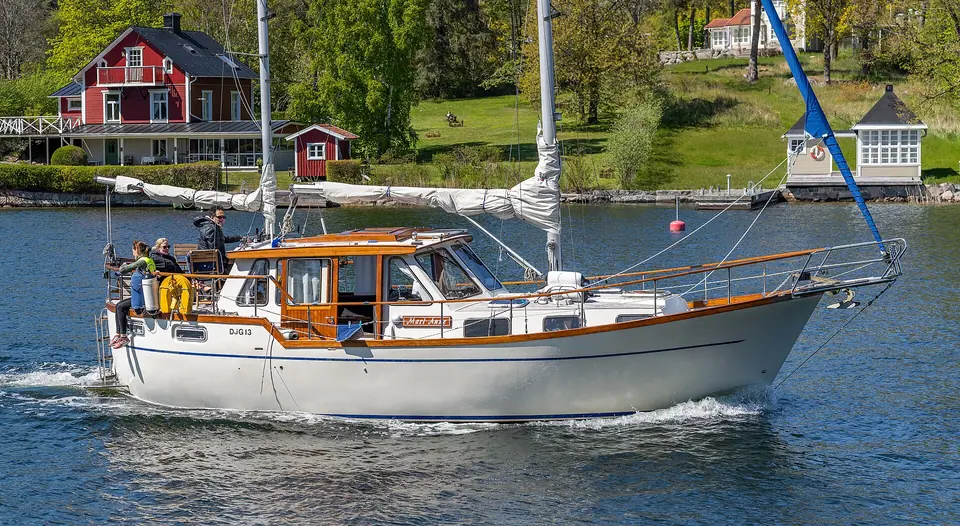
We have not found a freely licensed photo of the Nauticat 33 yet, so these show other Nauticat boats, each captioned with the boat pictured.