Bavaria Yachts Cruising Sailboats
Bavaria C38 Review, Specs and What It Really Costs
A 36-foot hull with a blunt V-bow, hard chines and three king-size berths, built to put Bavaria back where it started: lots of boat for the money.
- Length
- 37.1 ft11.31 m
- Beam
- 13.1 ft3.98 m
- Draft
- 6.6 ft2 m
- Cabins
- 2 or 3 (owner's cabin forward, one or two aft cabins; the second aft space is a large locker as standard)
- Used price
- $205K to $330K
On this page
- Overview
- A 36-foot hull that lives like a 40-footer
- What the V-bow actually does on the water
- Speeds from three independent sea trials
- Deck plan, winches and the options you should tick
- Three king-size berths and the layout trap
- How it is built, and what changed from the prototypes
- Bavaria C38 price list versus a boat you would actually cruise
- Who the C38 suits, and who should look elsewhere
- Specifications
- Price and value
- Strengths and weaknesses
- Used buyer checklist
- Rivals
- Our verdict
- FAQ
The Bavaria C38 is a Cossutti-designed family cruiser launched in 2020 and delivered from 2021. It shares 94 percent of its parts with the C42, sails with one rudder and a self-tacking jib, and is still in Bavaria's 2026 range.
- Families who need three private doubles
- Couples moving up from a 30 to 34 footer
- Charter management programs
- Coastal cruising on the Chesapeake, New England and Florida
Bavaria C38 by the numbers
- Sail area to displacement
- 16.7Balanced power for coastal and offshore cruising.
- Displacement to length
- 241Moderate displacement, a classic cruising balance between load carrying and speed.
- Theoretical hull speed
- 7.8 knThe practical top speed of a displacement monohull under normal sailing, based on waterline length.
- Ballast ratio
- 24%Relatively low ballast, form stability does more of the work.
- Capsize screening
- 1.91Below 2.0, the traditional threshold for offshore suitability.
- Motion comfort ratio
- 29.9Moderate motion comfort, typical of modern cruisers.
- Length to beam ratio
- 2.83 : 1A beamy hull with lots of volume for its length.
A 36-foot hull that lives like a 40-footer
Strip away the bowsprit and the Bavaria C38 is a 36 ft 1 in hull (10.99 m). Step below and it feels like a boat four feet longer. That is the whole point of the design. When Bavaria came out of its 2018 insolvency under new owners, the brief from product manager Pascal Kuhn was blunt: good quality and function at a good price, the values that made the Giebelstadt yard Europe's volume leader in the first place. The C42 of 2020 proved the formula, and the C38 followed as its downsized sister.
Maurizio Cossutti, the Italian designer better known for ORC race boats, drew the hull with Bavaria's in-house team. Its signature is what Bavaria calls the V-bow: a rounded, almost scow-like forefoot with topsides that flare outward above the waterline, plus hard chines that run from far forward to the transom. The waterline uses nearly the full length, at 33 ft 8 in (10.27 m). Nobody calls the boat pretty. Every tester who went below came back talking about the space.
Searching for a Bavaria C38 price list? A stripped boat looks cheap and a cruise-ready one does not, as the price section explains.
What the V-bow actually does on the water
Bavaria's argument for the bluff bow goes beyond volume. Extra buoyancy forward stops the boat from trimming bow-down as it heels, so the stern does not lift and the single rudder stays buried. YACHT magazine's test team saw that in practice: the boat felt stiff in 15 knots of breeze despite a ballast ratio of only 24 percent, and the hard chines pulled far forward added form stability. Cossutti chose one deep rudder rather than twin blades, which saves cost and gives prop wash over the blade for tight marina work.
Yachting Monthly's Theo Stocker found the helm direct and engaging, with plenty of warning before the rudder lost grip. The deeper, rounder forefoot is also meant to reduce slamming in a short chop.
Speeds from three independent sea trials
SAIL magazine sailed a shoal-draft C38 on the Chesapeake in 11 to 16 knots of true wind with an in-mast furling main and the small self-tacking jib. The best upwind angle the tester could manage was 45 degrees apparent at 5.2 knots, partly because the cockpit table blocked the mainsheet from coming near the centerline. Cracked off to 55 degrees apparent the boat hit 6.6 knots, then 5.6 on a beam reach, 4.8 with the wind aft of the beam and 4.4 knots wing and wing downwind. The helm stayed light, even in gusts near 20 knots apparent.
Cruising World's Boat of the Year crew saw a steady 5.5 knots hard on the wind in about 15 knots and a little over 7 knots on a close reach. YACHT's prototype, fitted with dealer-supplied Elvstrom membrane sails and a classic main, was faster: about 6.5 knots upwind and over 9 knots under gennaker, with 10 knots showing on the log in gusts. The lesson is that the C38's performance depends heavily on the sail package. A furling main and blade jib make it easy; a proper main, a Code 0 and a gennaker make it genuinely quick.
Deck plan, winches and the options you should tick
Twin wheels sit far aft and outboard, giving clear sightlines forward and a path through the cockpit to the swim platform. The standard boat has no traveler: a double-ended German-style mainsheet attaches mid-boom and the self-tacking jib sheet runs to the coachroof winches. On the basic boat the helmsman cannot reach either sheet, so a third pair of winches aft is worth ordering if you sail short-handed.
Two testers independently criticized the standard Lewmar 40 winches as undersized for a boat with this sail area; YACHT recommended 45s, which are on the options list. The fixed cockpit table is a good brace and plotter mount but, on SAIL's boat, prevented the main from being trimmed fully. Forward there is a short sprit with an integral anchor roller, a large forepeak locker for fenders or a Code 0, and wide side decks thanks to outboard chainplates.
- Genoa tracks and coaming winches if you want an overlapping 103 percent headsail
- Aft winches and led-back mainsheet for single-handed sailing
- 45 mm winches instead of the standard 40s
- Bowsprit kit for a gennaker or Code 0
- Bow thruster, which most dealers fit and most buyers expect at resale
Three king-size berths and the layout trap
Bavaria quotes a 5 ft 8 in by 6 ft 7 in owner's berth forward (1.73 by 2.00 m) and 4 ft 11 in by 6 ft 7 in aft berths (1.50 by 2.00 m). SAIL's reviewer could not think of another boat this size that genuinely supports three king-size doubles. The two aft cabins have good headroom and clearance over the berths, a direct payoff from the beam carried aft by the chines.
Four layouts come from two choices. The port aft cabin can be a cabin or a huge locker (the locker is standard; the cabin cost 2,800 euros extra at launch), and the forward cabin can have its own en suite head. Every tester warned against the second head: it eats a corner of the forward berth and, in SAIL's words, demotes the double to a large single. One generous midships head with a semi-separate shower, close to 6 ft 7 in of headroom and an optional electric toilet, serves three cabins well.
The saloon has a U-shaped dinette to starboard whose table drops to make a lounge, a settee and small nav desk to port, and an L-shaped galley lifted almost unchanged from the C42 with a three-burner stove and a 110 liter fridge. Joinery is mahogany as standard with whitewashed oak as an option.
How it is built, and what changed from the prototypes
Early C-Line prototypes were reported as vacuum infused, but production C38 hulls and decks are hand-laid foam sandwich with solid laminate below the waterline, aluminum backing plates where hardware mounts, and bulkheads laminated to the hull. The floor structure is a closed molded unit bonded in with structural adhesive, with glued-in tubes linking compartments so water cannot pool in hidden cells. The keel is cast iron, bolted through heavy plates set into a glass grid.
YACHT praised the accessibility of wiring, plumbing, seacocks, batteries and pumps, which matters more on a used boat than any cushion fabric. Steering is a continuous cable system without redundancy, so the quadrant and autopilot drive under the cockpit hatch deserve a look at survey. Engine access through the lifting companionway steps and side panels is excellent. Most boats carry the optional 40 hp Yanmar, which pushed SAIL's test boat to 6 knots at 2,000 rpm, 6.7 knots at 2,200 rpm and 7.8 knots flat out at 2,970 rpm.
Bavaria C38 price list versus a boat you would actually cruise
At launch the base price was 153,000 euros, level with the Hanse 388, Oceanis 38.1 and Sun Odyssey 389. The YACHT test boat, sold to a British owner, came to 280,251 euros, roughly 80 percent above base. The big items were air conditioning (21,000 euros), the nav package (11,000), teak side decks (10,700), the Sail Ready package with electric windlass and extra batteries (10,500) and the bow thruster (6,500). In the US, Cruising World reported a $248,000 base and about $350,000 for a boat with three air conditioning units, Fusion audio and Esthec synthetic teak.
For 2026 we would budget roughly $285,000 to $400,000 for a new C38 commissioned in the US, depending on air conditioning, electronics and sails. Used boats from 2021 to 2025 typically ask $205,000 to $330,000. Ex-charter boats from Croatia, Greece and the Caribbean sit at the bottom of that band and usually lack air conditioning and the upgraded sail plan.
Who the C38 suits, and who should look elsewhere
Bavaria's own description, a family coastal cruiser, is honest. Two couples or a family with teenagers get private doubles without fighting over a quarter berth, and the boat is easy enough for a couple to run alone once the right winches are fitted. Charter fleets like it for the same reasons, which means plenty of used supply in a few years.
Look elsewhere if you want a refined upwind boat out of the box or a classic sheer. A Dufour 390 feels more upscale and a Hanse 388 has a cleaner short-handed deck as standard, but neither matches the C38's sleeping volume on this hull length.
Bavaria C38 specifications
| Length overall | 37.1 ft11.31 m |
|---|---|
| Waterline length | 33.7 ft10.27 m |
| Beam | 13.1 ft3.98 m |
| Draft | 6.6 ft2 m |
| Air draft | 60.9 ft18.56 m |
| Displacement | 20,693 lbs9,386 kg |
| Ballast | 5,024 lbs2,279 kg |
| Sail area | 786 sq ft73 m² |
| Fuel capacity | 48 gal18 L |
| Fresh water | 48 gal18 L |
| Cabins | 2 or 3 (owner's cabin forward, one or two aft cabins; the second aft space is a large locker as standard) |
| Berths | 6 in three doubles, plus the saloon table that lowers into a lounge or extra berth |
| Heads | 1 or 2 (optional en suite head forward) |
| Standard engines | Yanmar 29 hp diesel with saildrive |
| Optional engines | Yanmar 40 hp diesel; eLINE electric or hybrid drive (C38e) |
| Maximum power | 40 hp |
| Cruise speed | 6 knots |
| Top speed | 7.8 knots |
| Hull type | Beamy monohull with hard chines, a rounded V-bow and a single spade rudder |
| Keel | Cast iron L-shaped bulb keel, 6 ft 7 in standard or 5 ft 3 in shoal |
| Rig | Fractional 9/10 sloop with swept spreaders, self-tacking jib standard, classic or in-mast furling main, optional genoa, Code 0 and gennaker on a short sprit |
| Hull construction | Hand-laid GRP sandwich with foam core, solid laminate below the waterline, laminated bulkheads |
| CE design category | A8 / B12 / C14 |
| Builder | Bavaria Yachtbau GmbH, Giebelstadt, Germany |
| Naval architect | Cossutti Yacht Design (Maurizio Cossutti) |
| Other design credits | Bavaria in-house product team |
| Production | 2021 to present |
| Status | In production |
Figures come from builder documentation and independent tests where available. Displacement is usually quoted light, so a loaded cruising boat will weigh more. Compare these specs with another model.
Performance data
| RPM | Speed (kn) |
|---|---|
| 2000 | 6 |
| 2200 | 6.7 |
| 2970 | 7.8 |
SAIL magazine test on Chesapeake Bay with the optional 40 hp Yanmar and a shoal keel. Fuel burn was not measured.
How much does a Bavaria C38 cost?
The headline number misleads. YACHT magazine quoted a 153,000 euro base price at launch, but its test boat came to 280,251 euros once air conditioning, the Sail Ready package, nav electronics, a bow thruster and teak were added. Cruising World reported a US base of $248,000 and about $350,000 for a well equipped boat delivered to the East Coast. A Bavaria C38 price list is long, so compare used boats on options rather than year alone.
Estimate your yearly cost
A planning estimate using common rules of thumb: insurance near 1.5 percent of value, maintenance near 3 percent, haul out and bottom paint by length. Your marina, region and use will move these numbers. Open the full cost calculator.
Versions and options
- Two-cabin owner version
- Owner's cabin forward, one aft cabin and a large port-side storage locker. Standard at launch and practical for couples.
- Three-cabin version
- Second aft cabin replaces the locker. The better resale and charter configuration.
- Two-head option
- En suite head forward. Costs berth width in the owner's cabin and is generally best avoided.
- C38e eLINE
- Electric or hybrid drive from EPTechnologies, listed by Bavaria alongside the diesel boat.
Bavaria C38 timeline
- 2018Bavaria Yachtbau files for insolvency and is bought by Capital Management Partners
- 2020C42 launches the Cossutti C-Line revival; C38 prototype sea trials in Neustadt in the autumn
- 2021First C38 deliveries, with around 30 sold before the boat was publicly shown
- 2022C38 sails in Cruising World's Boat of the Year after the Annapolis show and is a SAIL Best Boats nominee
- 2026C38 and C38e remain in Bavaria's sailing range
Strengths and weaknesses
What owners like
- Three genuine king-size berths on a 36 ft hull
- Single deep rudder gives a light, grippy helm and easy marina handling
- Self-tacking jib and simple rig suit couples
- Neat, accessible systems installation
- Competitive base price against the French and Hanse rivals
What to weigh up
- Base boat needs costly options to be cruise-ready
- Standard 40 mm winches are undersized
- Helmsman cannot reach sheets without optional aft winches
- Bluff bow is an acquired taste
- Modest 48 gallon tanks for fuel and water
Used Bavaria C38 buyer checklist
Take this list to a viewing. Your ticks are saved in this browser so you can come back to it.
Always commission an independent marine survey and an engine survey before you buy. How a marine survey works.
Rivals to consider
Beneteau Oceanis 38.1
The French benchmark at this size, with a lower freeboard and more conventional looks.
Compare side by sideHanse 388
Self-tacking jib and single-handed deck as standard, a little more performance feel.
Dufour 390 Grand Large
Newer and more upscale inside, but also slightly larger and pricier.
Compare side by sideJeanneau Sun Odyssey 380
Walk-around side decks and a well proven hull, often cheaper on the used market.
Our verdict on the Bavaria C38
The Bavaria C38 is the clearest sign that the post-2018 Bavaria remembered what it is for. It gives you more sleeping space than anything else on a 36-foot hull, sails better than its shape suggests and is honestly built where it matters. The catch is that the attractive base price is a starting line, not a finish line: the boat you actually want, with air conditioning, a thruster, better winches and decent sails, costs far more. Buy one with those options already fitted, avoid the two-head layout unless you truly need it, and you get one of the most practical family cruisers of its size.
Bavaria C38 questions answered
How much does a Bavaria C38 cost?
The launch base price was 153,000 euros, and Cruising World reported a US base of $248,000. Well equipped US boats ran about $350,000, and used C38s now ask roughly $205,000 to $330,000.
Is there a Bavaria C38 price list?
Bavaria publishes prices through dealers and its online configurator. Expect options such as air conditioning, the Sail Ready package and electronics to add 50 to 80 percent to the base price.
How long is the Bavaria C38?
The hull is 36 ft 1 in (10.99 m), overall length is 37 ft 1 in (11.31 m) and it reaches 39 ft (11.90 m) including the bowsprit.
Does the Bavaria C38 have twin rudders?
No. Cossutti used a single deep spade rudder, relying on the V-bow and chines to keep the boat upright and the rudder gripping.
Is the Bavaria C38 a bluewater boat?
It carries CE Category A for up to eight people, but it was designed as a family coastal cruiser with 48 gallon fuel and water tanks, so offshore passages need extra preparation.
Photos from the Bavaria Yachts range
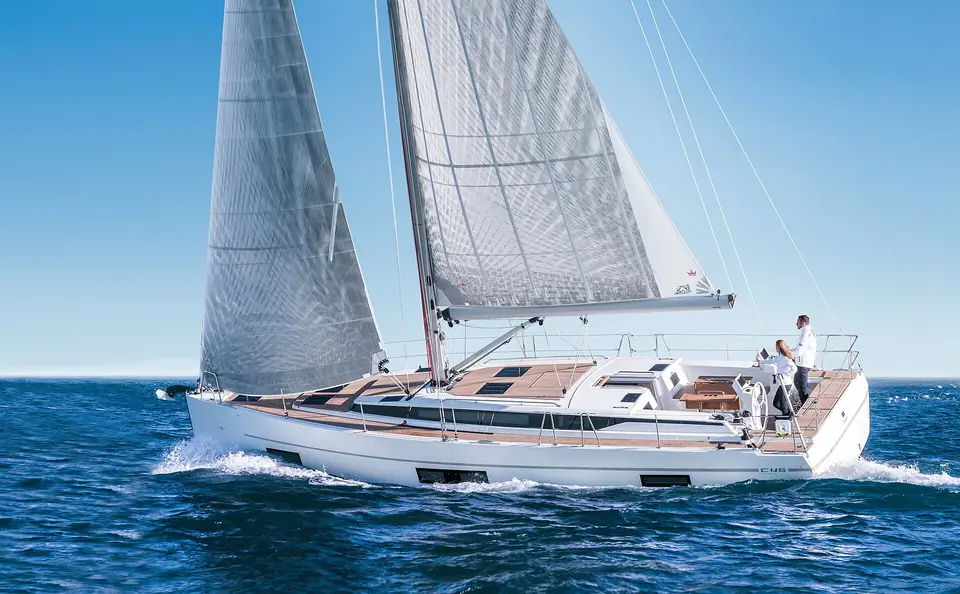
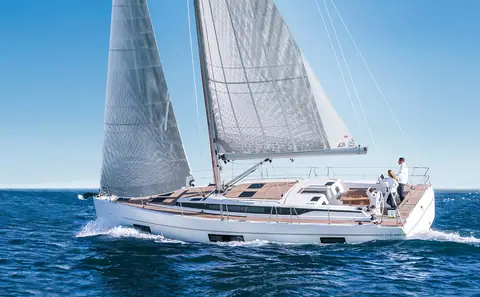
We have not found a freely licensed photo of the Bavaria C38 yet, so these show other Bavaria Yachts boats, each captioned with the boat pictured.
More cruising sailboats to explore
Bavaria Cruiser 36
Cruising Sailboats, 37 ft
Used $70K to $106K
Bavaria Cruiser 37
Cruising Sailboats, 37 ft
Used $95K to $200K
Beneteau Oceanis Clipper 373
Cruising Sailboats, 37 ft
Used $68K to $112K
Hanse 371
Cruising Sailboats, 37 ft
Used $55K to $90K
Other Bavaria Yachts models
- Bavaria 30 Cruiser
- Bavaria 31 Cruiser
- Bavaria 33 Sport
- Bavaria 35 Cruiser
- Bavaria 35 Match
- Bavaria 38 Cruiser
- Bavaria 39 Cruiser
- Bavaria 42 Cruiser
- Bavaria 43 Cruiser
- Bavaria 44
- Bavaria 47 Ocean
- Bavaria 49
- Bavaria 50 Cruiser
- Bavaria 340
- Bavaria 820
- Bavaria C42
- Bavaria C50
- Bavaria C57
- Bavaria Cruiser 32
- Bavaria Cruiser 33
- Bavaria Cruiser 34
- Bavaria Cruiser 36
- Bavaria Cruiser 37
- Bavaria Cruiser 40
- Bavaria Cruiser 41
- Bavaria Cruiser 45
- Bavaria Cruiser 46
- Bavaria Cruiser 51
- Bavaria Cruiser 55
- Bavaria Cruiser 56
- Bavaria Ocean 38
- Bavaria R40
- Bavaria R55
- Bavaria S29
- Bavaria S33
- Bavaria S36
- Bavaria S40
- Bavaria Sport 32
- Bavaria Sport 34
- Bavaria Sport 35 HT
- Bavaria Sport 39
- Bavaria Sport 43
- Bavaria SR41
- Bavaria Vision 42
- Bavaria Vision 44
- Bavaria Vision 46
- All Bavaria Yachts models