Knowledge
Boat Hull Types Explained, Displacement, Planing and More
How the shape of a hull decides a boat's speed, ride, fuel burn and stability. Covers displacement, semi-displacement and planing hulls, deadrise and the deep-V, flat and cathedral bottoms, stepped hulls, catamarans and trimarans, with real boats as examples.
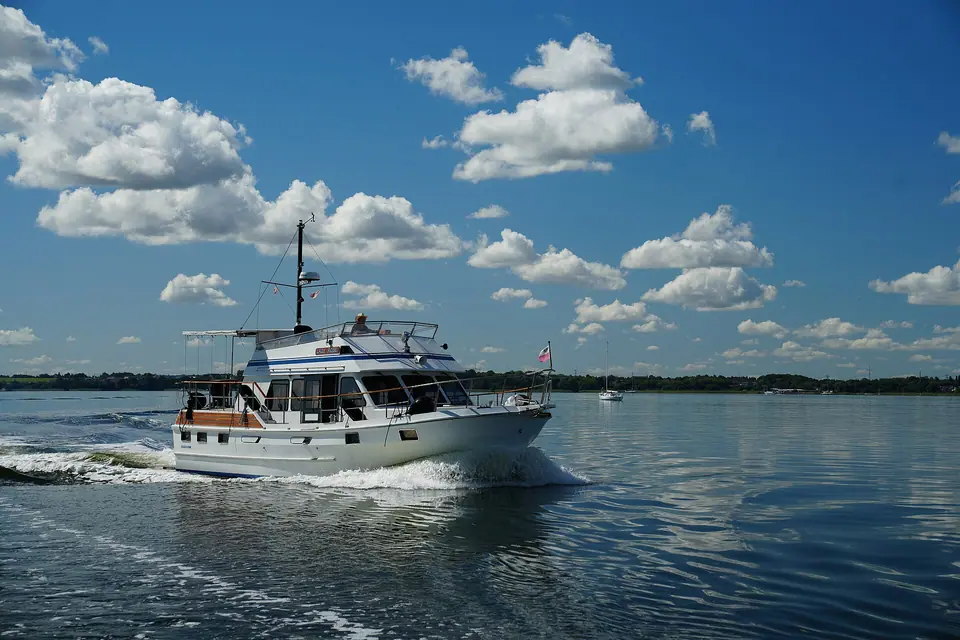
On this page
- Why hull shape decides almost everything
- Displacement hulls and the hull speed limit
- Semi-displacement, the trawler compromise
- Planing hulls and what deadrise really means
- The deep-V and Ray Hunt's legacy
- Flat bottoms, cathedral hulls and tunnels
- Stepped hulls, speed with strings attached
- Catamarans and trimarans
- Keels, hull materials and how to choose
- FAQ
Why hull shape decides almost everything
Engines, layout and styling get the attention at a boat show, but the hull type determines how a boat behaves. It sets how fast the boat can go and at what fuel cost, how it rides in a head sea, how much it rolls at anchor, how much draft it needs and how much weight it can carry before performance suffers. Two boats of the same length can feel completely different because one is a heavy displacement trawler and the other a light planing express cruiser.
The basic split is simple. A displacement hull moves through the water, a planing hull rises and skims over it, and a semi-displacement hull sits in between. Within those families, designers vary the bottom shape, chines, keels, steps and number of hulls. The sections below go through each type with examples from boats covered on this site.
| Hull type | Typical speed range | Ride and motion | Fuel efficiency | Common examples |
|---|---|---|---|---|
| Full displacement | Below hull speed, usually 6 to 10 kn | Seakindly, deep, can roll without stabilizers | Excellent at low speed | Nordhavn, Kadey-Krogen, most cruising sailboats |
| Semi-displacement | 8 to 20 kn | Comfortable, some squat and wake at mid speeds | Good slow, poor in the transition zone | Grand Banks Classic, Mainship 34, Swift Trawler |
| Modified-V planing | 20 to 35 kn | Balanced, soft in moderate chop | Moderate | Sea Ray Sundancer, Back Cove, Sabre |
| Deep-V planing | 25 to 55+ kn | Best in rough water at speed, tender at rest | Needs more power | Bertram 31, Regulator, Contender, Viking |
| Flat or shallow-V | Varies | Pounds in chop, very stable at rest | Efficient in calm water | Jon boats, flats skiffs, some pontoons |
| Cathedral or tri-hull | Planing | Stable platform, wet and bumpy in chop | Moderate | Boston Whaler 13 Sport, classic Montauks |
| Stepped planing | 40 kn and up | Fast and free, needs skilled trim | Efficient at high speed | Yellowfin, Fountain, many go-fast boats |
| Catamaran | Sail 6 to 10 kn cruise, power 15 to 30 kn | Low heel, quick motion in some seas | Good for the space carried | Lagoon, Leopard, Aquila, Freeman |
Displacement hulls and the hull speed limit
A displacement hull is supported entirely by buoyancy. As it moves, it creates a bow wave and a stern wave. When the wavelength of that bow wave matches the boat's waterline length, the hull is effectively trapped in a trough of its own making, and pushing harder mostly makes a bigger wave rather than more speed. That threshold is called hull speed.
The traditional rule of thumb is hull speed in knots equals 1.34 times the square root of the waterline length in feet. Naval architects treat it as an approximation, and sources quote constants ranging from 1.34 to about 1.51, but it explains why a long waterline is so valuable on cruising sailboats and trawlers. Some light, narrow sailboats and racing yachts exceed it by surfing, which is why the rule is a guide rather than a law.
Full-displacement hulls are usually round-bilged, with a deep forefoot and a fine stern or a gentle transom. They carry heavy loads well, which matters for long-range cruisers that need fuel, water and spares. Nordhavn and Kadey-Krogen trawlers and nearly every keelboat sailboat in our bluewater section use this kind of hull. The trade-off is roll. A round-bilged hull with little form stability rolls at anchor and in beam seas, which is why active fin or gyro stabilizers are common on ocean-going trawlers.
| Waterline length | Approximate hull speed (1.34 x square root of LWL) |
|---|---|
| 16 ft | 5.4 kn |
| 25 ft | 6.7 kn |
| 36 ft | 8.0 kn |
| 49 ft | 9.4 kn |
| 64 ft | 10.7 kn |
Semi-displacement, the trawler compromise
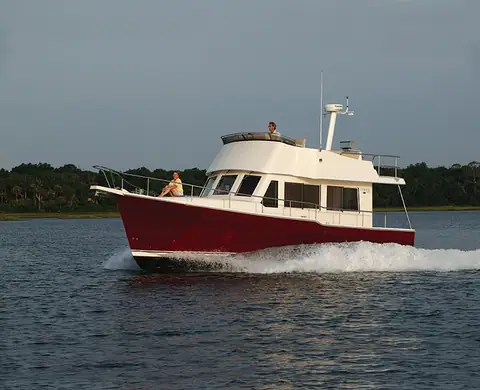
Semi-displacement hulls, sometimes called semi-planing, have a flatter run aft and harder chines toward the stern than a true displacement hull. At low speed they behave like a trawler. Add power and they can climb partly out of the hole and run in the teens or low twenties. Classic Grand Banks, the Mainship 34 Trawler, the Beneteau Swift Trawler range and Fleming yachts all use variations of this idea.
The appeal is flexibility. You can cruise at 8 knots on the Intracoastal Waterway sipping fuel, then run at 16 knots to beat weather into an inlet. The cost is the transition zone between those speeds, where the boat squats, throws a big wake and burns fuel without much gain. Owners of these boats tend to learn the two or three speeds where the hull is happiest and avoid the middle. For Great Loop cruisers, this hull type is extremely popular, as our Great Loop boat guide explains.
Planing hulls and what deadrise really means
A planing hull uses hydrodynamic lift. Once the boat reaches enough speed, the pressure of water on the flat sections of the bottom lifts much of the hull clear of the water, drag drops and the boat accelerates without the hull speed limit. Planing requires a favorable power-to-weight ratio, which is why weight additions such as generators, hardtops and extra fuel matter so much on these boats.
Deadrise is the angle between the bottom and a horizontal line, usually measured at the transom. A high deadrise makes a sharp V that slices into waves, and a low deadrise makes a flatter bottom that rises onto plane early and sits stable at rest. Most builders publish the transom deadrise figure, and it is one of the most useful single numbers for comparing hulls.
| Transom deadrise | Typical hull label | What it means on the water |
|---|---|---|
| 0 to 8 degrees | Flat or near-flat | Very shallow draft and stable at rest, pounds hard in any chop |
| 10 to 16 degrees | Modified-V | Planes easily, efficient, comfortable in protected and coastal water |
| 17 to 20 degrees | Medium-V | All-round compromise for bays, sounds and nearshore runs |
| 21 to 25 degrees | Deep-V | Soft ride offshore at speed, needs more power, rolls more at rest |
The deep-V and Ray Hunt's legacy
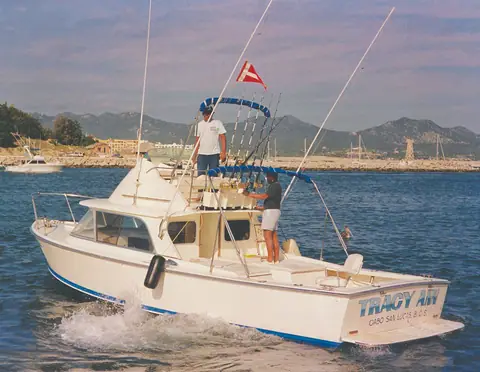
The modern offshore powerboat traces back to C. Raymond Hunt's deep-V design for the 31-foot Moppie, which won the 1960 Miami to Nassau race in rough conditions and became the basis for the Bertram 31. Hunt combined a constant high deadrise from midships to transom with longitudinal lifting strakes that add lift and push spray down and out. The result could hold speed in seas that flattened conventional boats.
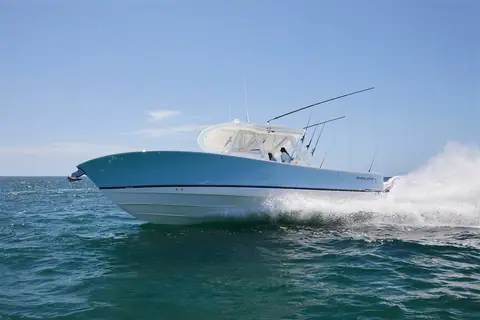
That formula now underpins most offshore center consoles and sportfishing yachts. Regulator and Contender build deep-V hulls designed for running offshore in the Atlantic, and convertible builders such as Viking pair a sharp entry with a flatter run aft for stability while trolling. Deep-V boats need more horsepower to reach a given speed, sit deeper and roll more at rest than flatter boats, which is why designers often add wide chines or reverse chines that improve stability and lift without giving up the sharp entry.
Flat bottoms, cathedral hulls and tunnels
Flat-bottom and shallow-V boats are the workhorses of protected water. Jon boats, many skiffs and shallow-water flats boats use them because they float in inches of water and stay level when people move around. Run them into a short chop, though, and the ride becomes harsh quickly.
The cathedral or tri-hull, made famous by the Boston Whaler 13 designed by Dick Fisher with Ray Hunt's input, uses a central V with two sponsons. The result is a stable, unsinkable-feeling platform that does not tip when someone stands at the gunwale, though it can be wet and slappy in waves. Whaler later moved its larger boats to deep-V hulls, but the 13 and early Montauks still sell steadily on the used market.
Tunnel hulls trap air between two sponsons to add lift and are mostly found on racing boats and some shallow-water fishing boats. Pontoon and tritoon boats sit on aluminum tubes and are a separate category built mainly for lakes and calm rivers.
Stepped hulls, speed with strings attached
A stepped hull has one or more notches across the bottom that let air flow under the after sections. That breaks up the wetted surface and reduces drag, so the boat runs faster and often more efficiently at high speed for the same power. Stepped bottoms are common on performance powerboats from builders such as Fountain, on some fast center consoles including Yellowfin, and on a growing number of outboard-powered sport boats.
The drawbacks show up in handling. Stepped hulls can behave unpredictably in tight high-speed turns if trimmed badly, and some models need more skill from the driver than a conventional deep-V. If you are buying a stepped boat as your first fast boat, sea trial it in the conditions you plan to use it and ask the dealer to show you correct trim behavior.
Catamarans and trimarans
Multihulls spread buoyancy across two or three slender hulls. Sailing catamarans such as the Lagoon 42 and Leopard 45 use that width for stability instead of heavy ballast, so they sail nearly flat and have vast living space for their length. Power catamarans such as the Aquila 44 and Invincible 40 Catamaran use two planing or semi-planing hulls that reduce the slamming common on monohulls in a head sea and give a more efficient cruise for the size of the boat.
The trade-offs are real. A 45-foot catamaran is roughly twice as wide as a monohull of the same length, which can mean paying for one and a half or two slips at many marinas. Catamarans are sensitive to overloading, can slam under the bridgedeck in short steep seas, and have a quick, jerky motion in some sea states. Trimarans, such as the folding designs popular with trailer sailors, sit between a monohull and a catamaran in space and speed. Our catamaran vs monohull guide covers the decision in depth.
Keels, hull materials and how to choose
For sailboats, the keel is part of the hull decision. Full keels track well and protect the rudder but turn slowly; fin keels with spade rudders are faster and more maneuverable; swing keels and centerboards reduce draft for trailering and shallow water. Our guide to sailboat types and rigs explains each option in more detail.
Hull material affects weight, maintenance and repair options more than the hull's basic behavior. Solid fiberglass, cored fiberglass with balsa or foam, aluminum and steel all have their place, and a surveyor should check for moisture in cored hulls and corrosion in metal ones.
To choose, start with where you boat and how fast you really need to go.
- Long-range cruising, Great Loop or liveaboard at low cost per mile, choose a full or semi-displacement hull.
- Offshore fishing or running inlets at speed, choose a deep-V with at least 20 degrees of transom deadrise.
- Bays, lakes and coastal day trips, a modified-V planing hull balances ride, stability and economy.
- Very shallow water, consider a flat or shallow-V skiff and accept a harder ride in chop.
- Maximum living space and level sailing, consider a catamaran and budget for wider slips.
Models mentioned in this guide
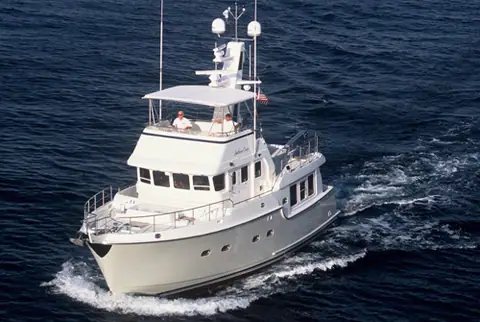
Nordhavn 47
Trawlers & Explorer Yachts, 48 ft
Used $520K to $900K
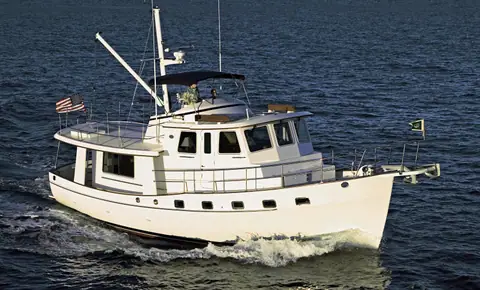
Kadey-Krogen 44 AE
Trawlers & Explorer Yachts, 49 ft
Used $650K to $1.1M
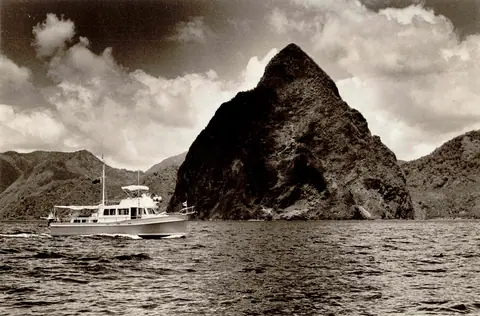
Grand Banks 42 Classic
Trawlers & Explorer Yachts, 43 ft
Used $75K to $360K
Mainship 34 Trawler
Trawlers & Explorer Yachts, 39 ft
Used $35K to $200K
Bertram 31
Sportfishing Yachts, 31 ft
Used $25K to $275K
Regulator 37
Center Consoles & Offshore Boats, 38 ft
Used $640K to $1M
Frequently asked questions
What are the main types of boat hulls?
The main types are displacement, semi-displacement and planing hulls, with planing hulls subdivided into flat, modified-V, deep-V, cathedral and stepped designs. Multihulls such as catamarans and trimarans are a separate family.
Which hull type is best for rough water?
For running at speed in rough water, a deep-V planing hull is generally best. For slow, long-distance passages, a heavy displacement hull with stabilizers gives the most comfortable motion.
What is hull speed?
Hull speed is the practical top speed of a displacement hull, roughly 1.34 times the square root of the waterline length in feet. A boat with a 36-foot waterline has a hull speed of about 8 knots.
What is the most fuel-efficient hull type?
A full-displacement hull running below hull speed is the most fuel-efficient per mile. Planing hulls burn far more fuel per mile but cover distance much faster.
What does deadrise mean on a boat?
Deadrise is the angle of the hull bottom relative to horizontal, usually measured at the transom. Higher deadrise gives a softer ride in waves, and lower deadrise gives more stability at rest and earlier planing.
Is a catamaran hull more stable than a monohull?
Catamarans have far more initial stability, so they heel and roll less in normal conditions. Monohull sailboats have a righting moment that keeps increasing as they heel, while a catamaran that is pushed past its limit does not right itself.
Keep reading
Types of Yachts Explained
A plain-English map of the main types of yachts sold in the US, from sailboats and catamarans to trawlers, sportfish…
KnowledgeTypes of Sailboats and Rigs Explained
A buyer-focused guide to the types of sailboats, sorted four ways: by rig, by keel, by hull and by purpose, with real models…
BuyingCatamaran vs Monohull, Which Should You Buy?
An honest comparison of cruising catamarans and monohull sailboats for US buyers, covering comfort, safety, sailing ability…
CruisingBest Trawlers and Boats for the Great Loop
How to choose a Great Loop boat, with the hard limits every Looper boat must meet, our picks from budget Mainships to…
BuyingCenter Console Buying Guide
Everything a US buyer needs to choose a center console, from size bands and hull types to outboard packages, layouts, brand…