Buying
Best Liveaboard Catamarans
Our picks for the best liveaboard catamarans on the US market, judged on tankage, storage, payload, draft and air draft rather than brochure volume, with realistic 2026 used prices and the upgrades most liveaboards add.
On this page
- What living aboard actually asks of a catamaran
- The shortlist by the numbers
- Best all-round liveaboard, Leopard 45 and Lagoon 42
- Best value for a first liveaboard, Leopard 40 and Bali Catspace
- Best for the Bahamas and shoal water, the daggerboard cats
- Best for couples who plan real ocean miles
- The power catamaran option for Loop and ICW liveaboards
- Buying ex-charter, where the savings are and where they go
- The upgrade list almost every used cat needs
- What living aboard a cat costs each year
- FAQ
What living aboard actually asks of a catamaran
Picking the best liveaboard catamarans is a different exercise from picking the best charter cat. A charter boat needs four double cabins and four heads for a week. A liveaboard couple needs one great cabin, a workspace, big tanks, enormous storage and the ability to carry a year of gear without dragging the bridgedeck through every wave.
Weight is the quiet enemy. Catamarans are sensitive to load because their performance and bridgedeck clearance depend on staying light. A cruising couple can easily add 3,000 to 5,000 pounds (estimate) of spares, tools, provisions, dive gear, a heavier dinghy and an outboard. On a 38 footer that load can push the hulls deep enough to cause slamming under the bridgedeck in a short chop. On a 45 footer it is far less noticeable.
That is why most experienced liveaboards settle in the 40 to 46 foot range. It is the smallest size that carries a liveaboard load comfortably and the largest that two people can dock, haul and maintain without crew.
The shortlist by the numbers
Figures come from the specifications on our individual model pages. Tank sizes are standard builder capacities; options and owner modifications vary. Used prices are our 2026 US asking-price estimates. Air draft is shown where the builder publishes it.
| Model | LOA | Beam | Draft | Air draft | Water | Fuel | Used price (est.) |
|---|---|---|---|---|---|---|---|
| Lagoon 380 | 37.9 ft | 21.4 ft | 3.8 ft | n/a | 79 gal | 58 gal | $150,000 to $310,000 |
| Leopard 40 | 39.3 ft | 22.0 ft | 4.4 ft | 63.8 ft | 206 gal | 95 gal | $250,000 to $400,000 |
| Bali Catspace | 40.4 ft | 21.5 ft | 3.6 ft | 59.8 ft | 185 gal | 106 gal | $380,000 to $560,000 |
| Lagoon 42 | 42.0 ft | 25.3 ft | 4.1 ft | n/a | 79 gal | 79 gal | $340,000 to $600,000 |
| Leopard 45 | 45.0 ft | 24.1 ft | 4.9 ft | 70 ft | 206 gal | 185 gal | $380,000 to $760,000 |
| Fountaine Pajot Elba 45 | 44.2 ft | 24.8 ft | 3.9 ft | n/a | 185 gal | 124 gal | $560,000 to $880,000 |
| Nautitech 46 Open | 45.2 ft | 24.7 ft | 4.8 ft | 75.1 ft | 159 gal | 159 gal | $420,000 to $700,000 |
| Lagoon 46 | 45.9 ft | 26.1 ft | 4.4 ft | n/a | 159 gal | 275 gal | $620,000 to $950,000 |
| Bali 4.6 | 47.0 ft | 25.1 ft | 4.2 ft | n/a | 211 gal | 211 gal | $620,000 to $850,000 |
| Outremer 51 | 51.3 ft | 24.4 ft | 3.1 ft boards up | 75.7 ft | 100 gal | 88 gal | $700,000 to $1,300,000 |
| Seawind 1600 | 51.7 ft | 25.9 ft | 2.1 ft boards up | n/a | 174 gal | 200 gal | $850,000 to $1,250,000 |
| Aquila 44 (power) | 44.9 ft | 21.5 ft | 3.8 ft | 18.7 ft | 206 gal | 295 gal | $450,000 to $900,000 |
Best all-round liveaboard, Leopard 45 and Lagoon 42
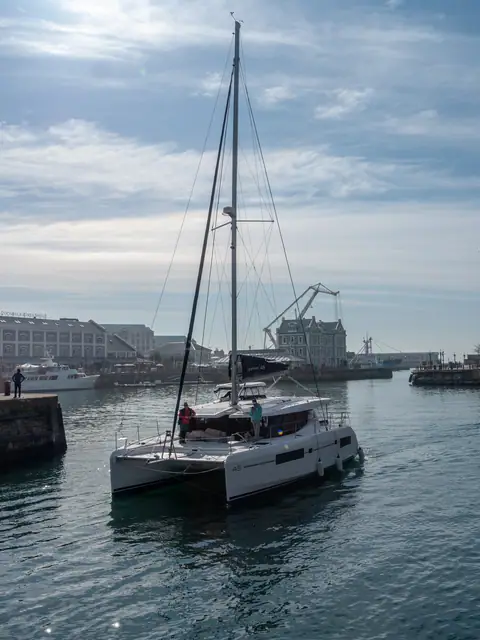
The Leopard 45 earns the top spot for full-time living on the strength of its numbers alone: 206 gallons of water and 185 gallons of fuel are serious liveaboard tankage, and the forward cockpit with a door through to the saloon gives a second outdoor living space that becomes the favorite room at anchor. The owner's version turns the starboard hull into a private suite with a large head and storage. Production ended in 2024 after 379 hulls, and because so many went into charter fleets (including as the Moorings 4500), there is a deep used market across a wide price range.
The catch is height. At about 70 feet of air draft the Leopard 45 cannot pass under the standard 65 foot fixed bridges of the Atlantic Intracoastal Waterway, so East Coast owners make outside passages between inlets. For many liveaboards that is acceptable; for those who want to ride the ditch north and south each season it is a deal breaker.
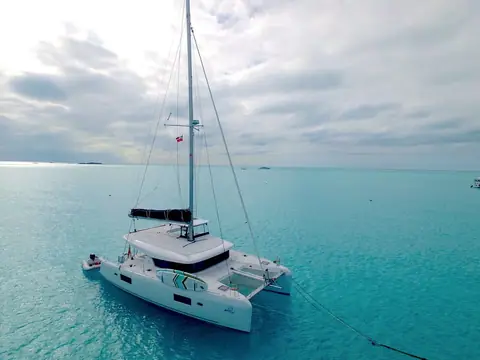
The Lagoon 42 is the alternative for buyers who value a calmer, more upright motion and Lagoon's dealer network. Its aft-stepped mast and self-tacking jib make it easy for a couple to handle, and with more than a thousand built there is plenty of choice. Its standard tankage is modest for full-time cruising, so plan on a watermaker and check whether a previous owner added fuel or water capacity.
Best value for a first liveaboard, Leopard 40 and Bali Catspace
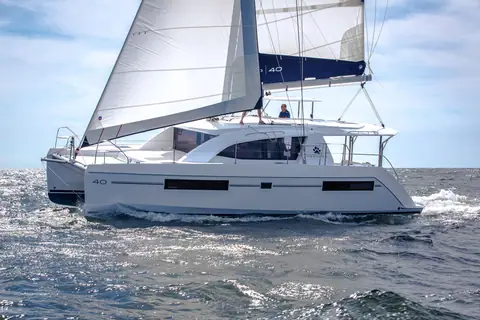
The second-generation Leopard 40 is one of the most sensible liveaboard purchases in the under $400,000 bracket. It shares the big-boat feature list of its larger sisters, including a forward cockpit and generous 206 gallon water capacity, and its 63.8 foot air draft clears most ICW fixed bridges, though with antennas and tide it is tight and needs careful planning.
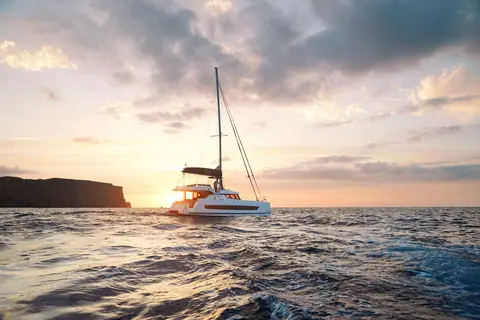
The Bali Catspace takes a different route. Bali's tilting aft door opens the saloon and cockpit into one huge room, the forward cockpit is a solid deck rather than trampolines, and the 185 gallon water capacity is impressive for 40 feet. At 59.8 feet of air draft it clears the 65 foot ICW standard with real margin. The trade-offs are small engines (around 20 horsepower each), which limit motoring into wind and current, and a design that favors space over sailing performance.
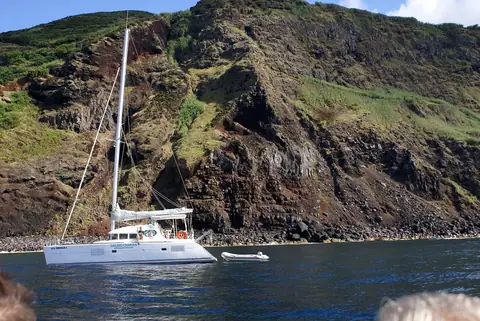
The Lagoon 380 remains the budget entry point. With around 1,000 built over two decades it is everywhere, and well-kept examples are still crossing oceans. It is light and small for a full liveaboard load, so it suits couples who travel light.
Best for the Bahamas and shoal water, the daggerboard cats
Draft decides which anchorages you can reach in the Bahamas, the Florida Keys and the Chesapeake. The fixed-keel production cats on our list draw 3.6 to 4.9 feet, which is workable almost everywhere. Daggerboard cats change the equation entirely.
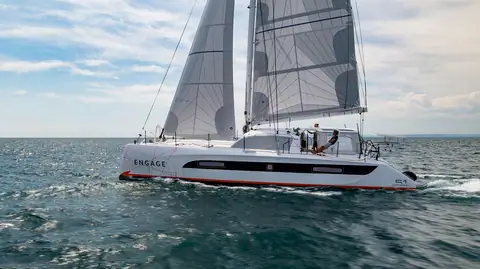
The Seawind 1600 draws about 2 feet 1 inch with its boards and rudders raised, which lets it tuck into anchorages where monohulls and fixed-keel cats cannot follow. Its Australian design also emphasizes a cockpit and saloon on one level with folding doors that open the whole aft end, a layout that works well for full-time living in the tropics. The Outremer 51, at about 3 feet 1 inch boards up, offers similar access with a far sportier sailing character.
Best for couples who plan real ocean miles
If living aboard means crossing oceans, prioritize sailing performance, payload tolerance and build quality over interior volume. A faster boat spends less time exposed to weather and can sail away from systems you would rather avoid.
The Outremer 51 is the benchmark. Light displacement for its length, daggerboards and a strong reputation among circumnavigating couples keep resale values high; good examples rarely sit on the market. The Excess 14 is Groupe Beneteau's answer, a VPLP design with a sportier rig and twin aft helms close to the sheets, and it costs considerably less than an Outremer. The Nautitech 46 Open, with aft helms close to the sheets and a lighter build than most charter cats, sits between the two.
For buyers with larger budgets, the Lagoon 46 and Fountaine Pajot Elba 45 are comfortable and capable ocean liveaboards if you keep the load under control. The Lagoon 46's 275 gallon fuel tankage is a meaningful advantage on long motoring legs through the doldrums.
The power catamaran option for Loop and ICW liveaboards
Not every liveaboard wants a mast. A power catamaran like the Aquila 44 gives the stability and space of a sailing cat with an air draft of about 18.7 feet, under the 19.6 foot limit that governs the Great Loop, and a 21.5 foot beam that fits the 23 foot limit of the Trent-Severn Waterway. Our data puts its cruise at around 17 knots on about 20 gallons per hour with 295 gallons of fuel, so range is the limiting factor rather than speed.
The trade is fuel cost and simplicity of propulsion. A sailing cat can cross an ocean on wind; a power cat cannot. For coastal liveaboards who spend winters in Florida and the Bahamas and summers in the Chesapeake or New England, that is often a fair swap.
Buying ex-charter, where the savings are and where they go
Most used Leopards, Lagoons, Fountaine Pajots and Balis in the US market spent their first five years in a charter fleet. That is not automatically bad. Charter boats are maintained on schedules and often have newer engines and sails than private boats of the same age. But they are optimized for a week of hard use by guests, not for years of living.
- Saildrives and seals. Check service records and seal replacement intervals on both units.
- Rudder bearings and stocks. Charter groundings show up here first.
- Bulkhead bonding and the forward crossbeam area. Look for cracking or stress lines.
- Soft goods. Cushions, canvas and mattresses are usually due for replacement.
- Layout conversion. A four-cabin charter boat can sometimes be converted to an owner's layout, but the cost is significant and value rarely recovers it.
- Electrical. Charter cats often have minimal battery banks and solar, sized for marina nights.
The upgrade list almost every used cat needs
Budget for systems before moving aboard. The ranges below are rough installed estimates for a 40 to 46 foot cat in 2026 and depend heavily on brand choices and yard rates.
| Upgrade | Why it matters for liveaboards | Rough installed cost (estimate) |
|---|---|---|
| Solar array, 1 to 2 kW | Cuts generator and engine run time at anchor | $8,000 to $20,000 |
| Lithium battery bank | More usable capacity, faster charging, less weight | $10,000 to $30,000 |
| Watermaker | Freedom from marinas for water, essential with small tanks | $8,000 to $20,000 |
| Heavier anchor and chain | Sleep well in crowded or exposed anchorages | $3,000 to $8,000 |
| Hard dinghy and outboard | Your car for every shore trip | $6,000 to $20,000 |
| Air conditioning or upgrade | Summer in Florida and the Bahamas | $8,000 to $25,000 |
What living aboard a cat costs each year
Catamarans carry a beam penalty in marinas. Many US marinas charge a premium for multihulls, often somewhere between 1.5 and 2 times the monohull rate for the same length (a common pattern, not universal), or require an end tie. Liveaboards who anchor most nights avoid most of that cost, which is one reason solar and a watermaker pay for themselves.
Insurance is the other variable. Underwriters care about hurricane plans, experience and where the boat will be from June through November. Expect questions about crew experience for offshore passages and, for older or ex-charter boats, a recent survey. Haul-out costs more than for a monohull of the same length because fewer travel lifts can handle a 22 to 26 foot beam.
As a planning estimate, many liveaboard couples on 40 to 46 foot cats budget annual boat costs (maintenance, insurance, haul-out, some marina time, fuel) in the range of 8 to 12 percent of the boat's value, before food and personal expenses. Your number depends heavily on how often you anchor and how much work you do yourself.
Models mentioned in this guide
Leopard 45
Sailing Catamarans, 45 ft
Used $380K to $760K
Lagoon 42
Sailing Catamarans, 42 ft
Used $340K to $600K
Leopard 40
Sailing Catamarans, 39 ft
Used $250K to $400K
Bali Catspace
Sailing Catamarans, 40 ft
Used $380K to $560K
Lagoon 380
Sailing Catamarans, 38 ft
Used $150K to $310K
Outremer 51
Sailing Catamarans, 51 ft
Used $700K to $1.3M
Frequently asked questions
What is the best size catamaran to live on?
For most couples 40 to 46 feet is the sweet spot. It carries a full liveaboard load without slamming, offers good tankage and is still manageable for two people to dock and maintain.
What is the best catamaran for living aboard on a budget?
A used Leopard 40 or Lagoon 380 offers the most liveaboard boat for the money, with the Bali Catspace a good choice if you want more interior space and can spend a little more.
Can a catamaran use the Intracoastal Waterway?
Yes, if its air draft clears the 65 foot standard for fixed bridges, plus some margin for antennas and tide. Cats like the Bali Catspace (59.8 ft) fit, while the Leopard 45 (70 ft) does not.
Is it cheaper to live on a catamaran than a monohull?
Not usually at the dock, because many marinas charge multihulls a premium. At anchor the difference narrows, and many cats carry more solar and storage that make long stretches away from marinas easier.
Are ex-charter catamarans good liveaboards?
They can be excellent value if surveyed carefully. Focus on saildrives, rudders, bulkhead bonding and electrical systems, and expect to upgrade batteries, solar and soft goods.
Which catamaran is best for crossing oceans as a liveaboard?
The Outremer 51 is the benchmark for couples who plan serious ocean miles, with the Excess 14 and Nautitech 46 Open as lower-cost alternatives.
Keep reading
Catamaran vs Monohull, Which Should You Buy?
An honest comparison of cruising catamarans and monohull sailboats for US buyers, covering comfort, safety, sailing ability…
OwnershipCatamaran Charter Management Programs Explained
A clear look at catamaran charter management programs, how guaranteed income and revenue-share contracts differ, what owner use…
BuyingHow to Buy a Used Yacht, Step by Step
A step-by-step walkthrough of buying a used yacht in the US, from setting a real budget to closing, documentation and the first…
BuyingMarine Surveys Explained, What a Surveyor Checks
What happens during a pre-purchase marine survey, what it costs, how to choose a surveyor, and how to turn the report into a…
CruisingIntracoastal Waterway Guide for Yacht Owners
A practical Intracoastal Waterway guide for owners running the Atlantic or Gulf ICW, covering boat fit, draft and air draft…
BuyingBest Bluewater Sailboats for Ocean Crossings
Our shortlist of the best bluewater sailboats for ocean crossings, from $25,000 classics to million-dollar passagemakers, with…