Leopard Catamarans Sailing Catamarans
Leopard 40 Catamaran, Specs, Cabins and Used Buying Advice
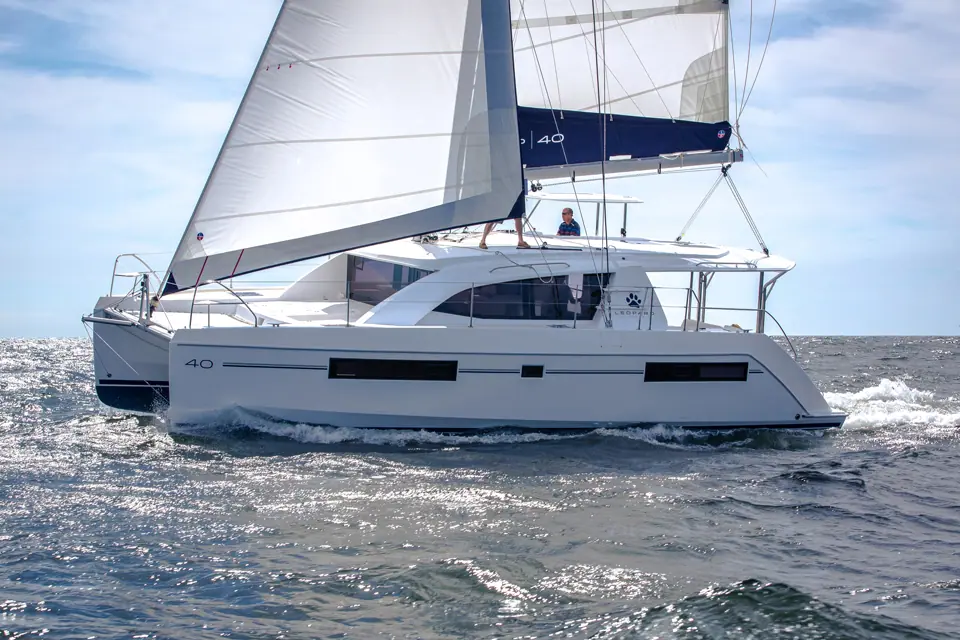
Three different boats have worn the Leopard 40 badge. This guide focuses on the 2014 Simonis Voogd sailing cat, the one most buyers find on the market today.
- Length
- 39.3 ft11.99 m
- Beam
- 22 ft6.72 m
- Draft
- 4.4 ft1.35 m
- Cabins
- 3 or 4
- Used price
- $250K to $400K
On this page
- Overview
- Which Leopard 40 catamaran are you looking at
- The brief, a big Leopard shrunk to 39 feet
- The forward door, the corner galley and other layout ideas
- Leopard 40 catamaran number of cabins, explained
- Under way, with 14 people aboard
- Water tanks that change the cruising equation
- Buying an ex-charter Leopard 40
- Successors and how the Leopard 40 holds value
- Specifications
- Price and value
- Strengths and weaknesses
- Used buyer checklist
- Rivals
- Our verdict
- FAQ
A 39-foot South African sailing catamaran built by Robertson and Caine from 2014, with a forward saloon door, huge water tanks and three or four cabins. Popular in charter and as a first cat.
- Couples buying a first cruising catamaran
- Bahamas and Caribbean cruising
- Families on a sub-$400,000 budget
- Buyers who value water capacity
Leopard 40 by the numbers
- Sail area to displacement
- 20.3Plenty of sail for the weight, the boat should feel lively in light air.
- Displacement to length
- 188Light displacement for its length, quick but sensitive to added cruising weight.
- Theoretical hull speed
- 8.3 knDisplacement hull speed for the waterline. Light catamarans regularly sail faster than this because their slim hulls do not make a large bow wave.
- Length to beam ratio
- 1.79 : 1Catamaran overall proportions. Wider platforms resist pitching and heel.
Which Leopard 40 catamaran are you looking at
Before comparing prices, make sure you know which boat a listing describes, because three quite different Leopards have used the number 40. The first was a Morelli and Melvin design built by Robertson and Caine in Cape Town from 2004 to 2009, with 136 boats completed before it gave way to the Leopard 39. The second, and the subject of this guide, is the Simonis Voogd design built from 2014, first shown at the Miami boat show in February 2015 and then to the European public at the multihull show in La Grande Motte that April. The third is the Leopard 40 PC, a power catamaran with no mast at all.
If you landed here looking for the Leopard 40 powercat, its price and layout are a separate story; it is still in the Leopard range while the sailing 40 is not. Everything below concerns the sailing Leopard 40 catamaran, which is the boat most buyers find on the brokerage market and in charter fleets in the Caribbean, the Bahamas and the Mediterranean.
- 2004 to 2009: first generation, Morelli and Melvin design, 136 built
- 2014 onward: second generation, Simonis Voogd design, more than 200 built
- Leopard 40 PC: power catamaran, unrelated hull and no rig
The brief, a big Leopard shrunk to 39 feet
Robertson and Caine asked Simonis Voogd to carry the forward-door concept of the larger Leopard 44 and 48 down to a much smaller platform. The result measures 39 feet 4 inches overall with a 38-foot waterline and 22 feet of beam. The bows are bluff to carry the waterline length well forward, while the hulls stay fine at the waterline and gain volume higher up. That shape, combined with a bridgedeck clearance of about 78 centimeters (roughly 31 inches), lets the boat stay comfortable in a choppy sea even upwind.
Construction is vacuum-infused GRP with balsa cores, and the boat benefits from the experience of more than a thousand Leopards built before it. The rig is a deck-stepped aluminum mast with a square-top, fully battened main and a furling genoa, and the hulls have fixed keels with a draft of about 4 feet 5 inches.
The forward door, the corner galley and other layout ideas
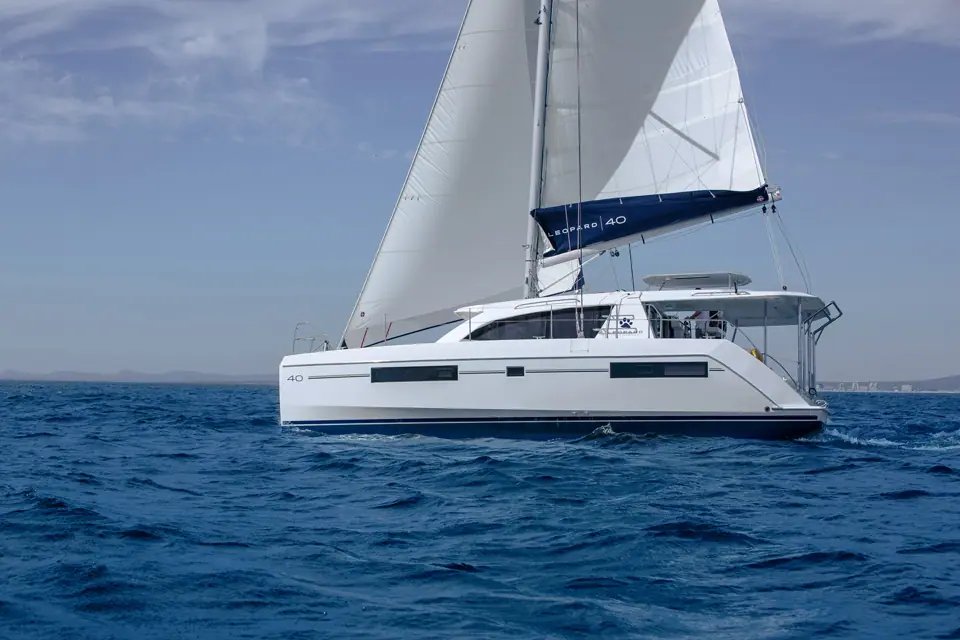
Two features define the layout. First, a door at the front of the saloon opens straight onto the foredeck, so air flows through the whole boat at anchor and you can walk from the cockpit to the bow without using the side decks. Unlike its bigger sisters, the 40 has no full forward cockpit, just a cushioned lounge Leopard calls the cocoon on the starboard side of the foredeck, which sits over a large locker that houses the optional generator. Second, the galley moved to the forward starboard corner of the saloon, which is unusual and gives the cook a view forward through a big fixed window, while the settee shifts aft and to port.
A drawer-style fridge and freezer opens from the cockpit, which is handy for drinks without tracking through the saloon. Above the cockpit, a rigid targa hardtop provides proper weather protection, and a dinghy davit system that lowers to the water is standard.
There are two main layouts. The four cabin charter version has a double in each corner and two heads, sleeping eight. The three cabin owner's version gives the full starboard hull to a master suite with a large head, leaving two cabins and a head in the port hull. Both have two heads, which is less than many rivals and worth noting if you sail with a full crew.
Leopard 40 catamaran number of cabins, explained
Buyers often ask how many cabins the Leopard 40 has because listings mix the two layouts. The answer is three or four double cabins, always with two heads. Ex-Moorings and other charter boats are almost always four cabin versions, while privately ordered boats are usually three cabin owner's versions.
For a cruising couple who host guests occasionally, the owner's version is far more pleasant to live aboard. For families with three children, or buyers planning to put the boat back into charter, the four cabin version is the practical choice and the easier one to resell.
Under way, with 14 people aboard
SAIL magazine tested the Leopard 40 in about 16 knots of breeze with 14 people aboard, a heavier load than most owners will ever carry. It made 8.3 knots at 70 degrees apparent, 8.5 knots on a beam reach and 5.9 knots at 120 degrees apparent in 4-foot seas. Those are good numbers for a fully loaded 39-foot cruising catamaran with fixed keels.
Under power, the twin 29 hp Yanmar saildrives cruised at about 7 knots and reached 8.4 knots in calm water. Those engines are on the small side when punching into chop, but they are economical and simple to service.
The weaknesses the testers found are practical rather than serious: eight rope clutches create a tangle of tails at the helm, the angled steps onto the cabin top are awkward, the cutout in the hardtop limits the view of the mainsail, and engine compartment access is tight.
Water tanks that change the cruising equation
One spec stands out: about 206 gallons of fresh water, more than double what most 40-foot French catamarans carry. For a cruising couple that means weeks between water stops, or a much smaller watermaker. Fuel capacity is about 95 gallons, which is adequate given the boat's economical small diesels.
Typical charter-fleet equipment includes a 6 kW generator, two air conditioning units, modest solar and Raymarine electronics. Private buyers usually add lithium batteries and more solar to cut generator hours at anchor.
Buying an ex-charter Leopard 40
Most second generation Leopard 40s for sale have charter history, many from The Moorings, whose brokerage arm sells the boats as they rotate out of the fleet. A 2020 three cabin boat in Saint Lucia, for instance, was listed at about $319,000 with roughly 2,100 hours on each engine. That is typical: high hours but documented maintenance.
Expect to refresh cushions, canvas and sails, and plan a careful survey of saildrives, rudders, steering, hatches and the forward crossbeam. The median recorded sale is roughly $295,000, with asking prices from about $250,000 to $400,000. A boat that has already been refitted after leaving charter is often worth the premium.
Annual costs in the US typically run $22,000 to $45,000 excluding depreciation. The 22-foot beam sometimes fits a wide single slip, which helps.
Successors and how the Leopard 40 holds value
The sailing Leopard 40 has left the range, which now starts at the Leopard 43 for sailing catamarans. That keeps demand for good used 40s steady, because buyers who want a sub-40-foot Leopard have no new option. Values have been remarkably stable since 2020, and a well-maintained boat bought today should resell close to its purchase price within a few years, assuming the market holds.
Leopard 40 specifications
| Length overall | 39.3 ft11.99 m |
|---|---|
| Waterline length | 38.1 ft11.62 m |
| Beam | 22 ft6.72 m |
| Draft | 4.4 ft1.35 m |
| Air draft | 63.8 ft19.45 m |
| Displacement | 23,215 lbs10,53 kg |
| Sail area | 1,032 sq ft95.9 m² |
| Fuel capacity | 95 gal36 L |
| Fresh water | 206 gal78 L |
| Cabins | 3 or 4 |
| Berths | 6 to 10 |
| Heads | 2 |
| Standard engines | 2 x Yanmar 3YM30 29 hp diesel with saildrives |
| Maximum power | 58 hp |
| Cruise speed | 7 knots |
| Top speed | 8.4 knots |
| Hull type | Catamaran, twin hulls |
| Keel | Twin fixed keels |
| Rig | Deck-stepped fractional sloop, square-top mainsail, aluminum mast, furling genoa |
| Hull construction | Vacuum-infused GRP with balsa-cored hull and deck |
| Builder | Robertson and Caine, South Africa |
| Naval architect | Simonis Voogd Design |
| Other design credits | First generation (2004 to 2009) designed by Morelli and Melvin |
| Production | 2014 to present |
| Status | Discontinued |
Figures come from builder documentation and independent tests where available. Displacement is usually quoted light, so a loaded cruising boat will weigh more. Compare these specs with another model.
Performance data
| Apparent wind angle | Conditions | Boat speed (kn) |
|---|---|---|
| 70 degrees | 16 kn breeze, 14 aboard | 8.3 |
| Beam reach | 16 kn breeze, 14 aboard | 8.5 |
| 120 degrees | 4-foot seas | 5.9 |
SAIL magazine sea trial. Under power, twin 29 hp Yanmars gave about 7 knots cruising and 8.4 knots maximum in calm water.
How much does a Leopard 40 cost?
Most second generation Leopard 40s on the market came out of The Moorings and other charter fleets, so condition varies widely and prices are tightly clustered, with a recorded median sale of roughly $295,000. Owner's versions, generator and air conditioning, solar and lithium upgrades and low engine hours push a boat toward $400,000. First generation 2004 to 2009 boats trade lower and should be valued on condition alone.
Estimate your yearly cost
A planning estimate using common rules of thumb: insurance near 1.5 percent of value, maintenance near 3 percent, haul out and bottom paint by length. Your marina, region and use will move these numbers. Open the full cost calculator.
Leopard 40 timeline
- 2004First Leopard 40 launched, a Morelli and Melvin design
- 2009First generation ends after 136 boats, replaced by the Leopard 39
- 2014Simonis Voogd designed second generation Leopard 40 enters production
- 2015Debut at the Miami boat show in February, then Europe at La Grande Motte in April; SAIL quotes about $450,000 well optioned
- 2020Late-production boats join charter fleets, later reaching the brokerage market
Strengths and weaknesses
What owners like
- Forward saloon door gives great airflow and easy access to the bow
- Huge 206-gallon water capacity
- Good bridgedeck clearance for comfort in chop
- Sailed well even with 14 people aboard
- Strong supply of ex-charter boats with maintenance records
- Stable resale values
What to weigh up
- Only two heads in either layout
- Small 29 hp engines in a head sea
- Cluttered rope clutches at the helm
- Tight engine room access
- Most used boats have heavy charter wear
Used Leopard 40 buyer checklist
Take this list to a viewing. Your ticks are saved in this browser so you can come back to it.
Always commission an independent marine survey and an engine survey before you buy. How a marine survey works.
Rivals to consider
Lagoon 40
Aft mast rig and a more refined interior, with a lower mast that clears ICW bridges.
Compare side by sideLagoon 380
Older and cheaper, with shallower draft but much smaller water tanks.
Compare side by sideFountaine Pajot Isla 40
A newer French design with a modern interior, priced higher as a newer boat.
Compare side by sideBali Catspace
Solid foredeck and opening saloon, maximizing living space over sailing feel.
Compare side by sideOur verdict on the Leopard 40
The Leopard 40 is one of the smartest used buys among 40-foot catamarans. The forward saloon door, corner galley and enormous water tanks make it an easy boat to live on, and it sails respectably even when loaded. Most boats come from charter fleets, so plan on a careful survey and a modest refresh, and favor a three cabin owner's version if you can find one. Done right, it delivers a practical, comfortable cruising home at a price well under that of newer rivals.
Leopard 40 questions answered
How many cabins does a Leopard 40 catamaran have?
Three or four double cabins, always with two heads. Charter boats are usually four cabin versions and private boats three cabin owner's versions.
How much is a used Leopard 40?
Second generation boats typically ask $250,000 to $400,000, with a recorded median sale near $295,000.
Who designed the Leopard 40?
The current generation was designed by Simonis Voogd and built by Robertson and Caine in South Africa. The 2004 to 2009 version was designed by Morelli and Melvin.
Is the Leopard 40 the same as the Leopard 40 PC?
No. The Leopard 40 PC is a power catamaran with a different hull and no rig, while the Leopard 40 is a sailing catamaran.
How fast does the Leopard 40 sail?
A loaded test boat made 8.5 knots on a beam reach in 16 knots of breeze and cruised at about 7 knots under power.
Leopard 40 photos
More sailing catamarans to explore
Bali 4.0
Sailing Catamarans, 39 ft
Used $260K to $380K
Fountaine Pajot Isla 40
Sailing Catamarans, 39 ft
Used $360K to $560K
Bali 4.1
Sailing Catamarans, 40 ft
Used $360K to $470K
Broadblue 385
Sailing Catamarans, 39 ft
Used $150K to $330K