Catana 50 Catamaran, the Comeback Cruiser Reviewed for Buyers
The boat that put Catana back in business: a 50 ft daggerboard cat with a cantilevered hardtop, a solent rig and a question every owner must answer about crew.
- Length
- 50 ft15.23 m
- Beam
- 26.1 ft7.94 m
- Draft
- 9.7 ft2.95 m
- Cabins
- 3 in the owner's version (full owner's hull plus two guest cabins), with family and charter variants offered
- Used price
- $430K to $650K
On this page
- Overview
- The 50 footer that brought Catana back
- Is the Catana 50 too much boat for two?
- Solent rig, screecher and what it does in 6 to 20 knots
- Bulb bows and boards designed to break
- Engines, controls and a one-boatlength turn
- Owner's hull, Alcantara and an opening galley window
- A 2008 systems list, seen from 2026
- Not the same boat as the Catana 50 Ocean Class
- Specifications
- Price and value
- Strengths and weaknesses
- Used buyer checklist
- Rivals
- Our verdict
- FAQ
The Catana 50 is a 15.2 m Christophe Barreau daggerboard catamaran built from 2007 to about 2013. Cruising World's Best Cruising Multihull for 2008, it now asks around $480,000 to $650,000 used.
- Experienced couples planning ocean passages
- Families who want three private cabins and speed
- Sailors who value windward ability over flybridge volume
- Buyers prepared to import from Europe
Catana 50 by the numbers
- Sail area to displacement
- 30.2Racing level power, needs active reefing as the breeze builds.
- Displacement to length
- 117Ultralight. Built for speed, keep payload to a minimum.
- Theoretical hull speed
- 9.4 knDisplacement hull speed for the waterline. Light catamarans regularly sail faster than this because their slim hulls do not make a large bow wave.
- Length to beam ratio
- 1.92 : 1Catamaran overall proportions. Wider platforms resist pitching and heel.
The 50 footer that brought Catana back
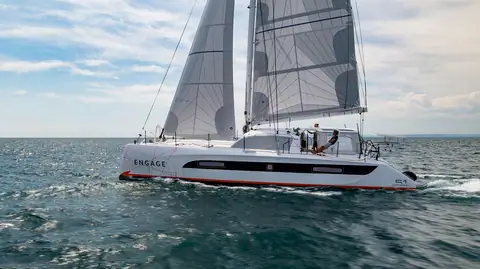
SAIL opened its 2008 review with a blunt line: Catana is back, and with a vengeance. The builder of performance cruising catamarans had foundered when the dot-com crash took its customers, then reorganized and resumed building in its Catalan yard. The Catana 50 was the first big statement of the new company. Hull and deck molds were new, the interior was new, and among the design changes from the 52 footer Catana had built before was a hardtop cantilevered over the cockpit with no aft supports.
Christophe Barreau, Catana's long-time designer, drew the boat to replace the 471 according to Cruising World. Catana positioned the Catana 50 as an owner's boat and told the magazine it was not intended for bareboat charter, which is why the standard specification arrived complete: watermaker, generator, washer-dryer and an energy management system were all included. Cruising World's judges named it Best Cruising Multihull in the 2008 Boat of the Year awards and called it the best built and most stylish of that year's cruising cats.
Is the Catana 50 too much boat for two?
The judges' praise came with a caveat that every buyer should take seriously. On a Chesapeake day gusting into the high 20s, Cruising World's senior editor watched sheets go from bar tight to flogging in an instant, and the panel asked whether a boat marketed as perfect for a couple was really too much for any but an experienced shorthanded multihull crew. A cat's initial stability means rig and winch loads are many times those on a similar monohull, and the 50 carries a 70 ft carbon spar.
The answer in the magazine's follow-up, sailing with first-time big boat owners Jim and Adean Bridges, was that it depends on method rather than muscle. They motored in tight water, used the Furuno autopilot to hold the bow to wind when hoisting, leaned on Harken electric winches and waited for weather. Raising the main proved to be a two-person job, because the halyard winch sits under the bimini where you cannot see the sail. A couple can run this boat, but only with good habits and reefing early.
Solent rig, screecher and what it does in 6 to 20 knots
The sail plan on the Bridges' boat totaled a 1,055 sq ft full-batten main, a 388 sq ft self-tacking jib and a 1,076 sq ft screecher on the outer stay of the solent rig; Catana's own 2011 figures were 100 m2 of main, 70 m2 of genoa and a 100 m2 gennaker. The self-tacking jib makes short tacking out of a harbor a matter of turning the wheel. Sail control lines run from the mast under the deck to a bank of clutches and a central electric winch that can be triggered from either helm.
Numbers from the tests give a sense of range. SAIL recorded almost 5 knots close-hauled under Code 0 in only 6 knots of wind, well over 5 knots when bearing off to a beam reach, and tacks inside 90 degrees. Cruising World logged about 7.5 knots on the jib alone in high-teens breeze, and about 8 knots under main and code zero once the wind settled to 10 knots. Daggerboards down, the boat draws about 9 ft 7 in to 9 ft 8 in.
Bulb bows and boards designed to break
Below the waterline the Catana 50 has the bulbous bow sections typical of the brand, which SAIL compared to the wave-piercing ferries of the Caribbean and New York Harbor: more buoyancy forward, less hobbyhorsing and a cleaner wake. The daggerboards are carefully foiled and angled slightly inboard for lift, and they are meant to shear off in a severe impact so that the much stronger trunks protect the hull. Watertight compartments fore and aft add a second line of defense after a collision.
The boards are raised and lowered by a purchase system led to the cockpit, which SAIL found worked well with occasional friction under load. The trunks steal only a small locker from the accommodation. The construction is Airex foam sandwich in hull and deck with cored furniture panels, which keeps the boat relatively light even when loaded for cruising, though Cruising World estimated the Bridges' boat at about 33,000 lb in cruising trim against Catana's light figure of 13.7 tonnes.
Engines, controls and a one-boatlength turn
Catana's spec sheet lists twin 55 hp engines, but many boats, including the one Cruising World sailed and two 2011 boats for sale in Europe, have 75 hp Volvo Pentas on saildrives. SAIL measured an easy 8 knots at 2,500 rpm with 69 dBA in the saloon and just under 9 knots at 3,000 rpm, and the boat turned in about one length with both engines ahead at 1,500 rpm. The genset lives in the port engine room and the watermaker in the starboard one, both with good access.
Control arrangements are worth checking. On the test boats the tachometers and instruments were on the starboard console, and switching control to the port helm meant idling, pressing throttle buttons and walking across a 26 ft wide cockpit. Visibility from either wheel is excellent forward and to the near side, but the cabin house hides the opposite bow.
Owner's hull, Alcantara and an opening galley window
SAIL counted four layouts, two of them charter versions; Catana's 2011 site showed Owner and Family versions. In the owner's layout the entire starboard hull is the owner's suite behind a curved sliding door, with a queen-size berth aft on slatted bases that lift for storage, a desk and hanging lockers amidships, and the head, separate shower and washer-dryer forward. The port hull has staterooms fore and aft, each with its own head and shower, and the aft cabin can have a queen or twins.
The saloon has a forward-facing nav station in the port forward corner, a table surrounded by deep seating, and an L-shaped galley to port with a four-burner stove, oven, microwave, fridge and freezer. A large window opens from the galley to the cockpit so the cook is part of the party, and Cruising World noted good fiddles, a rarity on cats. The cockpit has a triangular teak table that folds out square, two big lockers under the sole and davits sized for a 12 ft inflatable.
A 2008 systems list, seen from 2026
The early boats came with a 24 V DC system, six house and two starting batteries, solar panels on the hardtop (400 W on the Bridges' boat, eight panels on SAIL's), a 3 kW inverter, a watermaker of roughly 60 to 64 gallons per hour, dual water heaters, black and gray tanks, four bilge pumps and electric heads with freshwater flush. Every one of those systems is now old enough to need replacing on a boat that has not been refitted. A Catana 50 with lithium batteries, modern charging and a new watermaker is worth a meaningful premium over one still running its original kit.
Not the same boat as the Catana 50 Ocean Class
Since about 2020 Catana has built a different 50 footer called the Ocean Class, credited by sailboatdata to Olivier Poncin, with a 14.99 m hull, about 15.75 m overall with the bowsprit and twin 45 hp engines. Brokers sometimes list it as Catana 50 Ocean Class, and a 2023 example asks about 1.03 million euros. The updated Ocean Class squared version shown at Cannes in 2025 starts at 1,090,000 euros before VAT. If a listing says Catana 50 and the price is over a million, it is almost certainly the newer boat, not the Barreau design described here.
Catana 50 specifications
| Length overall | 50 ft15.23 m |
|---|---|
| Waterline length | 48.7 ft14.84 m |
| Beam | 26.1 ft7.94 m |
| Draft | 9.7 ft2.95 m |
| Air draft | 77.8 ft23.7 m |
| Displacement | 30,2 lbs13,7 kg |
| Sail area | 1,829 sq ft170 m² |
| Fuel capacity | 227 gal86 L |
| Fresh water | 211 gal8 L |
| Cabins | 3 in the owner's version (full owner's hull plus two guest cabins), with family and charter variants offered |
| Heads | 3 in the owner's version |
| Standard engines | 2 x 55 hp diesels with saildrives |
| Optional engines | 2 x Volvo Penta 75 hp diesels with saildrives |
| Maximum power | 150 hp |
| Cruise speed | 8 knots |
| Top speed | 9 knots |
| Hull type | Daggerboard cruising catamaran with bulbous bows and tulip-shaped topsides |
| Keel | Twin daggerboards angled slightly inboard, 3 ft 11 in up and about 9 ft 8 in down |
| Rig | Fractional solent rig with full-batten main, self-tacking jib and screecher or Code 0; 21.5 m mast |
| Hull construction | Vacuum-bagged Airex foam sandwich with carbon reinforcement and cored interior panels |
| Builder | Catana, France |
| Naval architect | Christophe Barreau |
| Other design credits | Interior by Linea Concept |
| Production | 2007 to 2013 |
| Status | Discontinued |
Figures come from builder documentation and independent tests where available. Displacement is usually quoted light, so a loaded cruising boat will weigh more. Compare these specs with another model.
How much does a Catana 50 cost?
Cruising World's judges quoted $1.15 million and later $1.4 million for the boats they tested in 2007 and 2008, when a strong euro pushed French prices up. In 2026 two 2011 boats in France and Spain both ask about 525,000 euros, with Volvo 75 hp engines. US-based examples are scarce, so a buyer often adds shipping or a delivery passage to the price. Engine size, sail inventory and the age of the energy system move the number more than the year.
Estimate your yearly cost
A planning estimate using common rules of thumb: insurance near 1.5 percent of value, maintenance near 3 percent, haul out and bottom paint by length. Your marina, region and use will move these numbers. Open the full cost calculator.
Catana 50 timeline
- 2007First Catana 50 sea trials on Chesapeake Bay for Cruising World's Boat of the Year
- 2008Named Best Cruising Multihull; SAIL reviews the new boat
- 2011Carbon-rich version nominated in SAIL's Best Boats 2012 program
- 2013Last year of production recorded by sailboatdata
- 2020Unrelated Catana Ocean Class 50 footer enters production
Strengths and weaknesses
What owners like
- Fast and close-winded for a fully equipped cruising cat
- Self-tacking solent jib makes short tacking simple
- Cantilevered hardtop and a big, social cockpit
- Boards designed to break away before the hull is damaged
- Comprehensive standard equipment and a well-finished interior
- Cruising World's 2008 Best Cruising Multihull
What to weigh up
- Big rig loads demand an experienced shorthanded crew
- Main hoisting is awkward to do alone
- Instruments and control transfer favor the starboard helm
- Exposed aft helms and a blind spot to the opposite bow
- Few boats in the US; most are in Europe
Used Catana 50 buyer checklist
Take this list to a viewing. Your ticks are saved in this browser so you can come back to it.
Always commission an independent marine survey and an engine survey before you buy. How a marine survey works.
Rivals to consider
Outremer 51
Lighter and more racy, with a big following and strong resale; newer boats cost more.
Compare side by sideLagoon 500
A contemporary with a flybridge and huge volume, slower and less weatherly but easier to find and service.
Privilege 495
A heavier French luxury cat with fixed keels and a strong liveaboard reputation.
Catana 53
Catana's 2017 successor in this size, lighter and more modern, at roughly double the price.
Compare side by sideOur verdict on the Catana 50
The Catana 50 is a serious ocean catamaran with a builder's confidence behind it: complete from the factory, quick upwind and safer than most thanks to breakaway boards and watertight compartments. It is not a casual couple's boat. Treat the rig with respect, budget for the systems a 2008 to 2013 boat now needs, and buy the best maintained example you can find, even if that means importing it. Done that way, it delivers performance-cat sailing for the price of a newer charter cat.
Catana 50 questions answered
How much is a Catana 50 for sale?
Original Barreau-designed boats from 2007 to 2013 ask roughly $430,000 to $650,000; two 2011 boats in Europe ask about 525,000 euros. A listing above a million is usually the newer Ocean Class.
Who designed the Catana 50?
Christophe Barreau, with interior design by Linea Concept.
What engines does the Catana 50 have?
Catana listed twin 55 hp engines; many boats have twin Volvo Penta 75 hp diesels on saildrives.
Can a couple sail a Catana 50?
Yes, but Cruising World's judges warned it suits an experienced shorthanded crew. Electric winches, early reefing and motoring in tight water make it manageable.
What is the draft of a Catana 50?
About 3 ft 11 in with the daggerboards raised and about 9 ft 8 in with them down.
Did the Catana 50 win any awards?
It was Cruising World's Best Cruising Multihull in the 2008 Boat of the Year awards and a SAIL Best Boats nominee for 2012.
More sailing catamarans to explore
HH44
Sailing Catamarans, 50 ft
Used $1.05M to $1.55M
Leopard 50
Sailing Catamarans, 51 ft
Used $620K to $1.15M
Bali 4.8
Sailing Catamarans, 49 ft
Used $780K to $1.15M
Outremer 51
Sailing Catamarans, 51 ft
Used $700K to $1.3M