Bali Catamarans Sailing Catamarans
Bali 4.6 Catamaran Buyer's Guide
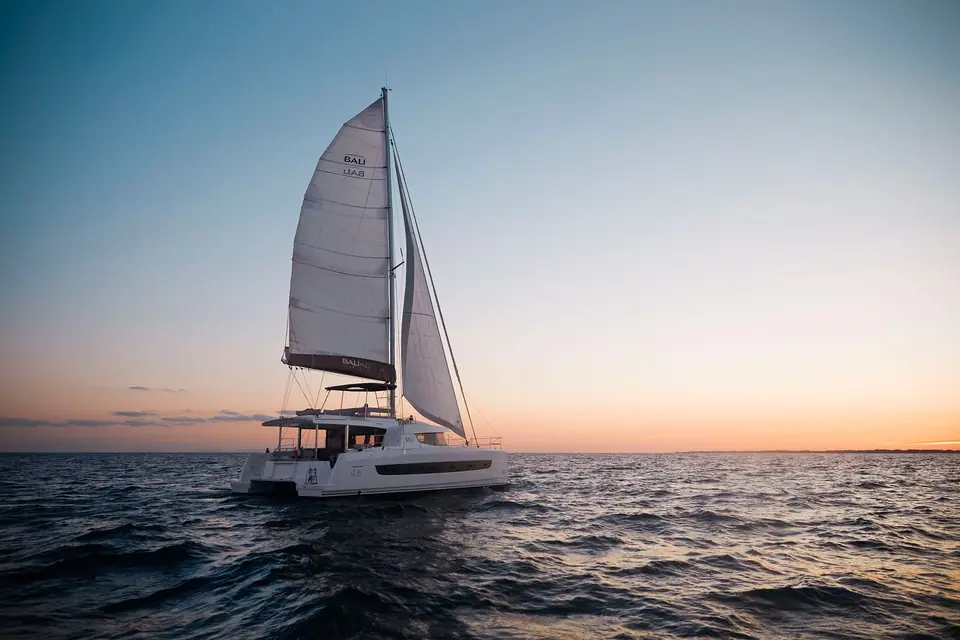
A 47-foot catamaran that turns the whole deck into living space, with a forward door, a flybridge helm and a tilt-up aft wall instead of trampolines.
- Length
- 47 ft14.31 m
- Beam
- 25.1 ft7.66 m
- Draft
- 4.2 ft1.27 m
- Cabins
- 3, 4 or 5
- Used price
- $620K to $850K
On this page
- Overview
- The Bali 4.6 catamaran at a glance
- Why Bali replaced trampolines with a solid foredeck
- Flybridge helm and short-handed sail handling
- Performance, set your expectations here
- Galley, saloon and three to five cabin layouts
- Engines and systems worth paying for
- Buying a used Bali 4.6, charter boats versus private boats
- Specifications
- Price and value
- Strengths and weaknesses
- Used buyer checklist
- Rivals
- Our verdict
- FAQ
The Bali 4.6 is a Xavier Fay designed 47-foot cruising cat from the Catana Group, built since 2021 as the successor to the Bali 4.5. Three to five cabins, twin 45 or 57 hp Yanmars.
- Families who live aboard at anchor
- Charter management owners
- Entertaining large groups
- Buyers moving from a motor yacht to sail
Bali 4.6 by the numbers
- Sail area to displacement
- 27.5Racing level power, needs active reefing as the breeze builds.
- Displacement to length
- 156Light displacement for its length, quick but sensitive to added cruising weight.
- Theoretical hull speed
- 8.9 knDisplacement hull speed for the waterline. Light catamarans regularly sail faster than this because their slim hulls do not make a large bow wave.
- Length to beam ratio
- 1.87 : 1Catamaran overall proportions. Wider platforms resist pitching and heel.
The Bali 4.6 catamaran at a glance
The Bali 4.6 is the boat that took the Bali formula, first seen on the Bali 4.5 in the mid-2010s, and scaled it into a serious liveaboard. It measures 47 feet overall on 44 foot 1 inch hulls with a 44 foot 5 inch waterline, 25 feet 1 inch of beam and a 4 foot 2 inch draft. Empty weight is 30,567 pounds according to Bali, and maximum loaded displacement is 45,578 pounds, a 15,000 pound spread that shows how much a cruising family can load aboard.
Xavier Fay drew the hulls with slender, straight bows. Olivier Poncin, founder of the Catana Group, led the concept, and Piaton Berco handled the interior. The boat is built at Chantier Catana and carries a CE Category A rating for 12 people. Bali still lists it in the current range in 2026.
Why Bali replaced trampolines with a solid foredeck
Every catamaran buyer should understand the three design choices that define a Bali before comparing it to a Lagoon or Leopard. First, there are no trampolines. The deck is a single solid composite structure from the transoms to the bows, which adds usable lounging area forward and stiffens the platform. Second, a door in the front of the saloon opens directly onto that foredeck lounge, which the smaller Catspace lacks. Third, the aft saloon wall is a pneumatic garage-style door that tilts up overhead, merging the saloon and cockpit into a single 1,026 square foot deck plan.
The trade-offs are real. A solid foredeck adds weight forward and, unlike netting, does not drain instantly, so water can pool and the drains need attention. The tilt-up door is a heavy moving panel in a salt environment, which makes its struts, seals and hinges a maintenance item. Neither feature has a documented failure pattern, but both deserve careful attention on a survey.
- Saloon to foredeck door and forward lounge
- Pneumatic up-and-over aft door
- Flybridge helm with lounge seating
- Three-piece swim platform
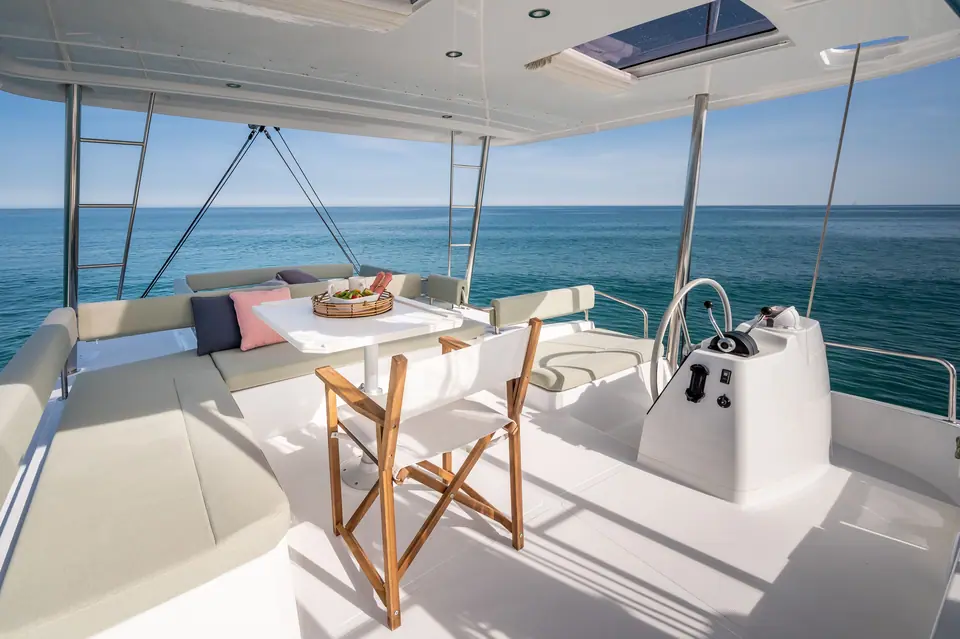
Flybridge helm and short-handed sail handling
The helm sits on the flybridge to port, with bench seating alongside. Cruising World praised the visibility around the boat and to the mainsail, and liked the double-ended mainsheet arrangement. Handling is designed for a couple: a self-tacking jib of about 44 square meters, a full-batten main of roughly 77 square meters and electric winches. One charter review described two people easily managing close to 200 square meters of canvas once the Code 0 was hoisted.
The weak spot is the view aft and to starboard. Reviewers note that seeing the starboard stern from the port helm is difficult when maneuvering, so most owners fit cameras or rely on a crew member during docking.
Performance, set your expectations here
The Bali 4.6 is a comfort boat first. Cruising World sailed it close-hauled in 10 to 12 knots and saw about 5 knots, rising to around 6 knots on a beam reach, and recommended a code zero to improve things. A charter-focused review recorded the same 5 knots in 10 knots of wind. Standard sail area is 1,248 square feet, with up to 1,679 square feet upwind once a Code 0 is added.
Those numbers put the 4.6 behind the Elba 45 and the Leopard 45 in light air, and roughly level with the heavier Lagoons. If you plan long ocean passages, add the Code 0, consider folding props, and accept that you will motor-sail more often than owners of sportier cats. If you plan to spend most nights at anchor, the trade is easily worth it.
Galley, saloon and three to five cabin layouts
Inside, the L-shaped galley runs along the port side with lots of counter space and a full upright refrigerator and freezer, which Cruising World singled out as rare on a sailing cat. The navigation station faces forward, and large sliding windows and the aft door make the saloon feel open to the water on all sides.
Bali offers a three cabin owner's version with the master suite in the starboard hull, a four cabin version, and five cabin layouts for charter. Every cabin has its own head, and the forepeaks can be used as extra berths or storage. Tankage is generous at about 211 gallons of diesel and 211 gallons of water, so the 4.6 makes a credible liveaboard even before a watermaker is added.
Engines and systems worth paying for
Twin 45 hp Yanmars with saildrives are standard and 57 hp Yanmars are optional. On a boat that can weigh more than 40,000 pounds loaded, we would always choose the 57s. They make headwind passages and inlet entries far less stressful, and they are what most private buyers want on the resale market.
Air conditioning and a generator are common options, and lithium batteries with expanded solar on the hardtop have become standard upgrades on privately owned boats. Check the electrical layout carefully on any boat you consider, because aftermarket additions on charter boats are not always installed to the same standard as factory work.
Buying a used Bali 4.6, charter boats versus private boats
The Bali 4.6 has been popular with charter companies, which means a growing supply of five-year-old fleet boats. Recent US and Caribbean asking prices run from about $649,900 for a 2022 boat in a boutique BVI fleet to $799,000 for a never-chartered 2022 boat in the USVI with more than $200,000 of added equipment. A 2023 boat advertised as the best-priced 4.6 on the market asked $794,000.
Expect annual costs of about $45,000 to $85,000 including a catamaran slip, insurance, haul-outs and engine and generator service. With 25 feet of beam you will need a wide slip and a yard with a big travel lift. The predecessor Bali 4.5 sells for substantially less and shows how these boats age, and a good 4.5 can be a value alternative.
Bali 4.6 specifications
| Length overall | 47 ft14.31 m |
|---|---|
| Waterline length | 44.4 ft13.56 m |
| Beam | 25.1 ft7.66 m |
| Draft | 4.2 ft1.27 m |
| Displacement | 30,567 lbs13,865 kg |
| Sail area | 1,679 sq ft156 m² |
| Fuel capacity | 211 gal8 L |
| Fresh water | 211 gal8 L |
| Cabins | 3, 4 or 5 |
| Berths | 6 to 12 |
| Heads | 3 to 5 |
| Maximum persons | 12 |
| Standard engines | 2 x Yanmar 45 hp diesel with saildrives |
| Optional engines | 2 x Yanmar 57 hp diesel |
| Maximum power | 114 hp |
| Hull type | Catamaran with straight bows and full-length solid deck |
| Keel | Twin fixed stub keels |
| Rig | Fractional sloop with full-batten mainsail and self-tacking jib, Code 0 optional |
| Hull construction | Resin-infused polyester over closed-cell foam core |
| CE design category | A |
| Builder | Bali Catamarans (Catana Group), France |
| Naval architect | Xavier Fay |
| Other design credits | Olivier Poncin (concept), Piaton Berco (interior) |
| Production | 2021 to present |
| Status | In production |
Figures come from builder documentation and independent tests where available. Displacement is usually quoted light, so a loaded cruising boat will weigh more. Compare these specs with another model.
How much does a Bali 4.6 cost?
Cruising World quoted $920,000 for a US-spec boat, and generator, air conditioning, lithium and electronics packs push well-optioned boats past $1 million. On the used side, a BVI boutique charter 2022 boat listed at $649,900, while a never-chartered 2022 boat with over $200,000 of added equipment and a 2023 boat both asked about $795,000 to $799,000.
Estimate your yearly cost
A planning estimate using common rules of thumb: insurance near 1.5 percent of value, maintenance near 3 percent, haul out and bottom paint by length. Your marina, region and use will move these numbers. Open the full cost calculator.
Bali 4.6 timeline
- 2014Catana Group launches the Bali brand and its solid foredeck concept with the Bali 4.5
- 2021Bali 4.6 launched as the successor to the 4.5; Sail magazine lists it among four new Catana/Bali designs
- 2022Charter fleets in the BVI and USVI add 4.6s in large numbers
- 2026Still listed in the Bali range alongside the larger Bali 5.2 and 5.8
Strengths and weaknesses
What owners like
- Huge 1,026 square foot deck plan with three linked living zones
- Direct saloon door to the solid foredeck lounge
- Generous 211 gallon fuel and water tanks
- Easy short-handed handling with self-tacking jib and electric winches
- Full upright refrigerator and home-style galley
What to weigh up
- Slow in light air without a Code 0
- Poor visibility to the starboard stern from the helm
- Solid foredeck can pool water and adds weight forward
- Tilt-up aft door is a maintenance item
- Standard 45 hp engines are light for the loaded weight
Used Bali 4.6 buyer checklist
Take this list to a viewing. Your ticks are saved in this browser so you can come back to it.
Always commission an independent marine survey and an engine survey before you buy. How a marine survey works.
Rivals to consider
Lagoon 46
Bigger flybridge and the largest charter network, with a trampoline foredeck and slightly better upwind ability.
Compare side by sideLeopard 45
Forward cockpit door like the Bali, with a lighter feel under sail and a huge used supply.
Compare side by sideFountaine Pajot Elba 45
Noticeably quicker in light air with an overlapping genoa, but less deck space.
Compare side by sideBali Catspace
The smaller sibling with the same philosophy, cheaper to buy and berth but without a forward saloon door.
Compare side by sideOur verdict on the Bali 4.6
Buy the Bali 4.6 for the way it lives, not the way it sails. The solid foredeck, forward saloon door and tilt-up aft wall create more connected living space than any trampoline cat its size, and big tanks make it a genuine liveaboard. It is slow in light air and its moving parts need care, so insist on the 57 hp engines, add a Code 0, and survey the doors and foredeck drains closely. For families who anchor more than they race, it is one of the most livable 47-footers on the market.
Bali 4.6 questions answered
How much is a Bali 4.6 catamaran?
New boats start around $920,000 in US spec and often exceed $1 million with options. Used Bali 4.6s ask about $620,000 to $850,000.
Does the Bali 4.6 have trampolines?
No. It has a solid composite foredeck with a lounge area and a door from the saloon, instead of trampoline netting.
How fast does the Bali 4.6 sail?
Tests recorded about 5 knots close-hauled in 10 to 12 knots of wind and around 6 knots on a beam reach. A Code 0 improves light air speed noticeably.
What engines are in the Bali 4.6?
Twin 45 hp Yanmar diesels with saildrives are standard, with 57 hp Yanmars optional.
How many cabins does the Bali 4.6 have?
It is offered with three, four or five cabins, each with its own head.
Who designed the Bali 4.6?
The hulls were drawn by Xavier Fay under Catana Group founder Olivier Poncin, with interiors by Piaton Berco.
Bali 4.6 photos
More sailing catamarans to explore
Catana 471
Sailing Catamarans, 47 ft
Used $260K to $420K
Fountaine Pajot FP48
Sailing Catamarans, 47 ft
Used $850K to $1.2M
Outremer 45
Sailing Catamarans, 48 ft
Used $300K to $1.1M
Catana 47
Sailing Catamarans, 46 ft
Used $450K to $720K