Lagoon 42 for Sale, a Broker's Guide to Prices, Specs and Pitfalls
More than 1,000 built since 2016 and still in production, the Lagoon 42 is the most traded cruising catamaran in its size. Here is how to buy a good one.
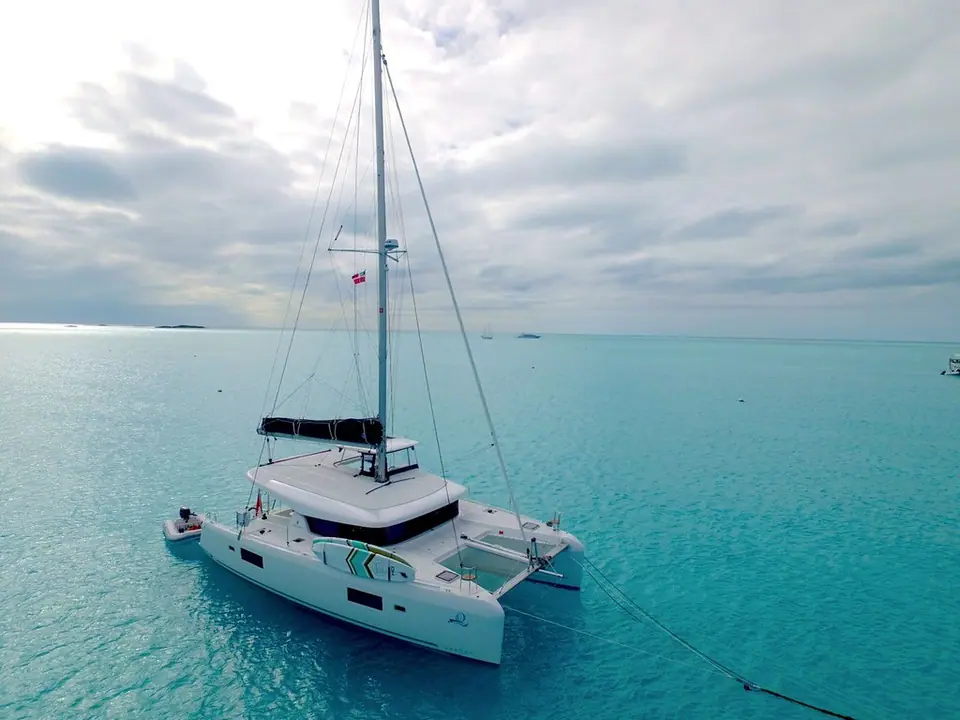
- Length
- 42 ft12.8 m
- Beam
- 25.3 ft7.7 m
- Draft
- 4.1 ft1.24 m
- Cabins
- 3 or 4
- Used price
- $340K to $600K
On this page
- Overview
- Why there is always a Lagoon 42 for sale
- What VPLP got right on a 42-foot platform
- Sea trial numbers, under sail and power
- Owner's version or four cabin charter boat
- Two numbers that catch out US buyers, tankage and air draft
- How to read a Lagoon 42 listing like a broker
- What a Lagoon 42 costs each year
- Values, the current Millennium boat and long-term resale
- Specifications
- Price and value
- Strengths and weaknesses
- Used buyer checklist
- Rivals
- Our verdict
- FAQ
A 42-foot VPLP catamaran built in France since 2016, Lagoon's best-selling model with over 1,000 delivered by 2023. Deep used market, strong values, light standard tankage.
- Couples looking for a liquid, easy-to-resell catamaran
- Charter management buyers
- Families who need four cabins
- Caribbean and Bahamas seasonal cruisers
Why there is always a Lagoon 42 for sale
Search any brokerage site for a Lagoon 42 for sale and you will rarely find fewer than a dozen boats in US waters alone. That is not a sign of trouble. The Lagoon 42 has been in production since 2016, Lagoon delivered the 1,000th hull in October 2023, and it has taken over from the Lagoon 380 and the Lagoon 450 as the brand's best-selling boat. A big share of those hulls went into charter fleets, and they flow steadily onto the used market after five or six years of service.
For a buyer, that volume is leverage. You can compare a dozen near-identical boats on price, equipment and history, and you can walk away from a weak survey without losing your only option. The trick is knowing which differences actually matter, because two Lagoon 42s of the same year can be $100,000 apart for good reasons.
Lagoon 42 by the numbers
- Sail area to displacement
- 20.2Plenty of sail for the weight, the boat should feel lively in light air.
- Displacement to length
- 171Light displacement for its length, quick but sensitive to added cruising weight.
- Theoretical hull speed
- 8.6 knDisplacement hull speed for the waterline. Light catamarans regularly sail faster than this because their slim hulls do not make a large bow wave.
- Length to beam ratio
- 1.66 : 1Catamaran overall proportions. Wider platforms resist pitching and heel.
What VPLP got right on a 42-foot platform
The Lagoon 42 carries its mast well aft, a layout VPLP also used on the Lagoon 40, 46 and 50 that followed it. With the mast closer to the middle of the boat, pitching drops, the boom shortens and the self-tacking jib sits in a larger foretriangle. Upwind sail area is about 1,119 square feet, with a 743-square-foot mainsail and an optional 732-square-foot Code 0 for light air.
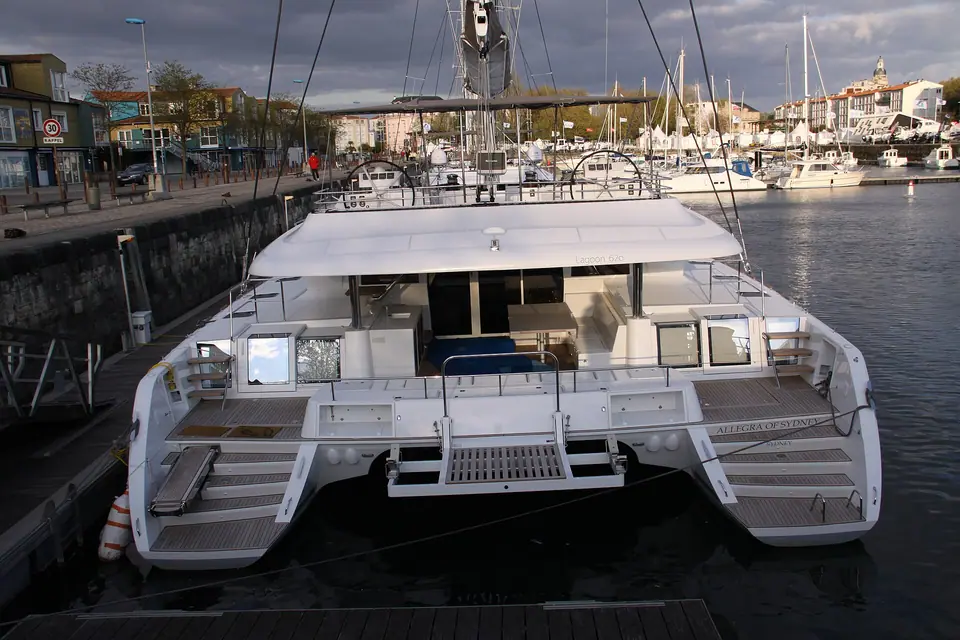
Hull dimensions are 42 feet overall, a 41-foot waterline and 25 feet 3 inches of beam, with a draft of just over 4 feet. Light displacement is about 26,000 pounds, kept in check by infused, balsa-cored construction. Patrick le Quément gave it the squared transoms and vertical-window coachroof that defined Lagoon styling for the next decade, and Nauta Design handled the interior.
Sea trial numbers, under sail and power
In a test on Biscayne Bay in light air, a Lagoon 42 made 6.1 knots at 50 degrees apparent in 11.6 knots of breeze, and 7 knots with the Code 0 in about 10 knots of wind at 75 degrees apparent. The same reviewer later reported 15 knots of boat speed with a spinnaker in 22 knots of true wind on flat water off Bimini. That spread tells you a lot: the 42 is ordinary in very light air without a Code 0, and genuinely quick once the breeze fills in.
Under power, the optional twin 57 hp Yanmars delivered 7.8 knots at 2,000 rpm, about 8.1 knots at 2,400 rpm, and 8.7 knots at 3,200 rpm, which was wide open throttle. The standard engines are 45 hp Yanmar 4JH45s, and they are fine for most coastal use. The 57s are worth a premium if you plan long motoring legs into a headwind or regular passages in open water.
Owner's version or four cabin charter boat
The three cabin owner's layout gives one hull to a master suite with an island berth aft, a desk or sofa amidships and a large head forward, and puts two guest cabins with their own heads in the other hull. It is the layout most private buyers want, and it holds a premium of several tens of thousands of dollars on the used market.
The four cabin version, with either two or four heads, dominates charter fleets. It is the easiest boat to resell into another charter program, but for a couple living aboard it wastes space that could have been storage. If you need four cabins for a family, look for a privately ordered four cabin boat rather than an ex-charter one, since it will typically have better equipment and lighter wear.
Reviewers flagged a few small design flaws that remain true of most used boats: a top-loading fridge awkwardly close to the companionway steps, limited ventilation in the saloon with no overhead hatch, and a coachroof edge without proper handholds or nonskid. All are fixable with small upgrades, but they are worth seeing for yourself on a viewing.
- 3 cabins, 3 heads: owner's version for couples and liveaboards
- 4 cabins, 2 heads: classic charter compromise, most common used
- 4 cabins, 4 heads: maximum privacy, least storage
Two numbers that catch out US buyers, tankage and air draft
Standard tankage is light for a 42-foot cruiser: about 79 gallons of diesel and 79 gallons of water. SAIL magazine's test called the tankage light and noted that owners who want to venture farther will need to increase both. For extended cruising, check whether the boat has had extra fuel capacity added and a watermaker fitted, because without them the boat is effectively a coastal cruiser that needs regular dock stops.
The other number is air draft. The Lagoon 42 stands nearly 68 feet above the waterline, which is too tall for the 65-foot fixed bridges on the Atlantic Intracoastal Waterway. East Coast owners have to make outside passages between inlets rather than motoring the ditch, which is a real consideration if you plan to migrate seasonally between New England, the Chesapeake and Florida. If ICW access matters, look at the shorter-masted Lagoon 40 instead.
How to read a Lagoon 42 listing like a broker
Start with history. A boat that spent five years in a charter base will have high engine hours, worn interior joinery and tired upholstery, but it will also have a documented maintenance trail from a professional fleet. A privately owned boat with low hours can be a better buy, or a worse one if it sat unused in the tropics with systems that were never exercised.
Next look at equipment. Generator, air conditioning, lithium batteries, solar, a watermaker, an electric winch at the helm and upgraded electronics can easily add up to $80,000 to $120,000 of value. A cheaper boat without them is not a bargain unless you were planning to choose those systems yourself.
Finally look at location and tax status. Many Lagoon 42s are listed in the BVI, Martinique or the Mediterranean. Factor in US import duty, a delivery or shipping cost and the time to bring the boat home before comparing it with a duty-paid boat already in Florida or the Chesapeake.
What a Lagoon 42 costs each year
Plan on about $30,000 to $60,000 per year in the US, excluding depreciation, for insurance, a slip, a haul-out, engine and saildrive service, canvas, and steady upgrades. At over 25 feet wide, the Lagoon 42 almost always needs a double slip or an end tie, and in busy markets like South Florida that alone can exceed the rest of the maintenance budget.
The mechanical side is straightforward: two four-cylinder Yanmars, saildrives, a generator on most boats and a simple fixed-keel hull. Saildrive diaphragms have a fixed replacement interval regardless of hours, so verify when they were last done.
Values, the current Millennium boat and long-term resale
The Lagoon 42 has held its value well. Early boats from 2016 and 2017 often ask $340,000 to $440,000, close to what their first owners paid with options, while 2021 to 2024 boats ask roughly $450,000 to $650,000. Recorded sales cluster around a median of about $499,000.
Lagoon still builds the boat, now marketed as the Lagoon 42 Millennium, and new sail-away prices with a realistic option list run roughly $650,000 to $850,000. Continued production and a huge owner base protect resale, because buyers know parts, service and know-how will stay available for decades.
Lagoon 42 specifications
| Length overall | 42 ft12.8 m |
|---|---|
| Waterline length | 41 ft12.5 m |
| Beam | 25.3 ft7.7 m |
| Draft | 4.1 ft1.24 m |
| Displacement | 26,46 lbs12,002 kg |
| Sail area | 1,119 sq ft104 m² |
| Fuel capacity | 79 gal3 L |
| Fresh water | 79 gal3 L |
| Cabins | 3 or 4 |
| Berths | 6 to 10 |
| Heads | 2 to 4 |
| Standard engines | 2 x Yanmar 4JH45 45 hp diesel with saildrives |
| Optional engines | 2 x Yanmar 57 hp diesel with saildrives |
| Maximum power | 114 hp |
| Cruise speed | 7.8 knots |
| Top speed | 8.7 knots |
| Hull type | Catamaran, twin hulls |
| Keel | Twin fixed keels |
| Rig | Fractional sloop, mast stepped aft, self-tacking jib, optional square-top mainsail and Code 0 |
| Hull construction | Infused polyester and balsa sandwich |
| Builder | Lagoon (Groupe Beneteau), France |
| Naval architect | VPLP Design |
| Other design credits | Patrick le Quément (exterior styling), Nauta Design (interior) |
| Production | 2016 to present |
| Status | In production |
Figures come from builder documentation and independent tests where available. Displacement is usually quoted light, so a loaded cruising boat will weigh more. Compare these specs with another model.
Performance data
| RPM | Speed (kn) |
|---|---|
| 2000 | 7.8 |
| 2400 | 8.1 |
| 3200 | 8.7 |
Twin optional 57 hp Yanmar diesels with saildrives and folding propellers, Miami sea trial reported by SAIL magazine. Fuel burn was not published.
How much does a Lagoon 42 cost?
Launch base price in 2016 was about $340,000 with roughly $120,000 of typical options on top, which is why early boats now trade near their original sticker. The biggest price drivers are charter history, engine size, generator and air conditioning, and whether extra fuel capacity and a watermaker have been added. Recorded sales cluster around a median of roughly $499,000, and the current production boat sells new as the Lagoon 42 Millennium.
Estimate your yearly cost
A planning estimate using common rules of thumb: insurance near 1.5 percent of value, maintenance near 3 percent, haul out and bottom paint by length. Your marina, region and use will move these numbers. Open the full cost calculator.
Lagoon 42 timeline
- 2016Lagoon 42 launched with an aft-stepped mast and self-tacking jib
- 2017Becomes a staple of charter fleets in the Caribbean and Mediterranean
- 2019The aft-mast concept spreads to the Lagoon 46 and the rest of the range
- 2023Lagoon delivers the 1,000th Lagoon 42 in October
- 2025Still in the range as the Lagoon 42 Millennium
Strengths and weaknesses
What owners like
- Largest used supply of any 42-foot cruising catamaran
- Self-tacking jib and aft mast make two-handed sailing easy
- Quick in a breeze, especially with a Code 0 or spinnaker
- Still in production, so parts and support are secure
- Strong resale values and liquid market
What to weigh up
- Light standard fuel and water tankage
- Air draft of nearly 68 feet blocks the ICW
- Ordinary light-air performance without a Code 0
- Charter boats show heavy interior wear
- Saloon ventilation and coachroof handholds are weak points
Used Lagoon 42 buyer checklist
Take this list to a viewing. Your ticks are saved in this browser so you can come back to it.
Always commission an independent marine survey and an engine survey before you buy. How a marine survey works.
Rivals to consider
Leopard 45
Larger, with a forward cockpit and huge water capacity, typically priced higher on the used market.
Compare side by sideFountaine Pajot Isla 40
A smaller, newer design that competes on price with late-model 42s.
Compare side by sideLagoon 40
Shorter mast that clears ICW bridges and costs less, but with less interior volume.
Compare side by sideBali 4.6
More open-plan living space and a solid foredeck, a different take for buyers who value room over tradition.
Compare side by sideOur verdict on the Lagoon 42
The Lagoon 42 is the safe, liquid choice in the 40 to 45 foot cruising catamaran market. It sails better than its looks suggest once there is some breeze, it is easy for two people to run, and the sheer number of boats means you can be selective. Buy a privately owned three cabin boat with the 57 hp engines, extra fuel tank and a watermaker if you can find one, and accept that the mast height will keep you outside on the East Coast.
Lagoon 42 questions answered
How much does a Lagoon 42 cost?
Used Lagoon 42s for sale typically ask from about $340,000 for early ex-charter boats to around $600,000 or more for recent privately owned boats. New boats sail away for roughly $650,000 to $850,000 depending on options.
How many Lagoon 42 catamarans have been built?
Lagoon delivered the 1,000th Lagoon 42 in October 2023, and the model remains in production.
Can a Lagoon 42 use the Intracoastal Waterway?
Not along the full route. Its air draft of nearly 68 feet is too tall for the 65-foot fixed bridges, so East Coast owners make outside passages.
How fast is a Lagoon 42 under power?
With the optional 57 hp engines, test boats cruised at 7.8 knots at 2,000 rpm and reached 8.7 knots at 3,200 rpm.
What is the Lagoon 42 fuel capacity?
Standard fuel capacity is 79 gallons (300 liters), with the same 79 gallons of fresh water, figures SAIL magazine described as light for a cruising boat.
Is the Lagoon 42 good for charter?
Yes. Its four cabin layout made it one of the most popular charter catamarans in the world, which also keeps resale demand strong.
Lagoon 42 photos
More sailing catamarans to explore
Bali 4.2
Sailing Catamarans, 42 ft
Used $400K to $620K
Leopard 44
Sailing Catamarans, 43 ft
Used $300K to $430K
Catana 42
Sailing Catamarans, 41 ft
Used $360K to $520K
Catana 431
Sailing Catamarans, 43 ft
Used $220K to $360K