Excess Catamarans Sailing Catamarans
Excess 14 Catamaran, Specifications and Sailing Review
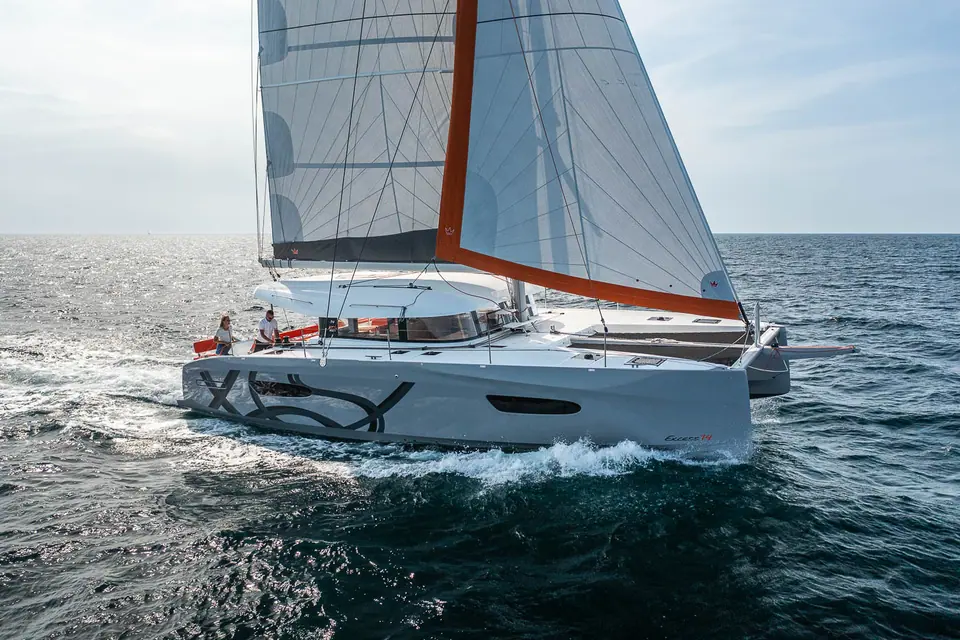
A VPLP-designed 46-footer from Groupe Beneteau with aft helms, asymmetric hulls and an optional Pulse Line rig, built for owners who actually want to sail.
- Length
- 45.8 ft13.97 m
- Beam
- 25.8 ft7.87 m
- Draft
- 4.8 ft1.48 m
- Cabins
- 3 or 4
- Used price
- $540K to $800K
On this page
- Overview
- Why Beneteau created Excess and where the 14 fits
- Excess 14 catamaran specifications, explained
- Asymmetric hulls and deeper rudders from VPLP
- Twin aft helms and the low boom
- Measured speeds from Biscayne Bay to a Cannes delivery
- Owner versions, charter boats and the transformer cabin
- Price, resale and running costs
- Specifications
- Price and value
- Strengths and weaknesses
- Used buyer checklist
- Rivals
- Our verdict
- FAQ
The Excess 14 premiered at Cannes in 2022 as a sail-first cruising catamaran from Beneteau's Excess brand. Twin aft helms, 28,219 lb light, 3 or 4 cabins, standard or taller Pulse Line rig.
- Couples who sail short-handed
- Monohull sailors moving to a cat
- Owners planning offshore passages
- Buyers who want steering feel
Excess 14 by the numbers
- Sail area to displacement
- 22.8Plenty of sail for the weight, the boat should feel lively in light air.
- Displacement to length
- 153Light displacement for its length, quick but sensitive to added cruising weight.
- Theoretical hull speed
- 8.8 knDisplacement hull speed for the waterline. Light catamarans regularly sail faster than this because their slim hulls do not make a large bow wave.
- Length to beam ratio
- 1.78 : 1Catamaran overall proportions. Wider platforms resist pitching and heel.
Why Beneteau created Excess and where the 14 fits
Groupe Beneteau already owned Lagoon, the biggest catamaran brand in the world, when it presented Excess at the Dusseldorf boat show in 2019 with the Excess 12 and 15, two models SAIL describes as modified Lagoon designs. The pitch was simple: catamarans for people who enjoy sailing, with aft helms, lower booms and livelier rigs, aimed at owners who found Lagoons too much like floating apartments. Multihulls World describes the brand as deliberately more performance and sailing focused than its sister company.
After Beneteau revamped the brand's management and messaging, the all-new Excess 11 arrived, and the Excess 14 catamaran followed at the Cannes Yachting Festival in 2022 with a from-scratch VPLP hull. The design team was led by Thibaut de Montvalon, with product manager Herve Piveteau, who previously worked on the Sun Fast range of offshore racers. Today the 14 is the flagship of a range that also includes the Excess 11 and 13.
Excess 14 catamaran specifications, explained
The headline numbers are 45 feet 9 inches overall on 43 foot 9 inch hulls, 25 feet 9 inches of beam and 4 feet 10 inches of draft. Light displacement is 12,800 kilograms (28,219 pounds), roughly 2,500 to 10,000 pounds lighter than many 45 to 47 foot charter cats. With the optional bowsprit and platform extensions, maximum length grows to 16.46 meters (54 feet), which matters for marinas that measure every inch.
The standard rig carries an 83 square meter square-top mainsail and a 40 square meter overlapping genoa, 1,323 square feet upwind, with a 72 square meter Code 0 optional. The Pulse Line adds about 6 feet of mast and 130 square feet of upwind area for 1,453 square feet, and extends the profile by 1.7 meters with a bowsprit a meter longer. Mast clearance is listed at 64 feet 11 inches standard and 70 feet 8 inches with the Pulse rig. East Coast owners should note that the Pulse rig rules out the 65 foot fixed bridges of the Intracoastal Waterway, and even the standard rig leaves almost no margin once a masthead antenna is fitted.
- Fuel 2 x 200 liters (106 US gal total)
- Fresh water 300 liters (79 US gal), per builder data
- Black water 2 x 80 liters
- CE Category A for 10 people
Asymmetric hulls and deeper rudders from VPLP
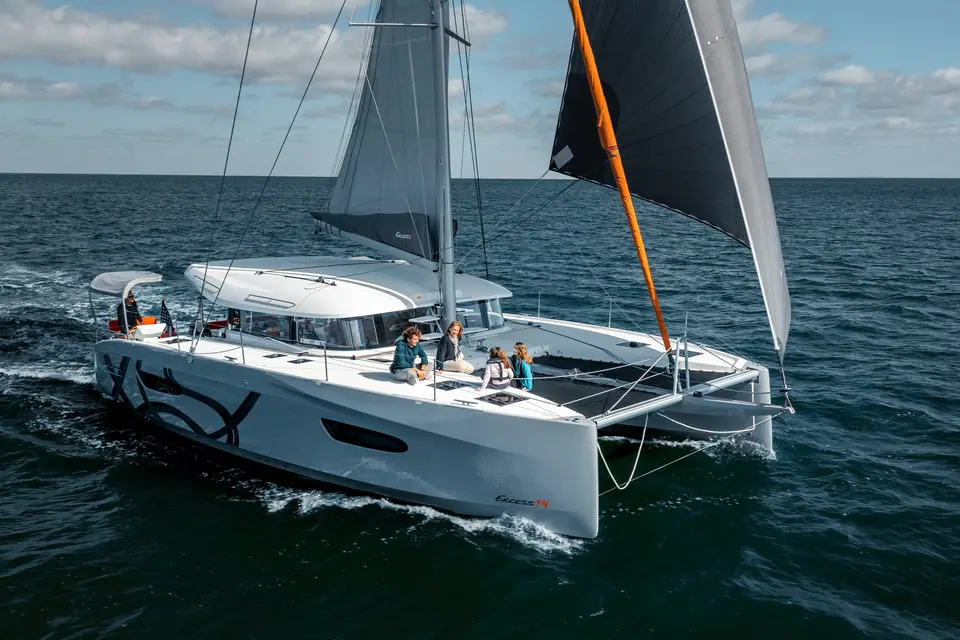
VPLP gave the Excess 14 asymmetric hulls, fuller on the outboard side and flatter inboard. SAIL explains that this moves the center of buoyancy outboard for more stability and reduces interference drag between the hulls. The bows are inverted and stand clear of the surface, the bridgedeck is raised for clearance, and the rudders are 8 inches deeper than on earlier Excess models for better grip and pointing. The mast is stepped well forward.
The raised bridgedeck helps, but it does not eliminate slamming. Owner and review summaries mention wave slap under the bridgedeck in short, steep chop, which is typical of catamarans in this size range and worth feeling on a sea trial in real conditions.
Twin aft helms and the low boom
The Excess 14's defining feature is its pair of helm stations at the aft end of each hull, a layout the builder calls new to the market at launch. The wheels sit right above the rudders with direct cable steering, so the boat feels like a big performance cat rather than a condominium steered by hydraulics. SAIL found visibility excellent forward and aft and fair when sighting through the saloon windows to the opposite bow.
The boom is low, so reefing and sail handling happen from the cockpit roof without climbing, though the low boom also limits use of the sky lounge on top while sailing. The one oddity SAIL flagged is the absence of a fixed compass at either wheel or at the nav desk, so you will want a hand-bearing compass or a retrofit.
Measured speeds from Biscayne Bay to a Cannes delivery
Yachting World sailed the boat across three sessions. In 12 to 14 knots it made 7.4 to 8.0 knots upwind, 7.3 knots under Code 0 in 8 to 12 knots, and 7 to 8.5 knots under asymmetric spinnaker, with a best of 10.3 knots. The delivery crew reported 16.5 knots. Testers also noted that it is not a boat for sustained upper-teen speeds, and that in light air it lags slightly behind comparable performance monohulls. Listing summaries add that it loses speed fast if pinched below about 10 knots of breeze.
SAIL's Miami test in a 6.6 knot true breeze on flat water saw 5.5 knots at 70 degrees apparent, and the boat pointed to 40 degrees apparent, encouraging the reviewer to suggest it would sail at wind speed in 10 knots or more. Under power with the optional 57 hp Yanmars, SAIL logged 7.9 knots at 2,300 rpm and 8.4 knots at wide open throttle of 2,860 rpm. Multihulls World's 36-hour delivery from Cannes to Genoa in 8 to 25 knots added confidence in its offshore manners.
Owner versions, charter boats and the transformer cabin
The charter configuration has four cabins, four heads and four separate showers. Owner versions give the starboard hull to a master suite with a large aft stateroom, desk or dressing table and a midships washroom, and Excess offers a so-called transformer cabin in the forepeak with fold-up twin bunks and folding platforms, so the space can switch between guest berths and storage.
Water is the one capacity to watch. Builder data shows just 300 liters (79 gallons) of fresh water, so a watermaker is essential for anyone cruising beyond a weekend.
Price, resale and running costs
Yachting World quoted a UK base price of 436,153 pounds excluding VAT, with the test boat at 615,019 pounds. In the US, expect sail-away figures roughly between $700,000 and $950,000. Used boats are still scarce; the one 2023 owner's version on the market at the time of writing asked $569,000, a price that reflects the thin market as much as depreciation.
Annual costs of $40,000 to $75,000 cover a catamaran slip for a 25 foot 9 inch beam, insurance, a yearly haul and engine service. Beneteau's dealer network gives Excess owners good parts support for Yanmar engines and rigging, an advantage over smaller performance cat builders.
Excess 14 specifications
| Length overall | 45.8 ft13.97 m |
|---|---|
| Beam | 25.8 ft7.87 m |
| Draft | 4.8 ft1.48 m |
| Air draft | 64.9 ft19.78 m |
| Displacement | 28,219 lbs12,8 kg |
| Sail area | 1,323 sq ft123 m² |
| Fuel capacity | 106 gal4 L |
| Fresh water | 79 gal3 L |
| Cabins | 3 or 4 |
| Berths | 6 to 12 |
| Heads | 3 or 4 |
| Maximum persons | 10 |
| Standard engines | 2 x Yanmar 45 hp diesel with saildrives |
| Optional engines | 2 x Yanmar 57 hp diesel |
| Maximum power | 114 hp |
| Cruise speed | 7.9 knots |
| Top speed | 8.4 knots |
| Hull type | Catamaran with asymmetric hulls, inverted bows and raised bridgedeck |
| Keel | Twin fixed stub keels with deep rudders |
| Rig | Fractional sloop with square-top mainsail and overlapping genoa; taller Pulse Line rig optional |
| Hull construction | Infused polyester sandwich |
| CE design category | A |
| Builder | Excess Catamarans (Groupe Beneteau), France |
| Naval architect | VPLP Design |
| Other design credits | Thibaut de Montvalon (Excess design lead), Herve Piveteau (product manager) |
| Production | 2022 to present |
| Status | In production |
Figures come from builder documentation and independent tests where available. Displacement is usually quoted light, so a loaded cruising boat will weigh more. Compare these specs with another model.
How much does a Excess 14 cost?
Yachting World's test listed a UK base price of 436,153 pounds before VAT and 615,019 pounds as tested, so US sail-away prices land roughly between $700,000 and $950,000 depending on rig, engines and electronics. The used market is thin because the boat is young; a 2023 three cabin owner's version, hull number 6, listed in Grenada at $569,000. Pulse Line rigs and 57 hp engines are the options that matter most at resale.
Estimate your yearly cost
A planning estimate using common rules of thumb: insurance near 1.5 percent of value, maintenance near 3 percent, haul out and bottom paint by length. Your marina, region and use will move these numbers. Open the full cost calculator.
Versions and options
- Excess 14 standard rig
- 1,323 sq ft upwind, mast clearance 64 ft 11 in, 45 ft 9 in LOA.
- Excess 14 Pulse Line
- About 6 ft taller mast, 1,453 sq ft upwind, longer bowsprit and 70 ft 8 in mast clearance.
Excess 14 timeline
- 2019Groupe Beneteau presents the Excess brand at Dusseldorf with the Excess 12 and 15, both derived from Lagoon designs
- 2021The Excess 11, the first Excess built on an all-new hull, joins the range
- 2022Excess 14 premieres at the Cannes Yachting Festival with a VPLP hull and twin aft helms
- 2023US debut at the Miami boat show in February; SAIL and Yachting World tests published
- 2026Flagship of the Excess range alongside the Excess 11 and 13
Strengths and weaknesses
What owners like
- Twin aft helms with direct cable steering give real feel
- Light 28,219 lb displacement and powerful square-top rig
- Optional Pulse Line rig for more light air power
- Points to 40 degrees apparent in light air
- Beneteau group backing for parts and dealers
What to weigh up
- Only 79 gallons of fresh water standard
- Wave slap under the bridgedeck in short chop
- No fixed compass at the helms or nav desk
- Low boom limits sky lounge use underway
- Pulse Line mast too tall for 65 foot ICW fixed bridges
Used Excess 14 buyer checklist
Take this list to a viewing. Your ticks are saved in this browser so you can come back to it.
Always commission an independent marine survey and an engine survey before you buy. How a marine survey works.
Rivals to consider
Nautitech 46 Open
The closest concept, with aft helms and an open saloon, slightly more cruising volume.
Compare side by sideFountaine Pajot Elba 45
Heavier and roomier with a bulkhead helm, less steering feel but more liveaboard capacity.
Compare side by sideLagoon 46
Its Beneteau group sibling, much more volume and a flybridge, but heavier and slower.
Compare side by sideOutremer 51
A true performance cruiser with daggerboards, faster and far more expensive.
Compare side by sideOur verdict on the Excess 14
The Excess 14 is the production catamaran for sailors who were never convinced by production catamarans. Its aft helms, light displacement, deep rudders and square-top rig make it genuinely fun to steer, it points like few cruising cats, and the Pulse Line gives it extra light air punch. It asks you to accept less water capacity, some bridgedeck slap and less volume than a Lagoon or Bali. If you care how the boat sails, that is a trade worth making.
Excess 14 questions answered
What are the Excess 14 catamaran specifications?
45 ft 9 in LOA, 25 ft 9 in beam, 4 ft 10 in draft, 28,219 lb light displacement, 1,323 sq ft upwind sail area (1,453 with Pulse Line) and twin 45 or 57 hp Yanmars.
How much does an Excess 14 cost?
US sail-away prices run roughly $700,000 to $950,000 new. A 2023 owner's version recently listed at $569,000.
What is the Excess 14 Pulse Line?
It is the performance rig option, with a mast about 6 feet taller, a longer bowsprit and 1,453 sq ft of upwind sail area.
How fast is the Excess 14?
Tests recorded 7.4 to 8 knots upwind in 12 to 14 knots of wind and a best of 10.3 knots, with a delivery crew reporting 16.5 knots.
Who designed the Excess 14?
VPLP Design drew the hull, working with the Excess team led by Thibaut de Montvalon.
Where are the helms on the Excess 14?
There are two wheels at the aft end of each hull, with direct cable steering to the rudders.
Excess 14 photos
More sailing catamarans to explore
Fountaine Pajot Saona 47
Sailing Catamarans, 46 ft
Used $560K to $800K
Lagoon 450
Sailing Catamarans, 46 ft
Used $250K to $580K
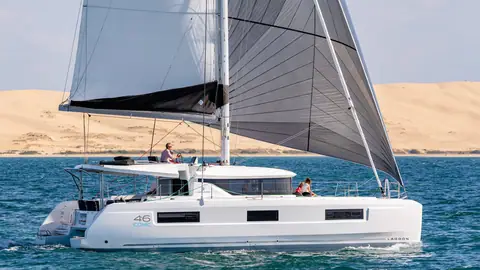
Lagoon 46
Sailing Catamarans, 46 ft
Used $620K to $950K
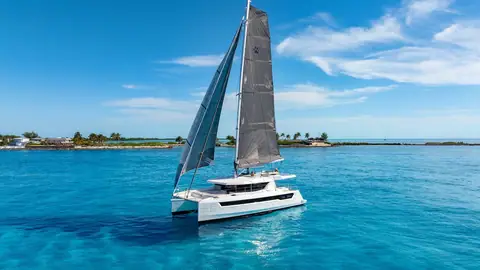
Leopard 46
Sailing Catamarans, 46 ft
Used $300K to $1M