Seawind Catamarans Sailing Catamarans
Seawind 1370 Review, Specs and Price for a Bluewater Couple's Cat
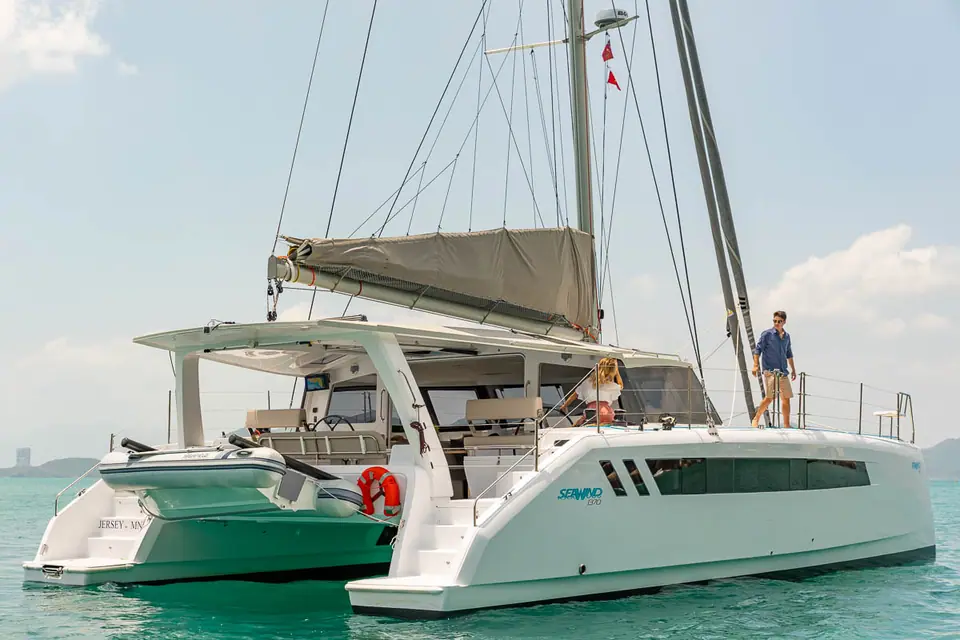
Seawind's 45 footer brings the galley up, keeps the twin protected helms and trifold door, and sold 90 hulls before the first one launched.
- Length
- 45 ft13.7 m
- Beam
- 24.9 ft7.59 m
- Draft
- 4.3 ft1.3 m
- Cabins
- 3 (owner's hull to port, double aft and a smaller forward cabin to starboard)
- Used price
- $850K to $1.1M
On this page
- Overview
- The Seawind catamaran that sold out before launch
- Ward's concept, French hull modeling
- Mini keels that still point to 38 degrees
- Twin protected helms and the trifold door
- Galley up, single level, and a real nav desk
- An owner's hull to port and flexible space to starboard
- Yanmar 40s or 57s and a 24 volt electrical system
- Base price, the real price and ownership costs
- Specifications
- Price and value
- Strengths and weaknesses
- Used buyer checklist
- Rivals
- Our verdict
- FAQ
The Seawind 1370 is a 45 ft cruising catamaran designed by Richard Ward with The Yacht Design Collective and built by Seawind in Vietnam since 2023. It won SAIL's Top 10 Best Boats and Cruising World's midsize multihull award for 2025 and starts at $820,000.
- Liveaboard cruising couples
- Bluewater passages without daggerboard complexity
- Owners moving up from a Seawind 1160 or 1260
The Seawind catamaran that sold out before launch
Seawind has always marketed its boats to what it calls real sailors, and the Seawind 1370 is the clearest expression of that idea so far. Seawind's sales and marketing manager told SAIL the company took 90 orders before the first boat was launched in 2023, and by 2025 it was booking production out to 2028. Owners formed a WhatsApp community to compare upgrades before their boats even existed.
The awards confirmed the hype. SAIL named the 1370 one of its Top 10 Best Boats for 2025, and Cruising World's judges named it the 2025 Best Midsize Multihull, ahead of the new Lagoon 43 and the Vision 444 ES. Nearly two decades earlier, the Seawind 1160 had won Cruising World's multihull category, and many of the details that judges praised then are still on the 1370.
Seawind was founded by Australian Richard Ward, who began with beach cats in 1982 and launched his first cruising model, the 850, in 1991. In 2010 Seawind bought Corsair Marine and moved production to a large plant in Ho Chi Minh City, Vietnam, where the 1370 is built. Cruising World also notes a newer Seawind facility in Turkey.
Seawind 1370 by the numbers
- Sail area to displacement
- 23.8Plenty of sail for the weight, the boat should feel lively in light air.
- Displacement to length
- 119Ultralight. Built for speed, keep payload to a minimum.
- Theoretical hull speed
- 9.0 knDisplacement hull speed for the waterline. Light catamarans regularly sail faster than this because their slim hulls do not make a large bow wave.
- Length to beam ratio
- 1.81 : 1Catamaran overall proportions. Wider platforms resist pitching and heel.
Ward's concept, French hull modeling
Richard Ward drew the boat, but for the hull shape Seawind brought in The Yacht Design Collective, the French duo François Pérus and Romain Scolari, to model the hulls by computer for performance. The result has sharp reverse bows with a fine entry, hard chines that add volume to the cabins, and fully integrated mini keels with spade rudders instead of daggerboards.
Construction is vinylester infusion over PVC foam, reinforced with carbon and Kevlar, and the layup is lean. SAIL's preview gave a displacement of 24,250 lb, while its later review quoted about 27,000 lb, presumably with gear aboard. Either way the 1370 is light for a 45 foot fixed-keel cruising cat, which is why it sails so well. The aluminum mast is set farther aft than usual to reduce pitching, which lengthens the foredeck and shrinks the forward cockpit area.
Mini keels that still point to 38 degrees
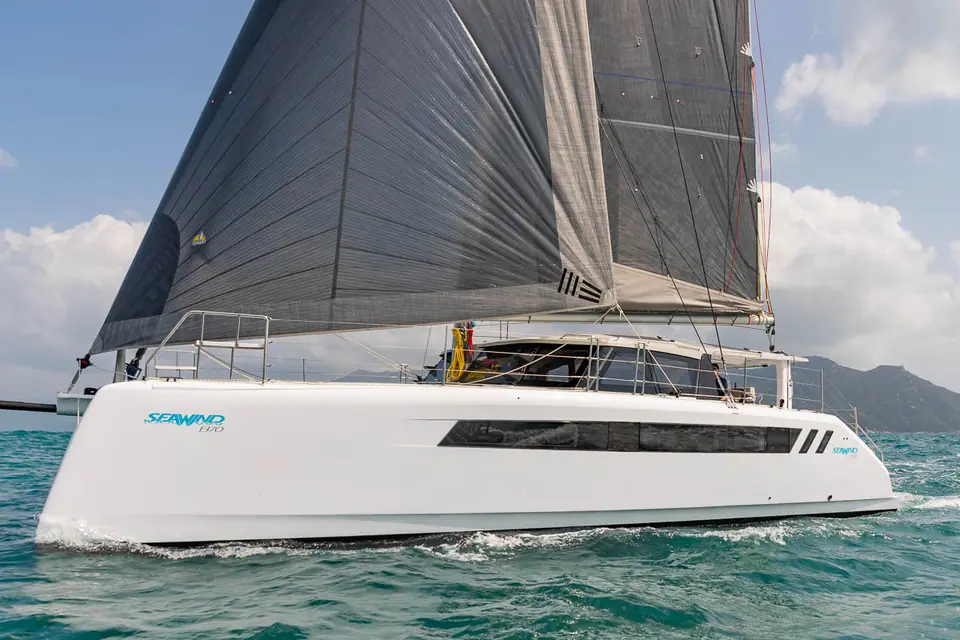
The argument for daggerboards is pointing ability. The 1370's test results make a strong case that well-designed fixed keels can come close. SAIL sailed with the square-top main and self-tacker at 38 degrees apparent and held 6.4 knots, and Cruising World made about 6 knots at just under 40 degrees off the wind. With only a partially hoisted asymmetric and no main, SAIL still made 7.2 knots in 9.2 knots of true wind on a beam reach, 78 percent of wind speed, and 8.3 knots at 125 degrees in 12 knots of breeze. Cruising World hit close to 9 knots on a broad reach under spinnaker.
The standard sail plan is a solent arrangement of full-batten square-top main and self-tacking jib, about 1,248 sq ft together, plus a screecher on a furler. With both headsails furling, changing gears short-handed is easy, and all lines lead aft to the cockpit, where electric Harken winches are optional.
Twin protected helms and the trifold door
Every Seawind has the same helm philosophy, and the 1370 refines it. Twin Carbonautica wheels are mounted on the aft bulkheads of the cabinhouse, either side of the cockpit, protected by the hardtop above and the saloon ahead. Removable or drop-down windows in front of each wheel give a view through the saloon to the bows, overhead skylights show the main, and you can sit outboard on the coaming for a clear look at the jib telltales. The test boat had engine controls and 12 inch B&G plotters at both helms, which makes docking easy.
Between saloon and cockpit is Seawind's trademark trifold door, which folds up and stows under the hardtop using a winch, with carbon in the hinge to save weight. With it raised, the whole main deck is open. The cockpit has a full-width transom bench with storage underneath, a sink to starboard and a stainless barbecue to port, and the helm seats are wide enough for two with backrests that flip to face aft.
Galley up, single level, and a real nav desk
Seawind's smaller models put the galley down in a hull. The 1370 borrows the galley-up arrangement of the larger Seawind 1600: a U-shaped counter in the aft starboard corner of the saloon with a sink facing aft, a three-burner stove (an induction cooktop on Cruising World's test boat) and oven, drawer refrigeration and a 130 liter upright fridge. A breakfast bar extends from the galley into the cockpit. Judges liked the many bracing points for cooking underway.
There are no steps between cockpit, saloon and galley, which makes moving around safer. A forward-facing nav desk in the starboard forward corner is a proper watchkeeping station, and SAIL praised Seawind for recognizing that ocean sailors need a dedicated place for ship's business. To port, an L-shaped settee surrounds a swiveling table that lowers to form a lounge or sea berth. Finishes in light ash and bird's-eye maple impressed both magazines.
An owner's hull to port and flexible space to starboard
The owner's suite fills the port hull, with a raised athwartships queen berth amidships, where motion is least, a vanity, a large head and shower aft that Cruising World called best in class, and a walk-in closet in the forepeak behind a watertight bulkhead. The starboard hull has a double aft, a head and shower amidships and a fore-and-aft berth forward, with the forepeak available for another berth or stowage, bringing sleeping space to nine.
Seawind's standard specification lists a 600 liter (about 158 gallon) fresh water tank, 520 liters (about 137 gallons) of fuel in two tanks, and holding tanks of 120 and 100 liters.
Yanmar 40s or 57s and a 24 volt electrical system
Standard power is twin 40 hp Yanmar saildrive diesels, with 57 hp Yanmars optional. SAIL's boat had the 57s with Gori folding propellers and found an easy cruise of 6.8 knots at 1,800 rpm. The 1370 runs on 24 volts, with four gel batteries standard and lithium optional. Seawind left out the generator on the test boat; with high-output alternators, four Mastervolt lithium batteries totaling 920 Ah and up to 1,930 watts of solar on the hardtop, SAIL's reviewer said you could run air conditioning all night and still wake up with power. Cruising World's boat carried 2.5 kW of solar.
Base price, the real price and ownership costs
Seawind's base price is $820,000. The Annapolis test boat, with the bigger engines, Corian counters, lithium, solar and electric winches, came to about $1.15 million, which SAIL said is right in the ballpark of its competitors. Expect most US boats to fall between those figures depending on options.
Annual costs of roughly $38,000 to $75,000 are realistic in the US, driven by a 24 ft 11 in beam slip, insurance for offshore cruising and normal maintenance. Skipping the generator and running a lithium and solar system lowers maintenance and fuel costs compared with many cats of this size.
Seawind 1370 specifications
| Length overall | 45 ft13.7 m |
|---|---|
| Waterline length | 45 ft13.7 m |
| Beam | 24.9 ft7.59 m |
| Draft | 4.3 ft1.3 m |
| Air draft | 70.8 ft21.58 m |
| Displacement | 24,25 lbs11, kg |
| Sail area | 1,248 sq ft116 m² |
| Fuel capacity | 137 gal52 L |
| Fresh water | 158 gal6 L |
| Cabins | 3 (owner's hull to port, double aft and a smaller forward cabin to starboard) |
| Berths | Up to 9 with the forepeak berth fitted |
| Heads | 2, each with shower |
| Standard engines | 2 x Yanmar 40 hp diesel with saildrives |
| Optional engines | 2 x Yanmar 57 hp diesel with saildrives |
| Maximum power | 114 hp |
| Cruise speed | 6.8 knots |
| Hull type | Wave-piercing, reverse-bow cruising catamaran with hard chines and 2 ft 9 in bridgedeck clearance |
| Keel | Twin integrated mini keels with spade rudders |
| Rig | Fractional sloop, double-spreader aluminum mast, square-top full-batten main, self-tacking jib on a curved track and furling screecher on a composite sprit |
| Hull construction | Infused vinylester over PVC foam core with carbon and Kevlar reinforcement |
| Builder | Seawind Catamarans, Vietnam (Ho Chi Minh City), with an additional facility in Turkey |
| Naval architect | Richard Ward with The Yacht Design Collective (François Pérus and Romain Scolari) |
| Production | 2023 to present |
| Status | In production |
Figures come from builder documentation and independent tests where available. Displacement is usually quoted light, so a loaded cruising boat will weigh more. Compare these specs with another model.
How much does a Seawind 1370 cost?
Both Cruising World and SAIL quote a base price of $820,000, and the hull number six test boat in Annapolis, with twin 57 hp Yanmars, electric winches, lithium and solar, was priced at about $1.15 million. With Seawind booking production out to 2028, the few early boats that reach the brokerage market should sell close to their equipped cost; we have not yet seen enough resales to price them precisely.
Estimate your yearly cost
A planning estimate using common rules of thumb: insurance near 1.5 percent of value, maintenance near 3 percent, haul out and bottom paint by length. Your marina, region and use will move these numbers. Open the full cost calculator.
Versions and options
- Standard specification
- Twin 40 hp Yanmars, gel batteries, molded GRP counters, manual winches.
- Typical US-equipped boat
- Twin 57 hp Yanmars, lithium bank, up to about 2.5 kW of solar, electric Harken winches and Corian galley, around $1.15 million.
Seawind 1370 timeline
- 1982Richard Ward begins building catamarans in Australia
- 2010Seawind buys Corsair Marine and moves production to Vietnam
- 2023Seawind 1370 launched after 90 pre-launch orders
- 2025SAIL Top 10 Best Boats winner and Cruising World Best Midsize Multihull
Strengths and weaknesses
What owners like
- Points well and sails fast without daggerboards
- Twin protected helms with good visibility
- Galley-up, single-level living with a trifold door
- Proper forward-facing nav station
- High bridgedeck clearance
- Strong demand supports resale
What to weigh up
- Long wait for a new boat
- Forward cockpit area is small because the mast is set aft
- TV location at the owner's stairs is exposed
- Night visibility can suffer from interior reflections on the forward windows
- Few boats yet on the used market
Used Seawind 1370 buyer checklist
Take this list to a viewing. Your ticks are saved in this browser so you can come back to it.
Always commission an independent marine survey and an engine survey before you buy. How a marine survey works.
Rivals to consider
Lagoon 43
The mainstream choice with more volume and dealer reach, but a heavier, slower boat.
Compare side by sideSeawind 1600
The bigger Seawind with a carbon mast and more space, at a much higher price.
Compare side by sideVision 444 ES
South African bluewater rival that finished behind it in the 2025 Cruising World contest.
Our verdict on the Seawind 1370
The Seawind 1370 nails the brief of a bluewater cruising cat for two: it sails like a performance boat without daggerboards, keeps the helms sheltered, puts the galley where the action is and costs less than carbon alternatives. Its awards and its order book are deserved. The only real drawbacks are the wait for a new boat and the scarcity of used ones, so if you want one soon, be ready to pay close to new for an early hull.
Seawind 1370 questions answered
How much does a Seawind 1370 cost?
The base price is $820,000, and well-equipped boats such as the Annapolis test boat come to about $1.15 million.
Where is the Seawind 1370 built?
In Seawind's plant in Ho Chi Minh City, Vietnam. Seawind also operates a newer facility in Turkey.
Does the Seawind 1370 have daggerboards?
No. It uses integrated mini keels and spade rudders, yet still pointed to 38 degrees apparent in SAIL's test.
What engines does the Seawind 1370 have?
Twin 40 hp Yanmar diesels with saildrives are standard, with 57 hp Yanmars optional.
What awards has the Seawind 1370 won?
SAIL Top 10 Best Boats for 2025 and Cruising World's 2025 Best Midsize Multihull.
Is Seawind an Australian company?
Seawind was founded in Australia by Richard Ward and moved production to Vietnam in 2010.
Seawind 1370 photos
More sailing catamarans to explore
Leopard 45
Sailing Catamarans, 45 ft
Used $380K to $760K
Nautitech 46 Open
Sailing Catamarans, 45 ft
Used $420K to $700K
Bali 4.5
Sailing Catamarans, 45 ft
Used $330K to $520K
Lagoon 43
Sailing Catamarans, 45 ft
Used $640K to $880K