Outremer 51 Buyer's Guide, Specs and Used Prices
The daggerboard cruiser that passed 100 hulls and became the default choice for couples who want to cross oceans at 9 knots instead of 6.
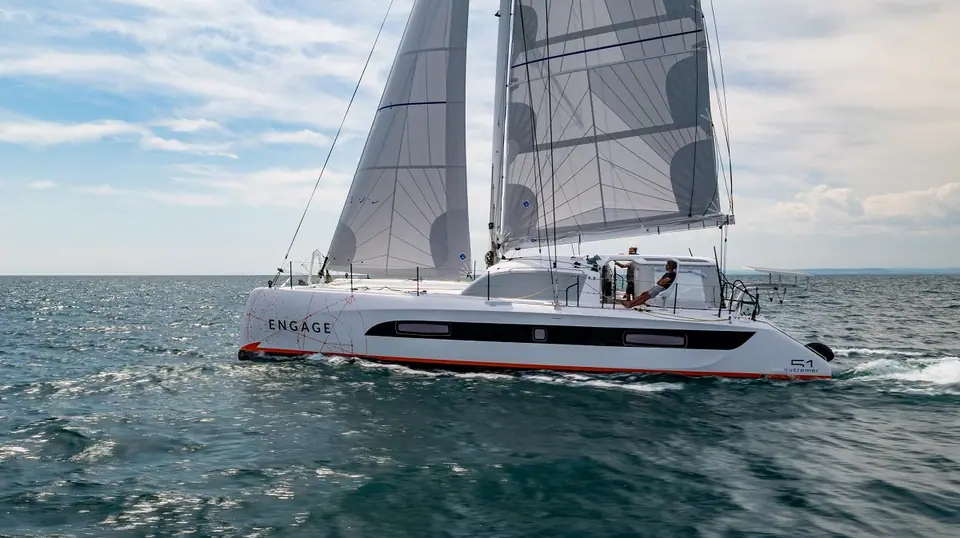
- Length
- 51.3 ft15.65 m
- Beam
- 24.4 ft7.45 m
- Draft
- 3.1 ft0.95 m
- Cabins
- 3 or 4
- Used price
- $700K to $1.3M
On this page
- Overview
- Why more than 100 buyers chose the Outremer 51
- Three generations of the same hull
- Eleven tonnes, daggerboards and a rotating mast option
- Real passage speeds, not brochure speeds
- Helm choices from wheel to bucket-seat tillers
- Accommodation in narrow, fast hulls
- Engines, energy and keeping the boat light
- Outremer 51 or 55, and where the 52 fits
- Specifications
- Price and value
- Strengths and weaknesses
- Used buyer checklist
- Rivals
- Our verdict
- FAQ
The Outremer 51 is a 51-foot Barreau/Neuman daggerboard catamaran built at La Grande-Motte from 2013 to 2022. With more than 100 built, it was Outremer's best seller and remains the benchmark used performance cruiser.
- Couples crossing oceans without crew
- World cruisers on trade wind routes
- Sailors moving from a performance monohull
- Buyers who value resale
Outremer 51 by the numbers
- Sail area to displacement
- 26.5Racing level power, needs active reefing as the breeze builds.
- Displacement to length
- 93Ultralight. Built for speed, keep payload to a minimum.
- Theoretical hull speed
- 9.4 knDisplacement hull speed for the waterline. Light catamarans regularly sail faster than this because their slim hulls do not make a large bow wave.
- Length to beam ratio
- 2.10 : 1Catamaran overall proportions. Wider platforms resist pitching and heel.
Why more than 100 buyers chose the Outremer 51
Outremer has built fast cruising catamarans at La Grande-Motte on the French Mediterranean coast since the 1980s, but no model sold like the 51. The boat grew out of the Outremer 49 of 2009, a Christophe Barreau design that sold 23 hulls in four years. For 2013 Barreau and Frédéric Neuman stretched it to 51 feet, following a large owner survey, enlarging the sugar scoops into usable living space and redesigning the interior. Multihulls World reported the 100th Outremer 51 leaving the yard in 2022, and the successor Outremer 52 premiered at the La Grande-Motte multihull show in April 2023.
The appeal is simple to state. An Outremer 51 lets a couple sail across oceans at 9 to 10 knot averages without a professional crew, on a boat that is comfortable enough to live on. That combination is rare, and the used market prices it accordingly.
Three generations of the same hull
The 51 changed more than most buyers realize during its nine-year run, and the year matters when you shop. Early boats from 2013 to about 2017 carry the original deckhouse and interior. The 2018 restyle brought sculpted topsides by Patrick Le Quément, inverted bows, updated chart table and galley, and new linings and finishes. Late boats also gained more options for carbon bulkheads, lighter daggerboards and a rotating mast.
In broker terms, the post-2018 boats look and feel newer, sell faster and command about 10 to 15 percent more than a comparable pre-restyle hull. The underlying hull, rig geometry and sailing character are much the same.
Eleven tonnes, daggerboards and a rotating mast option
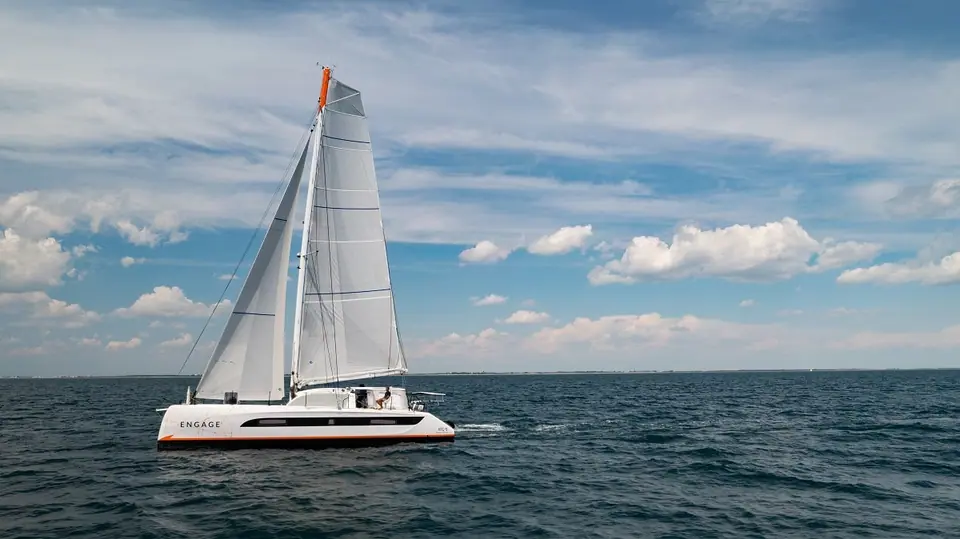
Light ship displacement is about 11,000 kg (24,251 lb), against a fully loaded displacement of 13,700 kg. On SAIL's numbers that gives a displacement to length ratio around 78 and a sail area to displacement ratio around 27, figures closer to a racing boat than a cruising cat. A typical Lagoon 50 weighs nearly double.
Daggerboards, raised and lowered with winches in the cockpit, take draft from 3 feet 1 inch to 7 feet 8 inches. They give the 51 upwind ability comparable to a good cruising monohull, and pulling them up downwind frees the boat to surf. The spade rudders are not retractable, so the boards are designed to take a grounding first.
The rig is a fractional solent arrangement with the mast stepped well aft. An aluminum mast was standard, and a carbon spar or a rotating carbon wing mast like the one on the larger Outremer 5X was a popular, expensive option. Full-roach mainsails were standard on early boats and square-top mains became the norm later.
- Upwind sail area 129 m2 (1,389 sq ft)
- Downwind sail area 254 m2 (2,734 sq ft)
- Mast height about 75 ft 8 in above the waterline
- Construction PVC foam, E-glass and resin sandwich, solid below the waterline
Real passage speeds, not brochure speeds
In SAIL's test in 10 to 15 knots of breeze, the boat made close to 10 knots under main and genoa and went over 10 knots once the screecher was unrolled. Katamarans.com puts the passage target at 9 to 10 knot averages, and SAIL's test boat owners had seen 20 knots.
The more realistic picture for a couple sailing conservatively is an average around 7.5 knots on long passages, which is what one SAIL owner reported while reefing early and sailing without stress. That still means four or five days saved on an Atlantic crossing compared with a heavy charter-style cat.
The light displacement is also why the 51 sails well in under 10 knots, a condition in which heavier cats start their engines. Light air downwind and trade wind reaching are where the boat is happiest.
Helm choices from wheel to bucket-seat tillers
Most 51s steer from wheel stations at the aft end of the cockpit, with good visibility past the deckhouse to both bows. Outremer also offered dual tillers with bucket seats on the aft beams, the brand's signature for owners who want feel and a redundant steering system. If you are buying a boat for long passages, the tillers are worth seeking out.
The trade-off of a low helm is exposure. Many owners add a dodger and bimini to protect the watch keeper. Electric winches on the main halyard and genoa sheets were common, and the overall deck layout is built around two people sailing without help.
Accommodation in narrow, fast hulls
The saloon puts the galley to starboard, a forward-facing navigation station with sightlines over the bows and a rectangular dinette with a telescoping table. In the three cabin layout the owner's hull runs to port, with a queen berth aft under large windows, a head, and a separate shower forward. The starboard hull holds two guest cabins, with a choice of athwartships or fore and aft queen berths aft. Four cabin boats exist but are rare.
The hulls are narrower than on a charter cat and the daggerboard trunks take space, so cabins feel compact and storage is tighter. Nobody buys an Outremer for the size of the guest heads. They buy it because the boat will deliver them to the Marquesas in comfort, and the interior is designed around sea berths and handholds rather than parties.
Engines, energy and keeping the boat light
Twin 40 hp Volvo Penta diesels on saildrives were standard, with 50 hp engines available. Tankage is modest by design, with SAIL listing 88 gallons of fuel and 100 gallons of water, because every kilo counts. A watermaker is the first option on almost every 51.
The SAIL test boat shows the Outremer ownership philosophy: about 560 watts of solar, an 800 Ah battery bank and an optional hydrogenerator, with the owners deliberately skipping a generator, dishwasher, washing machine and multi-zone air conditioning to keep the boat light and simple. Boats loaded with every appliance will sail measurably slower, so look at the equipment list with a performance eye.
Outremer 51 or 55, and where the 52 fits
The Outremer 55 sat above the 51 in the range and offers more interior volume and a bigger rig, at a substantial premium. The successor Outremer 52 took owner feedback from the 51 and ideas from the 55 into a new boat launched in 2023. For a used buyer, the 51 is the sweet spot: enough length for ocean comfort, a large supply of boats, and an owners' community with years of passage data.
Outremer's after-sales culture is part of the value. The yard keeps close contact with owners, supports second-hand buyers and organizes rallies, and that support network is one reason the boats keep their prices.
Outremer 51 specifications
| Length overall | 51.3 ft15.65 m |
|---|---|
| Beam | 24.4 ft7.45 m |
| Draft | 3.1 ft0.95 m |
| Air draft | 75.7 ft23.07 m |
| Displacement | 24,251 lbs11, kg |
| Sail area | 1,389 sq ft129 m² |
| Fuel capacity | 88 gal333 L |
| Fresh water | 1 gal379 L |
| Cabins | 3 or 4 |
| Berths | 6 to 11 |
| Heads | 2 or 3 |
| Standard engines | 2 x Volvo Penta 40 hp diesel with saildrives |
| Optional engines | 2 x 50 hp diesel (listed as the engine fit on the current builder spec) |
| Maximum power | 100 hp |
| Hull type | Catamaran, narrow high-volume hulls with axe bows on later boats |
| Keel | Twin daggerboards, 3 ft 1 in up and 7 ft 8 in down, with spade rudders |
| Rig | Fractional sloop, aluminum mast standard, carbon or rotating carbon wing mast optional, solent rig |
| Hull construction | Vacuum-infused E-glass and PVC foam sandwich, solid laminate below the waterline, carbon options |
| CE design category | A |
| Builder | Outremer Yachting (Grand Large Yachting group), France |
| Naval architect | Christophe Barreau and Frédéric Neuman |
| Other design credits | Patrick Le Quément (topside styling on the 2018 restyle) |
| Production | 2013 to 2022 |
| Status | Discontinued |
Figures come from builder documentation and independent tests where available. Displacement is usually quoted light, so a loaded cruising boat will weigh more. Compare these specs with another model.
How much does a Outremer 51 cost?
Outremer 51s hold value better than almost any production catamaran, because demand from ocean-crossing couples always outruns supply. Recent listings run from the high $800,000s for 2015 boats to about $1.09 to $1.28 million for 2021 hulls on the US East Coast. A carbon rig, lithium and solar upgrades and a recent Atlantic-ready refit add six figures, while boats lying in the South Pacific or Asia often list lower because of delivery costs.
Estimate your yearly cost
A planning estimate using common rules of thumb: insurance near 1.5 percent of value, maintenance near 3 percent, haul out and bottom paint by length. Your marina, region and use will move these numbers. Open the full cost calculator.
Outremer 51 timeline
- 2009Outremer 49 launched to a Barreau design, 23 built in four years
- 2013Outremer 51 replaces the 49 with longer sugar scoops and a new interior
- 2018Restyle with Patrick Le Quément topsides and inverted bows
- 2022Multihulls World reports the 100th Outremer 51 leaving the La Grande-Motte yard
- 2023Outremer 52 premieres at the La Grande-Motte multihull show as the successor
Strengths and weaknesses
What owners like
- Genuine 9 to 10 knot passage averages for a couple
- Daggerboards give monohull-like upwind ability
- Exceptional resale and a deep, active owners' community
- Large supply of used boats with documented ocean miles
- Choice of wheels or tillers with bucket seats
- Strong factory support for second owners
What to weigh up
- Compact cabins and storage in slim hulls
- Low helm stations need dodger and bimini protection
- Carbon options make some listings very expensive
- Modest tankage needs a watermaker and careful planning
Used Outremer 51 buyer checklist
Take this list to a viewing. Your ticks are saved in this browser so you can come back to it.
Always commission an independent marine survey and an engine survey before you buy. How a marine survey works.
Rivals to consider
Seawind 1600
Reichel/Pugh daggerboard cat with sheltered helms and more interior finish, usually a little cheaper than a same-year Outremer.
Compare side by sideOutremer 55
The bigger sister with more volume and a larger rig, at a significant price step.
Catana 53
French daggerboard rival with aft helms and curved boards, heavier but with more interior volume.
Compare side by sideNautitech 46 Open
A fixed-keel alternative with similar aft-helm feel at roughly half the price, but far less upwind ability.
Compare side by sideOur verdict on the Outremer 51
The Outremer 51 is the reference point for used performance cruising catamarans, and for good reason. It sails at speeds that change how you plan an ocean crossing, it is simple enough for two people, and it holds its value. You pay a premium to get in and you accept compact cabins, but you rarely lose much when you sell. A post-2018 boat with a documented refit is the safest buy; a well-maintained early hull with honest ocean miles is the smartest value.
Outremer 51 questions answered
How much is an Outremer 51 for sale?
Used Outremer 51s typically list from about $700,000 for early 2013 boats to around $1.3 million for late hulls. Recent 2021 boats in the US have been listed between about $1.09 and $1.28 million.
How many Outremer 51s were built?
More than 100. Multihulls World reported the 100th Outremer 51 leaving the yard in 2022, making it the yard's best-selling model.
What replaced the Outremer 51?
The Outremer 52, which premiered in April 2023, replaced the 51 and draws on lessons from both the 51 and the larger 55.
How fast does an Outremer 51 sail?
Owners commonly average 9 to 10 knots on passage, and SAIL's test boat owners had seen 20 knots. SAIL saw close to 10 knots in 10 to 15 knots of breeze.
What is the difference between the Outremer 51 and 55?
The 55 is longer with more interior volume and a bigger rig, at a much higher price. The 51 is easier for a couple to handle and far more plentiful on the used market.
Who designed the Outremer 51?
Christophe Barreau and Frédéric Neuman designed it, with topside styling by Patrick Le Quément on the 2018 restyle.
Outremer 51 photos
More sailing catamarans to explore
Seawind 1600
Sailing Catamarans, 52 ft
Used $850K to $1.25M
Leopard 50
Sailing Catamarans, 51 ft
Used $620K to $1.15M
Catana 50
Sailing Catamarans, 50 ft
Used $430K to $650K
HH44
Sailing Catamarans, 50 ft
Used $1.05M to $1.55M