Lagoon 50 Review, the 50 Feet Catamaran Benchmark
The Lagoon 50 is the yardstick most buyers use when they first step up to a 50 foot catamaran. It shows exactly what the extra length buys, and what it costs.
- Length
- 48.4 ft14.75 m
- Beam
- 26.6 ft8.1 m
- Draft
- 4.6 ft1.4 m
- Cabins
- 3 to 6
- Used price
- $540K to $1.17M
On this page
- Overview
- What changes when you move up to a 50 feet catamaran
- An aft mast and a central flybridge helm
- Test speeds under sail and power
- 50 foot catamaran interior, from three cabins to six
- Systems, tankage and engine rooms
- The true running cost at 50 feet
- The used market and the Lagoon 51 that followed
- Specifications
- Price and value
- Strengths and weaknesses
- Used buyer checklist
- Rivals
- Our verdict
- FAQ
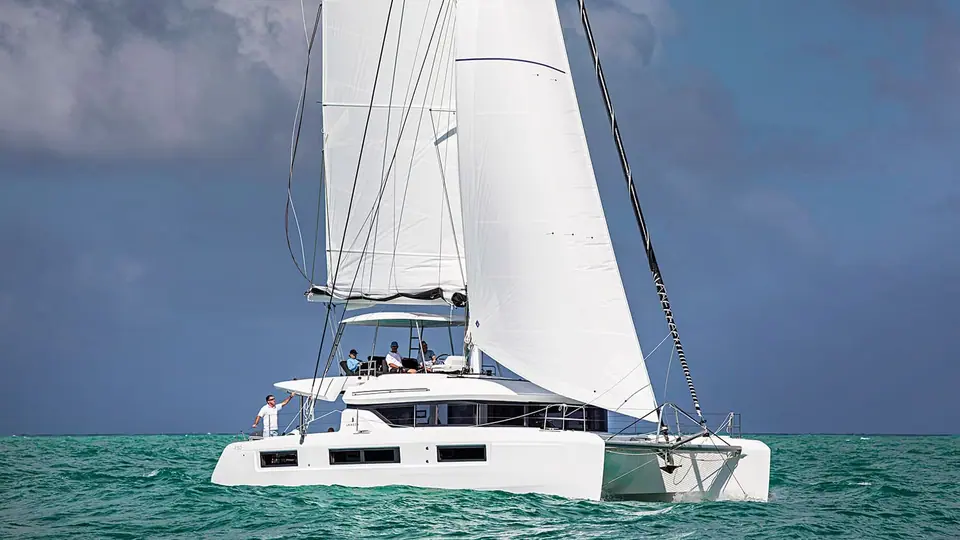
A 48.4-foot VPLP flybridge catamaran built in France from 2018 to 2021, offered with three to six cabins. Big volume, a central flybridge helm and a strong charter following.
- Large families or groups of friends
- Long-term liveaboards with frequent guests
- Charter management buyers
- Trade-wind ocean cruising
Lagoon 50 by the numbers
- Sail area to displacement
- 21.8Plenty of sail for the weight, the boat should feel lively in light air.
- Displacement to length
- 190Light displacement for its length, quick but sensitive to added cruising weight.
- Theoretical hull speed
- 9.2 knDisplacement hull speed for the waterline. Light catamarans regularly sail faster than this because their slim hulls do not make a large bow wave.
- Length to beam ratio
- 1.82 : 1Catamaran overall proportions. Wider platforms resist pitching and heel.
What changes when you move up to a 50 feet catamaran
Every catamaran buyer eventually asks whether to stop at 45 feet or keep going to 50. The Lagoon 50 is the most useful boat to answer that question with, because it was built in large numbers, it sold to both private owners and charter fleets, and its specifications sit right in the middle of the 50 foot catamaran class. If you understand what the Lagoon 50 does well and where it gets expensive, you understand the whole segment.
The headline gains over a 45-footer are volume and flexibility. At 48 feet 5 inches overall and 26 feet 7 inches of beam, the Lagoon 50 can be ordered with anywhere from three to six cabins and the same number of heads. That means a couple can have a full-hull master suite and two guest cabins with an office, or a charter operator can sleep twelve. The cost of that flexibility is weight. At about 44,000 pounds light, the Lagoon 50 is roughly a third heavier than a Lagoon 450, and every system, sail and haul-out scales with it.
An aft mast and a central flybridge helm
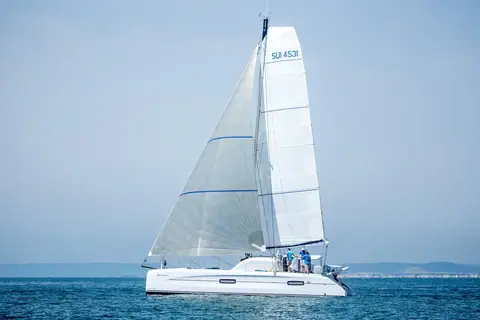
Lagoon introduced the 50 for the 2018 model year with the design team that shaped the modern range: VPLP for the hulls and rig, Patrick le Quément for the exterior and Nauta Design for the interior. As on the Lagoon 42 and Lagoon 40, the mast is stepped well aft, which reduces hobby-horsing, shortens the boom and creates room for a self-tacking jib. A high-aspect mainsail with an electric traveler drum keeps the main manageable for two people.
The flybridge is the defining feature. The helm sits on the flybridge, dead center behind the mast, rather than offset to one side as on most flybridge cats. It puts the skipper in the middle of the action with all lines and electric winches at hand, and the flybridge doubles as a lounge at anchor. The catch is visibility astern when backing into a slip, which reviewers called out, and the fact that the helm is a long climb from the transom when you need to handle lines. Many owners fit cameras and use a remote for the bow thruster.
Air draft is about 87 feet, so this boat stays outside on the US East Coast. Forget the Intracoastal Waterway, and check bridge clearances in any marina you plan to use.
Test speeds under sail and power
Two US tests in Miami give a realistic picture. In 12 to 16 knots of true wind and lumpy seas, one boat made 5.1 knots at 60 degrees off the wind and 7.4 knots at 140 degrees, then jumped to 11.4 knots on a beam reach with the Code 0 set. Another test in about 15 knots with a reefed main and self-tacking jib saw 5.6 to 6.2 knots upwind and better than 9 knots reaching with the optional genoa.
The conclusion is that the Lagoon 50 needs off-wind angles and a big reaching sail to shine. Upwind it is a comfortable but unspectacular performer, which is typical of a heavy, fixed-keel cruising catamaran. Buyers who plan long trade-wind passages will be happy; those who need to beat to windward often should look at lighter performance cats.
Under power, the optional twin 80 hp Yanmars gave 9.5 knots at 3,000 rpm and a more economical 7.5 knots at 2,200 rpm. Standard engines are 57 hp, which is adequate but leaves less in reserve on a boat of this weight.
50 foot catamaran interior, from three cabins to six
The most common private layout puts the owner's suite in the starboard hull, with an island double aft, a walk-in dressing area, a desk and a large head with separate shower forward. Two guest cabins with their own heads fill the port hull. A six cabin, six head layout serves charter fleets, and five cabin versions sit between the two.
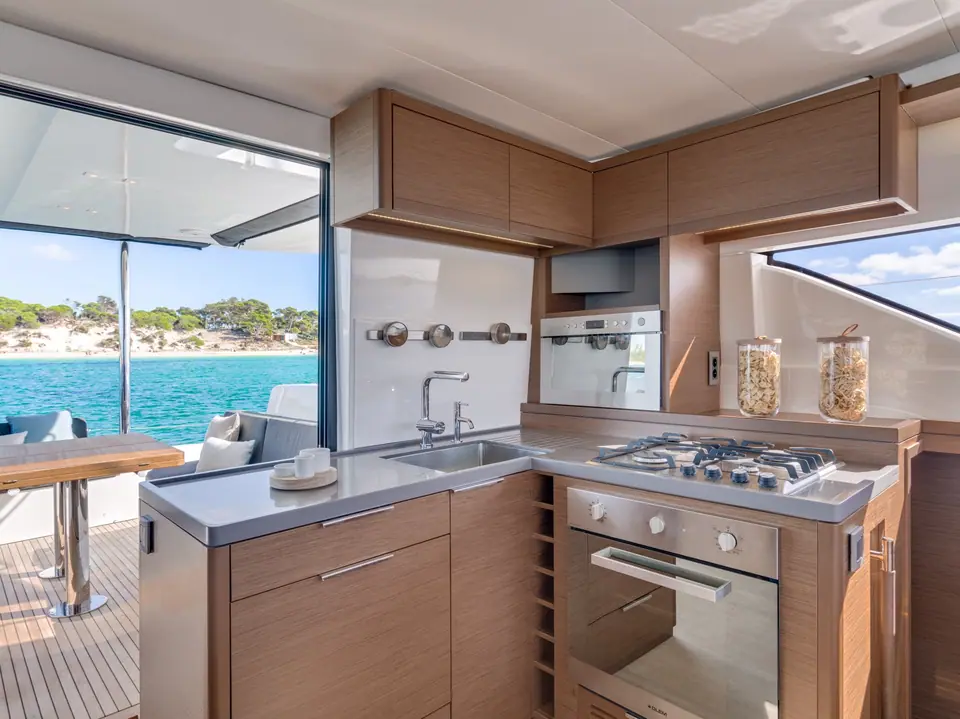
The saloon has a full-beam settee forward, a proper navigation station with a multifunction display, and a split galley with a three-burner Eno stove and two Isotherm refrigerators under the counter. Outside, the aft cockpit includes a second galley module with sink and fridge, a table that seats eight, and twin lounges, while a U-shaped forward cockpit gives a sheltered spot at anchor. Optional extras include a hydraulic swim platform that doubles as a tender lift.
This is where a 50 foot catamaran pulls away from a 45. Guests and owners can be in completely separate spaces, the galley can feed ten people without chaos, and storage is plentiful enough for long-term cruising.
- 3 cabins: owner's suite plus two guest doubles
- 4 cabins: owner's suite or four equal doubles
- 5 or 6 cabins: charter configurations sleeping up to 12
Systems, tankage and engine rooms
Fuel capacity is about 275 gallons and fresh water about 127 gallons. For a boat that may sleep eight or more, water is the constraint, so nearly every cruising Lagoon 50 carries a watermaker. A generator, commonly an 11 kW Onan, is needed to run air conditioning, and most boats have one.
Engine room hatches open aft, which lets you check the engines safely at sea, a small detail that serious cruisers appreciate. Bow thrusters, electric winches and networked electronics with autopilot were common options and are worth looking for on a used boat.
The true running cost at 50 feet
Plan on roughly $60,000 to $120,000 per year in the US for a privately operated Lagoon 50, excluding depreciation. The beam of more than 26 feet means a large end tie or a mega-yacht slip in most marinas, and those are scarce in Florida and New England during peak season. Haul-outs require a travel lift wide enough for the beam, which limits yard choices.
Everything is bigger: two four-cylinder diesels, a generator, air conditioning, a watermaker and a sail wardrobe that easily tops 1,700 square feet. Many owners of boats this size employ a part-time captain or a management company, which adds cost but keeps systems healthy between visits.
The used market and the Lagoon 51 that followed
Lagoon built the 50 from 2018 to 2021 and replaced it with the Lagoon 51, which remains in the current range. Some later Lagoon 50s carry 2022 or 2023 model years on brokerage listings because of delivery and registration timing, so check the hull identification number before you compare prices.
Asking prices currently range from about $540,000 for early ex-charter boats to around $1.17 million for late, privately owned boats. Charter fleets bought the boat in numbers, so there is a steady flow of ex-fleet boats, many of them five or six cabin versions. Those make excellent value if you want space for a big family and are prepared to refresh the interior.
If you are shopping 40 to 50 ft catamarans for sale on a budget, the Lagoon 50 sits at the upper end. It costs a premium over a Lagoon 450 or Leopard 45, but buys an entirely different level of space and separation.
Lagoon 50 specifications
| Length overall | 48.4 ft14.75 m |
|---|---|
| Waterline length | 47 ft14.31 m |
| Beam | 26.6 ft8.1 m |
| Draft | 4.6 ft1.4 m |
| Air draft | 87 ft26.52 m |
| Displacement | 43,995 lbs19,956 kg |
| Sail area | 1,701 sq ft158 m² |
| Fuel capacity | 275 gal1,04 L |
| Fresh water | 127 gal48 L |
| Cabins | 3 to 6 |
| Berths | 6 to 12 |
| Heads | 3 to 6 |
| Standard engines | 2 x Yanmar 4JH57 57 hp diesel with saildrives |
| Optional engines | 2 x Yanmar 80 hp diesel with saildrives |
| Maximum power | 160 hp |
| Cruise speed | 7.5 knots |
| Top speed | 9.5 knots |
| Hull type | Catamaran, twin hulls with flybridge |
| Keel | Twin fixed keels |
| Rig | Fractional sloop, mast stepped aft, high-aspect mainsail, self-tacking jib, optional genoa and Code 0 |
| Hull construction | Vacuum-infused polyester, balsa cored above the waterline |
| Builder | Lagoon (Groupe Beneteau), France |
| Naval architect | VPLP Design |
| Other design credits | Patrick le Quément (exterior styling), Nauta Design (interior) |
| Production | 2018 to 2021 |
| Status | Discontinued |
Figures come from builder documentation and independent tests where available. Displacement is usually quoted light, so a loaded cruising boat will weigh more. Compare these specs with another model.
Performance data
| RPM | Speed (kn) |
|---|---|
| 2200 | 7.5 |
| 3000 | 9.5 |
Twin optional 80 hp Yanmar diesels with saildrives, Miami sea trial reported by SAIL magazine. Fuel burn not published.
How much does a Lagoon 50 cost?
The base price in 2018 was about $665,000, but a cruising-ready boat with 80 hp engines, generator, air conditioning and electronics was quoted at roughly 1.07 million euros. That spread carries into the used market. Ex-charter five and six cabin boats from Caribbean bases start in the mid $500,000s, while privately owned three and four cabin boats with full options approach $1.1 million.
Estimate your yearly cost
A planning estimate using common rules of thumb: insurance near 1.5 percent of value, maintenance near 3 percent, haul out and bottom paint by length. Your marina, region and use will move these numbers. Open the full cost calculator.
Lagoon 50 timeline
- 2018Lagoon 50 enters production with an aft mast and central flybridge helm
- 2018US magazine tests record 11.4 knots on a beam reach with the Code 0 and 9.5 knots under power
- 2021Production ends as the Lagoon 51 takes over
- 2023Ex-charter boats begin reaching the brokerage market in numbers
Strengths and weaknesses
What owners like
- Huge interior volume with three to six cabin layouts
- Central flybridge helm with all lines and electric winches at hand
- Aft mast and self-tacking jib keep sail handling manageable
- Large fuel capacity and practical engine room access
- Plenty of ex-charter supply keeps used prices sensible
What to weigh up
- Heavy and unspectacular upwind
- Limited visibility astern from the flybridge when docking
- 87-foot air draft and 26-foot beam limit marinas and routes
- Running costs rise sharply over a 45-footer
Used Lagoon 50 buyer checklist
Take this list to a viewing. Your ticks are saved in this browser so you can come back to it.
Always commission an independent marine survey and an engine survey before you buy. How a marine survey works.
Rivals to consider
Leopard 50
South African build with a forward cockpit and a different helm approach, a common alternative for charter owners.
Compare side by sideOutremer 51
A lighter, faster bluewater cat with daggerboards, for buyers who value performance over volume.
Compare side by sideFountaine Pajot Saona 47
Smaller and less expensive, but with a modern interior and lower running costs.
Compare side by sideSeawind 1600
An Australian alternative with a different approach to cockpit and saloon integration.
Compare side by sideOur verdict on the Lagoon 50
The Lagoon 50 is the clearest demonstration of what a 50 foot catamaran is for: space, privacy and the flexibility to carry family or guests without anyone feeling crowded. It sails comfortably rather than quickly, it is expensive to berth and maintain, and the central flybridge helm takes some practice in a marina. Buy one with the 80 hp engines, a watermaker and a well-documented history, and it will deliver a level of comfort that no 45-footer can match.
Lagoon 50 questions answered
How much does a Lagoon 50 cost?
Used Lagoon 50s ask from about $540,000 for early ex-charter boats to around $1.17 million for late, well-equipped private boats. The 2018 base price new was about $665,000 before options.
What is the best 50 foot catamaran?
It depends on priorities. The Lagoon 50 is a benchmark for space and comfort, while boats like the Outremer 51 favor speed and the Leopard 50 offers a different layout with a forward cockpit.
Does the Lagoon 50 have a flybridge?
Yes. The helm is on the flybridge, centered behind the mast, with all lines and electric winches led to it.
How many cabins does a Lagoon 50 have?
It was offered with three to six cabins and the same number of heads, sleeping up to 12.
What replaced the Lagoon 50?
The Lagoon 51 replaced it after production ended in 2021.
How fast is the Lagoon 50?
Test boats reached 11.4 knots on a beam reach with a Code 0 and 9.5 knots under power with the optional 80 hp engines.
Lagoon 50 photos
More sailing catamarans to explore
Excess 15
Sailing Catamarans, 48 ft
Used $580K to $850K
Dufour Catamarans 48
Sailing Catamarans, 48 ft
Used $430K to $700K
Bali 4.8
Sailing Catamarans, 49 ft
Used $780K to $1.15M
Outremer 45
Sailing Catamarans, 48 ft
Used $300K to $1.1M