Lagoon 40 Catamaran Review and Used Buying Guide
Lagoon's entry-level cat from 2017 moved the mast aft, added a big Code 0 and quietly sailed better than boats a size larger.
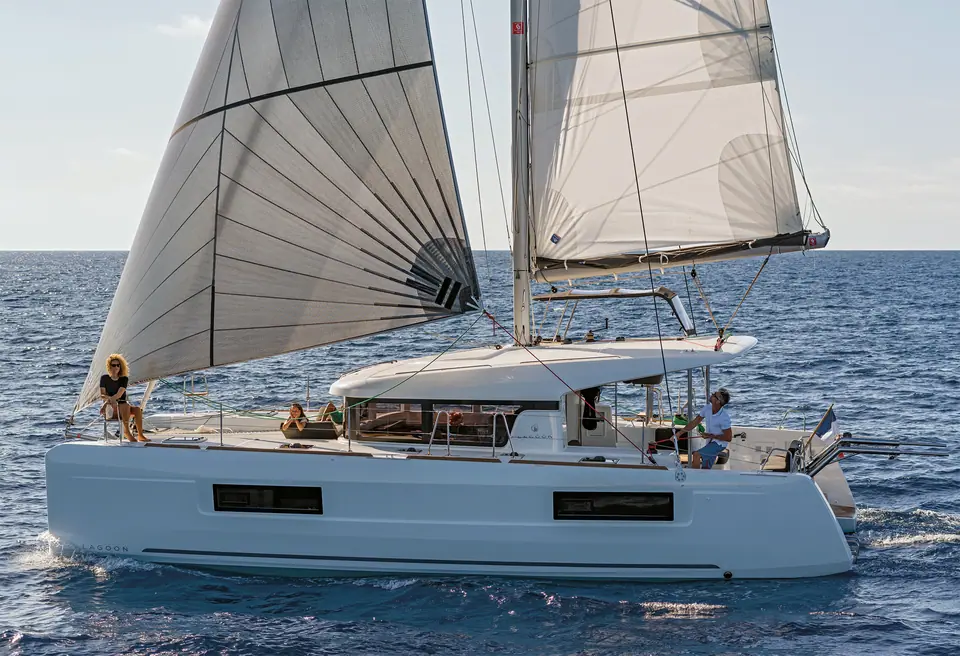
- Length
- 38.5 ft11.74 m
- Beam
- 22.2 ft6.76 m
- Draft
- 4.4 ft1.35 m
- Cabins
- 3 or 4
- Used price
- $280K to $490K
On this page
- Overview
- One boat to replace the Lagoon 39 and the Lagoon 400
- The mast moved aft, and why that changes how the boat sails
- What the test boats actually did
- A port-hull owner's suite and other layout quirks
- Raised bulkhead helm and a cockpit built for cruising couples
- 29 hp or 45 hp, and the tankage question
- What a Lagoon 40 costs to keep in the US
- Why the Lagoon 40 for sale is a used-market sweet spot
- Specifications
- Price and value
- Strengths and weaknesses
- Used buyer checklist
- Rivals
- Our verdict
- FAQ
A 38.5-foot VPLP catamaran that replaced both the Lagoon 39 and Lagoon 400. Built in France from 2017 until the Lagoon 38 took its place, now a strong used buy for couples.
- Couples cruising the US East Coast and ICW
- First-time catamaran buyers stepping up from a monohull
- Bahamas and Caribbean seasonal cruisers
- Buyers who want a modern Lagoon under $500,000
One boat to replace the Lagoon 39 and the Lagoon 400
When the Lagoon 40 arrived in 2017 it had an unusual job description. It replaced two models at once, the Lagoon 39 and the decade-old Lagoon 400, and it had to do so while standing in the shadow of the Lagoon 380, the most successful boat the yard had ever built. Lagoon's answer was not to make it bigger. At 38 feet 6 inches overall the Lagoon 40 is actually shorter than its name suggests, but it carries a waterline of almost 38 feet, a beam of 22 feet 2 inches and a much more modern rig.
The design team was the familiar Lagoon trio: VPLP for the naval architecture, the former Renault design chief Patrick le Quément for the exterior styling, and Nauta Design for the interior. The squared-off transoms, angular coachroof and big hull windows link it visually to the larger Lagoon 42 and Lagoon 50 of the same era.
Lagoon 40 by the numbers
- Sail area to displacement
- 16.8Balanced power for coastal and offshore cruising.
- Displacement to length
- 196Light displacement for its length, quick but sensitive to added cruising weight.
- Theoretical hull speed
- 8.3 knDisplacement hull speed for the waterline. Light catamarans regularly sail faster than this because their slim hulls do not make a large bow wave.
- Length to beam ratio
- 1.74 : 1Catamaran overall proportions. Wider platforms resist pitching and heel.
The mast moved aft, and why that changes how the boat sails
The single most important feature of the Lagoon 40 is where the mast stands. VPLP stepped it farther aft than on previous Lagoons, which opens up the foretriangle and lets the boat use a shorter boom and a smaller, higher-aspect mainsail. The standard headsail is a self-tacking jib, with an overlapping genoa and a square-top main on the options list. A smaller, easier main is a gift to short-handed crews, and the optional sails give the boat more drive than its 875 square feet of upwind sail area suggests.
The other key piece is the 706-square-foot Code 0, flown from a sprit. Testers consistently pointed to the aft-mast rig and the Code 0 as the two reasons this boat feels livelier than the 380 it was meant to follow. If you are comparing listings, a boat with the Code 0 and its furler is a meaningfully better sailing boat than one without.
Air draft is 60 feet 5 inches, which matters for American buyers. That is under the 65-foot fixed bridge height on the Atlantic Intracoastal Waterway, so the Lagoon 40 can run the ditch between the Chesapeake and Florida, which is not a given on a cruising cat of this size.
What the test boats actually did
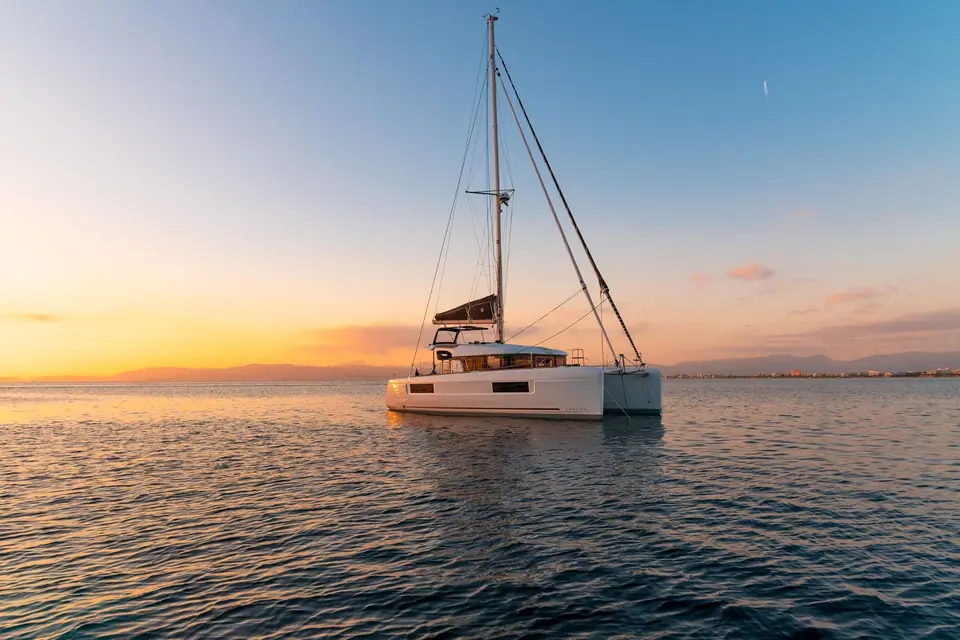
Magazine sea trials paint a consistent picture. Off South Beach, Miami, in 16 to 18 knots of true wind, a test boat reached 10 knots on a beam reach and held 7.9 knots at 50 degrees apparent in 15 knots of breeze. In a separate trial out of Government Cut, in 15 to 20 knots with steep waves against an outgoing current, the boat made 7 knots close-hauled and 7.8 to 8 knots on a broad reach with the genoa, surfing to 9 knots at times.
Under power, the optional 45 hp Yanmars pushed the boat at 7.5 knots at 2,400 rpm in lumpy seas. The standard engines are 29 hp Yanmar 3YM30s, which are adequate in protected water but leave little reserve punching into a short chop with a full load of water, fuel and people aboard.
A French review that spent two days and nights aboard on a delivery from Canet en Roussillon to Cannes in 20 to 25 knots of northwesterly described the boat as playful and pleasant in light to medium air, and praised the neat mechanical and electrical installation.
A port-hull owner's suite and other layout quirks
The Lagoon 40 owner's version dedicates the full port hull to the master cabin. It has a queen berth aft, a settee and desk amidships and a forward head with a large shower and a hull window that gives a panoramic view of the sea. Two queen cabins share the starboard hull and a single large head with a separate shower between them, giving three cabins and two heads in all.
The four cabin version comes with either two or four heads. The two-head version is the classic charter compromise, while the four-head version gives each couple a private bathroom at the cost of storage. For a family, the two-head four cabin layout is often the smartest compromise because it keeps more locker space.
Inside, the saloon is finished in walnut-toned Alpi joinery with leather accents, a definite step up from the 380. The galley has direct access to the outdoor table, which has a rotating top and can seat a crowd. Sightlines and ventilation through the saloon are good for a boat this size.
- Owner's version: 3 cabins, 2 heads, master suite in the port hull
- Charter version: 4 cabins with 2 heads
- Four cabin, four head version: maximum privacy, least storage
Raised bulkhead helm and a cockpit built for cruising couples
The Lagoon 40 has no flybridge. The helm is a raised station on the bulkhead, reached from both the cockpit and the side deck, with a two-person seat under a canvas bimini that has roll-up side panels. That placement keeps the skipper close to the crew and makes docking easier than on a flybridge boat, though visibility over the opposite bow still requires a step to the side.
Aft, the redesigned transoms have shallow steps that make boarding from a dinghy easy, and an aft bench serves as a lookout perch under way. Lines are led to the helm, and an electric primary winch is worth looking for on any used listing.
29 hp or 45 hp, and the tankage question
Fuel capacity is a respectable 106 gallons, far better than the 380, but fresh water is only 79 gallons as standard. Lagoon offered a second water tank that doubles that figure, and anyone planning to cruise beyond marina range should look for a boat with that tank or a watermaker, ideally both.
The engine choice is the single biggest mechanical difference between used boats. The 45 hp option makes the boat far more confident in a head sea and keeps cruising rpm lower, which helps longevity. On the brokerage market, boats with the larger engines command a clear premium, and we think they are worth it unless the boat will live in sheltered water.
What a Lagoon 40 costs to keep in the US
Budget roughly $24,000 to $48,000 per year for insurance, a slip, haul-outs, routine engine and saildrive service and modest upgrades. The 22-foot beam is the hinge: some marinas will treat it as a wide single, others will charge a double, and the difference can be thousands of dollars a year in places like South Florida or Annapolis.
Fuel costs are low. With two small diesels and good sailing manners, most owners motor only to clear harbors or in very light air. The big-ticket items to anticipate are sails after eight to ten years of cruising, saildrive diaphragm replacement on schedule, and generator service if fitted.
Why the Lagoon 40 for sale is a used-market sweet spot
The Lagoon 40 sits in an attractive gap. It is far more modern than the Lagoon 380, which many buyers consider at the same time, yet it costs much less than a used Lagoon 42. Asking prices for boats built from 2019 to 2022 typically run from about $300,000 to $490,000, with ex-charter boats from Caribbean bases at the bottom.
Because the model ran for a relatively short time compared with the 380, supply is thinner, so the right boat may take patience to find. The Lagoon 40 no longer appears in the current Lagoon range, where the new Lagoon 38 introduced in 2025 now holds the entry position. That should keep demand for good used 40s healthy, since buyers who want a sub-40-foot Lagoon with a modern aft-mast rig now have only the used market or a much pricier new boat.
Lagoon 40 specifications
| Length overall | 38.5 ft11.74 m |
|---|---|
| Waterline length | 38 ft11.57 m |
| Beam | 22.2 ft6.76 m |
| Draft | 4.4 ft1.35 m |
| Air draft | 60.4 ft18.41 m |
| Displacement | 23,997 lbs10,885 kg |
| Sail area | 875 sq ft81.3 m² |
| Fuel capacity | 106 gal4 L |
| Fresh water | 79 gal3 L |
| Cabins | 3 or 4 |
| Berths | 6 to 8 |
| Heads | 2 to 4 |
| Standard engines | 2 x Yanmar 3YM30 29 hp diesel with saildrives |
| Optional engines | 2 x Yanmar 45 hp diesel with saildrives |
| Maximum power | 90 hp |
| Cruise speed | 7.5 knots |
| Hull type | Catamaran, twin hulls |
| Keel | Twin fixed keels |
| Rig | Fractional sloop, mast stepped aft, self-tacking jib, optional genoa, square-top mainsail and Code 0 on a bowsprit |
| Hull construction | Vacuum-infused polyester with balsa core and anti-osmotic outer layers |
| Builder | Lagoon (Groupe Beneteau), France |
| Naval architect | VPLP Design |
| Other design credits | Patrick le Quément (exterior styling), Nauta Design (interior) |
| Production | 2017 to present |
| Status | Discontinued |
Figures come from builder documentation and independent tests where available. Displacement is usually quoted light, so a loaded cruising boat will weigh more. Compare these specs with another model.
Performance data
| True wind (kn) | Point of sail | Boat speed (kn) |
|---|---|---|
| 16 to 18 | Beam reach | 10 |
| 15 | 50 degrees apparent | 7.9 |
| 15 to 20 | Close-hauled | 7 |
| 15 to 20 | Broad reach, genoa | 8 |
Sea trials off Miami reported by SAIL and Cruising World. Under power, optional 45 hp Yanmars gave 7.5 knots at 2,400 rpm.
How much does a Lagoon 40 cost?
Base price in 2018 was roughly $322,000 to $330,000, but a typically equipped boat with generator, air conditioning, electronics and the 45 hp engines sold for well over $500,000. That gap explains the wide used range today. Ex-charter four cabin boats with 29 hp engines sit near $300,000, while privately owned three cabin boats with the bigger engines, Code 0 and solar push toward $450,000 and beyond.
Estimate your yearly cost
A planning estimate using common rules of thumb: insurance near 1.5 percent of value, maintenance near 3 percent, haul out and bottom paint by length. Your marina, region and use will move these numbers. Open the full cost calculator.
Lagoon 40 timeline
- 2017Lagoon 40 launched to replace the Lagoon 39 and Lagoon 400
- 2018US reviews in Miami praise its sailing ability; base price about $322,000
- 2023Still in production, with strong charter and private demand
- 2025New Lagoon 38 takes over the entry-level slot in the Lagoon range
Strengths and weaknesses
What owners like
- Aft mast, small main and self-tacking jib make sail handling easy for two
- Sails better than its size suggests, especially with the Code 0
- 60 foot 5 inch air draft clears ICW bridges
- Good 106-gallon fuel capacity
- Modern, well-finished interior with three or four cabin choices
- Priced between an old 380 and a costly 42 on the used market
What to weigh up
- Standard water tank of 79 gallons is small
- Standard 29 hp engines are marginal in a head sea
- Thinner used supply than the 380 or 42
- Bulkhead helm still limits sightlines over the far bow
Used Lagoon 40 buyer checklist
Take this list to a viewing. Your ticks are saved in this browser so you can come back to it.
Always commission an independent marine survey and an engine survey before you buy. How a marine survey works.
Rivals to consider
Leopard 40
A forward saloon door and much larger 206-gallon water tank, but a taller mast that is less ICW friendly.
Compare side by sideFountaine Pajot Isla 40
A newer design with more modern interior volume, generally priced higher as a newer boat.
Compare side by sideLagoon 380
The older, cheaper choice with shallower draft but far less interior volume and weaker light-air sailing.
Compare side by sideBali Catspace
Solid foredeck and fully opening saloon door create more living space, at the cost of the classic trampoline.
Compare side by sideOur verdict on the Lagoon 40
The Lagoon 40 is the best balance of size, sailing ability and price in the used Lagoon range. It sails noticeably better than the 380, slips under fixed ICW bridges, and gives a cruising couple a properly modern owner's suite. Look for a boat with the 45 hp engines, the Code 0 and either the second water tank or a watermaker, and you will have a compact cat that feels far bigger than its 38 and a half feet.
Lagoon 40 questions answered
How much is a Lagoon 40 catamaran?
Used Lagoon 40s for sale typically ask from about $280,000 for early ex-charter boats to around $490,000 for late, well-equipped owner's versions. The 2018 base price new was roughly $322,000 before options.
Is the Lagoon 40 still in production?
No. It no longer appears in the current Lagoon range, where the Lagoon 38 introduced in 2025 now holds the entry position.
Can a Lagoon 40 go down the Intracoastal Waterway?
Yes. Its air draft of about 60 feet 5 inches clears the 65-foot fixed bridges on the ICW.
How fast is the Lagoon 40?
Test boats reached 10 knots on a beam reach in 16 to 18 knots of wind and cruised at 7.5 knots under power with the optional 45 hp engines.
What replaced the Lagoon 380 and 400?
The Lagoon 40, launched in 2017, replaced the Lagoon 39 and Lagoon 400 and became the modern alternative to the 380.
Lagoon 40 photos
More sailing catamarans to explore
Broadblue 385
Sailing Catamarans, 39 ft
Used $150K to $330K
Fountaine Pajot Isla 40
Sailing Catamarans, 39 ft
Used $360K to $560K
Lagoon 380
Sailing Catamarans, 38 ft
Used $150K to $310K
Bali 4.0
Sailing Catamarans, 39 ft
Used $260K to $380K