Lagoon 43 Review, the Successor to Lagoon's Best-Seller
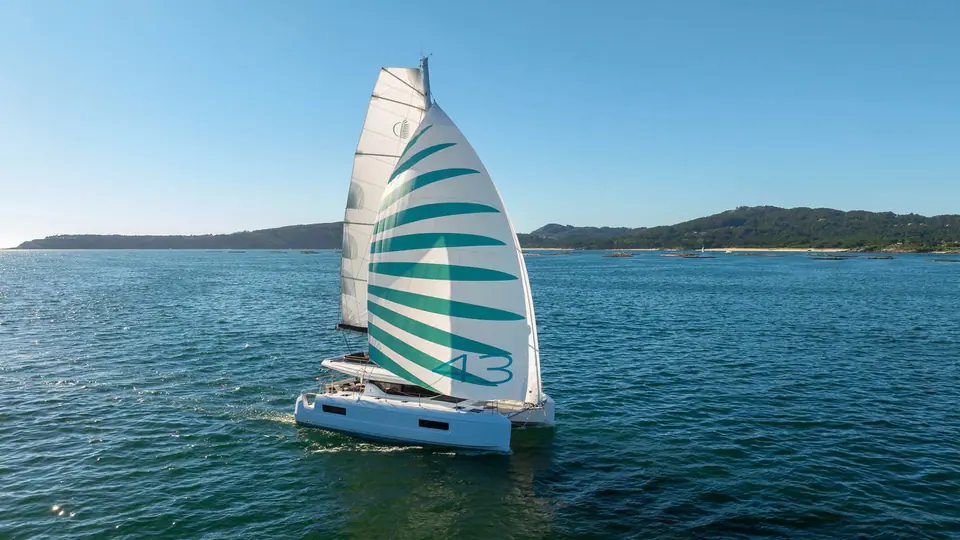
VPLP's replacement for the 1,100-hull Lagoon 42 moves the rig forward, the owner's bed forward and adds side boarding doors in the hulls.
- Length
- 45.4 ft13.85 m
- Beam
- 25.3 ft7.69 m
- Draft
- 4.3 ft1.31 m
- Cabins
- 3 or 4, with optional Pullman berth; owner's bed forward or aft
- Used price
- $640K to $880K
On this page
- Overview
- Replacing a 1,100 boat best-seller
- A rig moved forward and a bigger square-top main
- What the 43 did on the Chesapeake
- A semi-flybridge helm on the port bulkhead
- Side boarding doors, a transom bench and tables for twelve
- The owner's bed goes forward
- Buying new or nearly new, and the 42 question
- Specifications
- Price and value
- Strengths and weaknesses
- Used buyer checklist
- Rivals
- Our verdict
- FAQ
The Lagoon 43 is a 45 ft 5 in cruising catamaran by VPLP, Patrick le Quément and Nauta Design, built by Lagoon in France since 2024 as the successor to the Lagoon 42. It has twin 57 hp Yanmars and three or four cabins.
- Couples and families buying their first new cat
- Owners planning charter management
- Liveaboards who value a big owner's head and desk
Lagoon 43 by the numbers
- Sail area to displacement
- 18.4Balanced power for coastal and offshore cruising.
- Displacement to length
- 185Light displacement for its length, quick but sensitive to added cruising weight.
- Theoretical hull speed
- 8.7 knDisplacement hull speed for the waterline. Light catamarans regularly sail faster than this because their slim hulls do not make a large bow wave.
- Length to beam ratio
- 1.80 : 1Catamaran overall proportions. Wider platforms resist pitching and heel.
Replacing a 1,100 boat best-seller
Anyone shopping for a Lagoon catamaran for sale in the mid-40 foot range now has two generations to choose from. The Lagoon 42, launched in 2016, sold more than 1,100 hulls and became one of the most common cruising cats on earth. Its successor, the Lagoon 43, premiered at the Cannes Yachting Festival in September 2024 and made its US debut at the Annapolis Sailboat Show a month later, where SAIL reported long lines to get aboard.
Lagoon did not play it safe. The 43 keeps the brand's VPLP hull lineage and the gun-turret coachroof that has defined Lagoons since the 410 and 470, but it rearranges almost everything inside and on deck. SAIL counted 55 boats sold by October 2024 and Cruising World 70, with Lagoon aiming to build around 100 a year and expecting roughly half to go into charter fleets.
The design team is the established one: VPLP Design for the naval architecture, Patrick le Quément for the exterior and Nauta Design for the interior. Lagoon lists the European Yacht of the Year 2025 title among the boat's awards, and it was a finalist in Cruising World's 2025 Boat of the Year midsize multihull class, which the Seawind 1370 won.
A rig moved forward and a bigger square-top main
The most consequential change is structural. VPLP moved the mast forward, which pushes the compression post toward the saloon windows and clears it from the middle of the living area. The mast is about two feet shorter than the 42's, but the boom is longer, and the optional square-top mainsail is about 100 sq ft larger than its predecessor's. Lagoon quotes 1,130 sq ft upwind with a 646 sq ft high-roach main or 732 sq ft square top, a 398 sq ft furling genoa and an optional 785 sq ft code zero.
The self-tacking jib track of the 42 is gone, replaced by conventional genoa sheeting. That means more work when tacking, but better sail shape and more power on a reach. Lagoon offers in-boom furling, though SAIL's reviewer preferred a conventional stack pack for simplicity.
What the 43 did on the Chesapeake
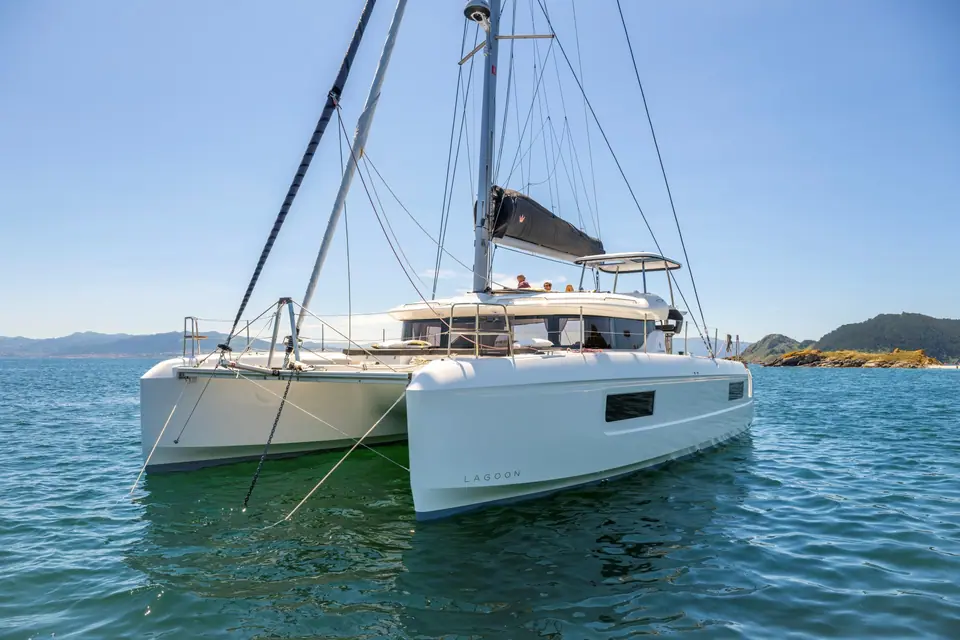
SAIL tested the boat in 14 to 17 knots of breeze on flat water with the square-top main. It made 7.7 knots in 16 knots of true wind at 65 degrees apparent and held 6.3 knots when hardened up to 50 degrees. On a broad reach with only main and jib and no code zero, speed dropped to 5.1 knots, which shows how much a downwind sail matters on a 30,800 lb cat.
Cruising World sailed it in a lighter 10 to 12 knot northwesterly and made just under 7 knots closehauled and nearly 6 knots on a beam reach, with a light, responsive helm. Under power, the twin 57 hp Yanmars gave SAIL a 7.1 knot cruise at 2,200 rpm and 8.7 knots at 3,200 rpm. Fuel capacity nearly doubled over the 42, from about 79 to 151 gallons, which extends motoring range considerably.
A semi-flybridge helm on the port bulkhead
Instead of a full flybridge, the 43 has what Lagoon calls a semi-fly. The helm sits on a raised station on the port bulkhead, between the main deck and the roof, with a U-shaped settee and a sun bed beside it. The arrangement keeps weight lower than a full flybridge, protects the helmsman behind the bulkhead and still lets guests sit with the skipper. Cruising World's Mark Pillsbury called it a better arrangement for a shorthanded crew than a flybridge.
The downside is limited roof space for solar. SAIL found room for only four panels, about 640 watts, around the traveler. Buyers who want to anchor out without a generator should look at Lagoon's Silent Package, which bundles lithium batteries, bigger alternators, a large inverter and solar.
Side boarding doors, a transom bench and tables for twelve
Lagoon cut boarding doors into the aft sections of both hulls. They are not new in the catamaran world, but they make stepping aboard from a side-tie dock or a dinghy far easier than climbing over the transom, and judges at both magazines singled them out. Aft, a transom bench with twin hinged backrests faces either into the cockpit or out over the anchorage, and netting integrated into the davit frame creates a small aft trampoline once the tender is launched.
The cockpit and saloon tables can be combined in a dozen ways. With the three-panel glass door pushed into its pockets, the tables line up to seat twelve. Forward, the foredeck borrows the U-shaped lounge from the Lagoon 46 around the windlass, and a window between the galley and the forward cockpit opens to pass food and drinks.
The owner's bed goes forward
The interior's star is the owner's hull. Lagoon moved the bed to the forward end of the starboard hull, away from engine noise and the dock, with better air from an unobstructed hatch. That leaves the wide aft section for a large head with a big shower, a vanity and a separate toilet compartment, plus a desk amidships. Lagoon now also offers the bed aft for owners who prefer the conventional arrangement.
In the port hull the fore and aft cabins have the same size beds thanks to a pronounced chine, the two heads are identical with sinks that fold into the shower stalls, and a Pullman berth can drop down in the aft cabin. Lagoon lists five arrangements: three cabins, three plus Pullman, three with the aft owner's bed, four plus Pullman and four cabins. The galley sits in the forward port corner of the saloon with a 152 quart upright fridge, two refrigerator drawers, a four-burner stove and a standard UV water filter.
Buying new or nearly new, and the 42 question
Because production only started in 2024, the market today is mostly new boats and a handful of nearly new ones. In Europe, new 2026 hulls are listed from about 556,000 to 590,000 euros before taxes and options, and 2024 to 2025 boats ask about 585,000 to 790,000 euros. A typical US delivered boat with generator, air conditioning, electronics and solar should land somewhere around $720,000 to $950,000.
The obvious alternative is a late Lagoon 42, which is cheaper and has a proven track record and parts supply. Lagoon still lists a Lagoon 42 Millenium edition alongside the 43. Choose the 43 if the forward owner's bed, side doors, bigger tanks and a more open saloon matter to you; choose a late 42 if price and a huge comparison base matter more.
Plan on about $40,000 to $80,000 a year to keep a 43 in the US, driven by a 25 ft 3 in beam slip, insurance and systems maintenance.
Lagoon 43 specifications
| Length overall | 45.4 ft13.85 m |
|---|---|
| Waterline length | 42.1 ft12.82 m |
| Beam | 25.3 ft7.69 m |
| Draft | 4.3 ft1.31 m |
| Air draft | 69.9 ft21.31 m |
| Displacement | 30,848 lbs13,9 kg |
| Sail area | 1,13 sq ft105 m² |
| Fuel capacity | 151 gal57 L |
| Fresh water | 166 gal63 L |
| Cabins | 3 or 4, with optional Pullman berth; owner's bed forward or aft |
| Berths | 6 to 13 |
| Heads | 3 or 4, each with shower |
| Maximum persons | 12 |
| Standard engines | 2 x Yanmar 57 hp diesel with saildrives |
| Maximum power | 114 hp |
| Cruise speed | 7.1 knots |
| Top speed | 8.7 knots |
| Hull type | Chined cruising catamaran hulls with plumb bows and a semi-flybridge helm deck |
| Keel | Twin fixed keels |
| Rig | Fractional sloop, high-roach or square-top main, furling genoa (no self-tacker), optional code zero |
| Hull construction | Infused E-glass and polyester with balsa core in hull, deck and coachroof |
| CE design category | A (12 persons), B 14, C 20, D 30 |
| Builder | Lagoon (Groupe Beneteau), France |
| Naval architect | VPLP Design |
| Other design credits | Exterior design by Patrick le Quément; interior by Nauta Design |
| Production | 2024 to present |
| Status | In production |
Figures come from builder documentation and independent tests where available. Displacement is usually quoted light, so a loaded cruising boat will weigh more. Compare these specs with another model.
How much does a Lagoon 43 cost?
European dealers list new 2026 Lagoon 43s from about 556,000 to 590,000 euros before taxes, delivery and the electronics, solar, generator and air conditioning packs most US owners specify, which is why delivered US boats land well above that. Early 2024 and 2025 boats in Europe ask roughly 585,000 to 790,000 euros, with three-cabin owner's versions and the Silent Package at the top. About half of production goes into charter, so ex-fleet four-cabin boats will become the value end of the market from about 2028.
Estimate your yearly cost
A planning estimate using common rules of thumb: insurance near 1.5 percent of value, maintenance near 3 percent, haul out and bottom paint by length. Your marina, region and use will move these numbers. Open the full cost calculator.
Versions and options
- 3-cabin owner's version
- Full starboard owner's hull with bed forward (or aft as an option), large aft head and desk.
- 4-cabin version
- Starboard hull split into two en suite cabins; aimed at charter and large families.
- Pullman berth option
- Fold-down single above the aft double in the port hull, available in 3 and 4 cabin layouts.
- Silent Package
- Lithium batteries, upsized alternators, a large inverter and solar so owners can skip the generator.
Lagoon 43 timeline
- 2016Lagoon 42 launches and goes on to sell more than 1,100 hulls
- 2024Lagoon 43 premieres at Cannes in September and in Annapolis in October
- 2025European Yacht of the Year title and Cruising World Boat of the Year finalist
- 2026Lagoon's current listing offers Panarea and Sorrento interior palettes and an aft owner's bed option
Strengths and weaknesses
What owners like
- Forward owner's bed with a huge aft head
- Side boarding doors in both hulls
- Rig moved forward opens up the saloon
- Fuel capacity nearly doubled over the Lagoon 42
- Protected semi-flybridge helm keeps the skipper social
- Lagoon's dealer and service network
What to weigh up
- No self-tacking jib, so tacking takes more work
- Limited roof space for solar
- Slow downwind without a code zero
- Heavier than performance cats at about 30,800 lb light
- Little resale history yet
Used Lagoon 43 buyer checklist
Take this list to a viewing. Your ticks are saved in this browser so you can come back to it.
Always commission an independent marine survey and an engine survey before you buy. How a marine survey works.
Rivals to consider
Lagoon 42
The proven predecessor, cheaper on the used market and still offered in a Millenium edition.
Compare side by sideLeopard 46
Larger South African rival with a forward cockpit and an optional hybrid drive.
Compare side by sideFountaine Pajot Elba 45
French alternative with a flybridge helm and a reputation for sailing well.
Compare side by sideSeawind 1370
The cat that beat it in Cruising World's 2025 midsize class, built for bluewater couples.
Compare side by sideOur verdict on the Lagoon 43
The Lagoon 43 is a bold rethink of a boat that did not obviously need one, and most of the risks Lagoon took pay off: the forward owner's bed, side doors, bigger tanks and the cleared-out saloon make it a better boat to live on than the 42. It is still a comfort-first cruiser that needs a code zero to sail well downwind, and solar space is tight. For buyers who want a new, mainstream cat with strong dealer support and solid resale prospects, it is the default choice in its size.
Lagoon 43 questions answered
How much is a Lagoon 43?
European dealers list new boats from about 556,000 to 590,000 euros before taxes and options; a well-equipped US-delivered boat typically lands around $720,000 to $950,000.
Is the Lagoon 43 replacing the Lagoon 42?
Yes. Lagoon presented the 43 as the successor to the 42, though a Lagoon 42 Millenium edition remains on Lagoon's website.
What engines does the Lagoon 43 have?
Twin 57 hp Yanmar diesels with saildrives are standard and the only propulsion package.
How fast is the Lagoon 43?
SAIL measured 7.7 knots under sail in 16 knots of wind and 8.7 knots top speed under power at 3,200 rpm.
How many cabins does the Lagoon 43 have?
Three or four, with an optional Pullman berth, for a total of 6 to 13 berths.
What does a 43 foot catamaran cost to run?
Expect roughly $40,000 to $80,000 a year in the US for slip, insurance, maintenance and systems, excluding depreciation.
Lagoon 43 photos
More sailing catamarans to explore
Nautitech 46 Open
Sailing Catamarans, 45 ft
Used $420K to $700K
Leopard 46
Sailing Catamarans, 46 ft
Used $300K to $1M
Excess 14
Sailing Catamarans, 46 ft
Used $540K to $800K
Fountaine Pajot Saona 47
Sailing Catamarans, 46 ft
Used $560K to $800K