Catalac 10M Review, a Rare 34 ft Liveaboard Cat Built Like a House
Only 45 were built, and the 10M's owners rarely let them go: a 34 ft cat with 6 ft 6 in saloon headroom, twin saildrives and North Sea manners.
- Length
- 33.7 ft10.3 m
- Beam
- 15.3 ft4.65 m
- Draft
- 2.8 ft0.84 m
- Cabins
- 2 forward double or twin cabins, plus a small aft cabin in the galley hull often converted to storage or galley space
- Used price
- $55K to $100K
On this page
- Overview
- The Catalac 10M is the Catalac you can live on
- When LMI took over, the 10M got stronger
- A knuckle at the waterline and rudders on skegs
- Inside: stable door, mahogany and a galley-down hull
- Yachting Monthly's 1987 test numbers
- Mediterranean winters and an Atlantic crossing
- Buying one of 45: price, patience and import
- Specifications
- Price and value
- Strengths and weaknesses
- Used buyer checklist
- Rivals
- Our verdict
- FAQ
The Catalac 10M (Catalac 34) is a 33 ft 8 in British cruising catamaran built from 1984 to about 1989. Just 45 were made; it offers standing headroom, two double cabins, twin Yanmar saildrives and a strong liveaboard following.
- Couples living aboard for months at a time
- Shallow-water cruising in the Bahamas and Florida Keys
- Owners who prize stability over speed
- Mediterranean and European canal cruising
The Catalac 10M is the Catalac you can live on
The Catalac 10M arrived in 1984 as the cruising flagship of a range that had started with the 9M in 1971. Where the 8M and 9M offer sitting headroom in the saloon, the 10M gives 6 ft 6 in, a solid table for up to ten people and enough stowage that owners compare it with a 45 ft monohull. It was sold as the Catalac 10M in Europe and as the Catalac 34 in the Americas.
Only 45 were built, according to both sailboatdata and CatamaranSite, which estimates about 18 are in America. Production ran to 1988 or 1989 depending on the source. That rarity, plus a layout liveaboards love, explains why CatamaranSite says 10Ms sell very quickly when they do appear.
Catalac 10M by the numbers
- Sail area to displacement
- 18.5Balanced power for coastal and offshore cruising.
- Displacement to length
- 279Moderate displacement, a classic cruising balance between load carrying and speed.
- Theoretical hull speed
- 7.0 knDisplacement hull speed for the waterline. Light catamarans regularly sail faster than this because their slim hulls do not make a large bow wave.
- Length to beam ratio
- 2.21 : 1Catamaran overall proportions. Wider platforms resist pitching and heel.
When LMI took over, the 10M got stronger
The Catalac name changed hands in the 1980s. Yachting Monthly's November 1987 test explains that when LMI took over the range, the construction of the 10M was revised considerably, with many parts of the hull and deck strengthened, including the mast support, foredeck, window glass and rigging. Enquiries by then went to Catalac Cruising Catamarans Ltd at Loddon, near Norwich, rather than Tom Lack's original yard at Christchurch, Dorset.
The basic build stayed conventional and heavy: layers of chopped strand mat and woven rovings in a solid laminate, with balsa core only in the cabin top and horizontal surfaces. Owners describe dense fiberglass everywhere and a stiff hull that tolerates groundings. CatamaranSite lists six watertight compartments, three in each hull, with crash compartments forward that double as sail lockers, plus a bolted and glassed hull-to-deck joint. When you inspect a 10M, ask whether it is an early Christchurch boat or a later one built after the revisions.
A knuckle at the waterline and rudders on skegs
Yachting Monthly describes symmetrical hulls designed to carry load while still being easily driven, with long, shallow V sections, considerable rocker and maximum draft forward of amidships. A sharp knuckle just on the waterline gives some dynamic lift and allows more weight to be carried, while widening the hulls for accommodation. At 15 ft 3 in the beam is modest by modern standards, a length to beam ratio of 2.2 to 1, and the full-length solid bridgedeck sits deep enough that slamming was not a problem in the test, though some wave interference was noted.
The low-aspect rudders hang on substantial skegs well forward of the transoms and just aft of the saildrive props, which protects both. The superstructure is substantial, and Yachting Monthly admitted the phrase block of flats comes to mind, with the wheelhouse standing above the cabin top.
Inside: stable door, mahogany and a galley-down hull
You enter the saloon through a split stable door and step down into a wide space with 6 ft 6 in headroom and a big table that converts to a double. Yachting Monthly found the joinery in light mahogany to be of a very high standard, closer to a good cruising monohull than to a lightweight multihull. The helmsman sits at the wheel on the port side, inside the shelter of the superstructure, with engine and instrument controls at hand.
The hulls carry two main sleeping cabins forward, each fitted with two singles or a double plus its own handbasin, with masses of drawers and lockers. In the port hull you find the chart table and a small but well equipped head with hot and cold pressure water and a shower. The starboard hull is the galley, with a split-level cooker and fridge, and over 6 ft of continuous window at eye level. Aft of the galley is a small cabin that can be a single berth or a freezer and storage room, and CatamaranSite says almost every owner has turned it into a galley extension. Some boats instead have a second head there.
Yachting Monthly's 1987 test numbers
This is not a fast cat, and Yachting Monthly was honest about it. In very light air the 10M wallowed and stopped. In a brisk Force 4 to 5 it came alive, making 7 knots on a close reach and holding 6 knots at 40 to 45 degrees to the wind, about as close as it is practical to sail. It sits high and level, so progress feels unhurried, and the hydraulically linked steering is light but has little feel and many turns lock to lock, so tacking takes practice.
Under power the test boat had two 18 hp Yanmar diesels with saildrives. It cruised happily on one engine at about 6 knots, made a little over 7 knots at full throttle and spun on its axis with one engine ahead and one astern. Owner reports are consistent: the 1985 boat Serendipity, re-engined with 25 hp saildrives, motors at around 6 knots on one engine at 2,400 rpm burning well under a gallon an hour fully loaded.
Mediterranean winters and an Atlantic crossing
The 10M's reputation rests on what owners have done with it. Serendipity's American owners shipped her to Mallorca and cruised the Mediterranean, living aboard for 22 months and riding out a 45 knot squall on a lee shore with 8 ft seas, reporting no hobby-horsing and nothing thrown about below. A German couple bought hull 35, Blue Felix, launched in 1988, in the Baltic in 2012, ran the Dutch standing-mast route, crossed Biscay and sailed via Madeira and the Canaries to Cape Verde and on across the Atlantic.
Both crews offer the same warnings: the four big end lockers invite overloading, which kills performance, and the many windows need resealing. Blue Felix also needed its hydraulic steering cylinder rebuilt in Cape Verde.
Buying one of 45: price, patience and import
CatamaranSite's records show a median sold price of $74,900 across ten sales, which is where a sound, cruise-ready 10M sits today. Expect roughly $55,000 for a boat that needs engines or a full window refit and up to about $100,000 for one with newer saildrive engines, solar, a watermaker and rebuilt steering. Most boats are in Europe, so budget for shipping or a delivery if you are buying from North America.
Annual running costs of roughly $7,000 to $16,000 in the US are realistic. The beam of about 15 ft 6 in including the rub rail lets a 10M squeeze into some monohull slips, and marinas charge for 34 ft. Saildrive diaphragms, seals and the hydraulic steering are the big-ticket maintenance items.
Catalac 10M specifications
| Length overall | 33.7 ft10.3 m |
|---|---|
| Waterline length | 27 ft8.23 m |
| Beam | 15.3 ft4.65 m |
| Draft | 2.8 ft0.84 m |
| Air draft | 45.3 ft13.79 m |
| Displacement | 12,32 lbs5,6 kg |
| Sail area | 616 sq ft57 m² |
| Fuel capacity | 48 gal182 L |
| Fresh water | 12 gal456 L |
| Cabins | 2 forward double or twin cabins, plus a small aft cabin in the galley hull often converted to storage or galley space |
| Berths | 4 to 5 in cabins plus the saloon table double |
| Heads | 1 with hot and cold pressure water and shower (some boats have a second head in place of the aft cabin) |
| Standard engines | Twin Yanmar diesels with saildrives, 18 hp each on the 1987 test boat; later boats are commonly seen with 25 to 27 hp units |
| Cruise speed | 6 knots |
| Top speed | 7 knots |
| Hull type | Symmetrical shallow-V catamaran hulls with rocker and a knuckle at the waterline, no keels |
| Keel | None; low-aspect rudders hung on substantial skegs ahead of the transoms |
| Rig | Masthead sloop, low-aspect plan with reefing led to the cockpit |
| Hull construction | Solid hand-laid chopped strand mat and woven roving hulls; balsa-cored cabin top and decks |
| Builder | Tom Lack Catamarans, later Catalac Cruising Catamarans Ltd (LMI), Loddon, Norfolk, United Kingdom |
| Naval architect | Tom Lack and John Winterbotham |
| Production | 1984 to 1989 |
| Status | Discontinued |
Figures come from builder documentation and independent tests where available. Displacement is usually quoted light, so a loaded cruising boat will weigh more. Compare these specs with another model.
How much does a Catalac 10M cost?
Yachting Monthly listed the 10M at 77,900 pounds plus VAT in November 1987. CatamaranSite records a median sold price of $74,900 across ten 10M sales and notes that boats with the popular layout sell quickly. With only 45 built and about 18 believed to be in America, buyers should expect to wait or to import; boats with renewed window seals, rebuilt hydraulic steering and newer saildrive engines command the top of the range.
Estimate your yearly cost
A planning estimate using common rules of thumb: insurance near 1.5 percent of value, maintenance near 3 percent, haul out and bottom paint by length. Your marina, region and use will move these numbers. Open the full cost calculator.
Versions and options
- Standard layout
- Two forward cabins, head in the port hull, galley in the starboard hull with a small aft single cabin.
- Galley extension layout
- The aft single cabin converted to pantry and counter space, the configuration CatamaranSite says most owners choose.
- Second head layout
- An additional head in place of the aft cabin.
- Catalac 34
- The name used for the 10M in the Americas; the boat is the same.
Catalac 10M timeline
- 1984Catalac 10M introduced
- 1985Sail number 2, Serendipity, built; she later spends years cruising the Mediterranean
- 1987Yachting Monthly tests the revised LMI-built 10M at 77,900 pounds plus VAT
- 1988Hull 35, Blue Felix, launched; she crosses the Atlantic in 2014
- 1989Production ends at 45 boats
Strengths and weaknesses
What owners like
- Standing headroom and a large saloon for a 34 footer
- Heavy, solid laminate and six watertight compartments
- Very stable motion at sea and at anchor
- Twin diesels give redundancy and good maneuvering
- Shallow 2 ft 9 in draft
- High-quality mahogany joinery and good stowage
What to weigh up
- Slow in light air
- Hydraulic steering has little feel
- Saildrives need regular maintenance
- Many windows to keep sealed
- Very few boats, mostly in Europe
Used Catalac 10M buyer checklist
Take this list to a viewing. Your ticks are saved in this browser so you can come back to it.
Always commission an independent marine survey and an engine survey before you buy. How a marine survey works.
Rivals to consider
Gemini 105Mc
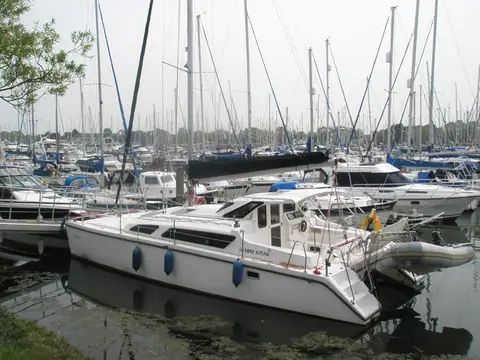
American 34 ft cruising cat with more modern systems and a large US owner base, typically priced higher.
Compare side by sideProut Snowgoose 37
The best-known British cruising cat of the era, longer and with a bigger rig, and a similar emphasis on comfort.
Lagoon 37 TPI
Early Lagoon built in the US, lighter and quicker, with less of the 10M's solid joinery.
Catalac 9M
The smaller, far more common Catalac with sitting headroom in the saloon, at about half the price.
Compare side by sideOur verdict on the Catalac 10M
The Catalac 10M is not the boat for anyone who wants to see double-digit speeds, and Yachting Monthly said as much in 1987. It is the boat for people who want a stable, solidly built home that motors economically, sits upright and keeps its crew comfortable when the weather turns. With only 45 built, you buy the individual boat rather than the model: find one with sorted windows, saildrives and steering, and it will repay you with a level of liveaboard comfort that very few 34 ft yachts can approach.
Catalac 10M questions answered
How much is a Catalac 10M worth?
CatamaranSite records a median sold price of $74,900 across ten sales. Most boats trade between about $55,000 and $100,000 depending on engines, windows and equipment.
How many Catalac 10Ms were built?
Only 45, between 1984 and about 1989. Roughly 18 are believed to be in America.
Is the Catalac 10M the same as the Catalac 34?
Yes. It was sold as the 10M in Europe and the Catalac 34 in the Americas.
Does the Catalac 10M have standing headroom?
Yes. Yachting Monthly measured 6 ft 6 in in the saloon, unlike the smaller 8M and 9M.
What engines does the Catalac 10M have?
Twin Yanmar diesels on saildrives. The 1987 test boat had 18 hp units; many boats now carry 25 to 27 hp engines.
Where can I find a Catalac 10M for sale?
Listings are rare and most are in Europe. Specialist catamaran brokers and owner networks are the best places to watch, and good boats sell quickly.
More sailing catamarans to explore
Broadblue 346
Sailing Catamarans, 34 ft
Used $240K to $360K
Gemini 105Mc
Sailing Catamarans, 34 ft
Used $60K to $150K
Excess 11
Sailing Catamarans, 38 ft
Used $340K to $560K
Catalac 9M
Sailing Catamarans, 30 ft
Used $28K to $55K