Viking Yachts Sportfishing Yachts
Viking 92 Convertible Review, Specs and Used Price
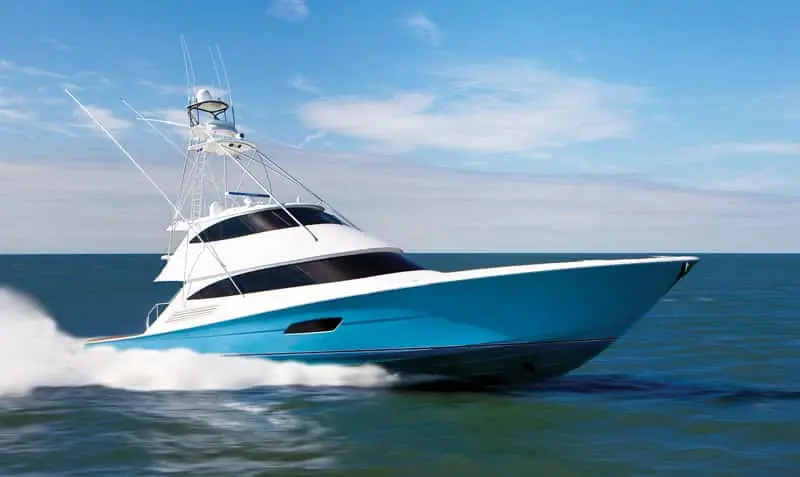
The 93-foot battlewagon that let owners sell a motoryacht and a sportfisherman and keep one boat that does both jobs.
- Length
- 93.3 ft28.45 m
- Beam
- 24.1 ft7.34 m
- Cruise
- 32 kn
- Cabins
- 5 or 6 plus aft crew quarters
- Used price
- $6.5M to $12.5M
On this page
- Overview
- Why the Viking 92 replaced two yachts in many fleets
- A flatter, faster bottom than any Viking before it
- Inside the 238 square foot cockpit
- Tower, electronics and tournament use
- Six staterooms, a full-beam master and a real crew zone
- MTU or Caterpillar, and what the test numbers say
- What a 92 really costs to run
- Reading the 92 brokerage market
- Specifications
- Price and value
- Strengths and weaknesses
- Used buyer checklist
- Rivals
- Our verdict
- FAQ
Viking's largest production convertible, 21 built in New Gretna from 2014 to 2021 in enclosed bridge, open bridge and Skybridge form, with 2,635 hp MTUs, a 238 sq ft cockpit and six staterooms.
- Owners replacing both a motoryacht and a sportfisherman
- International tournament campaigns
- Mothership operations with a chase boat
- Families who cruise as much as they fish
Viking 92 Convertible by the numbers
- Speed to length ratio at cruise
- 3.55A planing cruise. Fast passages in exchange for much higher fuel burn per mile.
- Estimated range at cruise
- 491 nmUsing 90 percent of tank capacity at the cruise speed and fuel burn listed on this page.
- Fuel economy at cruise
- 0.16 nmpgNautical miles per gallon at cruise, both engines combined.
- Horsepower per ton
- 51 hpStrong power to weight for a planing hull.
- Length to beam ratio
- 3.87 : 1A slim, easily driven hull.
Why the Viking 92 replaced two yachts in many fleets
The Viking 92 was announced in 2013, tooled in a 12-piece plug on Viking's five-axis milling machines, and premiered at the 2014 Fort Lauderdale International Boat Show as the largest boat in the company's 50-year history. Hull No. 1 was tested off Atlantic City that fall, and the story every reviewer heard on the dock was the same. Two of the first buyers each owned a big motoryacht and a big convertible, and they were selling both because the 92 could do both jobs.
That is the right way to think about the boat. Below decks the viking 92 is a six-stateroom yacht with a full-beam master and separate crew quarters aft. Behind the saloon door it is a tournament convertible with a 238 square foot cockpit that backs down at 8.5 knots and spins like a 60-footer.
Viking delivered 21 boats in less than seven years, and the model ran in three configurations. The 92 Enclosed Bridge came first and was the largest resin-infused convertible built in the United States at its launch. An open-bridge 92 Convertible followed for owners who fish hard and want to feel the wind at the helm, and the 92 Skybridge split the difference with a climate-controlled bridge that keeps 360-degree sightlines. Viking replaced the whole family with the 90 in 2023, explaining that new emissions rules requiring SCR exhaust treatment made the 92 impractical to keep building.
A flatter, faster bottom than any Viking before it
The 92 broke with Viking tradition below the waterline. The two-step knuckle and the keel that defined older Vikings are gone, and deadrise at the transom drops from about 15 degrees to less than 12. Like the 52 and 62 convertibles of the same era, the hull is drawn to maximize lift and minimize drag, with a common raw-water intake to cut down through-hulls and Viking's VIPER independent electro-hydraulic rudders to reduce toe-in and feather the outside rudder in a turn.
Weight control is the other half of the story. The hull is vacuum infused with end-grain balsa and foam coring, the deckhouse is laminated carbon fiber, and Viking engineers ran Hull No. 1 before and after installing roughly 10,000 pounds of interior furniture and reported almost no change in speed. The boat runs slightly bow up without tabs, which gives the captain room to drop the bow with half tab and bring the finer forward sections into a head sea.
In practice that means a 205,000-pound yacht with real seakeeping. The first test boat ran through 4 to 5 foot seas at better than 30 knots, with about ten feet of freeboard forward keeping the windows dry.
Inside the 238 square foot cockpit
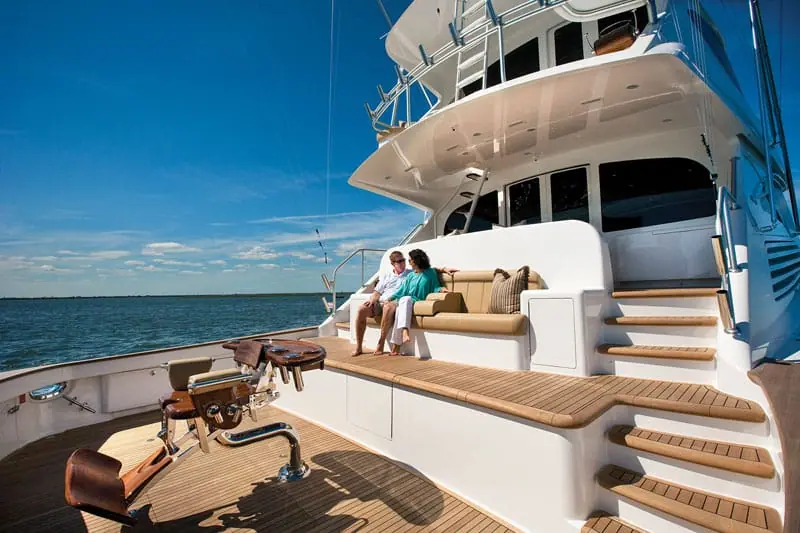
The fishing platform is where the 92 earns its tournament reputation. The cockpit measures 238 square feet, with teak covering boards and a center mounting plate that takes an unlimited-class fighting chair. Because each boat was semi-custom, cockpit layouts vary more than on smaller Vikings, and it pays to read the original build sheet for any boat you are considering.
Live bait capacity is generous. The transom carries a large illuminated fishbox and livewell that can be plumbed in several configurations, and many boats added a second refrigerated livewell in the lower mezzanine. Ice is handled by an Eskimo ice machine, upgraded on many hulls to a 1,000-pound-per-day unit feeding the fishbox, plus a large freezer and dunnage boxes in the sole. Tackle cabinets, fresh and saltwater washdowns and a refrigerated drink box are standard.
The two-tier mezzanine is a signature detail. The owner of Hull No. 1 liked it as a social space, while the owner of Hull No. 2 had the upper seating turned to face aft so everyone aboard is watching the spread rather than each other. That difference tells you a lot about whether a used boat was set up by a fisherman or a cruiser.
- 238 sq ft cockpit with chair plate for an unlimited-class fighting chair
- Transom fishbox and livewell with multiple plumbing configurations
- Optional refrigerated livewell in the lower mezzanine
- Ice maker options up to 1,000 lb per day, plus freezer and dunnage boxes
- Recessed electric teaser reels and Palm Beach Towers tower with minimal cross members
- Aft-facing wing or docking station on enclosed bridge boats to watch the cockpit
Tower, electronics and tournament use
Viking's sister companies build the parts that matter here. Palm Beach Towers designed the 92 tower with as few cross members as possible so the view from the top station is clean, and Atlantic Marine Electronics fitted most boats with triple main monitors on the enclosed bridge plus an aft station so the captain can watch baits during a backdown. Later boats commonly carry Furuno omni sonar, MTU dynamic positioning and a Seakeeper 35 class gyro.
On the tournament circuit the 92 is a mothership as much as a raise-and-release machine, often campaigned in the Bahamas, the Caribbean and Central America with a center console running alongside. The size gives the crew room to rig, sleep and eat properly during a multi-day event, and 3,410 gallons of standard fuel (4,000 optional) means few stops between tournaments.
The trade-off is draft and maneuvering room. At 5 feet 11 inches of draft and 24 feet of beam, a 92 is shut out of some shallow Bahamian harbors and many fuel docks.
Six staterooms, a full-beam master and a real crew zone
Most 92s have five or six staterooms with private heads and a day head on the main deck, so total head count runs from six to eight depending on the plan. The full-beam master amidships was offered with his-and-hers facilities, and dedicated fishermen sometimes traded the second bath for a larger closet and a second laundry, which tells you how custom these boats were.
Separate crew quarters sit aft under the upper mezzanine deck with their own entrance, a bunk room, head, shower and kitchenette. That arrangement matters for resale: a 92 needs at least a captain and a mate, and boats where the crew can live without walking through the owner's spaces are easier to staff.
The enclosed bridge is close to the size of the saloon on a 100-foot motoryacht, with lounge seating and air conditioning. One early buyer who ordered an open bridge switched after standing in it, which explains why EB and Skybridge boats dominate the brokerage fleet.
MTU or Caterpillar, and what the test numbers say
Standard power was a pair of 1,925 hp Caterpillar C32 ACERT diesels, but nearly every buyer chose the optional 2,635 hp MTU 16V2000 M96L engines with ZF transmissions and six-blade VEEM propellers. With the MTUs, Hull No. 1 accelerated from idle to 2,100 rpm and better than 30 knots in about 14 seconds, and Power and Motoryacht recorded 38.5 knots at 2,430 rpm.
Fuel burn is serious money. At 2,000 rpm the test boat made 28.8 knots on 166 gallons per hour, and a fast cruise of 33.1 knots at 2,250 rpm took 212 gallons per hour. Slowing to 12.6 knots cut the burn to 30 gallons per hour and stretched range past 1,500 nautical miles on the 4,000-gallon tankage, which is how most owners make long repositioning runs.
Standard systems included twin 40 kW Onan generators (55 kW optional), a 12-ton chilled-water air conditioning plant, an 1,800-gallon-per-day watermaker, a hydraulic bow thruster and an oil-change system. These are big-yacht systems with big-yacht maintenance.
What a 92 really costs to run
Plan on $1 million to $1.8 million a year before depreciation for a boat that fishes a full tournament season. Full-time crew of two to four, insurance on an eight-figure hull, dockage for a 93-foot boat in South Florida or the Bahamas, fuel, MTU service and a yard period every year drive that number. The MTU 16V2000 has a long service interval, but the major services on a pair of 16-cylinder engines are six-figure events.
Fuel is the most variable line. A boat that runs 400 hours a year at around 200 gallons per hour, the test burn near a 32-knot cruise, uses roughly 80,000 gallons, well over a quarter of a million dollars at 2026 marina prices.
Reading the 92 brokerage market
The viking 92 for sale market is small and specific. Most listings sit between about $6.5 million for early enclosed bridge boats and about $12.5 million for the last Skybridge hulls with low hours, and serious buyers usually shop the 90 Convertible and late 92s side by side. Because the 92 did not need SCR equipment, some owners actually prefer it for simpler engine rooms and lower long-term maintenance.
Bridge type and engine hours are the first filters. A Skybridge with fresh electronics, a Seakeeper, sonar and dynamic positioning sits at the top of the range, while early boats with original electronics and 5,000-plus hours need to be priced for the refit that is coming.
Viking 92 Convertible specifications
| Length overall | 93.3 ft28.45 m |
|---|---|
| Beam | 24.1 ft7.34 m |
| Draft | 5.9 ft1.8 m |
| Displacement | 205, lbs92,986 kg |
| Fuel capacity | 3,41 gal12,908 L |
| Fresh water | 485 gal1,836 L |
| Cabins | 5 or 6 plus aft crew quarters |
| Berths | 10 to 12 guests plus crew |
| Heads | 6 to 8 |
| Standard engines | 2 x Caterpillar C32 ACERT, 1,925 hp each |
| Optional engines | 2 x MTU 16V2000 M96L, 2,635 hp each |
| Maximum power | 5,270 hp |
| Cruise speed | 32 knots |
| Top speed | 38.5 knots |
| Hull type | Modified-V planing hull, under 12 degrees deadrise aft, no keel or knuckle |
| Hull construction | Resin-infused fiberglass with end-grain balsa and foam coring, carbon fiber deckhouse |
| Builder | Viking Yacht Company, United States |
| Naval architect | Viking in-house design and engineering team |
| Other design credits | Tank testing at the Stevens Institute of Technology, Hoboken, New Jersey |
| Production | 2014 to 2021 |
| Status | Discontinued |
Figures come from builder documentation and independent tests where available. Displacement is usually quoted light, so a loaded cruising boat will weigh more. Compare these specs with another model.
Performance data
| RPM | Speed (kn) | Fuel (gph) | Range (nm) |
|---|---|---|---|
| 1000 | 12.6 | 30 | 1519 |
| 1250 | 15.1 | 54 | 1012 |
| 1500 | 19 | 84 | 819 |
| 1750 | 24 | 120 | 721 |
| 2000 | 28.8 | 166 | 627 |
| 2250 | 33.1 | 212 | 564 |
| 2430 | 38.5 | 260 | 507 |
Power and Motoryacht test of Hull No. 1, November 2014, twin 2,635 hp MTU 16V2000 M96L, ZF 5050A gears, 2,250 gal fuel aboard in 4 to 5 foot seas. Ranges as published by Power and Motoryacht.
How much does a Viking 92 Convertible cost?
Hull No. 1 was priced at about $10.2 million as tested in 2014, and a 92 has never been a cheap boat to buy or to sell. The biggest value swings come from bridge type (Skybridge and enclosed bridge boats draw more cruising buyers), engine hours on the MTUs and whether the extended MTU coverage transfers, plus the tower, sonar, dynamic positioning and stabilizer package. A 2020 Skybridge with 3,400 hours was listed at $10.595 million in 2026, which is a fair marker for the middle of the market.
Estimate your yearly cost
A planning estimate using common rules of thumb: insurance near 1.5 percent of value, maintenance near 3 percent, haul out and bottom paint by length. Your marina, region and use will move these numbers. Open the full cost calculator.
Versions and options
- 92 Enclosed Bridge
- The launch configuration from 2014, with a fully enclosed, air-conditioned bridge roughly the size of a large motoryacht saloon and an aft wing station for watching the cockpit.
- 92 Convertible (open bridge)
- Open flybridge with hardtop and walkaround helm for owners who want maximum visibility and feel when fishing, with less interior volume up top.
- 92 Skybridge
- A later hybrid with a climate-controlled bridge and wide glass that keeps 360-degree sightlines, popular with owners who cruise as much as they fish.
Viking 92 Convertible timeline
- 2013Viking announces the 92 and builds its 12-piece plug in New Gretna
- 2014First float in July and premiere at the Fort Lauderdale show as Viking's largest boat yet
- 2021Production ends after 21 deliveries, as IMO Tier III rules requiring SCR exhaust treatment take effect for yachts of 24 meters and up
- 2023The SCR-free Viking 90 debuts at the Miami show and replaces the 92
Strengths and weaknesses
What owners like
- Six-stateroom yacht and 238 sq ft tournament cockpit in one hull
- High-30s top speed and 33-knot fast cruise with the MTU package
- Three bridge styles to suit fishing or cruising priorities
- No SCR exhaust treatment, which simplifies the engine room
- Viking service network and parts support in Florida and New Jersey
What to weigh up
- Seven-figure annual running costs with full-time crew
- Nearly 6 ft draft and 24 ft beam limit some harbors and fuel docks
- Heavy fuel burn at tournament speeds
- Semi-custom builds make every boat different to survey and value
Used Viking 92 Convertible buyer checklist
Take this list to a viewing. Your ticks are saved in this browser so you can come back to it.
Always commission an independent marine survey and an engine survey before you buy. How a marine survey works.
Rivals to consider
Viking 90 Convertible
The SCR-free replacement with CAT or MTU power, six staterooms and a 224 sq ft cockpit, priced well above most used 92s.
Compare side by sideHatteras GT70
Smaller and cheaper to run, with a classic Hatteras ride, but nowhere near the 92's interior volume.
Custom Carolina 80 to 90 footers
Bayliss, Spencer and Jarrett Bay builds offer cold-molded speed and prestige but less production consistency and slower resale.
Our verdict on the Viking 92 Convertible
The Viking 92 is the rare boat that does two expensive jobs well. It is a genuine six-stateroom yacht and a fast, nimble tournament convertible with one of the best big-boat cockpits ever built in production. Running costs are brutal and every hull is a semi-custom puzzle to survey, but for an owner who wants to fish international tournaments and still cruise with family in comfort, a well-kept MTU-powered 92 is easier to justify than two boats, and it avoids the SCR complexity of its replacement.
Viking 92 Convertible questions answered
How much does a Viking 92 cost?
Hull No. 1 was priced at about $10.2 million as tested in 2014. In 2026 used Viking 92s typically list between about $6.5 million and $12.5 million depending on year, bridge type and engine hours.
What is the difference between the Viking 92 Convertible and the 92 Skybridge?
The open-bridge convertible has an exposed helm with a hardtop, while the Skybridge adds a climate-controlled bridge with wide glass and 360-degree visibility. The enclosed bridge version fully closes in the upper deck as a second saloon.
How fast is the Viking 92?
With twin 2,635 hp MTU 16V2000 M96L diesels, tests recorded 38.5 knots at wide open throttle and about 33 knots at 2,250 rpm, burning roughly 212 gallons per hour at that speed.
Why did Viking stop building the 92?
Viking says emissions mandates requiring SCR exhaust treatment made the 92 impractical to keep building, so it invested about $20 million in the SCR-free Viking 90, kept just under 24 meters, which debuted at the Miami show in February 2023.
How many staterooms does a Viking 92 have?
Most have five or six staterooms with private heads, plus a day head and separate aft crew quarters with their own head and kitchenette.
Viking 92 Convertible photos
More sportfishing yachts to explore
Viking 90 Convertible
Sportfishing Yachts, 90 ft
Used $13M to $15.5M
Viking 82 Convertible
Sportfishing Yachts, 83 ft
Used $3.8M to $12.5M
Viking 80 Convertible
Sportfishing Yachts, 81 ft
Used $5.2M to $9M
Viking 72 Convertible
Sportfishing Yachts, 73 ft
Used $1.2M to $8.3M