Viking Yachts Sportfishing Yachts
Viking 60 Convertible, the 60 ft Viking That Dropped the Dropped Bow
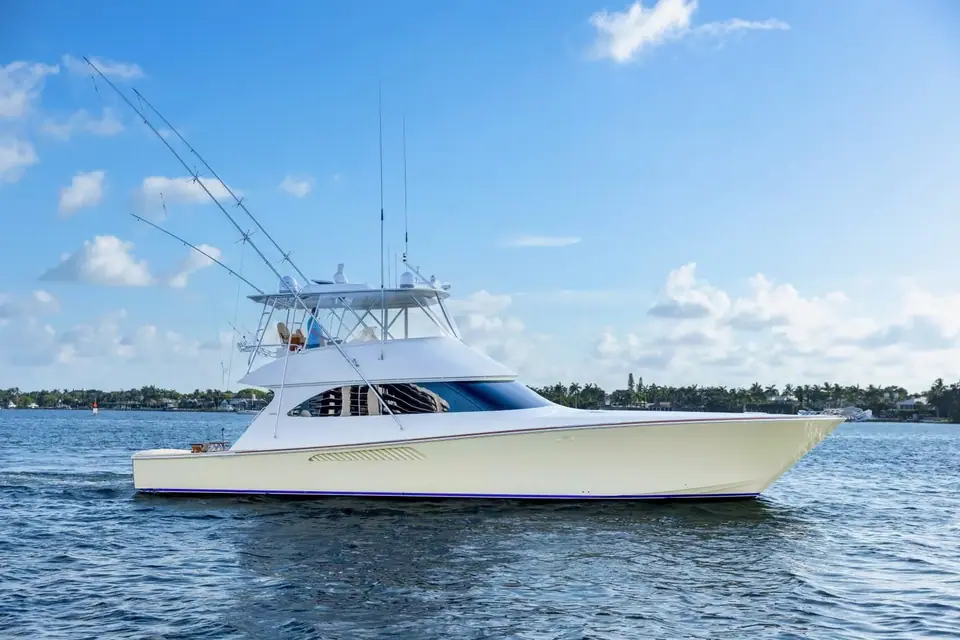
Viking's 2007 to early-2010s 60-footer introduced a convex-section hull, a higher bow and a 42-knot top end with optional Caterpillar C32s.
- Length
- 60.7 ft18.49 m
- Beam
- 18.8 ft5.72 m
- Cruise
- 36 kn
- Cabins
- 3 or 4
- Used price
- $1.5M to $2.45M
On this page
- Overview
- Why many captains call 60 feet the right size
- A higher bow and a convex running surface
- Two sea trials in snotty weather
- A 170 square foot cockpit and a three-chair bridge
- Three or four staterooms and an unusual salon
- Buying a Viking 60 for sale in 2026
- Specifications
- Price and value
- Strengths and weaknesses
- Used buyer checklist
- Rivals
- Our verdict
- FAQ
The Viking 60 Convertible is a 60-foot 8-inch tournament convertible launched in 2007 to replace the Viking 61, with 1,620 gallons of fuel, three or four staterooms, MAN or Caterpillar power and a tested 42-knot top speed.
- Owner-operators with a mate who fish tournaments
- Bahamas and Gulf canyon runs
- Buyers stepping up from a 50 to 55-foot convertible
- Families who want a fourth stateroom
Viking 60 Convertible by the numbers
- Speed to length ratio at cruise
- 4.96A planing cruise. Fast passages in exchange for much higher fuel burn per mile.
- Horsepower per ton
- 80 hpStrong power to weight for a planing hull.
- Length to beam ratio
- 3.24 : 1Moderate proportions.
Why many captains call 60 feet the right size
Plenty of people searching for a 60 ft Viking are really asking a size question. Yachting's 2008 review put it neatly: many consider 60 feet the perfect length for a sportfisherman, small enough to spin on a hot fish and big enough for three or four staterooms, a real salon and galley, a roomy cockpit and plenty of bridge seating. The Viking 60 Convertible was built for exactly that buyer, the owner who has outgrown a 50-something but does not want the crew, dockage and fuel bills of a 70.
Viking launched the 60 in 2007 as the replacement for its well-regarded 61, which it built from 2001 to 2006. The company was emphatic that the 60 was not an updated 61. It has a different hull, a different look and a different construction schedule, and it was the first boat of a new styling direction that the 50 and the first 82 would follow in 2008 and 2009.
A higher bow and a convex running surface
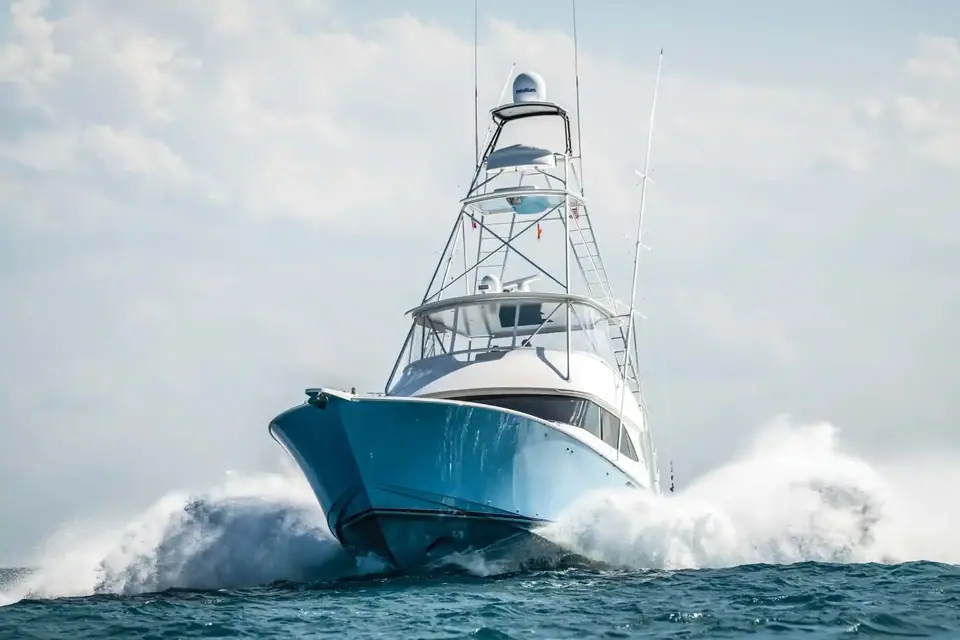
The most visible change was the end of Viking's trademark dropped bow. The 60 has a higher sheer forward, a more aggressively raked stem and more camber in the foredeck, with a gentle upsweep at the aft end of the side windows. Power and Motoryacht's tester measured about 7 feet of freeboard at the bow and about 2.5 feet aft, enough to keep water out but low enough for an easy gaff shot.
Below the waterline the 60 borrowed from the 68 and the 54 of 2006. Forward sections are convex rather than the 61's slightly concave shape, which softens the landing in a head sea and throws the wake farther aft for a drier ride. Aft, Viking took out three degrees of deadrise, leaving the transom at about 12 degrees for better lift, quicker planing and steadier behavior on the drift. Viking also shifted weight aft and changed the running angle.
Construction is fully cored and vacuum bagged: high-density end-grain balsa in the bottom, lower-density balsa in the sides, decks and superstructure, and PVC foam in bulkheads and stringers. Viking's five-axis CNC profiler cut the molds for the deckhouse, bridge and helm console, which is where the crisp feature lines come from. The weight is not trivial. Power and Motoryacht estimated about 91,300 pounds with the standard 1,620 gallons aboard, against a 73,000-pound dry figure quoted elsewhere.
Two sea trials in snotty weather
Both magazine tests of the 60 happened in conditions most owners would avoid, which makes them more useful. Power and Motoryacht ran the boat in 25-plus knots of wind and 4 to 6-foot seas and held a true 27 knots into it without a hiccup. In calmer water the optional twin 1,825 hp Caterpillar C32 ACERTs, with ZF 2070A gears at 2.25:1 and five-blade Veem props with Interceptor inserts, produced an average top speed of 48.2 mph (about 42 knots) and an easy 41.4 mph (about 36 knots) cruise.
Yachting went out an inlet with solid 8-footers breaking across it and saw the boat negotiate it at 18 to 20 knots, then average around 25 knots in 6 to 8-foot seas with a few big waves forcing the throttles back. Marlin quoted almost 36 knots at cruise and a top end of at least 40 with the Cats, and estimated around 37 knots top with the standard 1,550 hp MANs.
Handling drew praise across the board. SeaStar power-assisted steering made the boat feel like a runabout in hard-over turns, she did not heel excessively, and backing down hard both up and down sea only put water on the deck when the tester was trying to.
A 170 square foot cockpit and a three-chair bridge
Power and Motoryacht measured 170 square feet of cockpit including the mezzanine seating. Under the mezzanine is bait stowage with Viking-logo trays, there is a 14-cubic-foot in-deck livewell with macerator, and two more in-deck wells can be converted to livewells. Marlin noted refrigerated boxes that make a deck cooler unnecessary, gaff, mop and chamois stowage under the side decks, and an engine room reached through the mezzanine, which means lifting the seat back and cushion first. Customers chose the placement of livewells, freezers and grills, so no two cockpits are identical.
On the bridge, a center island helm is flanked by long bench seats with walkways, a forward-facing bench sits ahead of the console, and three teak ladder-back chairs line the helm. The Palm Beach-style console takes three 16-inch displays behind acrylic doors, and there is a chest freezer, drink box and freshwater washdown. One small complaint from Power and Motoryacht: trim tab controls sit under the console where the driver cannot see them.
A practical touch for shallow slips is the fuel transfer system. From the bridge you can move fuel between tanks to trim the boat, and Marlin said shifting fuel forward recovers about five inches of draft.
Three or four staterooms and an unusual salon
Viking offered four lower-deck layouts. Every version puts the master to port with an oblique queen berth, a large hanging locker and a private head with shower. The forepeak takes a centerline queen as standard or optional oblique berths, and the starboard cabin has fore-and-aft twins or an upper single over an oversized twin. The forward cabin has its own head, and the third head doubles as a day head. A 2017 brokerage listing describes a typical three-stateroom, three-head boat.
The salon departs from Viking convention by putting both the dinette and the L-shaped settee to starboard, with the galley and its island opposite, which makes the space feel more open. Rod storage hides under the settee on gas struts. This was also the first Viking in Marlin's memory to offer a satin varnish instead of high-gloss teak.
Systems were advanced for 2007. A Moritz Octoplex multiplexed power system with touch screens let the captain monitor and control the boat's electrics from the bridge, and Marlin reported it saved about 1,000 pounds of wiring and panels. On a 15-plus-year-old boat, that system deserves a specialist look during survey.
Buying a Viking 60 for sale in 2026
Most of the market is 2008 to early-2010s boats, and Viking's next model in this bracket, the 62 Convertible, debuted in February 2013. Asking prices have been remarkably stable: $1.6 million to $2.45 million in 2020 and a refitted 2008 boat at $1.85 million in 2026. That stability reflects strong demand for 60-foot tournament boats and the fact that a new Viking of this size now costs several times as much.
Budget roughly $220,000 to $400,000 a year to run one with a captain, depending on how many tournaments you fish. The C32s and MANs are proven engines, but a 1,000-hour service, a set of exhausts or an overhaul quickly reaches six figures, which is why the best-value boats are the ones where the previous owner already paid for it. The 2026 listing that included overhauled engines, new exhausts, new isolation mounts and a Seakeeper is a good model of what to look for.
Viking 60 Convertible specifications
| Length overall | 60.7 ft18.49 m |
|---|---|
| Beam | 18.8 ft5.72 m |
| Draft | 5.1 ft1.55 m |
| Displacement | 91,3 lbs41,413 kg |
| Fuel capacity | 1,62 gal6,132 L |
| Fresh water | 3 gal1,136 L |
| Cabins | 3 or 4 |
| Berths | 6 to 8 |
| Heads | 3 |
| Standard engines | 2 x MAN V12 1550 CRM, 1,550 hp each |
| Optional engines | 2 x Caterpillar C32 ACERT, 1,825 hp each |
| Maximum power | 3,650 hp |
| Cruise speed | 36 knots |
| Top speed | 42 knots |
| Range | 485 nm |
| Hull type | Modified-V planing hull, convex sections forward, flatter aft sections, about 12 degrees transom deadrise |
| Hull construction | Vacuum-bagged fiberglass with high-density end-grain balsa in the bottom, lighter balsa in the sides and decks, PVC foam in bulkheads and stringers |
| Builder | Viking Yacht Company, United States |
| Naval architect | Viking Yachts in-house design team |
| Production | 2007 to present |
| Status | Discontinued |
Figures come from builder documentation and independent tests where available. Displacement is usually quoted light, so a loaded cruising boat will weigh more. Compare these specs with another model.
How much does a Viking 60 Convertible cost?
The base price in 2008 was $2,241,000 with MAN power, and Power and Motoryacht's Caterpillar-powered test boat came to $3,105,434. In late 2020 Yachting counted four Viking 60s for sale from $1.6 million to $2.45 million, a 2008 boat with 2,025 hours was asking $1.749 million in 2017, and a refitted 2008 boat with overhauled C32s and a Seakeeper 18 was listed at $1.85 million in mid-2026. Engine overhauls, a gyro retrofit and modern electronics matter far more than model year in this market.
Estimate your yearly cost
A planning estimate using common rules of thumb: insurance near 1.5 percent of value, maintenance near 3 percent, haul out and bottom paint by length. Your marina, region and use will move these numbers. Open the full cost calculator.
Versions and options
- 60 Convertible (open bridge)
- Center island helm, three helm chairs and a 170 sq ft cockpit with mezzanine; the most common version.
- 60 Enclosed Bridge
- Climate-controlled bridge version of the same hull, also reviewed by Yachting.
- MAN or Caterpillar power
- Standard twin 1,550 hp MAN V12 1550 CRMs or optional twin 1,825 hp Caterpillar C32 ACERTs.
Viking 60 Convertible timeline
- 2001Viking 61 Convertible enters production, built through 2006
- 2007All-new 60 Convertible announced with convex hull sections and higher bow
- 2008Power and Motoryacht records about 42 knots with optional Cat C32 ACERTs; base price $2,241,000
- 2013Viking 62 Convertible debuts as the next model in the size range
- 2026Refitted 2008 boats still list near $1.85 million
Strengths and weaknesses
What owners like
- Dry, soft head-sea ride from the convex forward sections
- About 42 knots with the Caterpillar option
- Roughly 485 nm range at a 36-knot cruise
- Three or four stateroom plans with three heads
- Bridge-controlled fuel transfer to trim and reduce draft
- Stable resale values
What to weigh up
- Engine room access through the mezzanine is awkward
- Octoplex system on older boats needs specialist support
- Heavy for its length with full fuel
- Trim tab controls hidden under the console
Used Viking 60 Convertible buyer checklist
Take this list to a viewing. Your ticks are saved in this browser so you can come back to it.
Always commission an independent marine survey and an engine survey before you buy. How a marine survey works.
Rivals to consider
Viking 58 Convertible
The current Viking alternative near this size, far newer and far more expensive.
Compare side by sideHatteras GT59
Heavier North Carolina rival with a different ride and its own loyal following.
Compare side by sideViking 54 Convertible
Slightly smaller and newer, with similar MAN power and a similar price on the brokerage market.
Compare side by sideOur verdict on the Viking 60 Convertible
The Viking 60 Convertible is one of the best value tournament boats from the late-2000s Viking lineup. Its convex-section hull rides better than the 61 it replaced, it runs about 42 knots with the Cats, and three heads and up to four staterooms make it livable for a crew. Prices have held near $1.6 million to $2.45 million for years, so buy the boat with the freshest engines, a gyro and current electronics, and let the survey decide between otherwise similar hulls.
Viking 60 Convertible questions answered
How much does a Viking 60 cost?
Used Viking 60 Convertibles generally ask $1.5 million to $2.45 million. The 2008 base price was $2,241,000 with MAN power.
What is the range of a Viking 60?
Power and Motoryacht calculated 558 statute miles, about 485 nautical miles, at a 36-knot cruise on the standard 1,620 gallons; an option raises capacity to 1,920 gallons.
How fast is a 60 foot Viking?
With optional twin 1,825 hp Caterpillar C32s, testers recorded about 42 knots top and a 36-knot cruise. Marlin estimated about 37 knots top with the standard 1,550 hp MANs.
When was the Viking 60 Convertible built?
Viking introduced it in 2007, and most boats on the market are 2008 to early-2010s hulls. The 62 Convertible followed in February 2013.
How many staterooms does the Viking 60 have?
Three or four, depending on which of four layouts was ordered, with three heads.
What did the Viking 60 replace?
It replaced the Viking 61 Convertible, which was built from 2001 to 2006.
Viking 60 Convertible photos
More sportfishing yachts to explore
F&S Custom Express Sportfish
Sportfishing Yachts, 61 ft
Used $1.4M to $7M
Hatteras GT59
Sportfishing Yachts, 60 ft
Used $2.4M to $4.2M
Viking 58 Convertible
Sportfishing Yachts, 59 ft
Used $300K to $4.8M
Bertram 54 Convertible
Sportfishing Yachts, 57 ft
Used $150K to $1.5M