Viking Yachts Sportfishing Yachts
Viking 70 Convertible Guide to the First and Second Generations
Viking's 70-foot nameplate returns in 2026 with a narrower, four-stateroom Gen II, while the 2010 to 2016 original remains a sought-after brokerage boat.
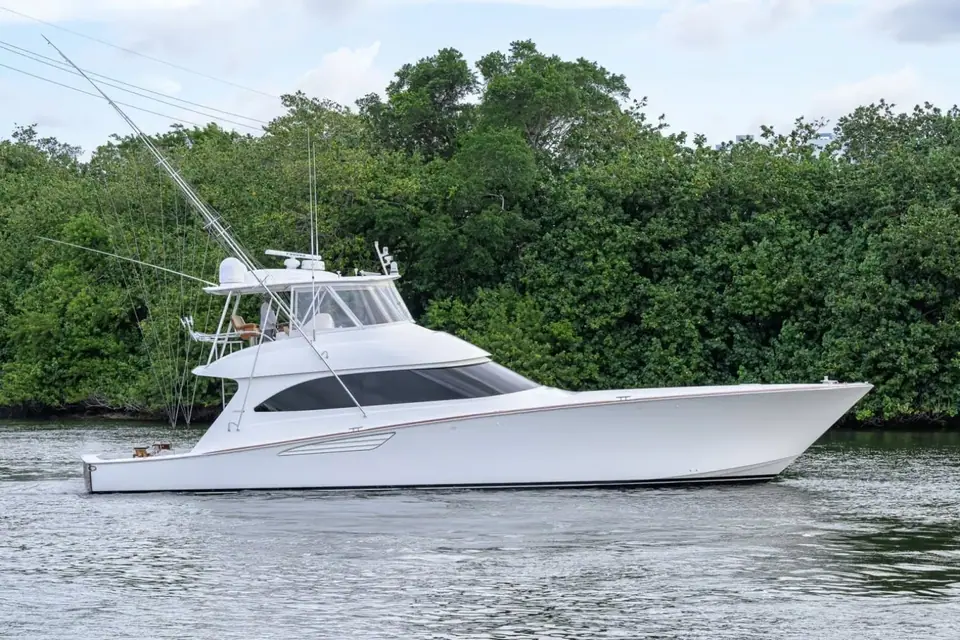
- Length
- 70.8 ft21.59 m
- Beam
- 18.9 ft5.77 m
- Cruise
- 5.5 ft1.68 m
- Cabins
- 4 plus crew stateroom
- Used price
- $2.4M to $4.2M
On this page
- Overview
- Why the Viking 70 name is back
- The Gen II hull, narrower than the 68 by design
- A longer cockpit and a four-stateroom, five-head interior
- The 2010 to 2016 boat that won the circuit
- Buying a first-generation 70 for sale
- Crew, fuel and the real cost of a 70
- Specifications
- Price and value
- Strengths and weaknesses
- Used buyer checklist
- Rivals
- Our verdict
- FAQ
The Viking 70 Convertible name covers a 2010 to 2016 tournament boat that ran 43.7 knots on twin 2,600 hp MTUs and a second-generation 70 premiering at the 2026 Fort Lauderdale show with 2,200 hp MAN or 2,222 hp MTU power.
- Tournament teams running 100-plus miles a day
- Owners stepping up from a 60 to 64-foot convertible
- Long-range Bahamas and Caribbean fishing
- Buyers who want a crew cabin without going to 80 feet
Viking 70 Convertible by the numbers
- Horsepower per ton
- 75 hpStrong power to weight for a planing hull.
- Displacement hull speed
- 10.5 knThe efficient cruising speed for a displacement hull of this waterline.
- Length to beam ratio
- 3.74 : 1A slim, easily driven hull.
Why the Viking 70 name is back
Anyone searching for a viking 70 in late 2026 will hit two different boats. The first Viking 70 Convertible arrived in 2010 and was replaced by the 72 in 2016 after a run that Yachting put at 36 hulls including Enclosed Bridge models, while Viking's engineering team has cited about 40. The second-generation 70 Convertible was announced in 2026 and makes its world premiere at the Fort Lauderdale International Boat Show that October, as an open-bridge boat with a Palm Beach Towers tower. Viking also offers it as an Enclosed Bridge and a Sky Bridge.
Viking says it has delivered 220 yachts between 68 and 72 feet, which is why it keeps returning to this size. A 70-footer can run 100-plus miles to the fishing grounds every day of a tournament week, sleep a team and a crew, and still spin on a fish like a much smaller boat. This guide covers both generations, because most 70 ft Viking buyers will compare a used first-generation boat with a new order.
The Gen II hull, narrower than the 68 by design
Viking design manager David Wilson's team continued the length-to-beam progression established on the 74, 82 and 90, so the new 70 is three inches narrower than the Gen II 68. Viking's specifications list 70 feet 10 inches overall, an 18-foot 11-inch beam, a 5-foot 6-inch draft and 118,500 pounds with standard fuel. Yachting reports 12.3 degrees of transom deadrise, 7 feet 11 inches of freeboard forward and 3 feet 1 inch aft, with changes to deadrise, chine placement and strake geometry aimed at a smoother, drier, more efficient ride.
The hull is resin infused with end-grain balsa core and strategically placed Corecell foam. Running gear is part of Viking's Advanced Propulsion System: flow-aligned rudders and struts, prop pockets that reduce shaft angle and draft, Veem Interceptor propellers on Aquamet shafts, and electronic power steering.
Power choices are the MAN V12X 2200 at 2,200 hp and the MTU 12V2000 M96Z at 2,222 hp, with Yachting also listing a standard 1,550 hp MAN package. Viking's stated performance goal is to match its latest 68 demo boat, which reached about 43 knots on twin 2,200 hp MANs. Until Hull No. 1 has been independently tested, treat that as a target rather than a number.
A longer cockpit and a four-stateroom, five-head interior
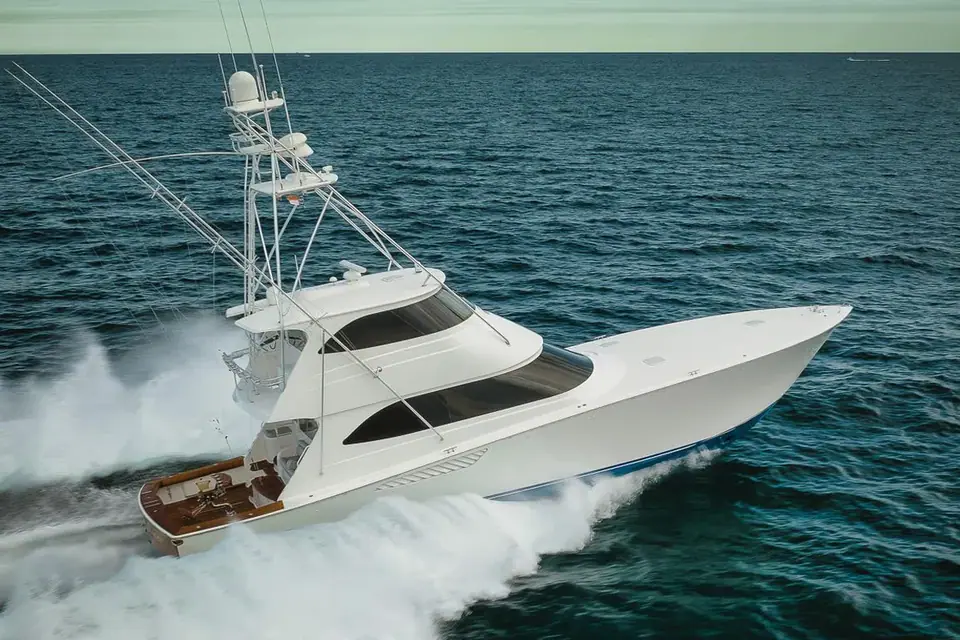
Viking lengthened the cockpit and engineered the extra length into the hull and machinery layout from the start so trim and sightlines stay balanced. Yachting measures it at 194 square feet, with a transom livewell, an aluminum backing plate for a fighting chair, mezzanine seating with a bait freezer, four flush rod holders and split-lid in-sole fishboxes as standard. The flybridge has a reshaped overhang, a repositioned center console with flush-mounted displays, three helm chairs, a forward lounge and back-to-back lounges to port and starboard.
Inside, a day head sits immediately to starboard of the salon door, followed by the electrical panel, bottle storage and a pop-up TV. The salon has an L-shaped settee to port, a raised dinette to starboard with rod storage below, and a galley in either peninsula or island form. Below are a large master, a forward VIP and guest staterooms, plus a crew stateroom aft with private access to the engine room. Joinery is horizontal-grain walnut from Viking's in-house woodshop.
The 2010 to 2016 boat that won the circuit
The first 70 was a statement of how far Viking had pushed big-boat speed. Power and Motoryacht tested it in 2010 with optional 2,600 hp MTU 16V2000 M94s, an $899,000 upcharge on a $3,742,000 base, and recorded an average 43.7 knots (50.3 mph) at 2,450 rpm on 274 gph. At 1,750 rpm it cruised at 32.2 knots on 130 gph, and at 2,000 rpm it made 37.3 knots on 172 gph. Viking's captain Ryan Higgins preferred about 39 knots at 2,100 rpm for 150-mile canyon day trips out of Cape May. Marlin's test topped out at just over 44 knots.
Specs for the original are 70 feet 11 inches overall, a 19-foot 7-inch beam and a 5-foot 8-inch draft, with Marlin listing 127,859 pounds, 2,068 gallons of fuel and 11.8 degrees of transom deadrise. A 600-gallon auxiliary tank was optional. Steering was Viking's VIPER electro-hydraulic system, which adjusts rudder toe to sharpen turns, and the boat could back down at more than 7 knots in Marlin's test.
Standard power was a pair of 1,550 hp MANs, with MAN, Caterpillar and MTU options up to 2,600 hp. The Viking team boat that Power and Motoryacht tested had already released 53 white marlin in 24 hours in early September, and later Viking 70s kept turning up in tournament results. The original layout put two crew berths beside the engine room, an amidships master to port, a bunk cabin and a forward queen cabin, and Marlin observed that Viking had fit essentially the whole Viking 74 interior into it.
Buying a first-generation 70 for sale
Viking 70 for sale listings in 2024 to 2026 ranged from $2.549 million to $3.895 million. The spread is mostly about engines and upgrades. The 2011 Enclosed Bridge at the low end had 2,030 hp MTU M91s with about 3,000 hours, while the 2014 Convertible near the top had the Viking Performance Package with 2,600 hp MTU M94s, carbon fiber in key areas, a factory Seakeeper 26 and extra fuel. Several boats have also had omni sonar, Starlink and modern Garmin or Furuno packages added.
Be careful with listing specs. At least one brokerage summary for a 2014 boat quotes the second-generation dimensions of 70 feet 10 inches and 18 feet 11 inches, which belong to the 2026 boat. The original is 19 feet 7 inches wide.
- First-generation LOA 70 ft 11 in, beam 19 ft 7 in, draft 5 ft 8 in
- Fuel about 2,068 to 2,100 gal standard, 600 gal auxiliary tank optional
- Power and Motoryacht test with 2,600 hp MTU M94s: 43.7 knots top, 37.3 knots at 172 gph
- Cockpit 206 sq ft (Power and Motoryacht) or 208 sq ft (brokerage data)
Crew, fuel and the real cost of a 70
A 70-foot convertible is a crewed boat. Expect roughly $450,000 to $800,000 a year for a captain and mate, insurance, a 75-foot slip, MTU or MAN servicing, gyro and generator maintenance and fuel. Power and Motoryacht's 172 gph at 37 knots means a 150-mile round trip burns roughly 700 gallons, and a busy tournament season can run past 30,000 gallons.
The engine room is designed to make that bill manageable. The Gen II carries a Spot Zero double-pass watermaker and purification system, ElectroSea raw-water treatment, Viking's ventilation and fire suppression, and Snow White Awlgrip paint so leaks are easy to spot. Original 70s had twin 27.5 kW Onan generators and a centralized raw-water system using two pool pumps, which are cheap and easy to replace almost anywhere.
Viking 70 Convertible specifications
| Length overall | 70.8 ft21.59 m |
|---|---|
| Beam | 18.9 ft5.77 m |
| Draft | 5.5 ft1.68 m |
| Displacement | 118,5 lbs53,751 kg |
| Fuel capacity | 2,027 gal7,673 L |
| Fresh water | 345 gal1,306 L |
| Cabins | 4 plus crew stateroom |
| Berths | 8 to 10 |
| Heads | 5 (including salon day head) |
| Standard engines | 2 x MAN diesels, 1,550 hp each (Gen II, per Yachting) |
| Optional engines | 2 x MAN V12X 2200, 2,200 hp each; 2 x MTU 12V2000 M96Z, 2,222 hp each |
| Maximum power | 4,444 hp |
| Hull type | Modified-V planing hull with prop pockets, 12.3 degrees transom deadrise (Gen II) |
| Hull construction | Resin-infused fiberglass with end-grain balsa and Corecell foam (Gen II); vacuum-bagged Baltek balsa-cored hull (Gen I) |
| Builder | Viking Yacht Company, United States |
| Naval architect | Viking Yachts design and engineering team (Gen II led by design manager David Wilson) |
| Production | 2010 to present |
| Status | In production |
Figures come from builder documentation and independent tests where available. Displacement is usually quoted light, so a loaded cruising boat will weigh more. Compare these specs with another model.
Performance data
| RPM | Speed (kn) | Fuel (gph) | Range (nm) |
|---|---|---|---|
| 1750 | 32.2 | 130 | |
| 2000 | 37.3 | 172 | |
| 2450 | 43.7 | 274 |
First-generation Viking 70 with twin 2,600 hp MTU 16V2000 M94 diesels, Power and Motoryacht test, flat calm, 67 percent load at 1,750 rpm. Figures from the article text; range not tabulated.
How much does a Viking 70 Convertible cost?
Viking had not published a price for the second-generation 70 when this guide was written, so new pricing is left blank. On the brokerage side, first-generation boats listed in 2024 to 2026 at $2.549 million for a 2011 Enclosed Bridge with MTU M91s and about 3,000 hours, $3.499 million for a 2012 Enclosed Bridge with 2,600 hp MTUs, and $3.895 million for a 2014 Convertible with the Performance Package and extra fuel. MTU M94 power, a Seakeeper and recent refits are the main price drivers.
Estimate your yearly cost
A planning estimate using common rules of thumb: insurance near 1.5 percent of value, maintenance near 3 percent, haul out and bottom paint by length. Your marina, region and use will move these numbers. Open the full cost calculator.
Versions and options
- 70 Convertible Gen I (2010 to 2016)
- 70 ft 11 in, 19 ft 7 in beam, MAN, Caterpillar or MTU power from 1,550 to 2,600 hp, about 43 to 44 knots with the big MTUs.
- 70 Enclosed Bridge Gen I
- Climate-controlled bridge version of the original, with interior staircase access and an aft control station.
- 70 Convertible Gen II (2026 on)
- 70 ft 10 in, 18 ft 11 in beam, four staterooms and five heads, MAN V12X 2200 or MTU 12V2000 M96Z power.
- 70 Enclosed Bridge and Sky Bridge Gen II
- Viking lists both alongside the open-bridge Gen II 70.
Viking 70 Convertible timeline
- 2010First Viking 70 Convertible launches; Power and Motoryacht records 43.7 knots
- 2013Viking's 70 team boat flies 21 white marlin flags in an overnighter off Cape May
- 2016Viking 72 replaces the 70 after 36 to 40 hulls
- 2026Second-generation 70 Convertible announced with MAN V12X 2200 or MTU 12V2000 M96Z power
- 2026Gen II 70 scheduled for its world premiere at the Fort Lauderdale International Boat Show
Strengths and weaknesses
What owners like
- First generation tested at 43.7 knots with MTU M94s
- Gen II is narrower than the 68 for a better ride
- Four staterooms plus crew quarters on both generations
- Salon day head right inside the door
- Gen II cockpit lengthened to about 194 sq ft
- Strong tournament reputation and resale
What to weigh up
- No independent test data yet for the Gen II
- New price not published
- Crewed-boat running costs
- Listing specs often mix the two generations
- Older boats carry 10 to 15-year-old systems
Used Viking 70 Convertible buyer checklist
Take this list to a viewing. Your ticks are saved in this browser so you can come back to it.
Always commission an independent marine survey and an engine survey before you buy. How a marine survey works.
Rivals to consider
Viking 72 Convertible
The 2016 successor to the first 70, faster and roomier, and the boat most Gen I buyers also look at.
Compare side by sideViking 58 Convertible
A smaller owner-operator alternative for buyers who do not want a full-time crew.
Compare side by sideHatteras GT59
A heavier North Carolina convertible at a lower price, with less top speed.
Compare side by sideViking 80 Convertible
The next step up in Viking's big-boat range for crews who need five staterooms.
Compare side by sideOur verdict on the Viking 70 Convertible
The Viking 70 is really two decisions. A first-generation boat with 2,600 hp MTUs is still a genuine 40-knot tournament weapon for $2.4 million to $4.2 million, as long as the engines and systems have been looked after. The 2026 Gen II brings the hull refinements of the 74, 82 and 90 down to 70 feet, adds a longer cockpit and five heads, and will cost far more. Wait for independent sea trial numbers on the new boat, and if you buy an old one, buy the engines and the service history first.
Viking 70 Convertible questions answered
How much is a Viking 70?
First-generation Viking 70s listed from about $2.55 million to $3.9 million between 2024 and 2026. Viking had not published pricing for the 2026 second-generation boat.
How fast is a Viking 70?
Power and Motoryacht recorded 43.7 knots on a 2010 boat with twin 2,600 hp MTUs. Viking's target for the Gen II is about 43 knots, matching its latest 68 demo boat.
How many Viking 70s were built?
Yachting puts the first generation at 36 hulls from 2011 to 2016 including Enclosed Bridge boats; Viking's engineering team has cited about 40 since 2010.
What is the new Viking 70 Convertible?
A second-generation 70 that is 70 feet 10 inches long with an 18-foot 11-inch beam, four staterooms and five heads, premiering at the 2026 Fort Lauderdale show.
What engines does the new Viking 70 use?
Twin MAN V12X 2200 diesels at 2,200 hp or twin MTU 12V2000 M96Z at 2,222 hp, with a 1,550 hp MAN package also listed by Yachting.
How much fuel does a Viking 70 carry?
The Gen II carries 2,027 gallons standard and 2,530 optional. The original carried about 2,068 to 2,100 gallons plus an optional 600-gallon tank.
Viking 70 Convertible photos
More sportfishing yachts to explore
Viking 72 Convertible
Sportfishing Yachts, 73 ft
Used $1.2M to $8.3M
Viking 80 Convertible
Sportfishing Yachts, 81 ft
Used $5.2M to $9M
F&S Custom Express Sportfish
Sportfishing Yachts, 61 ft
Used $1.4M to $7M
Viking 60 Convertible
Sportfishing Yachts, 61 ft
Used $1.5M to $2.45M