F&S Boatworks Sportfishing Yachts
F&S Boats for Sale, a Guide to F&S Custom Express Sportfish Yachts
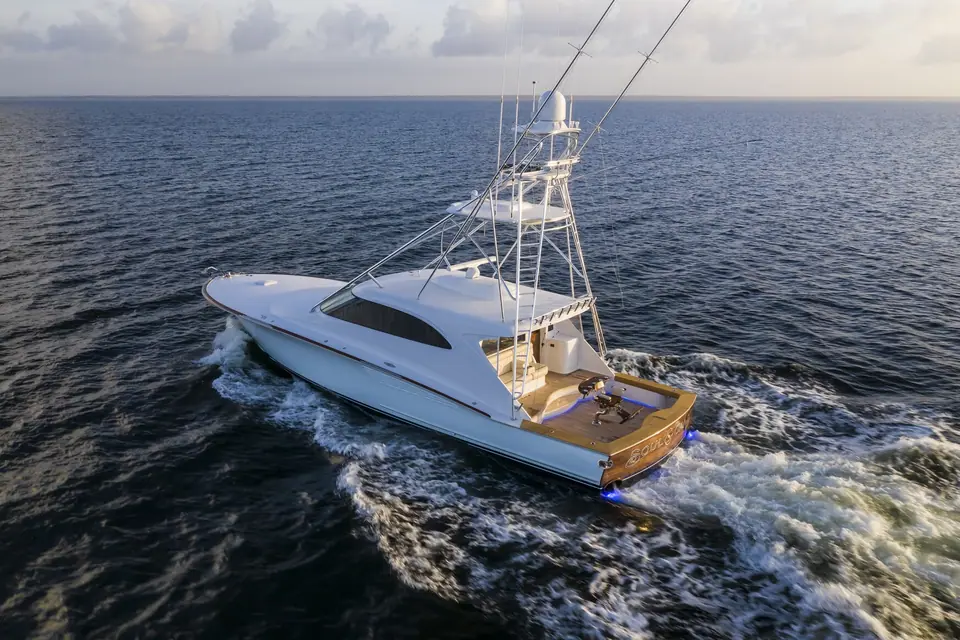
Cold-molded, hand-built express sportfishermen from Bear, Delaware, riding on a longitudinally stepped variable-deadrise hull inspired by the SeaCraft.
- Length
- 61 ft18.59 m
- Beam
- 18 ft5.49 m
- Cruise
- 35 kn
- Cabins
- Custom to each owner
- Used price
- $1.4M to $7M
On this page
- Overview
- Why F&S boats for sale are so hard to find
- From a 23-foot SeaCraft to a Delaware sportfish yard
- The stepped, variable-deadrise bottom explained
- Soul Candy, the 61-foot hardtop express
- Full Throttle, the 64-foot express that keeps up with center consoles
- Express or convertible, choosing the F&S layout
- Buying and owning a custom F&S
- Specifications
- Price and value
- Strengths and weaknesses
- Used buyer checklist
- Rivals
- Our verdict
- FAQ
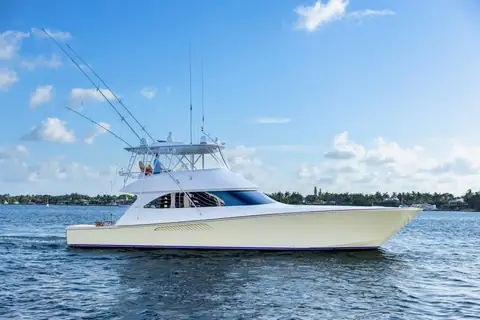
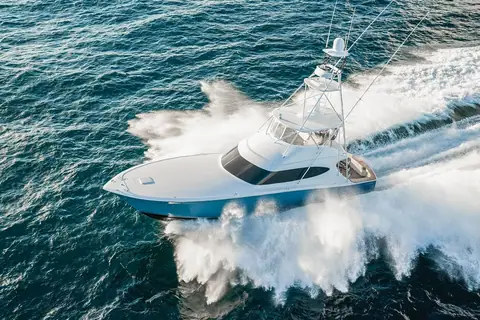
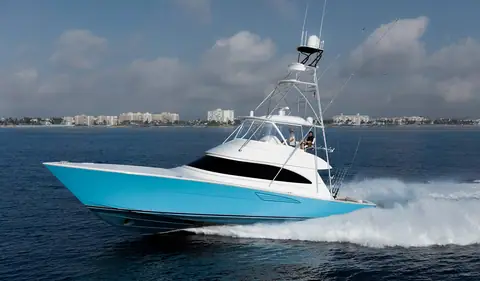
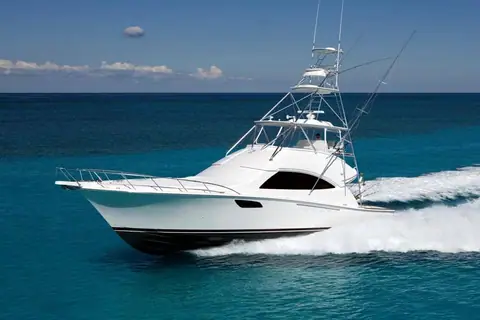
F&S Boatworks of Bear, Delaware, builds custom cold-molded sportfish yachts, mostly convertibles, plus a few hardtop expresses such as the 61-foot Soul Candy and the 64-foot Full Throttle. All ride on F&S's longitudinally stepped, variable-deadrise hull.
- Owner-operators who want to drive from the main deck
- Gulf of Mexico and Bahamas billfishing
- Buyers who prize ride quality in rough water
- Owners seeking a one-off custom boat
F&S Custom Express Sportfish by the numbers
- Speed to length ratio at cruise
- 4.80A planing cruise. Fast passages in exchange for much higher fuel burn per mile.
- Horsepower per ton
- 107 hpVery high power to weight, built for speed.
- Length to beam ratio
- 3.39 : 1Moderate proportions.
Why F&S boats for sale are so hard to find
F&S boats for sale turn up rarely because there are not many of them. F&S Boatworks, which now markets itself as F&S Yachts, builds every boat by hand in Bear, Delaware, with no assembly line, and its own fleet list runs to about 34 hull numbers since the first boat in 1996, several of them still in progress. Most are convertibles with flybridges. The custom express sportfish, a hardtop boat with the helm on the main deck, is the rarest F&S of all.
That makes this page a guide to a family rather than a single production model. We focus on the two expresses F&S publishes details for: hull No. 22, the 64-foot Full Throttle, and hull No. 30, the 61-foot Soul Candy. Both share the hull concept and construction that define every F&S, and both show what an owner can expect from a custom Delaware express.
From a 23-foot SeaCraft to a Delaware sportfish yard
The F&S story starts with a small boat. Jim Floyd, a master carpenter who became a longshoreman in the 1970s, found his inspiration in his family's 23-foot SeaCraft, a boat famous for its ride (F&S dates the family's SeaCraft years to the early 1980s). Floyd watched it handle waves that would have finished most boats its size. The family later spent years chasing pelagics in the Northeast canyons and built a relationship with the custom builders of Wanchese, North Carolina, working with Ricky Scarborough Sr. on several custom sportfish and learning cold-molded construction.
In 1996 Floyd began building the boat that became hull No. 1, the roughly 58- to 59-foot Fin-Ally (F&S lists 58 feet in her specs; Yachting describes her as a 59-footer). His idea was to marry the flare of a custom Carolina boat with the longitudinally stepped, variable-deadrise bottom that SeaCraft designer Carl Moesly had patented, and F&S later collaborated with Moesly directly. Floyd's nephew, John Floyd Jr., who holds degrees in finance, joined as a project manager and is now the company's president.
The yard sits on the Chesapeake and Delaware Canal next to Summit Marina, south of Bear. F&S puts it simply: the only place you can get an F&S is Delaware.
The stepped, variable-deadrise bottom explained
Every F&S runs on the same idea. Instead of one deep-V surface, the bottom is built from panels mounted on each side of a solid keel, each at a different deadrise angle and separated by deeply molded longitudinal steps. F&S says the steps are of release rather than pressure design, aerating the water along the bottom to reduce friction and soften the ride, and that the vertical faces of the steps act like multiple keels for directional stability in following seas.
At speed, F&S explains, the second step-up panels become the main lateral stabilizers and the chines may run clear of the water; at rest or slow trolling, the submerged chines and flatter outer panels resist roll and give lift for quick planing. The builder also claims the stepped bottom produces cleaner water behind the boat than tunnel designs, which helps baits run close to the transom. Marlin magazine, quoted by F&S, said most skippers who run the boats rave about the bottom.
The structure supports the ride. F&S hulls use tall, clear vertical-grain Douglas fir stringers and cold-molded okoume skins: three layers of half-inch okoume plywood on the bottom, with an extra inch in the engine room and bulkheads and a layer of biaxial fiberglass between the second and third layers. Bottoms are laminated in Kevlar for puncture protection, and the yard uses Gougeon Pro-Set epoxy, Vectorply fiberglass and aramid cloth, Divinycell and Gurit cores, BS1088 okoume from Joubert and Awlgrip finishes.
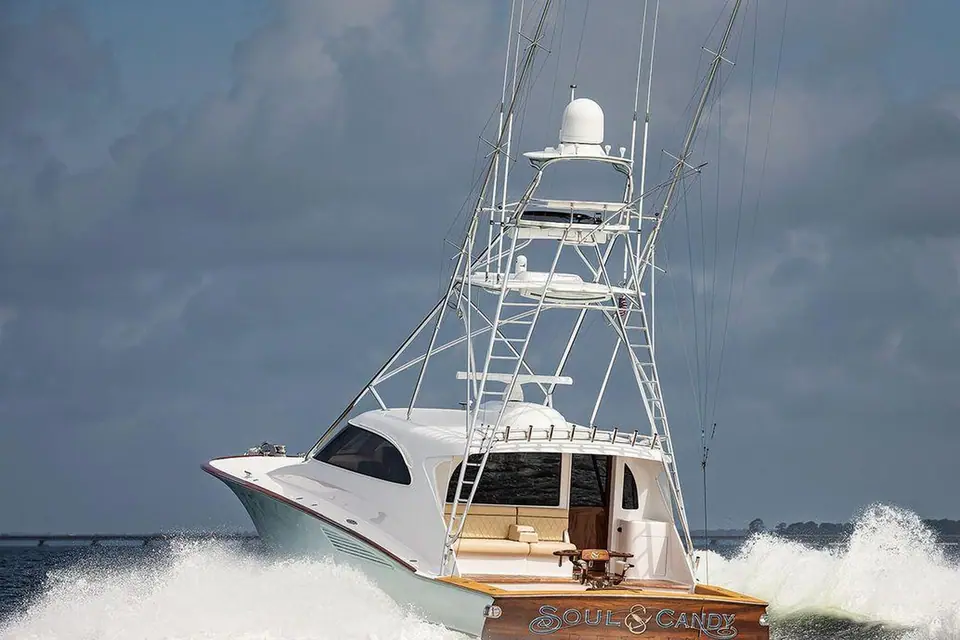
Soul Candy, the 61-foot hardtop express
Hull No. 30, Soul Candy, is the best-documented F&S express. F&S lists her at 61 feet with an 18-foot beam, a 4-foot-10-inch draft, a 60,000-pound displacement, 1,450 gallons of fuel and 210 gallons of water. Power is a pair of MTU 10V M96L diesels rated at 1,600 mhp through ZF 2:1 gears and five-blade Veem propellers. F&S reports a cruise approaching 35 knots and a top end of 42 knots, smooth and quiet through the rpm range.
She was designed as a family boat for an owner-operator fishing the Gulf of Mexico and the Bahamas. Because the owner is tall, F&S's design team created a 6-foot-8-inch virtual character in its CAD software and moved him through the boat to check headroom in the companionway, staterooms and showers and sightlines from the helm to the fighting chair. The express layout uses one large piece of custom curved glass on each side of the helm deck for an almost uninterrupted 360-degree view.
The 120-square-foot cockpit fits a large fighting chair with an offset pedestal and on-deck tuna tubes, with teak covering boards, the signature F&S radial mezzanine and a transom livewell. A Freeman hatch under the chair footrest opens to a large lazarette for the systems.
Full Throttle, the 64-foot express that keeps up with center consoles
Hull No. 22, Full Throttle, is the extreme end of the F&S express idea. F&S lists her at 64.4 feet with an 18-foot-7-inch beam, a 4-foot-6-inch draft, 1,700 gallons of fuel, 300 gallons of water and 82,000 pounds loaded. Her twin 16-cylinder MTU diesels appear as 2,600 hp M93 engines in one place and 2,650 hp in another on F&S's own page, and the builder claims a top speed of more than 50 knots, quick enough to run with fast center consoles.
The boat combines that speed with fishing and cruising detail. There is a Seakeeper gyro and a 27 kW Cummins Onan generator in a service-friendly engine room, a six-foot gap Palm Beach aluminum tower, a salon with power windows aft, and a mezzanine with tackle storage, an ice bin for the ice maker, drink boxes and freezers. Below, the galley and hallway use African zebrano veneer, wenge trim and ebony in the heads, with an L-shaped settee that converts to a double and a Pullman berth.
Full Throttle was built around 2012 to 2013, judging by F&S's dates for the hulls numbered either side of her.
Express or convertible, choosing the F&S layout
Most F&S owners choose convertibles, from the 50-foot Epiphany with Volvo IPS to the 82-foot Special Situation, whose 2,600 hp MTU 16V 2000 M96L engines give a reported 36-knot cruise at just under 200 gph and more than 42 knots flat out. The express suits a narrower buyer: an owner-operator who wants to drive from the main deck, stay in contact with the crew in the cockpit, and avoid the height and windage of a flybridge, often on a boat in the high 50s to mid 60s.
The trade-offs are familiar. An express gives up the flybridge's elevated view of the spread and the bait, though a tower like Full Throttle's restores it, and it usually has less interior volume than a convertible of the same length. In return it offers a lower profile, simpler docking and a closer connection between helm and cockpit.
Buying and owning a custom F&S
Plan a new F&S as a multi-year project. The builder's process starts with CAD layouts refined until the owner and captain approve them, followed by a jig, stringers built from the keel out, a hull flipped with two cranes, and interior and bridge work with daily owner's captain consultation and documented systems. F&S quotes each boat individually.
On the brokerage side, condition is everything. A cold-molded boat in good hands lasts decades, but survey the wood-epoxy structure carefully with a surveyor experienced in custom Carolina-style boats. We estimate F&S sportfish in the 58- to 70-foot range trade from about $1.4 million for older boats to $7 million or more for a recent, low-hour express, and running costs for a crewed 60-footer of $350,000 to $700,000 a year, including a captain, mate, insurance, dockage, engine service on large MTUs, fuel and yard periods.
F&S Custom Express Sportfish specifications
| Length overall | 61 ft18.59 m |
|---|---|
| Beam | 18 ft5.49 m |
| Draft | 4.8 ft1.47 m |
| Displacement | 60, lbs27,216 kg |
| Fuel capacity | 1,45 gal5,488 L |
| Fresh water | 21 gal795 L |
| Cabins | Custom to each owner |
| Berths | Custom to each owner |
| Heads | Custom to each owner |
| Standard engines | 2 x MTU 10V M96L 1,600 mhp diesels (61-foot Soul Candy) |
| Optional engines | Custom; the 64-foot Full Throttle uses twin 16-cylinder MTUs listed at 2,600 to 2,650 hp |
| Maximum power | 3,200 hp |
| Cruise speed | 35 knots |
| Top speed | 42 knots |
| Hull type | Longitudinally stepped variable-deadrise planing hull with Carolina flare |
| Hull construction | Cold-molded okoume plywood and Douglas fir with epoxy, fiberglass and Kevlar or aramid laminate |
| Builder | F&S Boatworks (F&S Yachts), United States |
| Naval architect | Jim Floyd (F&S Boatworks) |
| Other design credits | Hull concept based on Carl Moesly's SeaCraft longitudinally stepped variable-deadrise bottom |
| Status | Limited production |
Figures come from builder documentation and independent tests where available. Displacement is usually quoted light, so a loaded cruising boat will weigh more. Compare these specs with another model.
How much does a F&S Custom Express Sportfish cost?
Every F&S is a one-off, so there is no list price; new builds are quoted per owner. The used ranges are our 2026 estimates for F&S custom sportfish in the 58- to 70-foot range, convertibles and expresses alike, because express sales alone are too few to chart. Engine hours on large MTUs, the condition of the cold-molded structure and paint, gyro stabilization, tower and electronics generation drive the spread, and a recent express with low-hour MTUs would sit at or above the top.
Estimate your yearly cost
A planning estimate using common rules of thumb: insurance near 1.5 percent of value, maintenance near 3 percent, haul out and bottom paint by length. Your marina, region and use will move these numbers. Open the full cost calculator.
Versions and options
- Hull No. 22, Full Throttle (64.4 ft express)
- Hardtop express with twin 16V MTUs at 2,600 to 2,650 hp, Seakeeper, gap tower; builder-claimed top speed over 50 knots.
- Hull No. 30, Soul Candy (61 ft hardtop express)
- Family-oriented express with twin MTU 10V M96L 1,600 mhp, 35-knot cruise and 42-knot top speed per F&S.
- F&S convertibles
- The majority of F&S hulls, from the 50-foot Epiphany to the 78-foot and 82-foot Special Situation builds.
F&S Custom Express Sportfish timeline
- 1980sThe Floyd family's 23-foot SeaCraft inspires the future F&S hull
- 1996Jim Floyd begins hull No. 1, Fin-Ally, founding F&S Boatworks
- 2011Power and Motoryacht reports a new F&S 67 convertible topping 50 mph on twin CAT C32As
- 2012F&S hull No. 20 completed; express hull No. 22, Full Throttle, follows
- 2026F&S lists an 82-footer, hull No. 34, among boats in progress
Strengths and weaknesses
What owners like
- Distinctive stepped variable-deadrise ride
- Express speeds from 42 to more than 50 knots (builder figures)
- Fully custom layouts and joinery
- Strong, stiff cold-molded construction
- Very rare on the brokerage market
What to weigh up
- Few examples, so resale data is thin
- Cold-molded wood structure needs expert survey and care
- Builder performance figures are not independently verified
- Long build times and high running costs
Used F&S Custom Express Sportfish buyer checklist
Take this list to a viewing. Your ticks are saved in this browser so you can come back to it.
Always commission an independent marine survey and an engine survey before you buy. How a marine survey works.
Rivals to consider
Hatteras GT59
A production convertible of similar size with conventional deep-V running surfaces and a dealer network.
Compare side by sideViking 58 Convertible
The production benchmark for fit and finish and resale, with a flybridge rather than an express helm.
Compare side by sideValhalla V-55
Outboard-powered alternative for owners who want speed and a main-deck helm with less maintenance.
Compare side by sideOther Carolina-style custom builders
North Carolina and Florida custom yards offer cold-molded express boats on conventional bottoms.
Our verdict on the F&S Custom Express Sportfish
An F&S custom express sportfish is a niche within a niche: a cold-molded, hand-built Delaware boat on a stepped variable-deadrise bottom that owes its DNA to a 23-foot SeaCraft. Builder figures of a 35-knot cruise for the 61-foot Soul Candy and more than 50 knots for the 64-foot Full Throttle show what the hull can do, and the joinery and customization are on par with the best custom yards. The catches are rarity, a wood-epoxy structure that demands expert care and figures that come from the builder rather than independent tests. For an owner who wants an express that rides differently from everything else at the dock, an F&S deserves a sea trial.
F&S Custom Express Sportfish questions answered
Where are F&S boats built?
In Bear, Delaware, at a yard on the Chesapeake and Delaware Canal next to Summit Marina.
Who founded F&S Boatworks?
Jim Floyd founded F&S in 1996, when he began building the first hull, Fin-Ally. His nephew John Floyd Jr. is now president.
What is special about the F&S hull?
It uses a longitudinally stepped, variable-deadrise bottom inspired by Carl Moesly's SeaCraft design, combined with a Carolina-style flare.
How fast is an F&S express sportfish?
F&S reports a cruise approaching 35 knots and a 42-knot top speed for the 61-foot Soul Candy, and more than 50 knots for the 64-foot Full Throttle.
How many F&S boats have been built?
F&S's fleet list runs to about 34 hull numbers, including boats still in progress; only a few are express models.
How much is an F&S express sportfish?
There is no list price. We estimate used F&S sportfish from about $1.4 million to $7 million or more, depending on size, age and engines.