Viking Yachts Sportfishing Yachts
Viking 55 Convertible Buyer's Guide to the 1997 Original and the 2012 Remake
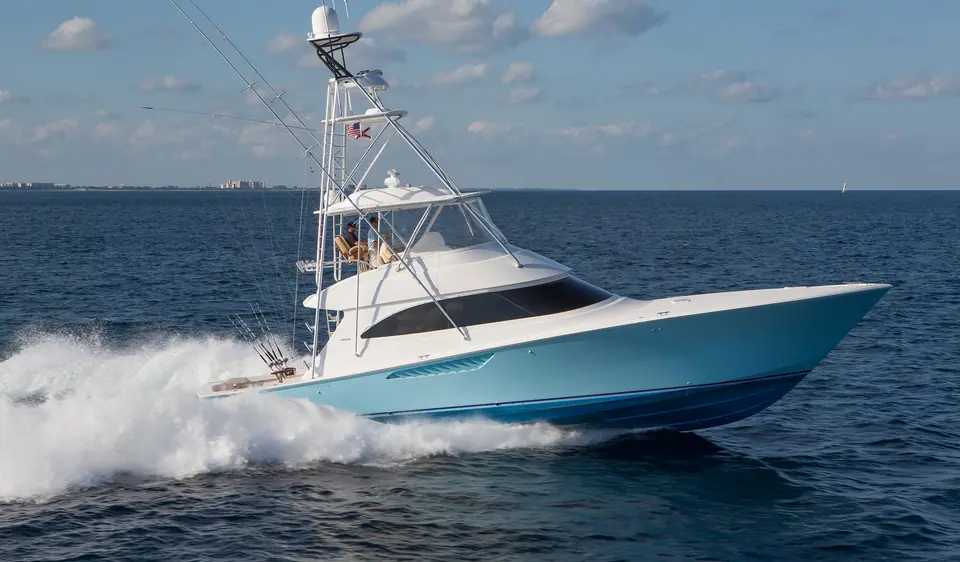
Two very different boats share the Viking 55 Convertible name, a late-1990s tournament icon and a 41-knot resin-infused remake from 2012.
- Length
- 56.4 ft17.2 m
- Beam
- 17.8 ft5.41 m
- Cruise
- 34.6 kn
- Cabins
- 3
- Used price
- $400K to $2.6M
On this page
- Overview
- One name, two very different 55 Vikings
- The 1997 original that rebuilt Viking's reputation
- What the 2012 redesign changed
- Cockpit, mezzanine and bridge on the newer boat
- Three staterooms that suit a tournament crew
- Twin MANs and the test numbers
- What a 55 costs to keep fishing
- Specifications
- Price and value
- Strengths and weaknesses
- Used buyer checklist
- Rivals
- Our verdict
- FAQ
The Viking 55 Convertible is a three-stateroom, two-head New Jersey sportfisherman built in two generations, the 1997 original that sold well over 100 hulls and a 2012 redesign with twin 1,400 to 1,550 hp MANs and a 41-knot top end.
- Owner-operators moving up from a 45 to 50-foot boat
- Mid-Atlantic and Gulf canyon tournaments
- Budget entry into a tournament convertible (1997 generation)
- Families who fish and cruise the Bahamas
One name, two very different 55 Vikings
Type 55 viking for sale into any listing site and you will get two boats that share nothing but a length and a badge. The first Viking 55 Convertible debuted at the Fort Lauderdale show in 1997 (some magazine accounts date the launch to 1996), and Viking's own history calls it the groundbreaking boat that set the standard for the modern convertible. Viking had sold 20 before the first one was shown. The second boat is a clean-sheet design that Viking launched in the summer of 2012, a resin-infused, Baltek-cored 56-footer that Power and Motoryacht said was selling like hotcakes, with eight delivered within a few months.
Knowing which one you are looking at matters more than anything else on this page. A late-1990s 55 is a well-proven tournament hull that now costs roughly what a new 40-foot express does. A 2013 to 2015 boat is a modern 40-knot convertible priced in the millions. They fish the same water but they are not substitutes, and a buyer who confuses the two will either overpay for an old boat or underestimate what a newer one costs to own.
Viking 55 Convertible by the numbers
- Speed to length ratio at cruise
- 4.94A planing cruise. Fast passages in exchange for much higher fuel burn per mile.
- Estimated range at cruise
- 400 nmUsing 90 percent of tank capacity at the cruise speed and fuel burn listed on this page.
- Fuel economy at cruise
- 0.31 nmpgNautical miles per gallon at cruise, both engines combined.
- Horsepower per ton
- 94 hpVery high power to weight, built for speed.
- Length to beam ratio
- 3.18 : 1Moderate proportions.
The 1997 original that rebuilt Viking's reputation
The first 55 arrived at a pivotal moment. Viking had been flattened by the 1991 federal luxury tax, which cut its workforce from 1,500 to fewer than 80, and the 55 was the boat that Pat Healey pushed his father Bill to build: a convertible with custom-boat features built on a production schedule. Viking's brochure called it the company's 31st in-house design. Marlin later wrote that 115 were sold during its five-year run, while Power and Motoryacht and Yachting both put the total above 150; the gap probably reflects how each counted late hulls, and either way it was one of the most successful big convertibles of its era.
The original brochure lists a length of 55 feet 10 inches, a 17-foot 4-inch beam, a 4-foot 10-inch draft, a gross weight of 68,800 pounds, 1,250 gallons of fuel, 250 gallons of water and a 153 square foot cockpit. The bottom was solid fiberglass reinforced by interlocking bulkheads and stringers, with a one-piece deck, superstructure and cockpit liner bonded to the hull and fiberglass fuel tanks. Viking also used steel engine beds on dedicated intermediate bulkheads to keep the drivetrain aligned.
Salt Water Sportsman's account of a tournament run to Veatch Canyon describes what owners still like: a hull whose deadrise works back to 15.5 degrees at the transom, a sharply raked entry, and a deckhouse tapered inward so spray is pulled astern instead of onto the bridge. The writer noted the boat loafing at 33 knots in moderate seas and settling to 22 knots in big ones without drama.
- LOA 55 ft 10 in, beam 17 ft 4 in, draft 4 ft 10 in (1997 brochure)
- Gross weight 68,800 lb, fuel 1,250 gal, water 250 gal
- Cockpit 153 sq ft with molded transom fishbox and in-sole refrigerated box
- Three staterooms and two heads, amidships master with walk-around queen
What the 2012 redesign changed
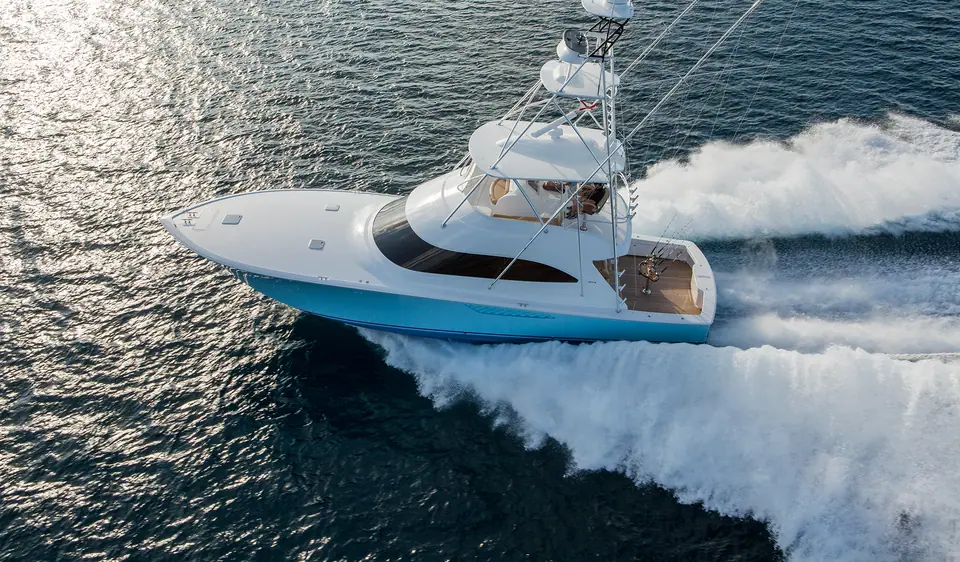
Viking's second 55 was a reimagining rather than a facelift. Power and Motoryacht's first look put the overall length at 56 feet 5 inches with a 17-foot 9-inch beam and a 5-foot 1-inch draft, and quoted a $2.3 million base price with twin 1,400 hp MAN V12s. The hull is vacuum infused with Baltek coring, except where through-hull penetrations pass through solid glass, and Viking used modified polyester resins with a vinylester barrier coat against blistering. Yachting described amplified convex sections forward and aft for head-sea comfort and stability on the drift, plus two small strakes that help the boat get on plane.
A note on published numbers: one magazine test box repeats the 1997 boat's 55-foot 10-inch length and 17-foot 4-inch beam alongside 2012 data. Treat any spec sheet that mixes those figures with caution, and measure the boat you are buying.
Cockpit, mezzanine and bridge on the newer boat
The 2012 cockpit measures about 151 square feet without the mezzanine, according to Power and Motoryacht, and comes with raw and fresh water washdowns, four rod holders, an in-deck fishbox and a space that can be a livewell, extra stowage or an ice chipper. Yachting's test boat had bigeye-size in-sole boxes that could be plumbed as livewells or fed by the ice maker, Rupp outriggers and a Release offset fighting chair. The mezzanine carries seating, tackle storage and a step-box cooler, and mezzanine air conditioning was an option worth looking for on boats that fish the tropics.
Viking fitted tuna tubes in the transom of every new boat of this period and built them to order. The transom is bowed outward, which helps the boat back down quickly and lets the chair swing without rods fouling the corners.
On the bridge, buyers chose a peninsula console from the port side or the more popular island console. Sightlines are excellent. Power and Motoryacht's tester did flag two safety gaps on the boat he ran: an aft-facing starboard seat with no railing behind it and an open ladder hole with no hatch or rail. Check whether the boat you are looking at has had both addressed.
Three staterooms that suit a tournament crew
Both generations use a three-stateroom, two-head plan. On the 2012 boat the salon has an L-shaped settee aft and a galley forward with a granite bar as either a peninsula or an island; high-gloss or satin teak was offered. The amidships master has a queen berth and an en suite head with a large shower and seat. The forepeak VIP takes either a queen or crossover bunks, and the crossover arrangement was the more popular choice. A third cabin to port has bunks and extra stowage.
The 1997 boat follows the same logic: an amidships master with a walk-around queen and private head, a forward cabin with a queen or an optional upper single over a lower double, an en suite guest head shared with the third cabin, and a starboard bunk room with a walk-in cedar locker. A washer and dryer near the companionway stairs was available, and on many used boats it has been added since.
Twin MANs and the test numbers
Standard power on the 2012 generation was a pair of 1,400 hp MAN V12s, and most buyers took the optional 1,550 hp MAN V12 1550s. Power and Motoryacht said engine packages at launch ran from 2,720 to 3,600 total horsepower. With the 1,550s, its December 2012 test recorded 41.6 knots at 2,356 rpm on 156 gph and 34.6 knots at 2,000 rpm on 110 gph, carrying 1,237 gallons of fuel. Yachting saw 42 knots with the same engines and a 33.5-knot cruise.
Displacement on the test boat was 77,000 pounds dry, and twin 20 kW Onan generators were fitted. The tester singled out how hard the props bit when backing down and how the boat turned at 35 knots in under two boat lengths with independent rudders.
Viking has not published test data for the original 1997 boat in a form we could verify, so treat any first-generation speed claims as boat-specific and ask for a recent sea trial log.
What a 55 costs to keep fishing
A second-generation 55 run by an owner with a part-time mate typically costs $180,000 to $350,000 a year before depreciation: insurance, a 60-foot slip, two big MAN services and periodic overhauls, generator and air conditioning upkeep, bottom work, electronics and fuel. At Power and Motoryacht's measured 110 gph at 34.6 knots, every 100 running hours is about 11,000 gallons of diesel, so tournament mileage moves the total quickly.
First-generation boats insure and dock for less but carry the costs of age. Exhaust systems, wiring, air conditioning, teak joinery and fuel system components are 25 years old or more, and many boats have been repowered. A documented repower or major refit is worth more to a buyer than cosmetic upgrades, and it is the main reason two 1998 boats can be $150,000 apart.
Viking 55 Convertible specifications
| Length overall | 56.4 ft17.2 m |
|---|---|
| Beam | 17.8 ft5.41 m |
| Draft | 5.1 ft1.55 m |
| Displacement | 77, lbs34,927 kg |
| Fuel capacity | 1,414 gal5,353 L |
| Fresh water | 255 gal965 L |
| Cabins | 3 |
| Berths | 6 (forward cabin with queen or crossover berths) |
| Heads | 2 |
| Standard engines | 2 x MAN V12, 1,400 hp each (2012 generation) |
| Optional engines | 2 x MAN V12 1550, 1,550 hp each; packages up to 3,600 hp total quoted at launch |
| Maximum power | 3,600 hp |
| Cruise speed | 34.6 knots |
| Top speed | 41.6 knots |
| Range | 400 nm |
| Hull type | Modified-V planing hull with convex sections forward and aft and two small lifting strakes (2012 generation) |
| Hull construction | Fiberglass; resin-infused, Baltek-cored hull on the 2012 generation, solid fiberglass bottom on the 1997 boat |
| Builder | Viking Yacht Company, United States |
| Naval architect | Viking Yachts in-house design and engineering team |
| Production | 1997 to present |
| Status | Discontinued |
Figures come from builder documentation and independent tests where available. Displacement is usually quoted light, so a loaded cruising boat will weigh more. Compare these specs with another model.
Performance data
| RPM | Speed (kn) | Fuel (gph) | Range (nm) |
|---|---|---|---|
| 1000 | 11.6 | 24 | 615 |
| 1250 | 15.1 | 42 | 458 |
| 1500 | 22.6 | 62 | 464 |
| 1750 | 28.9 | 80 | 460 |
| 2000 | 34.6 | 110 | 400 |
| 2250 | 39.3 | 138 | 362 |
| 2356 | 41.6 | 156 | 339 |
Power and Motoryacht test of a 2012 Viking 55 Convertible with twin MAN V12 1550 diesels, flat seas, 1,237 gal fuel, 255 gal water, 3 persons and 350 lb gear. Range as published.
How much does a Viking 55 Convertible cost?
Yachting counted 13 Viking 55 Convertibles for sale in mid-2025, asking from $399,000 to $2.6 million, which is really two markets under one name. First-generation boats from the late 1990s and early 2000s sit at the bottom and are priced on engine hours, repowers and refit history. Second-generation boats started at a $2.3 million base in 2012, and 2013 to 2015 hulls were listed between $1.74 million and $2.35 million in 2020; the 1,550 hp MAN option, a Palm Beach tower and a recent electronics package push a boat to the top of the band.
Estimate your yearly cost
A planning estimate using common rules of thumb: insurance near 1.5 percent of value, maintenance near 3 percent, haul out and bottom paint by length. Your marina, region and use will move these numbers. Open the full cost calculator.
Versions and options
- 55 Convertible (1997 generation)
- Solid fiberglass bottom, 55 ft 10 in LOA, 17 ft 4 in beam, 1,250 gal fuel, 153 sq ft cockpit, three staterooms and two heads.
- 55 Convertible (2012 generation)
- Resin-infused cored hull, 56 ft 5 in LOA, 17 ft 9 in beam, about 1,414 gal fuel, twin MAN V12s of 1,400 hp standard or 1,550 hp optional.
- Forward cabin options
- Queen berth or crossover bunks in the VIP on both generations; the crossover layout was the more common choice on the 2012 boat.
Viking 55 Convertible timeline
- 1991Federal luxury tax cuts Viking's workforce from 1,500 to fewer than 80
- 1997Original Viking 55 Convertible debuts at the Fort Lauderdale show with 20 boats already sold
- 2012All-new resin-infused 55 Convertible launches in summer at a $2.3 million base price
- 2012Power and Motoryacht records 41.6 knots with optional 1,550 hp MANs
- 2015Power and Motoryacht names the 55 one of the prettiest boats of all time
- 2020Viking introduces the 54 Convertible as its current boat in this size range
Strengths and weaknesses
What owners like
- Proven tournament hull in both generations
- 41 to 42 knots tested on the 2012 boat with optional MANs
- Owner-operator size that one captain can dock
- Three-stateroom layout with a real amidships master
- Huge spread of prices, from about $400,000 to $2.6 million
- Strong Viking service network and resale demand
What to weigh up
- First-generation boats are now 25 years old or more
- Published specs often mix the two generations
- Only two heads for six berths
- MAN service and overhaul costs are substantial
- No open-bridge safety rails behind some seats on early 2012 boats
Used Viking 55 Convertible buyer checklist
Take this list to a viewing. Your ticks are saved in this browser so you can come back to it.
Always commission an independent marine survey and an engine survey before you buy. How a marine survey works.
Rivals to consider
Viking 54 Convertible
Viking's current boat in the slot, with a 154 sq ft cockpit and the same MAN engine choices, at a much higher price.
Compare side by sideViking 58 Convertible
Three extra feet, more cockpit and a larger engine room, the natural next step for 55 owners.
Compare side by sideBertram 54
A classic deep-V alternative with a softer head-sea ride but less speed and older construction.
Compare side by sideHatteras 53 Yacht Fisherman
A heavier, more traditional convertible from an earlier era that suits buyers on a tight budget.
Compare side by sideOur verdict on the Viking 55 Convertible
The Viking 55 Convertible is two good boats with one name. The 1997 original is still one of the smartest ways into a tournament-capable convertible for under $650,000, as long as you buy the boat with the best repower and refit paperwork rather than the best upholstery. The 2012 remake is a genuinely modern 40-knot owner-operator boat that costs four times as much and holds its value like a Viking should. Decide which budget and which era you are in before you look at a single listing, and insist on a sea trial and engine survey either way.
Viking 55 Convertible questions answered
How much is a Viking 55 Convertible?
Mid-2025 listings ran from about $399,000 for first-generation boats to $2.6 million for late second-generation boats. Expect roughly $400,000 to $650,000 for a 1990s hull and $1.65 million to $2.45 million for a 2013 to 2015 boat.
What is the difference between the old and new Viking 55?
The original launched in 1997 with a solid fiberglass bottom and 1,250 gallons of fuel. The 2012 boat is a new resin-infused, cored hull that is about 7 inches longer and 5 inches wider and runs above 41 knots with optional MANs.
How fast is a Viking 55?
Power and Motoryacht recorded 41.6 knots and a 34.6-knot cruise at 110 gph on a 2012 boat with twin 1,550 hp MANs. Yachting saw 42 knots with the same package.
How many Viking 55s were built?
Sources disagree on the first generation, from 115 (Marlin) to 153 (Power and Motoryacht). Viking has not published a total for the 2012 generation.
How many staterooms does the Viking 55 have?
Three staterooms and two heads on both generations, with an amidships master, a forward VIP with queen or crossover berths, and a bunk cabin.
What replaced the Viking 55?
Viking's current convertible in this size range is the 54 Convertible, introduced in 2020, with the 58 Convertible one step up.
Viking 55 Convertible photos
More sportfishing yachts to explore
Bertram 54 Convertible
Sportfishing Yachts, 57 ft
Used $150K to $1.5M
Viking 54 Convertible
Sportfishing Yachts, 55 ft
Used $1.05M to $4M
Viking 58 Convertible
Sportfishing Yachts, 59 ft
Used $300K to $4.8M
Viking 52 Convertible
Sportfishing Yachts, 53 ft
Used $450K to $1.9M