Ocean Yachts Sportfishing Yachts
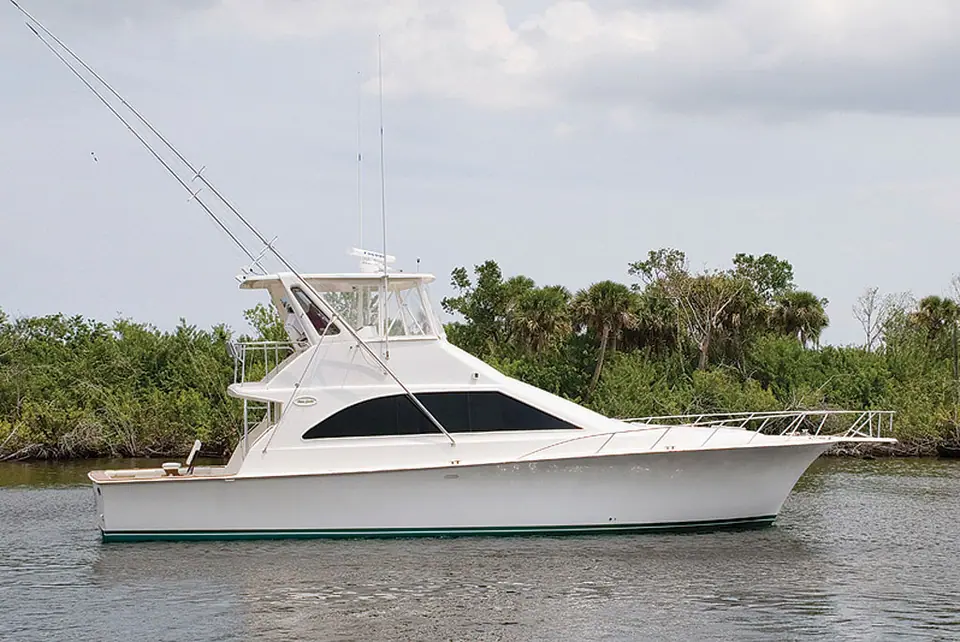
Ocean 48 Super Sport Review and Used Buying Guide
More than 400 hulls across three generations made the Ocean 48 Super Sport the family-friendly sportfisherman of the Jersey Shore.
- Length
- 48.7 ft14.83 m
- Beam
- 16 ft4.88 m
- Cruise
- 26 kn
- Cabins
- 2 or 3
- Used price
- $85K to $320K
On this page
- Overview
- The Ocean 48 and the Leek family formula
- 1986, 1991 and 1995, the three Ocean 48s
- The interior that sold the boat to families
- Cockpit, flybridge and fishability
- Engines, speed and fuel burn
- How the Ocean 48 rides
- Running costs and buying advice
- Specifications
- Price and value
- Strengths and weaknesses
- Used buyer checklist
- Rivals
- Our verdict
- FAQ
The Ocean Yachts 48 Super Sport is a Dave Martin designed modified-V convertible built in South Jersey from 1986 to 2003, with Detroit Diesel or MAN power, two or three staterooms and a mid to high 20s cruise.
- Families who fish and cruise
- Owner-operators on a budget
- Mid-Atlantic canyon fishing
- First sportfisherman over 45 feet
Ocean Yachts 48 Super Sport by the numbers
- Speed to length ratio at cruise
- 4.00A planing cruise. Fast passages in exchange for much higher fuel burn per mile.
- Horsepower per ton
- 71 hpStrong power to weight for a planing hull.
- Length to beam ratio
- 3.04 : 1Moderate proportions.
The Ocean 48 and the Leek family formula
Jack Leek founded Ocean Yachts in 1977, and three generations of the Leek family built sportfishermen at the company's South Jersey plant. The Ocean 48 Super Sport became one of the biggest success stories in that history. Built from 1986 through 2003, with one makeover and one complete redesign, it accounts for more than 400 hulls. On the brokerage market, that volume means there is almost always an Ocean 48 for sale somewhere on the East Coast.
The original 48 was an adaptation of the popular 46 Super Sport. Ocean learned from 46 owners who wanted more interior volume and a more contemporary style, and noted naval architect Dave Martin drew the new boat. The company aimed at what John Leek IV described as an owner-operator mentality: efficient yachts that customers could afford to run and fix themselves.
Ocean Yachts did not recover from the Great Recession. In late 2015 Viking Yachts agreed to buy the land and buildings of the plant to expand its own production, while explicitly not buying the Ocean product line. Every Ocean 48 is therefore a used purchase, supported by an owner community and independent yards rather than a factory.
1986, 1991 and 1995, the three Ocean 48s
Understanding the versions is the key to buying the right Ocean 48. The original 1986 boat offered two or three staterooms, with the two-cabin version using a galley-down plan. In 1991 Ocean gave it a makeover with a more refined house, new window shapes and a half tower, still powered by 485 hp GM 6-71 diesels for a mid 20s cruise and about 30 knots on top.
In 1995 the 48 changed from the keel up. Martin drew a new hull with more aggressive deadrise in the modified-V and more beam, and Ocean offered bigger power, including 680 hp MANs that delivered a 28 knot cruise. At the same time the company switched from stick-built interiors to modular interior construction. These later boats are the most sought after today.
- 1986 to 1990: original hull, two or three staterooms, galley down on two-cabin boats
- 1991 to 1994: restyled house and windows, half tower, 485 hp 6-71s
- 1995 to 2003: new hull with more deadrise and beam, modular interior, bigger engines
The interior that sold the boat to families
Ocean understood early that buying a sportfisherman is a family decision. The offshore angler might accept a bare interior; the spouse usually would not. The 48 Super Sport answered with a big L-shaped settee, a wet bar to starboard, a four-person dinette and an entertainment center, and on later boats a wide U-shaped galley up where two people can cook without bumping elbows. A galley-down option remained available.
Under-counter refrigeration keeps the galley open to the salon. The tradeoff for the huge salon is that the staterooms below are on the cozy side. They are meant for sleeping, with three deck hatches bringing in light and heads and stall showers sized appropriately for a 48-footer. Brokers like to say the 48 was a boat men could buy because the women loved the interior.
Cockpit, flybridge and fishability
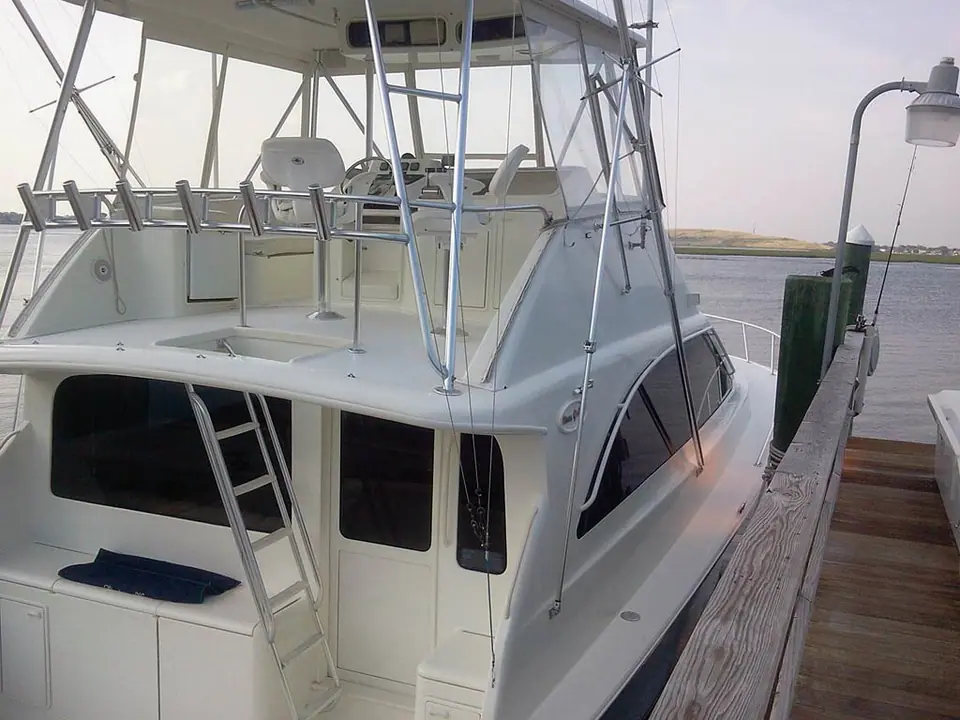
The cockpit is not huge, but it seats five or six anglers comfortably and comes with cockpit controls, a fishbox, a livewell in the sole, tackle drawers and a tackle center. Freeboard is low enough to land fish easily yet high enough to keep children secure. Engines breathe through vents in the cockpit, keeping the hull sides clean, and the trademark Ocean taper toward the transom narrows the boat at the waterline without stealing cockpit space.
The flybridge ladder runs athwartships at a gentle angle. Up top, twin helm seats sit forward with good sightlines, side and forward settees provide seating and a rocket launcher hangs behind the helm, although the forward settee ends up close to the enclosure. Only a handful of 48s were fitted with flybridge air conditioning, so check whether the boat has it if you fish in the South.
Engines, speed and fuel burn
Engine choice defines the boat. Early hulls ran 485 hp GM 6-71s. Later boats most commonly have Detroit Diesel 6V-92s, which deliver about a 26 knot cruise and 30 knots on top without burning a ton of fuel. Some boats have 8V-92s, which fit but tighten the engine room. MAN options arrived with the 1995 redesign, with 680 hp versions producing a 28 knot cruise and a handful of boats (one broker counted three) carrying 800 hp MANs that brokers say cruise over 30 knots. Power and Motoryacht noted that the bigger MANs add horsepower but the extra performance does not always follow.
Fuel capacity is 685 gallons. No published test gives fuel burn for the 6V-92 boats, but a two-stroke pair at a mid 20s cruise drinks enough that 685 gallons is a canyon-run tank rather than a long-range one; ask the seller for real logbook numbers and plan Bahamas crossings with care.
How the Ocean 48 rides
With modest deadrise at the transom, about 12 degrees, the 48 pops onto plane easily and runs efficiently once at cruise. It sits well in a beam sea and the modified-V handles most conditions comfortably. In a big head sea, though, you will pull the throttles back sooner than on a deep-V Bertram or a heavier Hatteras, which is simply the nature of the hull. The 1995 and later boats, with their more aggressive deadrise, should handle a chop better than the originals.
Running costs and buying advice
Plan on roughly $35,000 to $70,000 a year to keep an Ocean 48, covering dockage, insurance, hauling, bottom paint, engine and generator service and routine repairs. Most owners run them without paid crew, although a mate on fishing days is common.
Used Ocean 48 Super Sports generally ask between about $85,000 and $320,000. The engine room is well lit and easy to work in, which makes servicing straightforward, and the Westerbeke generators and air conditioning units commonly fitted are easy to replace. Focus your survey on the engines, the deck coring and the tower, then compare several boats, because there are enough on the market that patient buyers usually win.
Ocean Yachts 48 Super Sport specifications
| Length overall | 48.7 ft14.83 m |
|---|---|
| Beam | 16 ft4.88 m |
| Draft | 4.2 ft1.27 m |
| Displacement | 45, lbs20,412 kg |
| Fuel capacity | 685 gal2,593 L |
| Fresh water | 15 gal568 L |
| Cabins | 2 or 3 |
| Berths | 4 to 6 |
| Heads | 2 |
| Standard engines | 2 x GM Detroit Diesel 6-71 (485 hp) on early boats, 2 x Detroit Diesel 6V-92 on later boats |
| Optional engines | 2 x Detroit Diesel 8V-92, 2 x MAN 680 hp, rare 2 x MAN 800 hp |
| Maximum power | 1,600 hp |
| Cruise speed | 26 knots |
| Top speed | 30 knots |
| Hull type | Modified-V planing hull, 12 degrees transom deadrise |
| Hull construction | Fiberglass |
| Builder | Ocean Yachts, United States |
| Naval architect | Dave Martin |
| Production | 1986 to 2003 |
| Status | Discontinued |
Figures come from builder documentation and independent tests where available. Displacement is usually quoted light, so a loaded cruising boat will weigh more. Compare these specs with another model.
How much does a Ocean Yachts 48 Super Sport cost?
The 1995 and later redesign, with its wider hull and more modern interior, is worth substantially more than the original 1986 to 1994 boats. Engine package and hours come next: rebuilt 6V-92s are the mainstream choice, while the rare 800 hp MAN boats appeal to anglers who want a cruise over 30 knots. Because hundreds were built, buyers have plenty of choice and should not overpay for a tired example.
Estimate your yearly cost
A planning estimate using common rules of thumb: insurance near 1.5 percent of value, maintenance near 3 percent, haul out and bottom paint by length. Your marina, region and use will move these numbers. Open the full cost calculator.
Ocean Yachts 48 Super Sport timeline
- 1977Jack Leek founds Ocean Yachts in South Jersey
- 1986Ocean 48 Super Sport introduced as a larger evolution of the 46 Super Sport
- 1991Restyled house, new windows and a half tower
- 1995All-new Dave Martin hull with more deadrise and beam, modular interior and MAN options
- 2003Production ends after more than 400 hulls across all versions
- 2015Viking Yachts agrees to buy Ocean's plant after the company winds down
Strengths and weaknesses
What owners like
- Huge, family-friendly salon and galley
- Efficient cruise in the mid to high 20s
- More than 400 built, so choice and parts knowledge are plentiful
- Accessible, well lit engine room
- Low purchase price for a 48-foot convertible
- 1995 and later boats get a new hull with more deadrise and beam
What to weigh up
- Pounds in a big head sea compared with deep-V rivals
- Staterooms are small
- No factory support since Ocean closed
- Flybridge air conditioning is rare
- Many boats have been fished hard
Used Ocean Yachts 48 Super Sport buyer checklist
Take this list to a viewing. Your ticks are saved in this browser so you can come back to it.
Always commission an independent marine survey and an engine survey before you buy. How a marine survey works.
Rivals to consider
Viking 48 Convertible
The fellow New Jersey rival with stronger resale values and a slightly sportier ride.
Compare side by sideBertram 46 Convertible
Classic deep-V with a better head sea ride but a smaller, darker interior.
Hatteras 53 Yacht Fisherman
Older, heavier and slower, with a solid glass hull and more motor yacht comfort.
Compare side by sideBertram 54 Convertible
A bigger step up with more range and cockpit for serious tournament use.
Compare side by sideOur verdict on the Ocean Yachts 48 Super Sport
The Ocean 48 Super Sport is one of the best value sportfishermen on the used market. It is fast and efficient with 6V-92s, its interior keeps the whole family happy and there are so many on the market that buyers can afford to be choosy. The ride in a big head sea and the lack of factory support are its weak spots. Target a 1995 or later hull with documented engine work and dry decks, and you will get a capable canyon boat and weekend cruiser at a fraction of the cost of a modern convertible.
Ocean Yachts 48 Super Sport questions answered
How much is an Ocean 48 Super Sport worth?
Used Ocean 48 Super Sports generally ask between about $85,000 and $320,000, with 1995 and later boats at the top of the range.
How fast is the Ocean 48 Super Sport?
With Detroit Diesel 6V-92s it cruises around 26 knots and tops out near 30. The 680 hp MAN version cruises at about 28 knots.
How many Ocean 48 Super Sports were built?
More than 400 were built from 1986 to 2003 across the original, 1991 restyled and 1995 redesigned versions.
Who designed the Ocean Yachts 48 Super Sport?
Naval architect Dave Martin designed the 48 and drew the all-new hull introduced in 1995.
Is Ocean Yachts still in business?
No. Ocean Yachts did not recover from the Great Recession, and in 2015 Viking Yachts agreed to buy its plant without the product line.
What is the fuel capacity of an Ocean 48?
The Ocean 48 Super Sport carries 685 gallons of fuel and 150 gallons of water.