Bertram Yachts Sportfishing Yachts
54 Bertram for Sale, the Convertible Buyer's Handbook
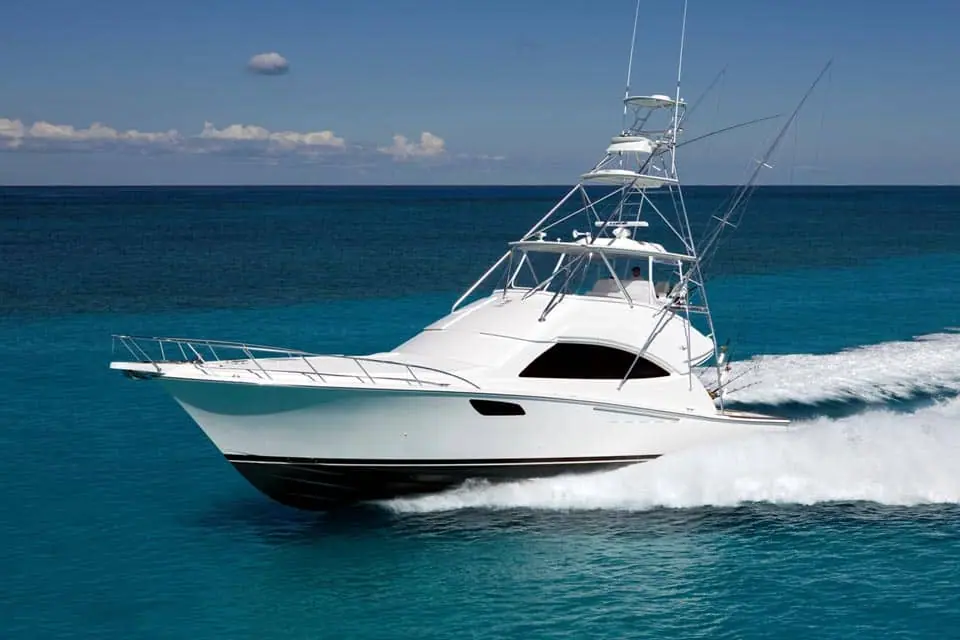
A name that meant the best-riding convertible of the 1980s, revived in 2008 and reworked in 2013 into a 40-knot tournament boat.
- Length
- 57.1 ft17.4 m
- Beam
- 18.2 ft5.54 m
- Cruise
- 33 kn
- Cabins
- 3
- Used price
- $150K to $1.5M
On this page
- Overview
- The 54 that set the bar for convertible ride
- What Robert Ullberg changed in 2013
- Cockpit, livewell and tournament setup
- Caterpillar C32 power and the test sheet
- Three staterooms and two galley plans
- Buying a classic 1980s Bertram 54
- Running costs and resale reality
- Specifications
- Price and value
- Strengths and weaknesses
- Used buyer checklist
- Rivals
- Our verdict
- FAQ
Two boats share the Bertram 54 Convertible name: the classic Miami-built boat of the 1980s and the 2008 to 2013 model reworked by Robert Ullberg, with CAT C32 power, a 160 sq ft cockpit and a 90-gallon livewell.
- Value-focused tournament teams
- Buyers who prize classic Bertram ride
- Bahamas and Gulf Stream crossings
- Owners ready to manage a repower or refit
The 54 that set the bar for convertible ride
Search for a 54 bertram for sale and you will find two different generations under one name. The original Bertram 54 Convertible, introduced in 1981 and built in Miami for about 12 years, earned a reputation as one of the best-riding convertibles on the water. Power and Motoryacht said exactly that in 2013, and it is the reason the name still means something to captains who grew up running them on the tournament circuit.
The second 54 arrived at the 2008 Fort Lauderdale show while Bertram was owned by Italy's Ferretti Group. It had an aft galley and forward windshield that made sense for cruising buyers but raised eyebrows among Bertram's hardcore fishing clientele, and early hulls drew criticism for vague, squirrelly steering. In 2012 the company hired naval architect Robert Ullberg, who had worked with Tom Fexas, Roy Merritt, John Bayliss and Mike Rybovich, and he reworked the boat. The revised 54 was tested in 2013 and is the version most buyers of modern 54s want.
This guide uses the 2013 model for the specification table, because its numbers are documented, and covers the classic boat in its own section.
Bertram 54 Convertible by the numbers
- Speed to length ratio at cruise
- 4.68A planing cruise. Fast passages in exchange for much higher fuel burn per mile.
- Estimated range at cruise
- 310 nmUsing 90 percent of tank capacity at the cruise speed and fuel burn listed on this page.
- Fuel economy at cruise
- 0.23 nmpgNautical miles per gallon at cruise, both engines combined.
- Horsepower per ton
- 81 hpStrong power to weight for a planing hull.
- Length to beam ratio
- 3.14 : 1Moderate proportions.
What Robert Ullberg changed in 2013
Ullberg's main fix was the rudders. They were reshaped to be more balanced and optimized for higher speeds, and the installation geometry was tuned so the boat responds crisply at both low and high speed. The result was a convertible that tracked and turned properly, with roughly a three-boat-length turning circle at speed.
The interior got a more traditional option too. Bertram kept the aft-galley plan, but added a forward galley layout without the saloon windshield, freeing up stowage and giving the boat a more conventional American sportfish look. Alton Herndon, a former Hatteras president who ran Bertram from about 2010, pushed these changes and moved production from Miami to a new waterfront plant at Merritt Island, Florida, in 2012.
At about 83,700 pounds the 54 was heavier than some rivals, but testers found that weight paid off in stacked 4 to 6 foot seas off Fort Lauderdale, with no rattling or shaking and an easy plane without touching the tabs. A single centerline fuel tank in the engine room avoids complicated fuel manifolds.
Cockpit, livewell and tournament setup
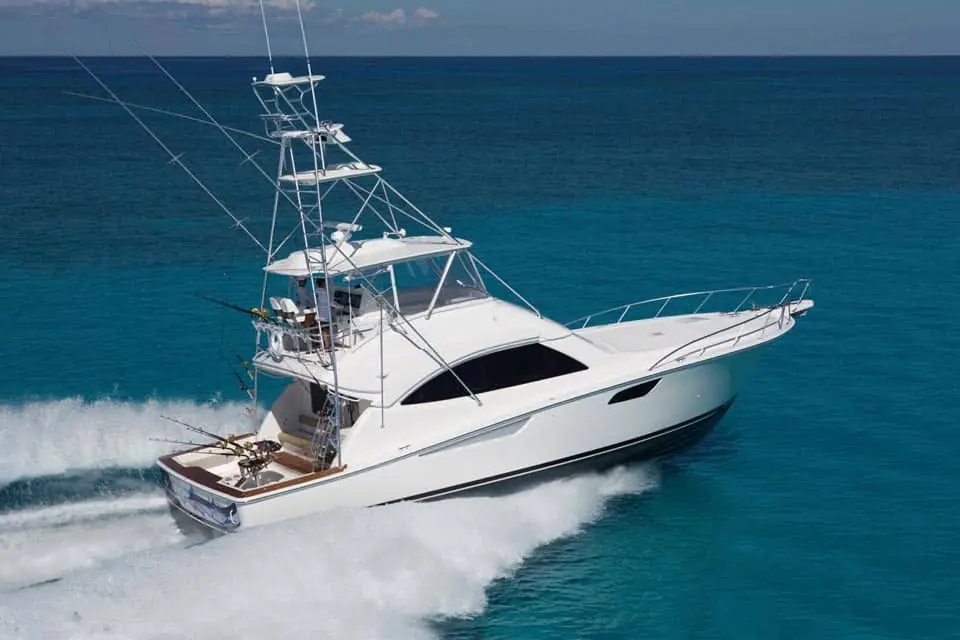
The cockpit measures 160 to 165 square feet depending on who held the tape, on an 18-foot 2-inch beam, which is generous for a 54. The headline fishing feature is a 90-gallon livewell built into the transom, big enough to keep a full load of goggle-eyes or blue runners alive for a sailfish or kite tournament.
Two large in-deck fishboxes handle the catch, and an Eskimo ice maker could be ordered to feed the transom fishbox. Mezzanine seating under the bridge overhang gives the crew a comfortable perch to watch baits, and owners could order either a bait-rigging center or an extra freezer in the cockpit. A lazarette takes buckets, brushes and spare gear.
The eight-step ladder to the bridge is angled so a mate can climb it almost facing forward, which matters when the captain needs help fast. On the bridge, the helm is set aft for a clear view into the cockpit during a backdown and over the bow when running, and a large U-shaped settee forward of the console seats guests out of the way.
- 160 to 165 sq ft cockpit on an 18 ft 2 in beam
- 90-gallon in-transom livewell
- Two large in-deck fishboxes, optional ice maker feed
- Mezzanine seating, optional bait center or freezer
- Aft-set bridge helm for cockpit visibility
Caterpillar C32 power and the test sheet
Standard engines on the 2013 boat were twin 1,380 hp MTU 10V2000 diesels, and the test boats carried twin Caterpillar C32 ACERTs rated at about 1,700 hp with ZF 2060A gears and 34 by 51 inch five-blade Veem props. Power and Motoryacht recorded 32.8 knots at 2,000 rpm burning 146 gph with about 308 nautical miles of range, and 38.1 knots at 2,250 rpm on 180 gph with about 290 miles. Yachting saw a 37-knot cruise at 2,100 rpm and 42 knots in calm water.
Pulled back to about 67 percent load, the 54 settled into a 20-knot-plus economy cruise with a little more than 300 miles of range and a 10 percent reserve. That is enough for Bahamas tournaments from South Florida and for overnight canyon trips in the Mid-Atlantic.
Standard equipment included a 15.5 kW generator, with a 23 kW unit, an Aquamatic watermaker and a zero-speed stabilizer on the options list.
Three staterooms and two galley plans
The saloon on the reworked boat has an L-shaped settee to port facing a television angled in the starboard aft corner, with a U-shaped galley forward to starboard and a dinette opposite. Hull-side windows and a large foredeck hatch make the three-stateroom, two-head lower deck brighter than most convertibles of the era.
The forward guest stateroom could be ordered with an over-under berth arrangement for tournament crews. Interior joinery was finished by a subcontractor, and testers rated the execution well, though it is not at the level of a Viking or a custom Carolina boat.
Buying a classic 1980s Bertram 54
Most 54 Bertrams on the market are the classic boats. They have the flowing sheer and rounded house that set Bertram apart from the squared-off Hatteras style of the same years, a deep-V ride that still impresses captains, and a layout built around a big cockpit and a practical saloon.
Original engines on these boats are now more than 30 years old, and their condition is the central question on any classic 54. Many boats have been repowered with modern electronically controlled diesels, which improves reliability, smoke and fuel burn but costs well into six figures. A boat still on its original engines needs a full engine survey and a price that reflects either a rebuild or a repower soon.
Beyond the engines, check the decks, flybridge and house for moisture, inspect fuel tanks, and expect original wiring, air conditioning and plumbing to need replacement. Done right, a classic 54 is a lot of convertible for the money and still fishes regional tournaments competitively.
Running costs and resale reality
Annual costs of about $150,000 to $300,000 cover insurance, dockage, fuel, engine service and yard work for an owner-run 54 with a part-time mate. Classic boats insure and dock for less but spend more time in the yard.
Resale is the weak point. Bertram's ownership changes, plant moves and closure left the 2008 to 2013 boats without the dealer and service network that props up Viking and Hatteras values, so they sell at a steep discount to comparable Vikings. For a buyer that is an opportunity, as long as the survey is thorough and the price assumes a slow sale later.
Bertram 54 Convertible specifications
| Length overall | 57.1 ft17.4 m |
|---|---|
| Beam | 18.2 ft5.54 m |
| Draft | 4.8 ft1.47 m |
| Displacement | 83,737 lbs37,982 kg |
| Fuel capacity | 1,524 gal5,769 L |
| Fresh water | 225 gal852 L |
| Cabins | 3 |
| Berths | 6 |
| Heads | 2 |
| Standard engines | 2 x MTU 10V2000, 1,380 hp each (2013 model) |
| Optional engines | 2 x Caterpillar C32 ACERT, about 1,700 hp each |
| Maximum power | 3,400 hp |
| Cruise speed | 33 knots |
| Top speed | 40 knots |
| Range | 300 nm |
| Hull type | Deep-V planing hull with sharp forefoot, 14 degrees transom deadrise (2013 model) |
| Hull construction | Fiberglass |
| Builder | Bertram Yacht, United States |
| Naval architect | Bertram design team; 2013 revisions by Robert Ullberg |
| Other design credits | 2008 model developed during Ferretti Group ownership |
| Production | 1981 to present |
| Status | Discontinued |
Figures come from builder documentation and independent tests where available. Displacement is usually quoted light, so a loaded cruising boat will weigh more. Compare these specs with another model.
Performance data
| RPM | Speed (kn) | Fuel (gph) | Range (nm) |
|---|---|---|---|
| 1000 | 11.6 | 32 | 497.2 |
| 1250 | 13.4 | 60 | 306.3 |
| 1500 | 20 | 82 | 334.5 |
| 1750 | 26.9 | 108 | 341.6 |
| 2000 | 32.8 | 146 | 308.1 |
| 2250 | 38.1 | 180 | 290.3 |
Power and Motoryacht test of the 2013 Bertram 54, twin 1,700 hp Caterpillar C32 ACERT, ZF 2060A 2.092 gears, 34 x 51 five-blade Veem props, 1,219 gal fuel and 5 persons aboard in 4 to 6 foot seas. Fuel burn is for both engines.
How much does a Bertram 54 Convertible cost?
Classic 1980s and early 1990s 54s trade roughly between $150,000 and $400,000, with repowers, paint, tower and electronics deciding where a boat lands. The 2008 to 2013 model was far more expensive new, with a 2013 base price of about $2.685 million, and now sells for roughly $750,000 to $1.5 million. Revised 2013-and-later hulls with the Ullberg steering changes and the forward galley layout carry a premium.
Estimate your yearly cost
A planning estimate using common rules of thumb: insurance near 1.5 percent of value, maintenance near 3 percent, haul out and bottom paint by length. Your marina, region and use will move these numbers. Open the full cost calculator.
Versions and options
- Classic Bertram 54 Convertible (1980s to early 1990s)
- Miami-built convertible introduced in 1981 and built for about 12 years, the model that gave the 54 name its reputation for ride.
- Bertram 54 (2008)
- Ferretti-era design with aft galley and forward saloon windshield, early hulls criticized for steering feel.
- Bertram 54 (2013 revision)
- Ullberg-reworked rudders and steering geometry, optional forward galley layout, MTU or CAT C32 power, built partly at Merritt Island.
Bertram 54 Convertible timeline
- 1980sClassic Bertram 54 Convertible debuts in 1981 and becomes a tournament favorite
- 2008New Bertram 54 debuts at the Fort Lauderdale show under Ferretti ownership
- 2012Robert Ullberg joins Bertram; production moves to Merritt Island, Florida
- 2013Revised 54 tested at 38 to 42 knots with CAT C32 ACERT power
Strengths and weaknesses
What owners like
- Classic boats offer a legendary ride for the money
- 90-gallon transom livewell on the modern boat
- High-30s cruise and roughly 40-knot top end with CAT C32s
- Spacious cockpit on an 18 ft 2 in beam
- Steep discount compared with similar Vikings
What to weigh up
- Two very different boats share the name, which confuses valuations
- Weak dealer support and slow resale for the modern boat
- Early 2008 hulls had steering complaints
- Classic boats need engine, fuel tank and systems work
Used Bertram 54 Convertible buyer checklist
Take this list to a viewing. Your ticks are saved in this browser so you can come back to it.
Always commission an independent marine survey and an engine survey before you buy. How a marine survey works.
Rivals to consider
Viking 54 Convertible
The modern benchmark, with better resale and dealer support but a much higher price.
Compare side by sideHatteras 53 Yacht Fisherman
The classic Hatteras alternative of the same period, squarer in style and very popular on the used market.
Compare side by sideOcean Yachts 48 Super Sport
A smaller, cheaper New Jersey convertible with lots of interior for its length.
Compare side by sideHatteras 54 Convertible
A heavier Carolina-built rival with strong brand support and a different ride.
Our verdict on the Bertram 54 Convertible
The Bertram 54 is a buyer's market boat. The classic 1980s convertible still has one of the best rides in its size if it has been repowered and kept dry, and the 2013 revision is a fast, capable tournament boat with a 90-gallon livewell that sells for far less than a comparable Viking. Know which 54 you are looking at, survey hard, and buy on price, because resale will be slow, but the fishing and the ride are the real thing.
Bertram 54 Convertible questions answered
How much is a 54 Bertram for sale?
Classic 1980s and early 1990s Bertram 54s typically ask about $150,000 to $400,000. The 2008 to 2013 model generally sells between roughly $750,000 and $1.5 million in 2026.
How fast is a Bertram 54?
The 2013 model with twin 1,700 hp Caterpillar C32 ACERTs tested at 38 to 42 knots at top speed and about 33 to 37 knots at a fast cruise.
How big is the Bertram 54 livewell?
The 2013 Bertram 54 has a 90-gallon in-transom livewell and two large in-deck fishboxes in a 160 to 165 sq ft cockpit.
Who designed the 2013 Bertram 54?
The 2008 Ferretti-era design was reworked in 2012 and 2013 by naval architect Robert Ullberg, who reshaped the rudders and steering geometry.
Is the Bertram 54 a good boat?
The classic 54 is known as one of the best-riding convertibles ever built, and the revised 2013 boat is fast and well equipped, but both need thorough surveys and resale is slower than for Viking or Hatteras.
Bertram 54 Convertible photos
More sportfishing yachts to explore
Viking 55 Convertible
Sportfishing Yachts, 56 ft
Used $400K to $2.6M
Viking 58 Convertible
Sportfishing Yachts, 59 ft
Used $300K to $4.8M
Viking 54 Convertible
Sportfishing Yachts, 55 ft
Used $1.05M to $4M
Hatteras GT59
Sportfishing Yachts, 60 ft
Used $2.4M to $4.2M