Cruising
Best Trawlers and Boats for the Great Loop
How to choose a Great Loop boat, with the hard limits every Looper boat must meet, our picks from budget Mainships to Kadey-Krogens and fast downeast cruisers, and estimated fuel bills for a full circuit.
On this page
- The four dimensions that decide your Loop boat
- What Loopers actually choose
- Our Great Loop picks at a glance
- Budget Loop boats that have done it hundreds of times
- Full-displacement trawlers for slow, cheap miles
- Faster boats for Loopers short on time
- What a full Loop costs in fuel, boat by boat
- Doing the Loop under sail or on a catamaran
- Features experienced Loopers look for
- Buying advice before you commit
- FAQ
The four dimensions that decide your Loop boat
Choosing among the best trawlers for the Great Loop starts with a tape measure, not a brochure. The route imposes physical limits that eliminate many otherwise excellent cruising boats. The America's Great Loop Cruisers' Association (AGLCA) publishes these figures, and they are the ones to design your search around.
| Limit | Figure | Where it applies |
|---|---|---|
| Air draft, unavoidable | 19.6 ft | Lowest fixed bridge on the route, near Chicago on the inland rivers |
| Air draft, Chicago River route | 17 ft | Taking the downtown Chicago River instead of the Cal-Sag or Sanitary and Ship Canal |
| Air draft, Erie Canal west to Lake Erie | 15 ft | Staying in the US on the full Erie Canal |
| Air draft, Oswego Canal | 21 ft | From the Erie Canal to Lake Ontario |
| Draft, recommended maximum | About 5 ft | Whole route; shallower is easier |
| Trent-Severn depth | 6 ft maintained | Ontario route to Georgian Bay |
| Trent-Severn beam | 23 ft | Port Severn lock, minimum width |
| Trent-Severn length | 84 ft | Maximum length on the waterway |
What Loopers actually choose
AGLCA's own fleet data is the best reality check. The average boat in its membership is 42.3 feet, and the average boat that completed the Loop in 2024 was 40.8 feet. When members describe their boats, 30 percent call them a motor yacht or power cruiser, 22 percent a trawler, 18 percent a sailboat, 13 percent a catamaran and 17 percent something else.
That spread tells you there is no single correct Loop boat. The Loop has been done in everything from jet skis to 70 foot yachts. But the center of gravity is a 36 to 44 foot diesel cruiser with a comfortable cabin for two, a guest cabin for visiting family, and an air draft that clears 19.6 feet with the mast and radar lowered.
Our Great Loop picks at a glance
Specifications and price ranges come from our model pages; used prices are 2026 US asking-price estimates. Where a figure is not published or not verified, we show n/a rather than guess. Confirm air draft on any specific boat, because owners add arches, antennas and electronics.
| Boat | LOA | Draft | Air draft | Cruise and burn | Used price (est.) | Loop role |
|---|---|---|---|---|---|---|
| Ranger Tugs R-27 | 31.6 ft | 2.8 ft | 8.5 ft | n/a | $85,000 to $285,000 | Trailerable budget Looper |
| Mainship 34 Trawler | 38.8 ft | 3.3 ft | n/a | n/a | $35,000 to $200,000 | Entry-level classic |
| Mainship 390 Trawler | 39.8 ft | 3.7 ft | n/a | n/a | $95,000 to $185,000 | Roomy single-engine value |
| Grand Banks 42 Classic | 43.3 ft | 4.2 ft | n/a | 8.5 kn at about 6 gph | $75,000 to $360,000 | The traditional choice |
| Kadey-Krogen 44 | 49 ft | 4.5 ft | n/a | 7 kn at about 3 gph | $650,000 to $1,100,000 | Premium full displacement |
| Nordhavn 41 | 41.3 ft | 4.7 ft | n/a | 7.4 kn at about 3.2 gph | $1,150,000 to $1,750,000 | Newest-generation passagemaker (production ended 2026) |
| Beneteau Swift Trawler 41 | 44.1 ft | 3.75 ft | 14.2 ft | Semi-displacement, faster | $450,000 to $760,000 | Speed when you want it |
| Back Cove 37 | 42 ft | 3.6 ft | 12.5 ft | 23.5 kn at about 20 gph | $300,000 to $700,000 | Fast downeast Looper |
| Aquila 44 power cat | 44.9 ft | 3.8 ft | 18.7 ft | 17 kn at about 20 gph | $450,000 to $900,000 | Stable, roomy multihull |
| Fleming 55 | 60.8 ft | 5 ft | 16 ft | 10 kn at about 10.5 gph | $650,000 to $3,300,000 | Upper limit of practical size |
Budget Loop boats that have done it hundreds of times
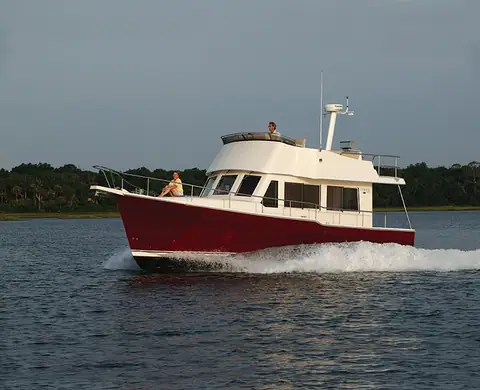
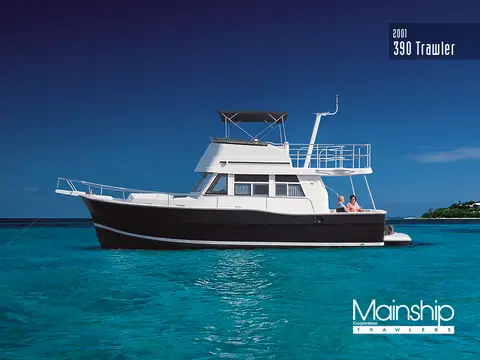
The Mainship 34 Trawler is the boat many first-time Loopers buy, and for good reason. It is a single-diesel semi-displacement boat with a keel protecting the propeller, a simple layout, a big cockpit and a price that leaves money for the trip itself. The Mainship 34 name covers the late 1970s sedan trawler, the downeast-style 34 Pilot and the 2000s 34 Trawler, which are different boats, so check which one you are viewing. The Mainship 390 adds an aft cabin and noticeably more volume for couples who will host guests.
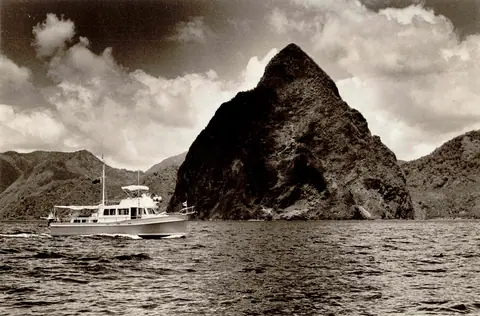
The Grand Banks 42 Classic is the archetypal American trawler. Single or twin Ford Lehman diesels on older boats, a full-length keel protecting the running gear, 600 gallons of fuel and a 4.2 foot draft make it nearly ideal for the Loop's rivers and canals. Old wooden-hulled boats exist, and fiberglass boats from the 1970s and 1980s need teak deck and fuel tank inspections, but a well-kept 42 is one of the best combinations of seaworthiness, room and Loop compatibility at any price.
For Loopers on a tighter budget, the Ranger Tugs R-27 is the smallest boat on our list and one of the most practical. With an 8 foot 6 inch beam it can be trailered home between segments, its shallow draft and low air draft eliminate route anxiety, and current boats run twin Yamaha outboards that any yard on the route can service. Space for two is snug for a full year aboard; many owners do the Loop in seasonal chunks.
Full-displacement trawlers for slow, cheap miles
Full-displacement trawlers trade speed for efficiency, motion comfort and range. On the Loop, where long stretches are no-wake zones, locks set the pace and many legs are under 50 miles, giving up speed costs less than you might think.
The Kadey-Krogen 44 cruises around 7 knots on roughly 3 gallons per hour from a single John Deere, with a full keel protecting the propeller. It is an expensive boat, but it delivers the most living space and the lowest fuel burn per mile on our list. Power and Motoryacht reported in 2026 that Kadey-Krogen would file for Chapter 7 and was out of production, so buy on the strength of the boat and its survey rather than on builder support. The Nordhavn 41 is the newest design here and draws 4.7 feet, inside the Loop's comfort zone, though its price puts it at the top of the market. Production ended in July 2026 after 44 hulls built by Telgeren and Partners in Turkey, so every 41 is now a resale boat.
Be careful with bigger Nordhavns. The Nordhavn 43 draws about 5.3 feet, the 47 about 5.9 feet and the 57 about 6.2 feet. All are superb ocean boats, but they exceed AGLCA's 5 foot recommendation, and the deeper boats will spend time watching depth sounders on the Tenn-Tom, in parts of the Gulf Coast and in Florida.
Faster boats for Loopers short on time
Not everyone has a full year. A boat that cruises at 15 to 25 knots can run between weather windows, cross open stretches like Lake Michigan or the Gulf's Big Bend quickly, and reach a marina before an afternoon storm.
The Back Cove 37, built from 2009 to 2020 and since replaced by the 372, has a single diesel and cruises around 23.5 knots on about 20 gallons per hour, which makes it one of the best fast Loop boats on the used market. Its 12.5 foot air draft and 3.6 foot draft clear every constraint with room to spare. The Beneteau Swift Trawler 41 offers a trawler-style layout with flybridge, a 14.2 foot air draft and twin diesels (Volvo Penta D4s on early boats, 320 hp Yanmars from late 2022) that let it run at displacement speed for economy or much faster when needed. The Aquila 44 power catamaran, at 18.7 feet of air draft and 21.5 feet of beam, fits the route and offers huge stability and living space.
Speed has trade-offs. Fuel burn per mile is much higher, wakes require constant courtesy in no-wake zones, and planing hulls with exposed running gear are more vulnerable to floating debris on the rivers.
What a full Loop costs in fuel, boat by boat
The table estimates fuel for one 6,000 statute mile Loop at each boat's published cruise speed and burn, at a diesel price range of $4.50 to $6.00 per gallon. These are estimates only. They ignore no-wake zones, generator use, side trips and current, and actual Loop mileage depends on your route.
| Boat | Cruise and burn used | Engine hours (est.) | Fuel used (est.) | Fuel cost (est.) |
|---|---|---|---|---|
| Kadey-Krogen 44 | 7 kn, 3 gph | about 745 | about 2,200 gal | $10,000 to $13,500 |
| Nordhavn 41 | 7.4 kn, 3.2 gph | about 705 | about 2,250 gal | $10,000 to $13,500 |
| Grand Banks 42 Classic | 8.5 kn, 6 gph | about 615 | about 3,700 gal | $16,500 to $22,000 |
| Back Cove 37 | 23.5 kn, 20 gph | about 220 | about 4,500 gal | $20,000 to $27,000 |
| Fleming 55 | 10 kn, 10.5 gph | about 520 | about 5,500 gal | $24,500 to $33,000 |
| Aquila 44 | 17 kn, 20 gph | about 305 | about 6,100 gal | $27,500 to $37,000 |
Doing the Loop under sail or on a catamaran
Sailboats make up a meaningful share of the Loop fleet, but every sailboat must travel the inland rivers with the mast down, because no cruising sailboat mast clears 19.6 feet. Most sailors unstep the mast before the Erie Canal and carry it on deck on a cradle until the Great Lakes or the Gulf, then restep. Draft is the other issue: many modern cruising sailboats draw 6 to 7 feet, which is a problem on the rivers and in Florida.
Sailing catamarans face both the mast problem and the beam problem. Most 40 to 46 foot cruising cats have beams of 21 to 26 feet, and anything wider than 23 feet cannot transit the Trent-Severn via Port Severn, forcing the Erie Canal route instead. Power cats with low profiles, like the Aquila 44, avoid both issues.
Features experienced Loopers look for
Beyond dimensions, a few features make a disproportionate difference over 6,000 miles.
- Protected running gear. A keel ahead of the propeller or pod-style protection reduces the risk from logs and debris on the rivers.
- Easy access to the side decks. Locking requires one person at the bow and one at the stern handling lines, often in wind.
- Fenders, fender boards and lots of cleats. Lock walls are rough and dirty.
- A lowerable mast, radar arch or antennas. Often the difference between 21 and 19 feet of air draft.
- Bow thruster. Highly valuable when docking in current or crowded transient marinas.
- Generator and air conditioning. Summer heat on the rivers and in the South is real.
- Fuel capacity for at least 300 miles. The longest gap between fuel stops, from Alton, Illinois to Paducah, Kentucky, is about 240 miles.
Buying advice before you commit
Join AGLCA before you buy. Its forums, member directory and boat specification webinars connect you with owners of the exact model you are considering, and many Looper boats change hands within the community at the end of a trip. Buying a boat that has already completed the Loop, with the gear and local knowledge that comes with it, is a common and sensible path.
Get a full survey including an engine survey with oil analysis. Many Loop boats are 20 to 40 years old, and engine and fuel system condition matters more than cosmetics. Ask your insurer early about navigation limits, as some policies need an endorsement for Canada and the Great Lakes, and about hurricane season requirements.
Finally, be honest about time. A slow trawler suits a year-long Loop. If you plan to do the trip in three or four months, a faster boat or a smaller trailerable boat that can be moved between segments may fit better.
Models mentioned in this guide
Mainship 34 Trawler
Trawlers & Explorer Yachts, 39 ft
Used $35K to $200K
Mainship 390 Trawler
Trawlers & Explorer Yachts, 40 ft
Used $95K to $185K
Grand Banks 42 Classic
Trawlers & Explorer Yachts, 43 ft
Used $75K to $360K
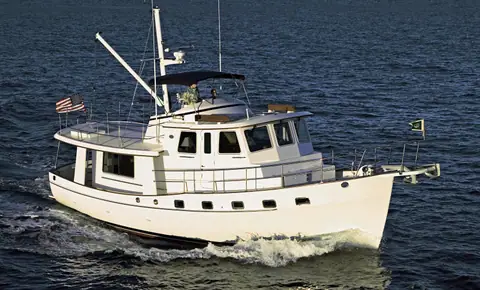
Kadey-Krogen 44 AE
Trawlers & Explorer Yachts, 49 ft
Used $650K to $1.1M
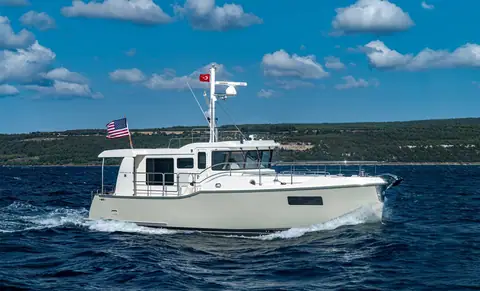
Nordhavn 41
Trawlers & Explorer Yachts, 41 ft
Used $1.15M to $1.75M
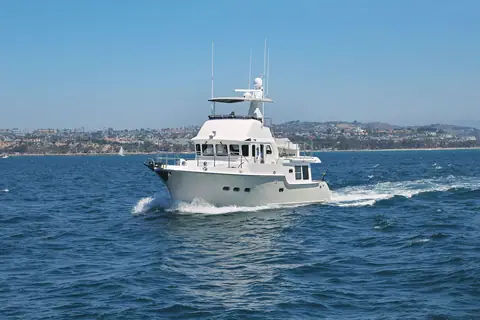
Nordhavn 43
Trawlers & Explorer Yachts, 43 ft
Used $420K to $760K
Frequently asked questions
What is the best boat for the Great Loop?
For most couples a 34 to 44 foot diesel trawler such as a Mainship 390, Grand Banks 42 Classic or Kadey-Krogen 44 is ideal. It clears the 19.6 foot bridge with masts lowered and draws less than about 5 feet.
What is the maximum air draft for the Great Loop?
The lowest unavoidable fixed bridge is charted at 19.6 feet, so boats must clear that height. Lower air drafts open more route options, such as the 17 foot Chicago River route and the 15 foot western Erie Canal.
What is the maximum draft for the Great Loop?
AGLCA recommends a draft not much greater than 5 feet. Boats drawing more can complete the Loop but face more restrictions and stress in shallow sections.
Can you do the Great Loop in a sailboat?
Yes. Sailboats are a meaningful share of the Loop fleet, but they must unstep the mast for the canals and inland rivers, and deep keels limit some routes.
What size boat is most common on the Great Loop?
According to AGLCA, the average boat that completed the Loop in 2024 was 40.8 feet, and the average member boat is 42.3 feet.
Is a trawler or a fast boat better for the Great Loop?
A trawler burns much less fuel and handles no-wake zones and locks comfortably. A faster boat suits Loopers short on time and can dodge weather, but costs more per mile.
Keep reading
The Great Loop, Route, Costs and Planning
A planning guide to America's Great Loop, the roughly 6,000 mile circuit of the eastern US and part of Canada, covering the…
CruisingIntracoastal Waterway Guide for Yacht Owners
A practical Intracoastal Waterway guide for owners running the Atlantic or Gulf ICW, covering boat fit, draft and air draft…
BuyingHow to Buy a Used Yacht, Step by Step
A step-by-step walkthrough of buying a used yacht in the US, from setting a real budget to closing, documentation and the first…
BuyingMarine Surveys Explained, What a Surveyor Checks
What happens during a pre-purchase marine survey, what it costs, how to choose a surveyor, and how to turn the report into a…
OwnershipYacht Insurance Guide, Costs and Coverage
A plain-English yacht insurance guide for US owners covering hull and liability coverage, agreed value versus actual cash value…
KnowledgeWhat Is a Flybridge? Pros, Cons and Who Needs One
A flybridge is an upper helm and lounge deck above a boat's main cabin. This guide explains how it works, the main variations…