Back Cove Yachts Downeast Yachts
Back Cove 37 for Sale, a Buyer's Guide to Maine's Single-Engine Cruiser
A single diesel, a hard-chined Downeast hull and a two-person cabin plan that turned a Rockland builder into the default choice for couples.
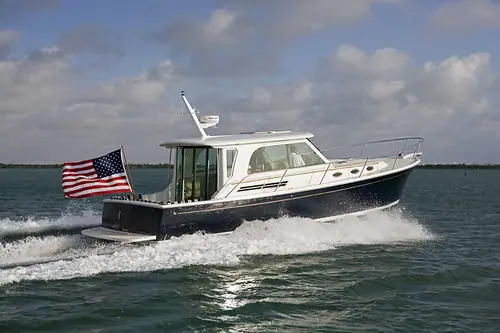
- Length
- 42 ft12.8 m
- Beam
- 13.3 ft4.04 m
- Cruise
- 23.5 kn
- Cabins
- 2
- Used price
- $300K to $700K
On this page
- Overview
- Why the Back Cove 37 for sale listings move so fast
- The case for one diesel on a 22,000-pound boat
- Hard chines in a Downeast suit
- A helm deck built for two people and a dog
- Island berth forward, mid-galley, one big head
- Picking between Yanmar, Cummins and Volvo packages
- What changed when the 37 became the 372
- Running a 37 for a season
- Resale and what the market rewards
- Specifications
- Price and value
- Strengths and weaknesses
- Used buyer checklist
- Rivals
- Our verdict
- FAQ
The Back Cove 37 is a 38-foot hull, single-engine Downeast express built in Rockland, Maine. It cruises in the low 20s on one diesel, sleeps a couple in real comfort and holds its value better than almost any production cruiser.
- Couples coastal cruising in New England
- Sailors moving to power
- Great Loop cruisers who want speed when needed
- Owners who value low running costs
Back Cove 37 by the numbers
- Speed to length ratio at cruise
- 3.89A planing cruise. Fast passages in exchange for much higher fuel burn per mile.
- Estimated range at cruise
- 316 nmUsing 90 percent of tank capacity at the cruise speed and fuel burn listed on this page.
- Fuel economy at cruise
- 1.17 nmpgNautical miles per gallon at cruise, both engines combined.
- Horsepower per ton
- 54 hpStrong power to weight for a planing hull.
- Length to beam ratio
- 3.17 : 1Moderate proportions.
Why the Back Cove 37 for sale listings move so fast
Brokers on the Maine coast and in Annapolis will tell you the same thing: a clean Back Cove 37 for sale rarely sits through a full season. The reason is simple arithmetic. It is a boat with a 38-foot hull that a couple can run alone, that burns one engine's worth of fuel, and that still looks right on a mooring in Northeast Harbor next to a hand-built lobster yacht costing twice as much.
Back Cove Yachts began in 2003 when a group of Sabre dealers asked for a smaller Downeast-style cruiser to sit below the Sabre range. The first boat was the Back Cove 29. The company now shares management and engineering with Sabre, builds in a 240,000-square-foot plant in Rockland, Maine, and says more than 1,000 Back Coves are in service worldwide. The 37 first splashed in 2009, and more than 200 were built before worn production molds led Back Cove to retire it in 2020. It was the model that turned the brand from a pleasant small-boat builder into a serious coastal cruiser company, and it is still the boat most people mean when they say Back Cove.
In 2014 Power and Motoryacht tested a 37 with a single 600 hp Cummins QSC 8.3 and saw 29.6 knots at wide open throttle and a comfortable 23.5 knot cruise burning 20.1 gallons per hour. That combination of a real 20-plus-knot gait on one diesel is the heart of the boat's appeal, and it is why Back Cove kept the formula when it retired the 37 and replaced it with the 372.
The case for one diesel on a 22,000-pound boat
Every Back Cove inboard has a single engine on a conventional shaft, and new buyers coming from twin-engine express cruisers often treat that as a compromise. In practice it is the best decision Back Cove made. One engine means one set of filters, one exhaust elbow, one heat exchanger and one cooling system to service. It also means a center-line engine room with genuine walk-around access, something that is impossible on a 13-foot beam with two diesels and a generator crammed side by side.
Redundancy comes from the thrusters rather than a second engine. Most 37s carry both bow and stern thrusters, and with a little practice an owner can walk the boat sideways into a slip on the thrusters alone. Get-home insurance is a sea tow membership and a meticulous maintenance log. For a boat that spends most of its life within 30 miles of a harbor, that trade has proven sound.
The economy story is real. At 1,000 rpm the test boat was making 8 knots on 1.6 gallons per hour, which is trawler territory. Run at 9 knots and you sip around 4 gallons per hour, open it up to 18 knots and the burn is roughly 14 gallons per hour. Few twin-engine 38-footers come close at displacement speed, and none at cruise.
Hard chines in a Downeast suit
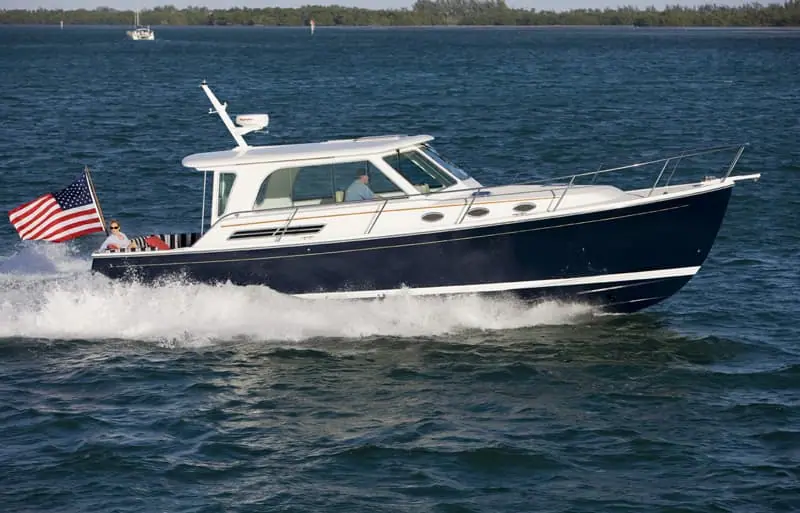
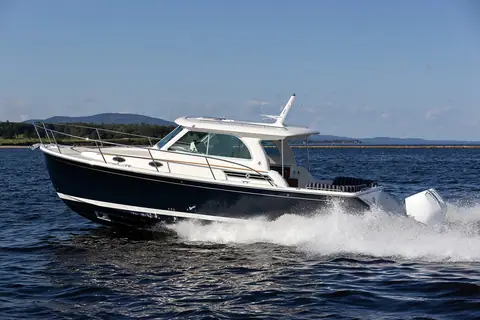
Look at a 37 out of the water and it is less traditional than the sheer suggests. The forefoot is fine, the chines are crisp and the hull runs flatter aft than a true lobster-boat derivative. The chines do two jobs. They throw spray down and away, which keeps the windshield dry in a quartering chop, and they add lift so the boat planes cleanly at modest rpm on one engine.
The testers found the boat would complete a full 360-degree turn at 2,400 rpm and 19 knots in about 30 seconds while losing very little speed, where comparable inboards commonly shed 4 to 6 knots in a hard turn. That speaks to a hull that carries its weight well and a single propeller that stays bitten in the water. In a steep head sea the 37 is drier than its size suggests, but at 22,000 pounds it is not a heavy-weather boat in the way a 50-foot Downeast cruiser is. Trim the bow down, ease off to the high teens and it is comfortable in the 3- to 4-foot chop typical of Buzzards Bay on a summer afternoon.
A helm deck built for two people and a dog
The bridgedeck sits under a hardtop with large side windows and opening sunroof panels, and the builder describes it as giving 360-degree visibility. That is close to true. The helm is to starboard with a companion seat opposite, and behind them a settee that converts for guests. Swing bi-fold doors link the helm deck to the cockpit, so in good weather the whole aft half of the boat becomes one room.
The cockpit is sized for sitting with drinks rather than fishing, with a transom door to the swim platform and enough space for a pair of folding chairs or a small table. Side decks are narrow but usable, protected by proper rails, and the foredeck has a working anchor setup rather than a sunpad. Owners who go into Maine fog and need to tend the anchor will appreciate that priority.
- Hardtop with large side glass and opening overhead hatches
- Bi-fold doors between helm deck and cockpit
- Bow and stern thrusters on nearly every boat
- Air draft of 12 feet 6 inches with the mast, a big plus on rivers and canals
Island berth forward, mid-galley, one big head
Below, the 37 is laid out for a couple who occasionally host another couple. The master stateroom forward has an island berth with walk-around space on both sides. A guest cabin tucks under the helm deck, workable for a weekend but tight for adults over several nights. The galley sits amidships with overhead windows that bring in daylight, and the single head is generously sized with a separate stall shower.
Back Cove finishes the interior in satin-varnished cherry or a lighter wood option, with flat-panel joinery that ages well. Compared with production express cruisers of the same era the joinery is a notch better, but it is not Hinckley. You pay for that difference and it is honest about it.
Picking between Yanmar, Cummins and Volvo packages
On the brokerage market you will see three engine choices. Early boats from 2009 came with a 480 hp Cummins QSB 6.7 as standard, although Back Cove says more than 95 percent of owners ordered a bigger engine. By 2014 the standard engine was a 530 hp Yanmar 6CX, with the 480 hp QSB and a 600 hp Cummins QSC 8.3 as alternatives. The QSC is the one to want. It gives the boat the 29-knot top end and lets you cruise at 23 to 24 knots without leaning on the engine, and the 8.3-liter block has a long service record in commercial use.
The refreshed 372 offers either a 600 hp Volvo Penta D8 or the 600 hp Cummins QSC 8.3 and moves to a 24-volt electrical system. A boat with the QSB will cruise a couple of knots slower and is perfectly adequate for a couple who cruise at 18 to 20 knots, which is where most owners settle anyway. Any older boat with a smaller engine should be priced accordingly, by $20,000 to $40,000 against a comparable QSC boat.
What changed when the 37 became the 372
The 37 is out of production, and the Back Cove 372 is its direct successor in a lineup that now runs 372, 412, 34O and 39O. Back Cove calls the 372 a reimagined evolution rather than a new boat, and that is accurate. The first 372 came out of the new mold in 2021 and debuted at the Annapolis powerboat show that October. Overall length grew slightly to 42 feet 8 inches with revised cockpit seating, but beam, draft, air draft and the 300 gallons of fuel and 120 gallons of water are unchanged. The visible differences are improved helm ergonomics, sightlines with reduced glare, a redesigned shower and more storage in the head. The 24-volt system cuts cable weight and makes lithium house banks and modern electronics easier to integrate.
For a used buyer, the 372 matters in two ways. It puts a ceiling on prices for late 37s, because a new 372 is only a phone call away, and it confirms that parts, support and know-how for the hull will be around for decades.
Running a 37 for a season
Plan on $28,000 to $52,000 a year to keep a 37 in good shape, excluding depreciation and financing. Slip fees are the swing factor: a seasonal slip in Newport or on Long Island Sound can top $15,000 on its own, while a Maine mooring and winter storage cost a fraction of that. Insurance for an experienced owner typically runs 1 to 1.5 percent of hull value.
Fuel is where the single engine pays off. A couple putting 150 hours a season on the boat, mostly at 18 to 22 knots, will burn roughly 2,000 to 2,500 gallons. A twin-engine 38-foot express doing the same mileage will burn far more. Routine maintenance on the engine, the generator and the thrusters is straightforward for any competent yard.
Resale and what the market rewards
Back Cove resale is among the strongest in production power boats. Boats lose value slowly because demand from couples downsizing from bigger yachts and sailors crossing over to power has been steady for a decade, and because the Rockland plant cannot flood the market. Expect a well-kept 37 to retain a higher share of its original price after ten years than most twin-engine express boats of the same size.
The market rewards the QSC engine, a hardtop with good canvas, a generator with air conditioning, updated Garmin or Raymarine electronics and, increasingly, a gyro stabilizer. It punishes deferred varnish, tired canvas, a missing service history and smaller engines. Boats that have spent their lives in fresh water on the Great Lakes or Lake Champlain often trade at a premium.
Back Cove 37 specifications
| Length overall | 42 ft12.8 m |
|---|---|
| Beam | 13.3 ft4.04 m |
| Draft | 3.6 ft1.09 m |
| Air draft | 12.5 ft3.81 m |
| Displacement | 22,1 lbs10,024 kg |
| Fuel capacity | 3 gal1,136 L |
| Fresh water | 12 gal454 L |
| Cabins | 2 |
| Berths | 4 |
| Heads | 1 |
| Standard engines | Single inboard diesel on a conventional shaft; 480 hp Cummins QSB 6.7 on early boats, 530 hp Yanmar 6CX listed as standard in 2014 |
| Optional engines | 600 hp Cummins QSC 8.3 (the choice of most buyers); the 480 hp Cummins QSB 6.7 remained an option in 2014. The successor 372 offers a 600 hp Cummins QSC 8.3 or 600 hp Volvo Penta D8 |
| Maximum power | 600 hp |
| Cruise speed | 23.5 knots |
| Top speed | 29.6 knots |
| Range | 332 nm |
| Hull type | Hard-chined modified-V planing hull with Downeast keel profile |
| Hull construction | Vacuum-infused fiberglass composite |
| CE design category | B |
| Builder | Back Cove Yachts (sister company of Sabre Yachts), USA |
| Naval architect | Back Cove and Sabre in-house design team |
| Production | 2009 to 2020 |
| Status | Discontinued |
Figures come from builder documentation and independent tests where available. Displacement is usually quoted light, so a loaded cruising boat will weigh more. Compare these specs with another model.
Performance data
| RPM | Speed (kn) | Fuel (gph) | Range (nm) |
|---|---|---|---|
| 600 | 6.2 | 0.5 | 3527 |
| 1000 | 8 | 1.6 | 1422 |
| 1400 | 9.3 | 4.4 | 601 |
| 1800 | 13 | 9.4 | 393 |
| 2200 | 18 | 13.8 | 371 |
| 2600 | 23.5 | 20.1 | 332 |
| 3080 | 29.6 | 31.7 | 265 |
Power and Motoryacht test, 2014 boat with single 600 hp Cummins QSC 8.3 and ZF 286A gear at 2.3:1. Load 225 gallons fuel, 120 gallons water, four people. Range based on 90 percent of the 300-gallon tank.
How much does a Back Cove 37 cost?
Engine choice moves the needle more than model year on the brokerage market, and 600 hp Cummins QSC boats command a clear premium over the smaller packages. A factory hardtop, generator, air conditioning and a recent bottom job are expected at the top of the range. The 37 is no longer built, so there is no new price for it; its successor, the Back Cove 372, sets the ceiling for late 37s with a typical Northeast cruising equipment list.
Estimate your yearly cost
A planning estimate using common rules of thumb: insurance near 1.5 percent of value, maintenance near 3 percent, haul out and bottom paint by length. Your marina, region and use will move these numbers. Open the full cost calculator.
Versions and options
- Back Cove 37, Cummins QSB 6.7 480 hp
- The original standard engine from 2009. Fine for 18 to 20 knot cruising, but Back Cove says fewer than 5 percent of owners kept it, so these boats are scarce and priced lowest.
- Back Cove 37, Yanmar 6CX 530 hp
- Listed as the standard package in 2014, sitting between the QSB and the QSC in output and cruising a knot or two slower than the QSC boat.
- Back Cove 37, Cummins QSC 8.3 600 hp
- The pick of the range, good for nearly 30 knots and the most sought-after configuration on the brokerage market.
- Back Cove 372
- Successor launched in 2021 with Cummins QSC 8.3 or Volvo Penta D8 at 600 hp, 24-volt electrics, revised helm, cockpit seating and head.
Back Cove 37 timeline
- 2003Back Cove Yachts founded as a sister brand of Sabre, starting with the Back Cove 29
- 2009The Back Cove 37 splashes, with a 480 hp Cummins QSB 6.7 as standard power
- 2013The Downeast 37 dayboat variant launches on the same hull
- 2014Power and Motoryacht tests a QSC-powered 37 at 29.6 knots top and 23.5 knots cruise
- 2020The 37's production molds are retired after more than 200 hulls
- 2021The Back Cove 372 debuts at the Annapolis powerboat show with 24-volt electrics and 600 hp Cummins or Volvo power
- 2026The 372 remains in the Rockland lineup alongside the 412, 34O and 39O
Strengths and weaknesses
What owners like
- Single-engine economy with a genuine 23-knot cruise
- Walk-around engine room access that twin-engine rivals cannot match
- Excellent visibility and a sheltered helm deck for shoulder seasons
- Low 12-foot-6 air draft opens up rivers, canals and the Loop
- Some of the best resale values in production power boats
- Factory and dealer support shared with Sabre
What to weigh up
- No engine redundancy, so maintenance discipline is not optional
- Guest cabin is tight for two adults beyond a weekend
- Only one head
- Cockpit is too small for serious fishing
- Strong demand keeps used prices high
Used Back Cove 37 buyer checklist
Take this list to a viewing. Your ticks are saved in this browser so you can come back to it.
Always commission an independent marine survey and an engine survey before you buy. How a marine survey works.
Rivals to consider
Sabre 38 Salon Express
Sister-ship from the same company with twin engines on pods or sterndrives, more beam inside and a higher price.
Compare side by sideBack Cove 34O
Outboard alternative that is faster and cheaper to buy, with less range and a smaller cabin.
Compare side by sideGrand Banks Eastbay 38
Twin diesel Hunt-designed deep-V with more offshore ride, but older boats and higher running costs.
Hinckley Picnic Boat
More prestige and finish with jet drive, less interior and a much higher price per foot.
Compare side by sideOur verdict on the Back Cove 37
The Back Cove 37 succeeds because it does not pretend to be a bigger boat. One diesel, one master cabin and a helm deck that works from May to October give a couple everything they actually use, and the boat delivers it at a fuel and maintenance cost that twin-engine express cruisers cannot touch. Buy a QSC-powered boat with a full service history, accept that the guest cabin is for occasional use, and you will own one of the most liquid power boats on the East Coast.
Back Cove 37 questions answered
How much is a Back Cove 37 for sale?
Used Back Cove 37s typically list between about $300,000 and $700,000 depending on year and engine. The 37 is no longer built; its successor, the Back Cove 372, had a base price of $880,545 in 2022.
Is the Back Cove 37 still in production?
No. The 37 was built from 2009 to 2020 and replaced by the Back Cove 372, which sits in the current range alongside the 412, 34O and 39O. Every 37 on the market is a used boat.
How fast is a Back Cove 37?
With the 600 hp Cummins QSC a 37 tops out near 30 knots and cruises comfortably at 23 to 24 knots. Boats with smaller engines cruise a couple of knots slower.
What is the difference between the Back Cove 37 and 372?
The 372 is the successor that replaced the 37, an updated version with a 24-volt electrical system, better helm ergonomics, revised cockpit seating and a redesigned head. Hull, tankage and engine size are essentially the same.
Does the Back Cove 37 have twin engines?
No. It uses a single inboard diesel on a shaft with bow and stern thrusters, which is a big reason for its economy and easy engine room access.
How much fuel does a Back Cove 37 burn?
About 20 gallons per hour at a 23.5 knot cruise, around 14 gallons per hour at 18 knots and under 2 gallons per hour at 8 knots.
Where are Back Cove yachts built?
In Rockland, Maine, in a vacuum-infusion plant shared in management with Sabre Yachts.
Back Cove 37 photos
More downeast yachts to explore
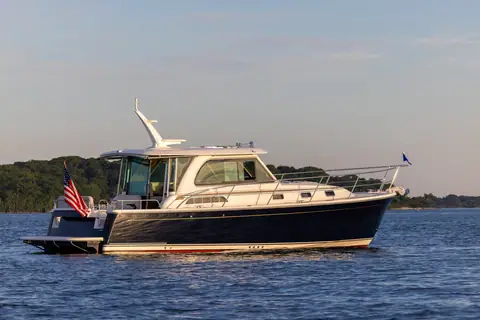
Sabre 38 Salon Express
Downeast Yachts, 42 ft
Used $330K to $675K
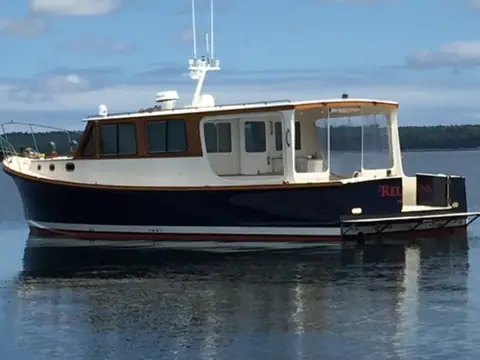
Wesmac 42
Downeast Yachts, 42 ft
Used $150K to $750K
Back Cove 34O
Downeast Yachts, 40 ft
Used $440K to $760K
Hinckley Picnic Boat
Downeast Yachts, 39 ft
Used $180K to $1.95M