Back Cove Yachts Downeast Yachts
Back Cove 41 Review, Specs and Used Market Guide
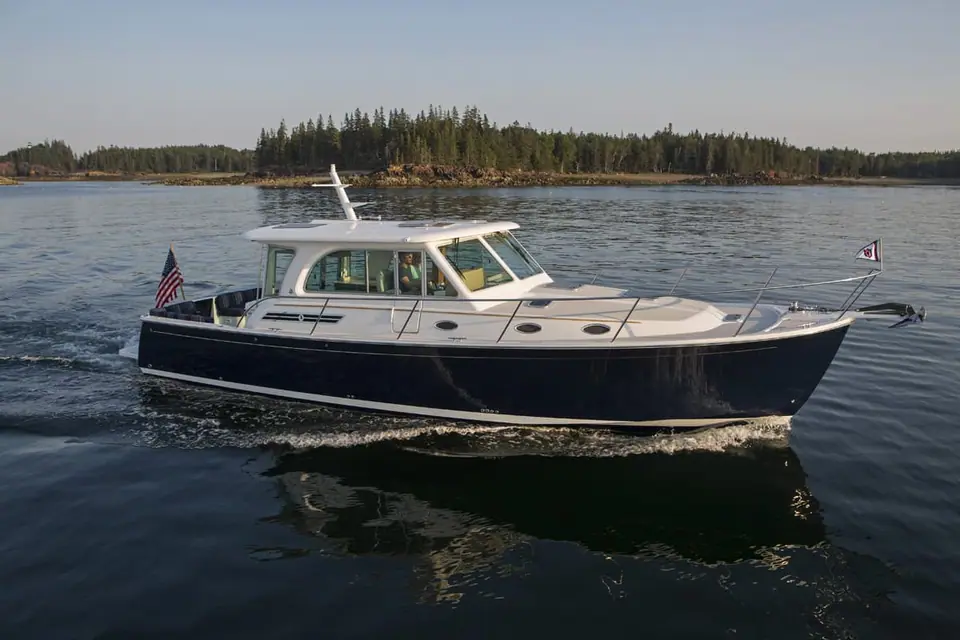
Back Cove's single-diesel, two-stateroom flagship from 2014 to 2025: 106 hulls, 400 gallons of fuel and a 7.5-knot cruise at 1.5 gph.
- Length
- 46.1 ft14.05 m
- Beam
- 14 ft4.27 m
- Cruise
- 20.8 kn
- Cabins
- 2
- Used price
- $450K to $980K
On this page
- Overview
- Back Cove yachts for sale, and why the 41 leads the list
- One Cummins, two thrusters and no pods
- 1.5 gph at 7.5 knots, 27 knots flat out
- A hull and grid infused in one shot
- Two private staterooms and a galley up
- 41 or 412: what the update changed
- Running a 41 for a cruising season
- How 41s trade and what to prioritize
- Specifications
- Price and value
- Strengths and weaknesses
- Used buyer checklist
- Rivals
- Our verdict
- FAQ
The Back Cove 41 is a 46-foot overall Downeast express built in Rockland, Maine, from 2014 to 2025, with one 600 hp Cummins, bow and stern thrusters, two en suite staterooms and a reputation as a Great Loop favorite.
- Great Loop cruisers
- Couples who travel with another couple
- Owners stepping up from a 34 to 37-foot single-diesel boat
- Northeast and Chesapeake coastal cruising
Back Cove 41 by the numbers
- Speed to length ratio at cruise
- 3.29A planing cruise. Fast passages in exchange for much higher fuel burn per mile.
- Estimated range at cruise
- 369 nmUsing 90 percent of tank capacity at the cruise speed and fuel burn listed on this page.
- Fuel economy at cruise
- 1.02 nmpgNautical miles per gallon at cruise, both engines combined.
- Horsepower per ton
- 49 hpStrong power to weight for a planing hull.
- Length to beam ratio
- 3.29 : 1Moderate proportions.
Back Cove yachts for sale, and why the 41 leads the list
Browse Back Cove yachts for sale and the 41 stands out as the boat cruising couples ask for by name. It was the largest model the Rockland, Maine, builder had produced when it launched, and it stayed the flagship for more than a decade. Back Cove announced the project in March 2013, put the first boat in the water for the 2014 season, and built roughly 106 of them before replacing it with the updated 412, which Power and Motoryacht tested in late 2025.
The formula never changed. One diesel on a straight shaft, bow and stern thrusters, a generator and reverse-cycle air as standard, two private staterooms each with its own head, and enough fuel to run a long way at trawler speed or a shorter way at 20 knots. Back Cove's own sales team told Power and Motoryacht that many 41s have completed or are working on the Great Loop, which says a lot about the type of owner who buys one.
One Cummins, two thrusters and no pods
Standard power is a 600 hp Cummins QSC 8.3 driving a big 28-inch four-blade propeller through a ZF gear at 2.39 to 1. A 725 hp Volvo Penta D11 was the main upgrade (Soundings priced it at $41,995 in 2014), and Power and Motoryacht's 2015 spec sheet also lists a 715 hp Cummins QSM11. The hull has a propeller recess on centerline that keeps draft at 3 feet 9 inches to the bottom of the prop and about 2 feet 7 inches to the hull.
Capt. Bill Pike's test for Power and Motoryacht is the best argument for this layout. With two proportional Side-Power thrusters he walked the boat sideways into a tight Florida slip and called the result more maneuverable than many pod boats, with none of the noise and turbulence of pods and a simpler, cheaper powertrain to maintain. The engine room is reached through a guttered cockpit hatch, with a second hatch over the lazarette and generator and an electrically raised salon sole for major work.
- Single Cummins QSC 8.3, 600 hp, standard; Volvo D11 725 hp or Cummins QSM11 715 hp optional
- Side-Power bow and stern thrusters, 9 kW Onan generator, reverse-cycle heat and air standard
- 400 gallons of fuel, 160 gallons of water, 55-gallon holding tank
- See-through cross-linked polyethylene fuel and water tanks for visual level checks
1.5 gph at 7.5 knots, 27 knots flat out
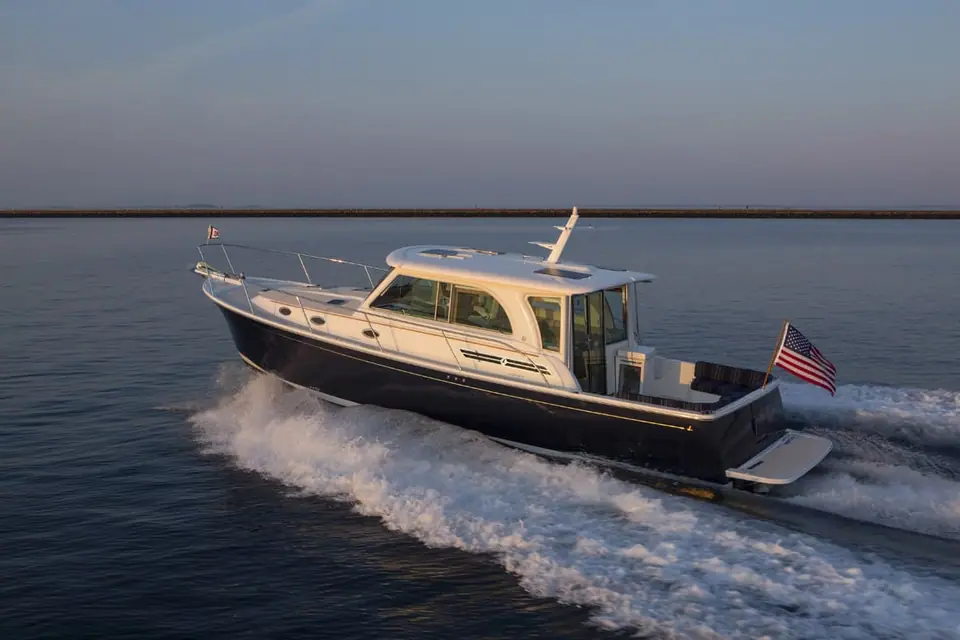
Power and Motoryacht's test boat, carrying 380 gallons of fuel and three people, reached 27.0 knots at 3,030 rpm burning 32.4 gph. At 2,500 rpm it made 20.8 knots on 20.3 gph, good for about 369 nautical miles, and Back Cove's sales chief told Soundings that a 20-knot cruise works out to roughly one nautical mile per gallon. The brochure says the hull planes efficiently from about 12 knots.
The number that sells the boat to Loopers is lower on the chart. At 1,000 rpm the 41 made 7.5 knots on 1.5 gph, which Power and Motoryacht calculated as about 1,800 nautical miles of range. Between 9 and 15 knots the curve is less friendly, as on any planing hull, so most owners either loaf at displacement speed or run in the high teens and low 20s.
Running attitude rose gently to about 4 degrees at wide-open throttle, and turns were broad, around four boat lengths, as expected with a single screw. Optional Lenco automatic trim tabs let the skipper drive with just wheel and throttle.
A hull and grid infused in one shot
Under the traditional sheer, the 41 is a thoroughly modern build. Pike found that the hull and its foam-cored longitudinals and athwartship members were resin-infused together in one shot, with no secondary bonding. Corecell stiffens the bottom panels, Coosa board replaces foam in way of through-hulls to resist compression, and a vinylester skin coat guards against print-through and osmotic blistering. Soundings added that every part, from hardtop to hatches, is infused to keep weight in check.
Details aimed at long-distance owners show up everywhere: #6 bonding wire instead of the usual #8, a large and clearly labeled fuel manifold, and plenty of elbow room around the single engine. Pike's one complaint was access to the generator's raw-water strainer, tucked behind the generator in the lazarette, and it is worth checking how a given boat's owner has dealt with it.
Two private staterooms and a galley up
The main deck carries two Stidd helm chairs on stowage pedestals with a door to the starboard side deck beside them, a small L-shaped lounge to port, a U-shaped dinette that powers down to make a berth, and a long galley with a ceramic cooktop, convection microwave, two refrigerator drawers and a freezer under the helm seat. A bi-fold door and an electrically lowered aft window open the salon to the cockpit. The varnished cherry joinery, built in Maine, includes real bookcases at the after end of the salon, a detail Pike singled out.
Below, the master stateroom fills the bow with an island queen, hanging lockers and drawers, and an en suite head with a separate glass shower stall that has its own opening port and a seat. The guest stateroom runs athwartships under the salon sole with a queen-size berth, standing headroom at the entry, a hanging locker and an opening port. Its head across the passage doubles as the day head. Few boats this size give a second couple this much privacy.
Outside, wide side decks with molded steps, a center transom door, corner seats in the cockpit that store ground tackle and a powered shore-power cord reel make the boat easy to handle shorthanded.
41 or 412: what the update changed
Back Cove's heritage page describes the 41 as recently reintroduced as the 412, and Power and Motoryacht's review of the new boat lists a 46-foot 1-inch LOA, 14-foot beam, 3-foot 9-inch draft, 29,500 pounds and the same 400 gallons of fuel. The underlying platform carries over. The 412 adds a slightly larger drop-down TV, a sleeker helm pod, a bigger salon table, a sliding door instead of the swing-out door, optional aft-facing cockpit seats and a grill, Zipwake trim control, and power from a standard 725 hp Volvo Penta D11 with a 600 hp D8 option.
With the 412 at roughly $1.1 million base, a well-kept late 41 at well under that figure is the value play. The trade-off is older electronics and the absence of the newest cockpit options, both of which are fixable.
Running a 41 for a cruising season
Fuel is the variable. A couple doing the Loop at 7 to 8 knots will burn very little, while an owner who runs at 20 knots will see about 20 gph. A 150-hour season at mixed speeds might consume 1,500 to 2,500 gallons of diesel.
Beyond fuel, budget roughly $30,000 to $60,000 a year for a 46-foot slip, insurance, hauling and storage, bottom paint, engine and generator service, thruster batteries, canvas and varnish. Single-engine owners should also budget for a spare-parts kit and a towing membership, since there is no second engine to limp home on.
How 41s trade and what to prioritize
Because production was limited and the boat has a loyal following, 41s tend to sell on reputation. Early 2014 to 2016 boats are the value entry, and the last boats built before the 412 command the most. Prioritize engine hours and service history, the condition of the thrusters and generator, and whether the electronics have been updated. A hardtop mast with radar and a modern autopilot is close to essential for Loop or coastal cruising.
A Great Loop history is not a negative by itself. Look for evidence of lock and fender-board wear on the topsides and rub rail, and for a running-gear inspection after any groundings, but a boat that has been used and maintained is often better than one that sat.
Back Cove 41 specifications
| Length overall | 46.1 ft14.05 m |
|---|---|
| Beam | 14 ft4.27 m |
| Draft | 3.8 ft1.14 m |
| Air draft | 13.2 ft4.01 m |
| Displacement | 29,5 lbs13,381 kg |
| Fuel capacity | 4 gal1,514 L |
| Fresh water | 16 gal606 L |
| Cabins | 2 |
| Berths | 4 plus a convertible dinette |
| Heads | 2 (master en suite with stall shower, plus a guest and day head) |
| Standard engines | 1 x Cummins QSC 8.3 600 hp diesel, straight shaft |
| Optional engines | 1 x Volvo Penta D11 725 hp or 1 x Cummins QSM11 715 hp diesel |
| Maximum power | 725 hp |
| Cruise speed | 20.8 knots |
| Top speed | 27 knots |
| Range | 369 nm |
| Hull type | Modified-V planing hull with prop recess, downturned chines, spray rails and 16-degree transom deadrise |
| Hull construction | One-shot vacuum resin-infused vinylester and E-glass with Corecell foam core and infused stringers |
| CE design category | B |
| Builder | Back Cove Yachts, United States |
| Naval architect | Kevin Burns and the Back Cove design team |
| Production | 2014 to 2025 |
| Status | Discontinued |
Figures come from builder documentation and independent tests where available. Displacement is usually quoted light, so a loaded cruising boat will weigh more. Compare these specs with another model.
Performance data
| RPM | Speed (kn) | Fuel (gph) | Range (nm) |
|---|---|---|---|
| 600 | 5 | 0.5 | 3673 |
| 1000 | 7.5 | 1.5 | 1800 |
| 1500 | 9.2 | 5.1 | 649 |
| 2000 | 15.2 | 12.1 | 449 |
| 2500 | 20.8 | 20.3 | 369 |
| 3000 | 26.6 | 31.6 | 303 |
| 3030 | 27 | 32.4 | 300 |
Power and Motoryacht test, February 2015, single 600 hp Cummins QSC8.3, ZF286A 2.39 to 1, 28 x 31 four-blade Nibral prop, 380 gallons fuel, 75 gallons water, three people, 1 to 2 foot seas. Range as published.
How much does a Back Cove 41 cost?
Back Cove told Soundings in 2014 that a 41 with electronics and key options came in under $600,000, and the 412 that replaced it lists at about $1.1 million, which props up late 41 values. The optional Volvo D11 or QSM11, Lenco or Zipwake auto trim, a hardtop mast with full electronics and a documented Great Loop history in good condition all add value, while high-hour engines and tired canvas pull boats down. Only about 106 were built, so good ones sell quickly.
Estimate your yearly cost
A planning estimate using common rules of thumb: insurance near 1.5 percent of value, maintenance near 3 percent, haul out and bottom paint by length. Your marina, region and use will move these numbers. Open the full cost calculator.
Versions and options
- Cummins QSC 8.3 600 hp
- Standard engine for the life of the model and the one most boats carry.
- Volvo Penta D11 725 hp
- The main power upgrade, priced at $41,995 in 2014, for a little more top end and margin when loaded.
- Back Cove 412
- The 2025 update on the same platform with a sliding salon door, revised helm pod, cockpit seating options and Volvo D11 power as standard.
Back Cove 41 timeline
- 2013Back Cove announces its largest project, a 41-footer with two en suite staterooms
- 2014Back Cove 41 goes into service with a 600 hp Cummins QSC 8.3
- 2015Power and Motoryacht tests the 41 and records 27 knots and 1.5 gph at 7.5 knots
- 2025After about 106 hulls the 41 is updated and reintroduced as the Back Cove 412
Strengths and weaknesses
What owners like
- Two private staterooms, each with its own head
- Single diesel with bow and stern thrusters handles like a twin
- 1.5 gph at 7.5 knots makes long-range cruising cheap
- Generator and reverse-cycle air standard
- Modern one-shot infused hull with a classic look
- Strong resale and loyal owner base
What to weigh up
- Single engine means no redundancy offshore
- Inefficient between 9 and 15 knots, like any planing hull
- Generator strainer access criticized in testing
- 46-foot overall length for slip fees
- Few boats on the market at any time
Used Back Cove 41 buyer checklist
Take this list to a viewing. Your ticks are saved in this browser so you can come back to it.
Always commission an independent marine survey and an engine survey before you buy. How a marine survey works.
Rivals to consider
Back Cove 37
The single-diesel sister one size down, cheaper but with one stateroom and one head.
Compare side by sideSabre 45 Salon Express
Twin-IPS stablemate from the same company, faster and more luxurious at a much higher price.
Compare side by sideBeneteau Swift Trawler 41
A semi-displacement alternative with more interior volume and a flybridge but a slower cruise.
Compare side by sideBack Cove 412
The updated successor, new and with warranty, for about twice the money of an early 41.
Our verdict on the Back Cove 41
The Back Cove 41 is the Downeast boat for couples who want to go somewhere and bring friends. It handles like a twin thanks to its thrusters, burns next to nothing at trawler speed, cruises at 20 knots when the weather is coming, and gives guests a private stateroom and head. The single engine and the soft spot between 9 and 15 knots are the only real compromises. With roughly 106 built and the 412 now priced around $1.1 million, a good used 41 is one of the smartest buys among Back Cove yachts for sale.
Back Cove 41 questions answered
How many Back Cove 41s were built?
Back Cove told Power and Motoryacht that about 106 were built before the model was updated as the 412.
What engine does the Back Cove 41 have?
A single 600 hp Cummins QSC 8.3 diesel on a straight shaft is standard, with a 725 hp Volvo Penta D11 or 715 hp Cummins QSM11 as options.
How fast is the Back Cove 41?
Power and Motoryacht recorded 27.0 knots at wide-open throttle and 20.8 knots at 20.3 gph with the 600 hp Cummins.
Is the Back Cove 41 a good Great Loop boat?
Yes. At 7.5 knots it burned 1.5 gph in testing, it has 400 gallons of fuel and an air draft of 13 feet 2 inches with the mast, and Back Cove says many owners have completed the Loop.
How much does a used Back Cove 41 cost?
Expect roughly $450,000 for an early 2014 boat up to around $980,000 for one of the last hulls built before the 412, with engine hours and equipment driving the spread.
What replaced the Back Cove 41?
The Back Cove 412, an updated version of the same 46-foot platform, which Power and Motoryacht reviewed in December 2025.
Back Cove 41 photos
More downeast yachts to explore
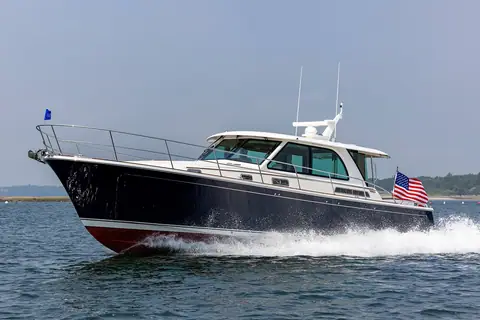
Sabre 45 Salon Express
Downeast Yachts, 49 ft
Used $900K to $1.35M
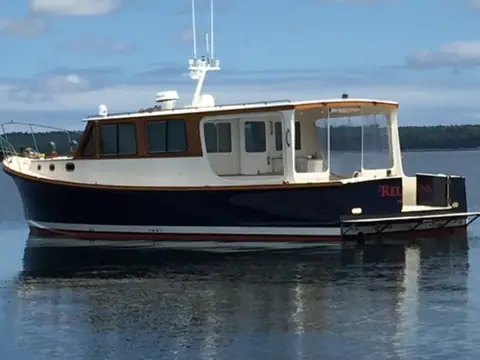
Wesmac 42
Downeast Yachts, 42 ft
Used $150K to $750K
Back Cove 37
Downeast Yachts, 42 ft
Used $300K to $700K
Sabre 38 Salon Express
Downeast Yachts, 42 ft
Used $330K to $675K