Back Cove Yachts Downeast Yachts
Back Cove 30 for Sale, a Used Buyer's Guide to the Single-Diesel Downeaster
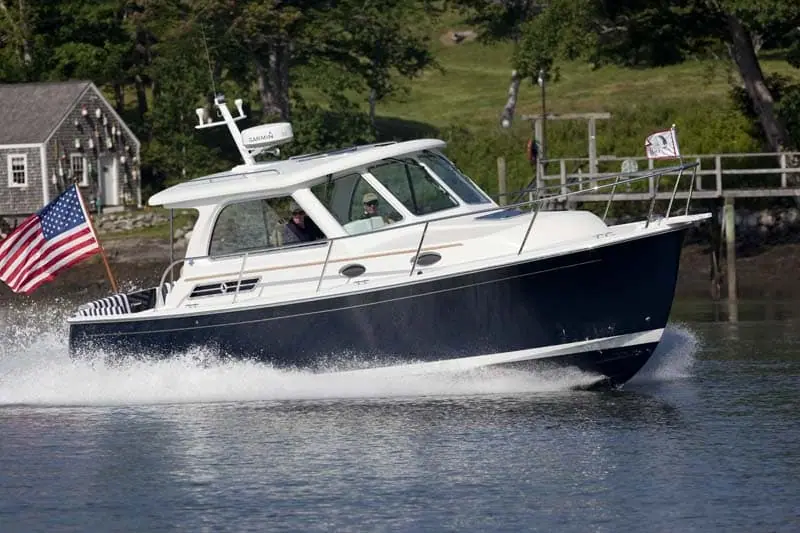
Maine's 30-foot single-diesel lobster yacht, built from 2010 until the 32 arrived, with real 20-knot cruising at about 10 gph.
- Length
- 34.2 ft10.42 m
- Beam
- 11.2 ft3.4 m
- Cruise
- 20.2 kn
- Cabins
- 1 (convertible V-berth and dinette forward)
- Used price
- $150K to $260K
On this page
- Overview
- Back Cove 30 for sale, and what the listing really means
- Nine inches of beam and a transom door, the upgrades over the 29
- Kevin Burns's hull: reverse chines, a prop pocket and 16 degrees aft
- Speed and fuel with the 370 hp Yanmar
- Helm deck, cockpit and a cabin for two
- Yanmar 6LP, Yanmar 8LV or Volvo D6
- A realistic yearly budget
- How the 30 holds value next to the newer 32
- Specifications
- Price and value
- Strengths and weaknesses
- Used buyer checklist
- Rivals
- Our verdict
- FAQ
The Back Cove 30 is a resin-infused Downeast cruiser built in Rockland, Maine, from 2010 to about 2016. One diesel of 315 to 380 hp, a bow thruster, a V-berth cabin and a 20-knot cruise at roughly 10 gph.
- Couples who weekend and day cruise
- First diesel boat after an outboard runabout
- Northeast and Chesapeake gunkholing
- Owners who want low running costs
Back Cove 30 by the numbers
- Speed to length ratio at cruise
- 3.70A planing cruise. Fast passages in exchange for much higher fuel burn per mile.
- Estimated range at cruise
- 277 nmUsing 90 percent of tank capacity at the cruise speed and fuel burn listed on this page.
- Fuel economy at cruise
- 1.92 nmpgNautical miles per gallon at cruise, both engines combined.
- Horsepower per ton
- 63 hpStrong power to weight for a planing hull.
- Length to beam ratio
- 3.06 : 1Moderate proportions.
Back Cove 30 for sale, and what the listing really means
Anyone searching for a Back Cove 30 for sale is shopping a boat that Back Cove stopped building about a decade ago, so every example has six to fifteen seasons on it. That is not a warning. The 30 came from the Rockland, Maine, company that also owns Sabre, it uses a single diesel and a bow thruster, and it was laid up with vacuum resin infusion when many 30-footers were still hand-laminated. A well-kept 30 ages gracefully.
The 30 arrived in 2010 to replace the Back Cove 29, a boat Yachting says sold 205 hulls between 2003 and 2009. In the summer of 2016 Back Cove launched the 32 and told Power and Motoryacht it was letting the 30 and 34 rest while it concentrated on the new boat. The 30 never came back, which means the production run is short and tidy: roughly 2010 to 2016 model years, all on the same hull.
What the market calls a 30 is actually a 30-foot 6-inch hull. With the swim platform and bow pulpit the overall length is 33 feet 11 inches on the original brochure and 34 feet 2 inches on Back Cove's current heritage page. Budget for a 34-foot slip, not a 30-foot one.
Nine inches of beam and a transom door, the upgrades over the 29
BoatTEST's launch report is the clearest summary of what Back Cove changed. The 30 is a foot longer than the 29, nine inches beamier at 11 feet 2 inches, and about 2,000 pounds heavier at an estimated 12,000 pounds full. Fuel and water capacity each grew by about 10 gallons. The extra beam paid for a forward-facing companion bench on the port side of the helm deck and a short sofa behind it, so three people can watch the water ahead instead of one.
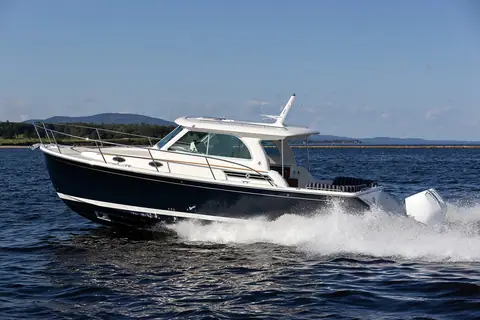
Just as important for daily use, the 29 had no transom door and the 30 does, an outward-opening door that keeps the cockpit sole clear. The whole helm-deck sole rises on a hydraulic lift to expose the engine, a far better arrangement than the access hatches on the 29. The bow gained a spoon shape with more flare, secondary spray rails were added, and the transom picked up a touch of tumblehome. The result looks softer than a working lobster boat and noticeably drier in a chop.
- Hull length 30 feet 6 inches, beam 11 feet 2 inches, draft about 2 feet 8 inches
- Estimated full-load displacement 12,000 pounds
- 160 gallons of diesel, 60 gallons of water, 30-gallon holding tank per the Back Cove brochure
- Air draft 8 feet 8 inches, low enough for many fixed bridges on the ICW
Kevin Burns's hull: reverse chines, a prop pocket and 16 degrees aft
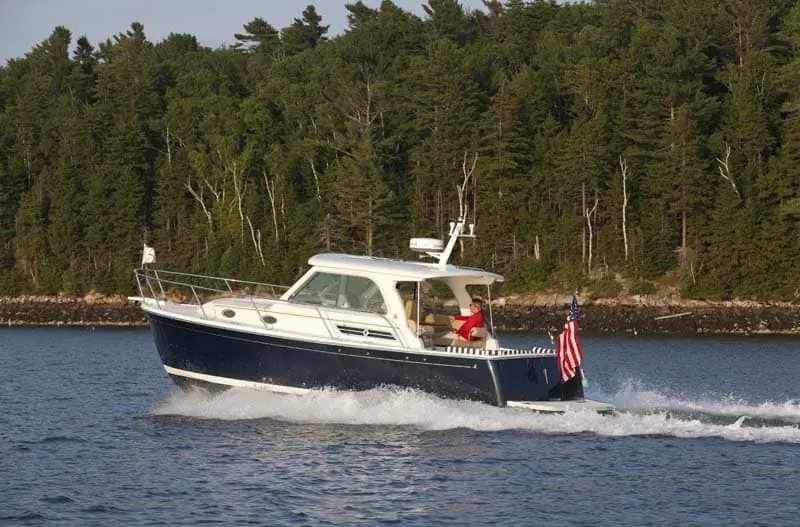
Back Cove head designer Kevin Burns described the 30 as a study in balance, and the hull shows it. The bottom is a vee with downward-turning chines forward that help the boat climb onto plane with little bow rise, then flattens to 16 degrees of deadrise at the transom. The single propeller runs in a shallow pocket, which reduces both draft and shaft angle, so the boat draws well under three feet and the prop pushes more horizontally.
Construction is VIP resin infusion with PVC foam coring in the hull and end-grain balsa in the deck, according to BoatTEST. Inside, the joinery is varnished American cherry with a teak-and-holly sole. There is little exterior teak to maintain, and the interior wood responds well to a light sand and fresh varnish, which is why a 30 still shows well years later.
Speed and fuel with the 370 hp Yanmar
BoatTEST ran a 30 with the optional 370 hp Yanmar 8LV turning a 20 by 24 propeller through a 2.13 to 1 gear in calm water with three-quarters fuel. It reached 28.3 knots at 3,800 rpm burning 18.7 gph, and the sweet spot sat around 3,000 rpm, where the boat made 20.2 knots on 10.5 gph, about 1.9 nautical miles per gallon and roughly 284 nautical miles of range. Time to plane was 7.4 seconds.
Back Cove's own claim for the standard 320 hp 8LV was a 26.7-knot top end with a 20-knot cruise, and the original brochure promised an average burn of about 5 gph across a typical day of mixed running. Those figures line up with the test: below plane at 8 to 9 knots the boat sips 2 to 3 gph, and owners who potter around the harbor will see far lower averages than the cruise number suggests.
The engine choice changes the top end by a knot or two, not the character of the boat. A 315 or 320 hp boat cruises at 20 knots without strain; the 370 and 380 hp options add margin when the boat is loaded with family, water and a hardtop.
Helm deck, cockpit and a cabin for two
Life aboard happens on the helm deck. The skipper sits in a single adjustable helm seat (Arrigoni standard, Stidd optional), the companion bench faces forward to port, and in the original layout the port settee and mate's seat convert into an L-shaped dinette around an inlaid table. At night that settee can serve as an extra berth. Forward panels of the side windows slide open and the center windshield panel opens too. An aft curtain was a dealer option, and a factory hard enclosure was available for owners who wanted a three-season boat.
The cockpit has corner lounges on each side of the transom door with stowage beneath, good for socializing but short on room for fishing. A swim platform with hot and cold shower was standard.
Below, the cabin is honest about its size. A dinette with a small table forward converts to V-berths about 76 inches long or a double about 79 inches long, there is 76 inches of headroom, a hanging locker, a galley with a dual-voltage refrigerator, single-burner alcohol and electric cooktop and microwave, and an enclosed head with a freshwater toilet and 72.5 inches of headroom. A couple can weekend aboard comfortably. A family of four will be camping.
Yanmar 6LP, Yanmar 8LV or Volvo D6
Early boats were offered with a 315 hp Yanmar 6LP as standard, with a 380 hp Yanmar 6LY and Volvo Penta D6 options at 330 and 370 hp. By the mid-2010s the standard engine was Yanmar's 320 hp 8LV common-rail diesel, with a 370 hp 8LV or 370 hp D6 as options. All of them drive a conventional shaft and propeller, so there is no sterndrive or pod to service.
On the used market, the 8LV boats are the newest and usually the most expensive, and the electronic common-rail engine is quieter and cleaner than the older mechanical-injection 6LP. The 6LP is a well-proven engine that many independent yards understand. Volvo D6 inboards are common and parts are easy to find. More than the badge, look at hours, service records, and whether the heat exchanger, aftercooler and raw-water pump have been serviced on schedule.
A realistic yearly budget
A single diesel and a modest fuel tank keep the 30 cheaper to run than twin-engine express cruisers of similar length. At 10 to 11 gph at a 20-knot cruise, a season of 100 engine hours with much of it at speed works out to around 800 to 1,000 gallons of diesel, and less for owners who mix in slow cruising.
Budget roughly $12,000 to $25,000 a year for slip or mooring, insurance, storage, bottom paint, engine service, canvas and varnish, with Northeast heated storage at the top of that range. Over a decade the big items are the engine cooling system, the helm-deck lift, enclosure panels and electronics.
How the 30 holds value next to the newer 32
Back Cove resale has always been strong because the boats are understated, built in Maine and backed by a builder that still exists and still supports its heritage models. The 30 benefits from that and from the fact that the 32 that replaced it was larger and pricier; Soundings listed the 32 at $320,000 with a 370 hp Volvo in 2016. For buyers who want a Back Cove under about $250,000, the 30 is the natural entry point after the 26 and 29.
Expect the best prices for late boats with low hours, a factory hardtop or enclosure, a stern thruster and updated electronics.
Back Cove 30 specifications
| Length overall | 34.2 ft10.42 m |
|---|---|
| Beam | 11.2 ft3.4 m |
| Draft | 2.7 ft0.81 m |
| Air draft | 8.7 ft2.64 m |
| Displacement | 12, lbs5,443 kg |
| Fuel capacity | 16 gal606 L |
| Fresh water | 6 gal227 L |
| Cabins | 1 (convertible V-berth and dinette forward) |
| Berths | 2 to 3 (V-berth converts to a double, plus a convertible helm-deck settee) |
| Heads | 1 enclosed head with freshwater MSD |
| Standard engines | 1 x Yanmar 6LP 315 hp diesel (2010 launch); later 1 x Yanmar 8LV 320 hp common-rail diesel |
| Optional engines | 1 x Yanmar 8LV 370 hp, Volvo Penta D6 330 or 370 hp, or Yanmar 6LY 380 hp (early option list) |
| Maximum power | 380 hp |
| Cruise speed | 20.2 knots |
| Top speed | 28.3 knots |
| Range | 284 nm |
| Hull type | Modified-V planing hull with downturned chines forward, 16-degree transom deadrise and a shallow prop pocket |
| Hull construction | Vacuum resin-infused fiberglass, PVC foam-cored hull, balsa-cored decks |
| CE design category | B |
| Builder | Back Cove Yachts, United States |
| Naval architect | Kevin Burns and the Back Cove design team |
| Production | 2010 to 2016 |
| Status | Discontinued |
Figures come from builder documentation and independent tests where available. Displacement is usually quoted light, so a loaded cruising boat will weigh more. Compare these specs with another model.
Performance data
| RPM | Speed (kn) | Fuel (gph) | Range (nm) |
|---|---|---|---|
| 1000 | 5.8 | 0.55 | 1552 |
| 1500 | 7.7 | 1.9 | 594 |
| 2000 | 9.3 | 4.35 | 316 |
| 2300 | 11.9 | 6.3 | 278 |
| 2500 | 14.2 | 7.35 | 286 |
| 2800 | 17.8 | 9.3 | 283 |
| 3000 | 20.2 | 10.5 | 284 |
| 3300 | 23.4 | 13.2 | 262 |
| 3500 | 25.5 | 15.5 | 242 |
| 3700 | 27.4 | 17.4 | 232 |
| 3800 | 28.3 | 18.7 | 224 |
BoatTEST test of a Back Cove 30 with a single 370 hp Yanmar 8LV, 2.13 to 1 gear, 20 x 24 propeller, three-quarters fuel and water, calm seas. Range as published by BoatTEST.
How much does a Back Cove 30 cost?
BoatTEST reported a launch MSRP of about $198,500, roughly what the smaller Back Cove 29 had cost, and well-optioned boats went out the door above that. On the brokerage market the engine package, hours and a factory hardtop or enclosure move the needle more than model year, and late 8LV common-rail boats bring the most. Generator and air conditioning are uncommon on this size, so a boat that has them carries a premium in southern markets.
Estimate your yearly cost
A planning estimate using common rules of thumb: insurance near 1.5 percent of value, maintenance near 3 percent, haul out and bottom paint by length. Your marina, region and use will move these numbers. Open the full cost calculator.
Versions and options
- Early 30 (from 2010)
- Launched with a 315 hp Yanmar 6LP as standard and options including a 380 hp Yanmar 6LY and Volvo Penta D6 at 330 or 370 hp.
- Later 30 (mid-2010s)
- Standard power moved to the 320 hp Yanmar 8LV common-rail diesel, with a 370 hp 8LV or 370 hp Volvo Penta D6 optional.
- Enclosure options
- Open helm deck with dealer-installed aft curtain, or a factory hard enclosure for a three-season boat.
Back Cove 30 timeline
- 2003Back Cove Yachts is founded in Rockland, Maine, and launches the Back Cove 29
- 2009Back Cove 29 production ends after 205 hulls
- 2010Back Cove 30 debuts with a 315 hp Yanmar, a transom door and nine inches more beam than the 29
- 2016Back Cove 32 debuts at the Maine Boats, Homes and Harbors Show and the 30 is rested
- 2026Back Cove's owner pages list the 30 as a retired model alongside the newer 412, 372, 39O and 34O
Strengths and weaknesses
What owners like
- Simple single diesel with shaft drive and standard bow thruster
- 20-knot cruise at about 10 gph and close to 2 nmpg
- Resin-infused hull and cherry interior that age well
- Draft under three feet and air draft under nine feet
- Helm deck seating for six with forward-facing companion bench
- Strong builder support and brand resale
What to weigh up
- Cabin is tight for more than two adults
- Cockpit corner lounges limit fishing space
- Single-burner cooktop on most boats
- Overall length nearly 34 feet for slip fees
- Oldest boats now need electronics and canvas updates
Used Back Cove 30 buyer checklist
Take this list to a viewing. Your ticks are saved in this browser so you can come back to it.
Always commission an independent marine survey and an engine survey before you buy. How a marine survey works.
Rivals to consider
Back Cove 26
The smaller family member, cheaper to buy and trailer-friendly but with far less cabin and helm-deck space.
Compare side by sideBack Cove 34O
The modern outboard-powered successor in spirit, much faster and far more expensive.
Compare side by sideRanger Tugs R-29 S
A single-diesel pocket cruiser with more interior volume and a slower, trawler-like attitude.
Compare side by sideCutwater 28
Lower price and more berths, but a lighter, less traditional build.
Compare side by sideOur verdict on the Back Cove 30
The Back Cove 30 is one of the most sensible small Downeast boats on the used market. It has a real hull under it, a single diesel that cruises at 20 knots for about 10 gph, a builder that still supports it, and an interior finished well enough to keep its looks for decades. It is a boat for two people who mostly day cruise and sometimes stay over, not for a family that wants to live aboard. Buy the newest, lowest-hour example you can afford, survey the engine and helm-deck lift carefully, and it will be cheap to own and easy to sell.
Back Cove 30 questions answered
How much is a Back Cove 30 for sale?
Most Back Cove 30 listings in 2026 should fall roughly between $150,000 and $260,000, depending on year, engine package and hours. Launch MSRP in 2010 was about $198,500.
What years was the Back Cove 30 built?
It was built from 2010 until Back Cove rested it in 2016, when the Back Cove 32 arrived. It replaced the Back Cove 29.
How fast is the Back Cove 30?
BoatTEST recorded 28.3 knots with the 370 hp Yanmar and a 20.2-knot cruise at 10.5 gph. Back Cove quoted about 26.7 knots top and 20 knots cruise for the standard 320 hp engine.
How long is a Back Cove 30 overall?
The hull is 30 feet 6 inches, but length overall with platform and pulpit is about 34 feet, so plan for a 34 to 35-foot slip.
Does the Back Cove 30 have a generator?
A 4 kW generator was optional, as was an inverter; many boats have neither, so check the listing if you need air conditioning.
Is the Back Cove 30 a good 30-foot boat for a lake?
Yes. Its shallow draft, single diesel and protected helm deck suit big lakes and sheltered coastal water well, and fresh water is kind to the engine and hull.
Back Cove 30 photos
More downeast yachts to explore
Hinckley Picnic Boat 34
Downeast Yachts, 34 ft
Used $300K to $560K
Cutwater C-248 Coupe
Downeast Yachts, 31 ft
Used $135K to $190K
Hinckley Picnic Boat
Downeast Yachts, 39 ft
Used $180K to $1.95M
Back Cove 34O
Downeast Yachts, 40 ft
Used $440K to $760K