Nordhavn Trawlers & Explorer Yachts
Nordhavn 41 Review, Range, Specs and Price Guide
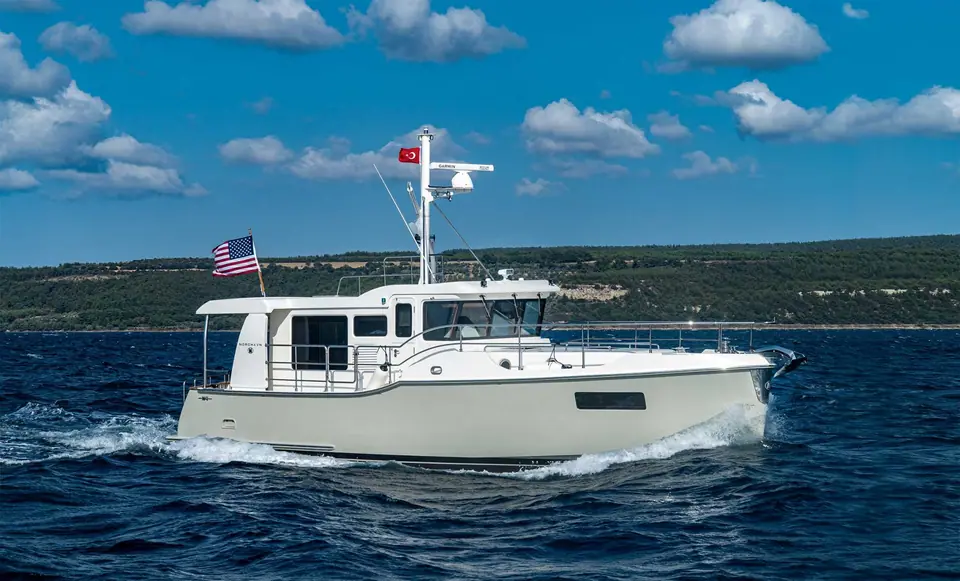
The smallest modern Nordhavn, built in Turkey from 2020 to 2026 with twin engines and CE Category A credentials, aimed at couples who want ocean ability.
- Length
- 41.3 ft12.6 m
- Beam
- 13.9 ft4.24 m
- Cruise
- 7.4 kn
- Cabins
- 1 or 2
- Used price
- $1.15M to $1.75M
On this page
- Overview
- Why the Nordhavn 41 exists
- Twin Kubota-based diesels in a single engine culture
- Range math at displacement speed
- Fin stabilizers and how she rides
- Is it a Great Loop boat?
- Single owner's cabin or two staterooms
- Ownership costs and how values hold
- What a surveyor should focus on
- Specifications
- Price and value
- Strengths and weaknesses
- Used buyer checklist
- Rivals
- Our verdict
- FAQ
A 41-foot full displacement passagemaker designed by Jeff Leishman with Vripack hull work, built in Turkey until PAE halted production in 2026 after 44 hulls, with 900 gallons of fuel and twin Kubota-based diesels.
- Couples planning the Great Loop and then offshore
- Owners moving down from a larger trawler
- Pacific Northwest to Alaska cruising
- First passagemaker buyers who want twin engine redundancy
Why the Nordhavn 41 exists
The Nordhavn 41 is the entry ticket to the brand today, and it is a different kind of small Nordhavn from the boats that made the name. The Nordhavn 40 proved the concept in 2001 and 2002 when a stock boat ran around the world from Dana Point, California, the smallest production power vessel to do it. That boat was single engine, heavy and unapologetically salty. The 41, introduced in 2019, keeps the CE Category A rating and the ocean intent, but it is lower, lighter at 43,300 pounds, and it runs on two engines.
Pacific Asian Enterprises, the Dana Point, California company behind Nordhavn, designed the boat in house. Jeff Leishman drew the lines and Phil Arnold worked the systems, while Vripack in the Netherlands ran computational fluid dynamics on the hull to tune running angles and resistance. Construction went to the Telgeren & Partners factory in Turkey for this model, a notable change from the Taiwanese and Chinese yards that built earlier generations. The first boat launched in 2020.
Who is it for? Mostly couples who have read the Nordhavn passagemaking stories, want the build standard, and do not want to handle a 50-footer. Nordhavn completed 44 of them before PAE halted production in July 2026, saying Turkish inflation and currency controls had made building there unpredictable and too expensive. That makes the 41 a closed, finite run and a brokerage-only boat.
Nordhavn 41 by the numbers
- Speed to length ratio at cruise
- 1.17Cruises at displacement speed, the most fuel efficient way to cover long distances.
- Estimated range at cruise
- 1,873 nmUsing 90 percent of tank capacity at the cruise speed and fuel burn listed on this page.
- Fuel economy at cruise
- 2.31 nmpgNautical miles per gallon at cruise, both engines combined.
- Horsepower per ton
- 11 hpModest power to weight, efficiency over outright speed.
- Length to beam ratio
- 2.97 : 1A beamy hull with lots of volume for its length.
Twin Kubota-based diesels in a single engine culture
Nordhavn built its reputation on one big, slow turning diesel with a wing engine or get-home drive as backup. The 41 breaks that habit with a pair of small Kubota-based diesels turning 28 inch four-blade bronze props through 3.94 to 1 gears. Early hulls used 75 hp engines marinized by Beta Marine; later hulls switched to 115 hp Nanni versions, a change Nordhavn says was made strictly to solve supply problems. The props are counter-rotating, so the boat does not walk to one side in reverse the way single screw trawlers do.
There are real advantages. Redundancy is built in, close quarters handling is simpler for a couple, and a joystick-linked Side Power bow thruster finishes the job. The trade-off is two sets of everything to service, two shaft seals, two sets of raw water impellers and a slightly higher fuel burn than one engine of the same total power would need at the same speed. For coastal and Loop cruising most owners will consider that trade a bargain. For long ocean legs the redundancy argument wins as well, because a crew can shut one engine down and run on the other at reduced speed to stretch fuel.
Both packages are mechanically injected Kubota blocks, which keeps them simple and free of the electronic controls on bigger engines. Before you buy, confirm which marinizer's engines a given hull carries and ask the nearest Beta or Nanni dealer about parts stock and turnaround, because that matters more than brochure horsepower.
Range math at displacement speed
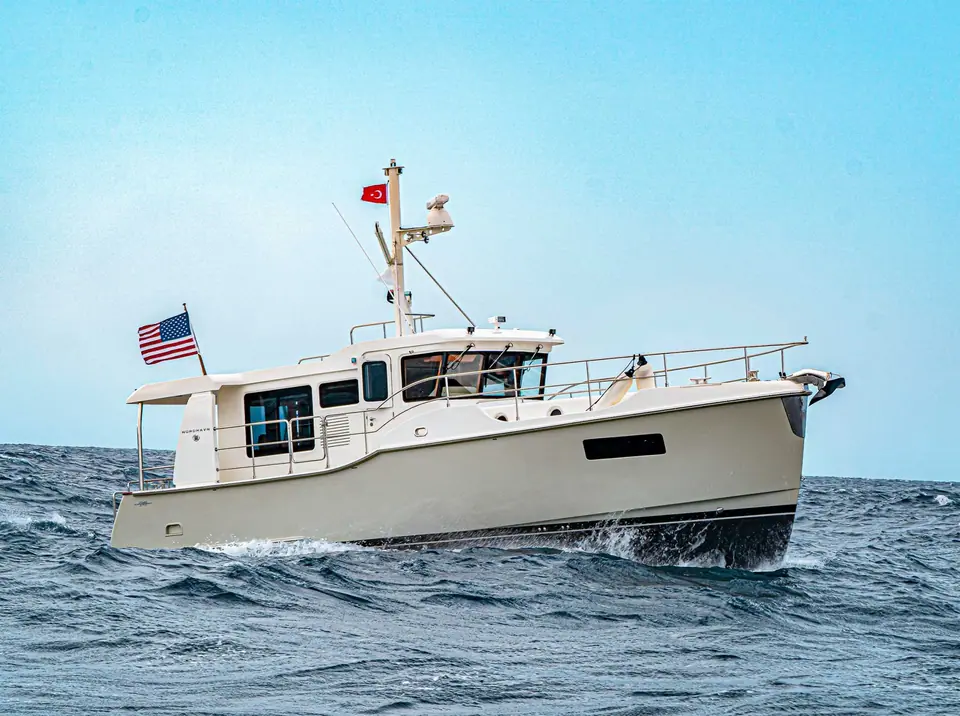
Searchers ask about Nordhavn 41 range more than almost anything else, and the honest answer is that it depends on speed far more than tankage. With 40 feet of waterline, theoretical hull speed sits a little above 8.4 knots. Push past that and fuel burn climbs steeply for very little gain. Slow to 6.5 or 7 knots and the boat becomes remarkably frugal.
Nordhavn published its own preliminary sea trial of an early 75 hp boat, run in July 2020 with one-eighth fuel, full water and a Beaufort 3 sea. It logged 6.2 knots at 1,600 rpm on 1.66 gph combined, 7 knots at 1,800 rpm on 2.36 gph, 7.4 knots at 2,000 rpm on 3.24 gph, 8 knots at 2,200 rpm on 4.61 gph and a 9.1 knot top speed at 2,800 rpm on 8.88 gph. Stretched over the full 900 gallons with no reserve, that is about 2,650 nautical miles at 7 knots and just over 2,050 at 7.4 knots. Take 10 to 15 percent off for a reserve and a loaded boat and the 41 still covers Bermuda from the US East Coast, the Bahamas without refueling, or a Pacific Northwest to Alaska season. Later Nanni-powered hull 31 reached 8.75 knots on trials; Nordhavn has not published a full fuel curve for the 115 hp boats.
Fin stabilizers and how she rides
Stabilizers are standard, as they should be on a round bilge displacement hull. Early boats use an ABT Trac 220 system with 6 square foot fins, and later hulls moved to Naiad stabilizers, both sized to tame the roll that a narrow, low resistance hull will otherwise produce in a beam sea. At anchor, fin stabilizers do little unless the system has a zero speed function, so if you anchor in rolly Bahamas or Pacific Mexico roadsteads, budget for flopper stoppers or ask whether the installed system supports at rest stabilization.
The CE Category A rating means the design is assessed for winds above Beaufort Force 8 and significant wave heights above 13 feet. That is a design category, not a promise of comfort. In practice the 41 is a capable coastal and offshore passagemaker with a crew who reads weather well. The builder pitches it for transatlantic and Mediterranean cruising, and the fuel capacity supports that on a Bermuda and Azores routing.
Is it a Great Loop boat?
Mostly yes, which is one of the best arguments for it. At 4 feet 8 inches of draft the 41 slips under the 5 foot comfort limit most Loop veterans recommend for the Tenn-Tom, the Trent-Severn and the shallow Bahamas leg. The beam of 13 feet 11 inches fits standard locks and transient slips without drama.
The open question is air draft. The fixed railroad bridge in Chicago sets an effective 19 foot 1 inch limit for the inland route, and the boat's mast, radar and antenna stack determine whether you clear it. Nordhavn does not publish an air draft figure that we could confirm, so measure the actual boat with mast lowered before you commit to the Loop. Most owners who plan the route specify a hinged mast and keep antennas foldable.
- Draft of 4 ft 8 in suits the Loop and Bahamas banks
- Twin engines and bow thruster ease lock work for two people
- Double side decks make line handling in locks safer
- Confirm air draft against the 19 ft 1 in Chicago limit before you buy
Single owner's cabin or two staterooms
Two layouts are offered. The single cabin version gives the forward third of the hull to a generous owner's stateroom with an island berth, real hanging lockers and a single head with a full shower. The two cabin version carves out a small guest room for grandchildren or occasional crew. Resale favors the two cabin boat slightly in the US market, but couples who rarely host should not feel pressured; the single cabin boat simply lives better.
The pilothouse sits up a few steps with a settee for an off watch crew, and the saloon and galley share the main deck aft. Reverse cycle air conditioning runs throughout, powered by a 7 to 9 kW Onan generator. A 1,530 amp hour AGM house bank was specified on earlier boats, and many owners now spec lithium for quieter nights at anchor.
Outside, the boat deck carries a 12 foot center console tender on an 800 pound davit, which is a meaningful step up from the tiny inflatables many 40-foot trawlers are limited to. Later hulls include a foredeck awning.
Ownership costs and how values hold
Plan on roughly $45,000 to $80,000 a year for slip, insurance, haul outs, routine service on two engines and a generator, and the electronics refresh cycle. Insurance on a Category A boat crewed by experienced owners is usually straightforward for coastal use; ocean crossings need a specific endorsement and sometimes a crew requirement.
Nordhavns hold value better than nearly any production trawler, partly because the brand runs a strong in-house brokerage and an active owner community. Expect the 41 to follow that pattern, helped by the fact that no more will be built. Asking prices on 2020 to 2025 hulls should cluster between about $1.15 million and $1.75 million. With production closed at 44 boats there is no new-build alternative any more, which should support values, but also means the factory warranty and parts pipeline now run entirely through PAE.
What a surveyor should focus on
The boat is too new to have a long list of pattern failures, so a survey here is about build quality verification and system commissioning rather than rot and corrosion. Pull service records on both main engines and note whether they are the early Beta or later Nanni units, confirm stabilizer actuator service, and test the electronic Hypromarine steering under load. Check warranty transfer terms carefully, because the Turkish builder has stopped building Nordhavns and any remaining coverage now depends on PAE.
Nordhavn 41 specifications
| Length overall | 41.3 ft12.6 m |
|---|---|
| Waterline length | 40 ft12.19 m |
| Beam | 13.9 ft4.24 m |
| Draft | 4.7 ft1.42 m |
| Displacement | 43,3 lbs19,33 kg |
| Ballast | 4, lbs1,814 kg |
| Fuel capacity | 9 gal3,407 L |
| Fresh water | 3 gal1,136 L |
| Cabins | 1 or 2 |
| Berths | 2 to 4 |
| Heads | 1 |
| Standard engines | 2 x Nanni 115 hp diesel (later hulls), PRM 3.94:1 gears, 28 in four-blade counter-rotating props |
| Optional engines | Early hulls: 2 x Beta Marine 75 hp (Kubota based) with 3.942:1 gears |
| Maximum power | 230 hp |
| Cruise speed | 7.4 knots |
| Top speed | 9.1 knots |
| Range | 2,056 nm |
| Hull type | Full displacement, twin screw with keel and skegs |
| Hull construction | Fiberglass composite |
| CE design category | A |
| Builder | Pacific Asian Enterprises (Nordhavn), built by Telgeren & Partners in Turkey, Turkey |
| Naval architect | Jeff Leishman (Nordhavn) |
| Other design credits | Phil Arnold (PAE), hull optimization and CFD work by Vripack Yacht Design |
| Production | 2020 to 2026 |
| Status | Discontinued |
Figures come from builder documentation and independent tests where available. Displacement is usually quoted light, so a loaded cruising boat will weigh more. Compare these specs with another model.
Performance data
| RPM | Speed (kn) | Fuel (gph) | Range (nm) |
|---|---|---|---|
| 1600 | 6.2 | 1.66 | 3383 |
| 1800 | 7 | 2.36 | 2655 |
| 2000 | 7.4 | 3.24 | 2056 |
| 2200 | 8 | 4.61 | 1558 |
| 2400 | 8.5 | 5.59 | 1364 |
| 2800 | 9.1 | 8.88 | 922 |
Nordhavn preliminary sea trial, 11 July 2020, early hull with twin 75 hp engines, 28.5 x 21 props, one-eighth fuel, full water, Beaufort 3. Speeds are two-way averages, fuel is both engines combined, range is the full 900 gallons with no reserve.
How much does a Nordhavn 41 cost?
Production ended in July 2026 after 44 hulls, so every Nordhavn 41 is now a brokerage boat and supply is fixed. Engine package (early 75 hp Beta or later 115 hp Nanni), stabilizer brand, electronics, lithium house banks, the two-cabin versus single owner's layout and the tender package all move the number. Strong brand resale and the lack of new builds should keep asking prices firm.
Estimate your yearly cost
A planning estimate using common rules of thumb: insurance near 1.5 percent of value, maintenance near 3 percent, haul out and bottom paint by length. Your marina, region and use will move these numbers. Open the full cost calculator.
Versions and options
- Single stateroom
- One large owner's cabin forward with island berth, the choice for couples who want storage over guest berths.
- Two stateroom
- Adds a compact guest cabin for family or crew. Slightly easier to resell in the US.
Nordhavn 41 timeline
- 2002A stock Nordhavn 40 completes a circumnavigation from Dana Point, setting the small passagemaker benchmark
- 2019Nordhavn 41 introduced, with Vripack CFD hull work and construction in Turkey
- 2020First boat launches; preliminary sea trial logs 7.4 knots on 3.24 gph
- 2023Later hulls switch to 115 hp Nanni engines and Naiad stabilizers and add a foredeck awning
- 2026PAE halts production at Telgeren & Partners in July after 44 hulls
Strengths and weaknesses
What owners like
- CE Category A design in a 41-foot package couples can run
- Twin engines with counter-rotating props simplify docking
- 900 gallons of fuel supports long passages at 7 knots
- Fin stabilizers are standard
- Draft under 5 feet suits the Great Loop and Bahamas
- Strong Nordhavn resale and owner network
What to weigh up
- Production ended in 2026, so supply is fixed at 44 boats
- Twin engines double the maintenance list
- Only one head in either layout
- Air draft must be verified for the Chicago bridge on the Loop
- Thin used market means little room to negotiate
Used Nordhavn 41 buyer checklist
Take this list to a viewing. Your ticks are saved in this browser so you can come back to it.
Always commission an independent marine survey and an engine survey before you buy. How a marine survey works.
Rivals to consider
Kadey-Krogen 44 AE
Single engine, wider and roomier inside, with a similar full displacement philosophy and strong liveaboard following.
Compare side by sideBeneteau Swift Trawler 41
Semi-displacement and much faster, far cheaper, but not built or tanked for ocean crossings.
Compare side by sideNordhavn 43
The older single-engine used alternative with a proven ocean record, usually at a much lower price.
Compare side by sideGrand Banks 42 Classic
A classic coastal trawler for buyers who want the Loop lifestyle on a much smaller budget.
Compare side by sideOur verdict on the Nordhavn 41
The Nordhavn 41 was the most approachable way into modern Nordhavn ownership, and its twin engine layout, standard stabilizers and sub 5 foot draft make it a better Great Loop boat than most of its ancestors. It is not cheap, but the builder's own sea trial shows roughly 2,000 nautical miles of still water range at 7.4 knots, which covers the ocean legs most owners will actually run. With production closed at 44 hulls, buy one if you value build quality, resale and a credible offshore option over sheer interior volume; buy a used Nordhavn 43 instead if range per dollar is the priority.
Nordhavn 41 questions answered
What is the range of a Nordhavn 41?
Nordhavn's own 2020 sea trial of an early hull logged 3.24 gph at 7.4 knots and 2.36 gph at 7 knots, which works out to about 2,050 and 2,650 nautical miles on 900 gallons with no reserve. Allow 10 to 15 percent less for a reserve and a loaded boat.
How much does a Nordhavn 41 cost?
New builds are no longer available because production ended in 2026. Used hulls from 2020 onward should ask roughly $1.15 million to $1.75 million depending on year, engines and equipment.
Does the Nordhavn 41 have stabilizers?
Yes. Early boats have ABT Trac 220 fin stabilizers with 6 square foot fins, and later hulls were upgraded to Naiad stabilizers.
Can a Nordhavn 41 do the Great Loop?
Yes, its 4 foot 8 inch draft and 13 foot 11 inch beam suit the route. Confirm the air draft with the mast down against the 19 foot 1 inch Chicago bridge limit.
Where is the Nordhavn 41 built?
The 41 was built in Turkey by Telgeren & Partners for Pacific Asian Enterprises, which designs and markets Nordhavn yachts from Dana Point, California. Production stopped in July 2026 after 44 hulls.
Is the Nordhavn 41 single or twin engine?
It has twin Kubota-based diesels, 75 hp Beta Marine units on early hulls and 115 hp Nannis on later ones, a departure from Nordhavn's traditional single engine designs.
Nordhavn 41 photos
More trawlers & explorer yachts to explore
Targa 37
Trawlers & Explorer Yachts, 41 ft
Used $140K to $650K
Greenline 40
Trawlers & Explorer Yachts, 42 ft
Used $260K to $600K
Kadey-Krogen 42
Trawlers & Explorer Yachts, 42 ft
Used $140K to $380K
President 42
Trawlers & Explorer Yachts, 43 ft
Used $90K to $280K