Greenline Yachts Trawlers & Explorer Yachts
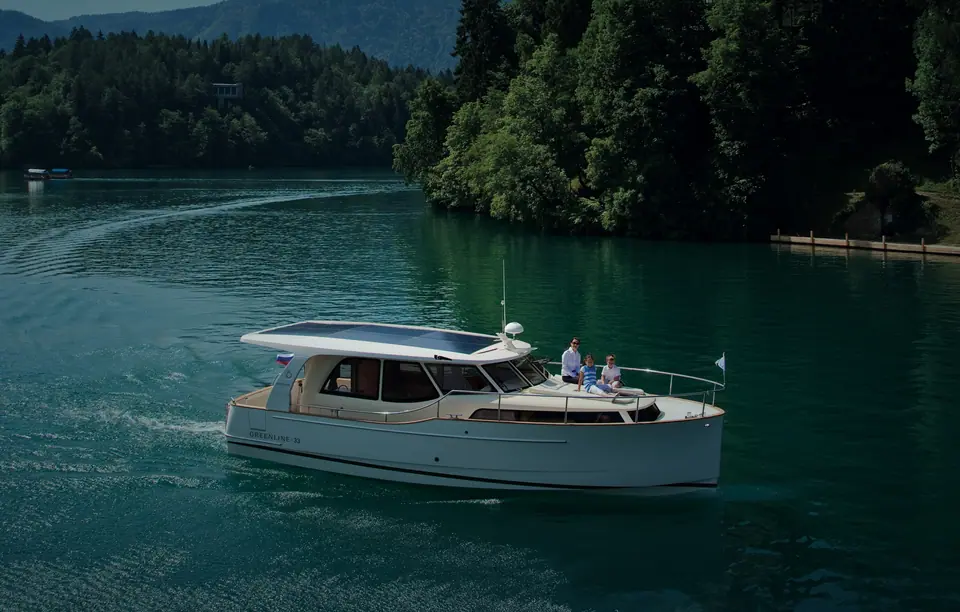
Greenline 33 Review, Specs and the Story Behind Greenline Yachts
The Slovenian 33-footer that made diesel-electric cruising affordable, with a sailboat-derived hull, an aft galley and roughly 550 hulls delivered.
- Length
- 32.8 ft9.99 m
- Beam
- 11.4 ft3.49 m
- Cruise
- 8 kn
- Cabins
- 1 plus saloon (optional bunk on late boats)
- Used price
- $125K to $290K
On this page
- Overview
- The boat that put Greenline Yachts on the map
- A sailboat-derived hull under a motor cruiser
- What 'hybrid' really meant on a Greenline 33
- Speed and fuel numbers from tests and owners
- Aft galley, one-level living and a single big cabin
- Ownership costs, solar power and service
- Finding a Greenline 33 for sale in the US
- Specifications
- Price and value
- Strengths and weaknesses
- Used buyer checklist
- Rivals
- Our verdict
- FAQ
The Greenline 33 is a 32-foot 9-inch semi-displacement cabin cruiser built in Slovenia from 2008 to 2023. Around 550 were delivered with diesel, hybrid or electric drives, solar roofs and one double cabin.
- Couples cruising rivers, lakes and canals
- Former sailors moving to power
- Owners who prioritize quiet and economy over speed
- Great Loop style inland cruising
Greenline 33 by the numbers
- Speed to length ratio at cruise
- 1.50Runs in the semi-displacement range, faster than a trawler but thirstier per mile.
- Estimated range at cruise
- 547 nmUsing 90 percent of tank capacity at the cruise speed and fuel burn listed on this page.
- Fuel economy at cruise
- 5.33 nmpgNautical miles per gallon at cruise, both engines combined.
- Horsepower per ton
- 49 hpStrong power to weight for a planing hull.
- Length to beam ratio
- 2.87 : 1A beamy hull with lots of volume for its length.
The boat that put Greenline Yachts on the map
Anyone researching Greenline Yachts ends up at the 33 sooner or later, because this is the model that created the brand. Slovenian studio J&J Design, run by brothers Jernej and Japec Jakopin and credited by Motor Boat and Yachting with more than 300 designs for 55 builders, launched Greenline in 2008 and built the boats at its Seaway yard. The pitch was simple and, at the time, unusual: a roomy 10-meter family cruiser with a diesel-electric hybrid option, a solar roof and a slippery hull, sold at a price that undercut most conventional rivals.
It worked. Motor Boats Monthly judged the hybrid among the best-value 30-footers on the market at under 100,000 pounds, and the boat won Best Wheelhouse and Walkaround at the 2011 Motor Boat Awards. By the end of production in early 2023, about 550 had been delivered to owners in 28 countries, which J&J Design claimed made it the world's best-selling 10-meter boat.
The company had a bumpy ride. In 2015 a Slovenian court filed an insolvency petition on behalf of Seaway, but Greenline continued, and by the end of the 33's run the brand belonged to SVP Yachts, which still builds the larger models.
A sailboat-derived hull under a motor cruiser
Greenline calls the shape a superdisplacement hull, and the reason it behaves so differently from a typical planing cruiser is its origin. Motor Boats Monthly reported that Seaway adapted one of its sailboat hulls to get the low-drag underwater shape needed for the small electric motor to move the boat at all. The result is long, fine and easily driven, happiest at 6 to 10 knots, and it will push past that with enough diesel horsepower without ever behaving like a true planing boat.
That sailboat DNA brings a gentle roll in any beam sea, which twin wing keels reduce without eliminating. One British owner who logged 925 engine hours over 12 years, including a Channel crossing and the French canals, simply stayed in port once waves passed about 1.5 meters. The 33 is CE category B for eight people: a capable coastal boat, not a passagemaker.
Construction is conservative: a solid polyester hull laminate, foam-cored decks and vacuum infusion. Motor Boat and Yachting saw no core delamination risk in the hull and judged the interior finish basic but durable.
What 'hybrid' really meant on a Greenline 33
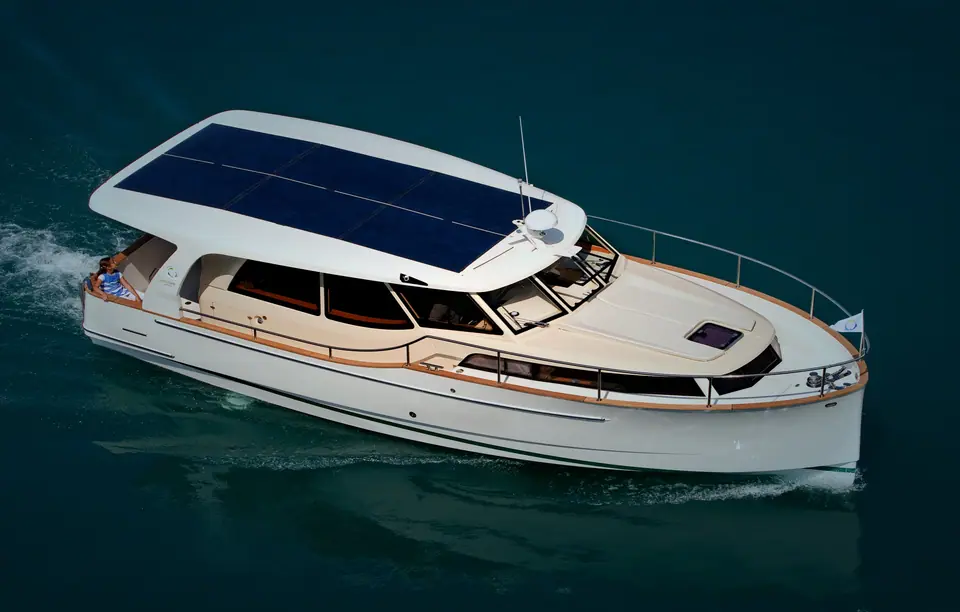
Here is the detail buyers miss: not every Greenline 33 Hybrid is actually a hybrid. The hull side said hybrid on most boats, but the electric motor and lithium battery bank were options. In 2010 the 7 kW motor and 48-volt, 240 Ah lithium polymer pack added 23,500 pounds in the UK, plus another 7,673 pounds for the roof solar panels, and plenty of buyers skipped them. Motor Boat and Yachting described many boats as hybrid ready rather than hybrid equipped.
On a true hybrid, the electric motor sits on the shaft line and doubles as a generator when the diesel runs. Early boats paired it with a Volkswagen Marine diesel; Power and Motoryacht's 2013 US spec listed a 150 hp VW/CMD TDI coupled to a 7 kW Iskra electric motor with a 5 kW generator. Greenline claimed about 20 nautical miles at 4 knots on batteries alone, and the solar roof could supposedly sustain about 3.5 knots on the sunniest days. Late boats moved to a Volvo Penta D3-220 with a 14 kW motor and 10 kW generator, up to two 13.3 kWh LiPo packs and 6.5 knots on electric power, while a full-electric version used a 50 kW shaft motor with a 4 kW diesel range extender.
Diesel-only boats used engines from about 60 to 260 hp from Volvo Penta, Volkswagen and Nanni; the last builder spec listed a 250 hp Yanmar 4LV.
- Diesel only: simplest to own, cheapest to buy, still efficient thanks to the hull
- Hybrid: silent marina and canal running, battery-powered house loads, but battery age is critical
- Full electric (late boats): quiet and clean, but range and charging dictate how you cruise
Speed and fuel numbers from tests and owners
Do not buy a Greenline 33 expecting sportscruiser pace. Motor Boat and Yachting's original test boat, with a 165 hp VW diesel, reached 13.3 knots and 5.5 knots on electric power, with suggested cruising speeds of 7 knots slow and 10 knots fast and a quoted diesel range of 431 miles. Power and Motoryacht listed 11 knots cruise and 14 knots top for the US-spec 150 hp hybrid, and the late 250 hp Yanmar boats were rated at 18 knots maximum.
The more useful numbers come from owners. The British couple mentioned above chose a 60 hp Nanni for economy and kept a detailed log: across 925 engine hours their average burn was 5.7 liters per hour, roughly 1.5 US gallons per hour, at a cruise of about 8 knots with 10 knots flat out. Motor Boat and Yachting used that figure to estimate up to 491 nautical miles at 7 knots. Few 33-foot cruisers with an enclosed saloon and full galley come anywhere near that frugality.
Aft galley, one-level living and a single big cabin
The layout is the 33's real selling point. There is no step between the bathing platform and the helm, and the galley sits aft where it serves both saloon and cockpit. A sliding door and a large rear window that hinges up to roof level turn the galley into a servery, and a worktop extension flips down to form a small cockpit bar. One owner described it as opening up like an ice cream shop, which is exactly the right picture.
Forward of the galley, two large settees face a two-leaf dining table. The helm bench flips over to become part of the starboard settee, which is clever but leaves no bolster and no room to stand and drive. Visibility through the saloon glass is excellent, though only two small side windows and the center windscreen open.
Below, a single forward cabin uses scissor-action berths that work as a vee or slide together into a king-size island double, with hanging lockers on each side. The one head has doors to both the cabin and the companionway, so it serves as en suite or day head. Some boats added a small second cabin or bunk; owners who skipped it gained storage, and testers noted it was cramped anyway. Realistically this is a couple's boat that can sleep four using the saloon.
On deck, near-waist-high bulwarks make line handling safe, the transom folds down on an electric winch to form a swim platform, and there is a boarding gate on the starboard side only.
Ownership costs, solar power and service
Running a Greenline 33 is cheap by powerboat standards. Fuel is a rounding error for most owners, and a 10-meter boat can be trucked between cruising grounds relatively economically. In the US, budget roughly $8,000 to $20,000 a year for a slip, insurance, haul-out, bottom paint, engine service and the occasional systems repair, with the higher end for a full hybrid that needs specialist attention.
The solar roof is useful even on a diesel-only boat because it keeps house batteries topped up for refrigeration and lighting; late boats had six panels totaling 1.8 kW as standard. On a hybrid, Motor Boat and Yachting advises confirming the lithium pack still holds a decent charge and lining up an engineer qualified to maintain the system, since older packs will not match the original 20-mile electric range.
Engine access is the one daily irritation: the motor lives under a hatch beneath the dining table, so checks mean moving cushions and folding the table over.
Finding a Greenline 33 for sale in the US
Most of the roughly 550 boats were sold in Europe, so the US pool of Greenline 33s for sale is thin and many listings are overseas. Current European asking prices run from about EUR 123,000 to 169,000 for 2010 to 2015 boats, about EUR 160,000 for a 2018 and EUR 180,000 to 249,000 for 2020 to 2023 hulls. In US dollars that suggests roughly $125,000 to $290,000 for most of the fleet before shipping, duty and recommissioning.
Value retention has been strong because nothing quite replaced the 33 at its price. Prioritize a documented hybrid with healthy batteries, or a well-serviced diesel-only boat priced accordingly, and check whether the optional stern thruster was fitted; with one engine and high topsides the 33 needs practice in a crosswind.
Greenline 33 specifications
| Length overall | 32.8 ft9.99 m |
|---|---|
| Beam | 11.4 ft3.49 m |
| Draft | 2.3 ft0.7 m |
| Air draft | 9.7 ft2.95 m |
| Displacement | 10,58 lbs4,8 kg |
| Fuel capacity | 114 gal43 L |
| Fresh water | 79 gal3 L |
| Cabins | 1 plus saloon (optional bunk on late boats) |
| Berths | 2 in the forward cabin plus convertible saloon berths (builder lists 2+2+3) |
| Heads | 1 with dual access |
| Maximum persons | 8 |
| Standard engines | Single diesel; early boats used 75 or 165 hp Volkswagen Marine five-cylinder units, late boats a 250 hp Yanmar 4LV |
| Optional engines | Hybrid drive (7 kW electric motor with 5 kW generator on early boats, 14 kW motor with 10 kW generator and Volvo Penta D3-220 later), or full electric 50 kW shaft drive with 4 kW range extender |
| Maximum power | 260 hp |
| Cruise speed | 8 knots |
| Top speed | 13.3 knots |
| Hull type | Semi-displacement 'superdisplacement' hull with twin wing keels |
| Hull construction | GRP, solid hull laminate with foam-cored deck, vacuum infused |
| CE design category | B |
| Builder | Seaway (Greenline Yachts), later SVP Yachts, Slovenia |
| Naval architect | J&J Design (Jernej and Japec Jakopin) |
| Other design credits | Volkswagen Marine partnered on the original diesel and hybrid drivetrain |
| Production | 2008 to 2023 |
| Status | Discontinued |
Figures come from builder documentation and independent tests where available. Displacement is usually quoted light, so a loaded cruising boat will weigh more. Compare these specs with another model.
How much does a Greenline 33 cost?
Power and Motoryacht quoted a 2013 US base price of $320,000 for the hybrid. Most used boats sit in Europe, where 2010 to 2015 hulls ask roughly EUR 123,000 to 169,000 and 2020 to 2023 boats EUR 180,000 to 249,000, so US buyers should budget shipping and import costs. Whether the boat is a genuine hybrid, battery health, the engine fitted and the solar roof move value more than year alone.
Estimate your yearly cost
A planning estimate using common rules of thumb: insurance near 1.5 percent of value, maintenance near 3 percent, haul out and bottom paint by length. Your marina, region and use will move these numbers. Open the full cost calculator.
Versions and options
- Diesel only
- Single diesel from about 60 to 260 hp (Volkswagen, Volvo Penta, Nanni, later Yanmar 4LV 250 as standard). The most common configuration and the simplest to maintain.
- Hybrid
- Diesel plus shaft-mounted electric motor that doubles as a generator: 7 kW motor and 5 kW generator with a 48 V lithium polymer bank on early boats, a 14 kW motor and 10 kW generator with a Volvo Penta D3-220 on late boats.
- Electric
- Late-production option with a 50 kW electric shaft drive, up to two 40 kWh packs and a 4 kW diesel range extender, rated for about 11 knots.
Greenline 33 timeline
- 2008J&J Design launches Greenline Yachts and the 33, built by its Seaway yard in Slovenia
- 2010Motor Boats Monthly tests the hybrid and praises its value; European award wins follow
- 2011Wins Best Wheelhouse and Walkaround at the Motor Boat Awards
- 2013Power and Motoryacht lists a US base price of $320,000 for the VW hybrid
- 2015Insolvency petition filed for Seaway; the founder says Greenline will continue
- 2023Production ends after about 550 boats; the brand is by then owned by SVP Yachts
Strengths and weaknesses
What owners like
- Exceptional fuel economy, about 1.5 gph in one owner's long-term log
- Aft galley and opening rear window make a superb social space
- Shallow 2-foot 4-inch draft and low air draft suit rivers and canals
- Solar roof keeps house loads running without a generator
- Single-level deck from swim platform to helm
- Strong resale for a 10-meter cruiser
What to weigh up
- Rolls in a beam sea despite twin wing keels
- Only one proper cabin
- Awkward engine access under the dining table
- Many 'Hybrid' boats are actually diesel only
- Small US fleet, so importing is often required
Used Greenline 33 buyer checklist
Take this list to a viewing. Your ticks are saved in this browser so you can come back to it.
Always commission an independent marine survey and an engine survey before you buy. How a marine survey works.
Rivals to consider
Beneteau Swift Trawler 35
Faster semi-displacement trawler with two cabins and a flybridge, but far thirstier and taller.
Compare side by sideRanger Tugs R-31
Trailerable-minded American alternative with more speed and a strong dealer network, no hybrid option.
Compare side by sideNordic Tug 32
Classic semi-displacement tug with a loyal following and better resale in the US, but no solar or electric drive.
Compare side by sideGreenline 40
The twin-engine big sister with a second cabin and the same aft-galley concept.
Compare side by sideOur verdict on the Greenline 33
The Greenline 33 earned its fame honestly. It is not fast, it rolls a little and it really only sleeps two in comfort, but it delivers an airy, single-level living space, an aft galley that changes how you use a cockpit, and fuel economy that makes most 33-foot cruisers look wasteful. For inland and coastal cruising it remains one of the smartest used buys in its size, provided you know exactly which drivetrain you are getting and, on a hybrid, how healthy the batteries are.
Greenline 33 questions answered
Who builds Greenline yachts?
Greenline Yachts was created in 2008 by Slovenian studio J&J Design and built by its Seaway yard. The brand now belongs to SVP Yachts, also in Slovenia.
Is every Greenline 33 a hybrid?
No. The electric motor and lithium batteries were options, and many owners bought diesel-only boats even though the hull carries the Hybrid name.
How fast is the Greenline 33?
Motor Boat and Yachting recorded 13.3 knots on a 165 hp diesel and 5.5 knots on electric power. Typical cruise is 7 to 10 knots, and late 250 hp boats were rated at 18 knots.
How much fuel does a Greenline 33 use?
One owner with a 60 hp Nanni averaged 5.7 liters per hour, about 1.5 US gallons, over 925 engine hours cruising around 8 knots.
How much is a Greenline 33 for sale?
European asking prices run from about EUR 123,000 for older boats to roughly EUR 249,000 for late hulls, around $125,000 to $290,000 before import costs.
Greenline 33 photos
More trawlers & explorer yachts to explore
Beneteau Swift Trawler 30
Trawlers & Explorer Yachts, 33 ft
Used $170K to $260K
Ranger Tugs R-29 S
Trawlers & Explorer Yachts, 33 ft
Used $170K to $400K

Nordic Tug 32
Trawlers & Explorer Yachts, 32 ft
Used $70K to $230K
Grand Banks 32
Trawlers & Explorer Yachts, 32 ft
Used $30K to $125K