Nordhavn Trawlers & Explorer Yachts
Nordhavn 40 Buyer's Guide, the Small Passagemaker That Went Around the World
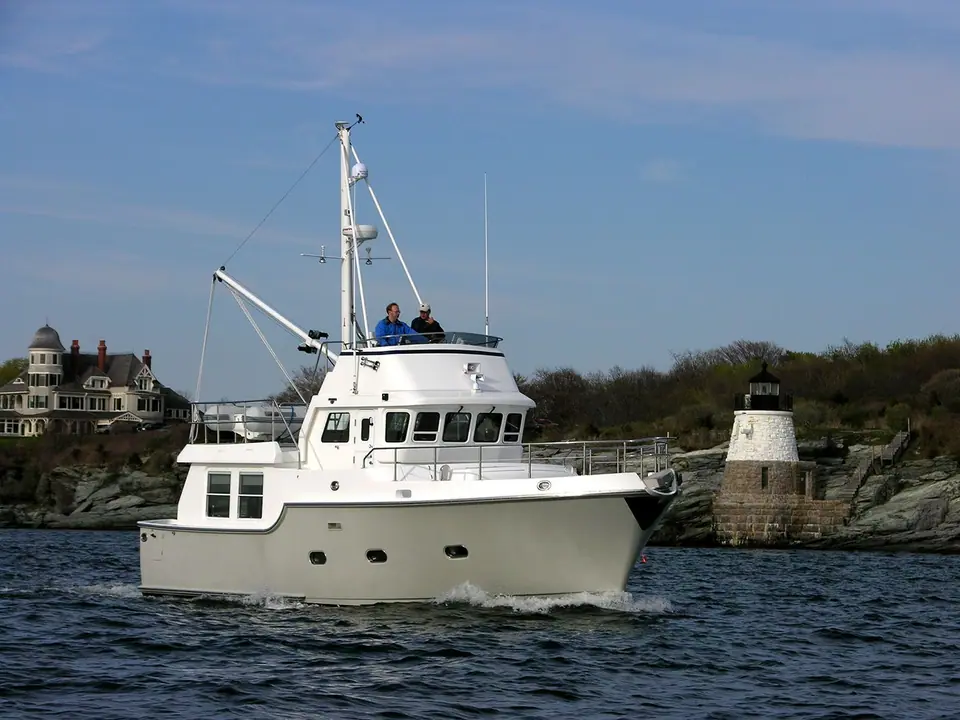
Forty feet, 50,000 pounds, 920 gallons of diesel and a stock hull that circled the planet in 2001 and 2002. Few small trawlers carry that pedigree.
- Length
- 39.8 ft12.12 m
- Beam
- 14.5 ft4.42 m
- Cruise
- 7 kn
- Cabins
- 2 (owner's queen forward, guest cabin with bunks), plus an off-watch berth in the pilothouse
- Used price
- $300K to $600K
On this page
- Overview
- The forty footer that ran 26,000 miles to prove a point
- A full displacement hull with 4,000 pounds of lead
- Range at 6, 7 and 8 knots, from the boat that actually went
- Pilothouse, saloon and two cabins below
- California hulls versus the 40 II from Xiamen
- Single engine, dry stack and the get-home question
- What a Nordhavn 40 costs to buy and keep in 2026
- Specifications
- Price and value
- Strengths and weaknesses
- Used buyer checklist
- Rivals
- Our verdict
- FAQ
The Nordhavn 40 is a full displacement ocean trawler designed by Jeff Leishman for Pacific Asian Enterprises, built by Pacific Seacraft in California from 1999 and later by South Coast Marine in China as the 40 II.
- Couples planning offshore passages
- Pacific Northwest and Alaska cruisers
- Liveaboards who value seakeeping over space
- Buyers moving up from sail who want ocean capability
Nordhavn 40 by the numbers
- Speed to length ratio at cruise
- 1.18Cruises at displacement speed, the most fuel efficient way to cover long distances.
- Estimated range at cruise
- 2,229 nmUsing 90 percent of tank capacity at the cruise speed and fuel burn listed on this page.
- Fuel economy at cruise
- 2.69 nmpgNautical miles per gallon at cruise, both engines combined.
- Horsepower per ton
- 6 hpModest power to weight, efficiency over outright speed.
- Length to beam ratio
- 2.74 : 1A beamy hull with lots of volume for its length.
The forty footer that ran 26,000 miles to prove a point
Most people shopping for a Nordhavn 40 for sale already know the story, and it still matters to resale. In 1998 Pacific Asian Enterprises, the Dana Point company behind Nordhavn, chose Southern California sailboat builder Pacific Seacraft to build a new small passagemaker. Hull 21, named simply Nordhavn, was then taken from stock and driven around the world by rotating crews of PAE staff during a 27 week run in 2001 and 2002, covering about 26,000 miles. Soundings later described the 40 as the holder of the record for the fastest circumnavigation by a production powerboat.
That voyage did more than sell boats. It shaped later designs, from the 43 and 47 to the 41 that eventually replaced the 40, and it gave the 40 a reputation as the smallest Nordhavn that can genuinely cross oceans. The model also completed an Atlantic crossing with the Nordhavn Atlantic Rally before the 40 II debuted in Europe.
Search data shows plenty of people spell it Nordhaven 40. The boat is the same; the brand is spelled Nordhavn, without the extra e.
A full displacement hull with 4,000 pounds of lead
Jeff Leishman's hull is pure passagemaker: a high, buoyant bow for dry running, a moderate forefoot to avoid pounding, a long keel that protects the prop and a large rudder tucked behind it. At 39 ft 9 in overall and 35 ft 5 in on the waterline, with a 14 ft 6 in beam and 5 ft 2 in draft, the 40 displaces about 50,000 lb, enormous for its length. Roughly 4,000 lb of that is internal lead glassed in place, which the spec sheet says is about half the weight of a full fuel load.
The result is motion that owners describe as heavy and steady. One couple who lived aboard a 2000 Nordhavn 40 full time in British Columbia told Power and Motoryacht they were shocked by the boat's stability at anchor, underway and at the dock. The trade-off is speed: this is a 6 to 8 knot boat, and there is no hidden planing mode.
Stabilization was optional rather than standard on many boats, with buyers choosing Nordhavn's towed passive stabilizers (paravanes) or hydraulic fins. For ocean work, fins or a well-rigged paravane system are essentially mandatory, so check what a listed boat carries.
Range at 6, 7 and 8 knots, from the boat that actually went
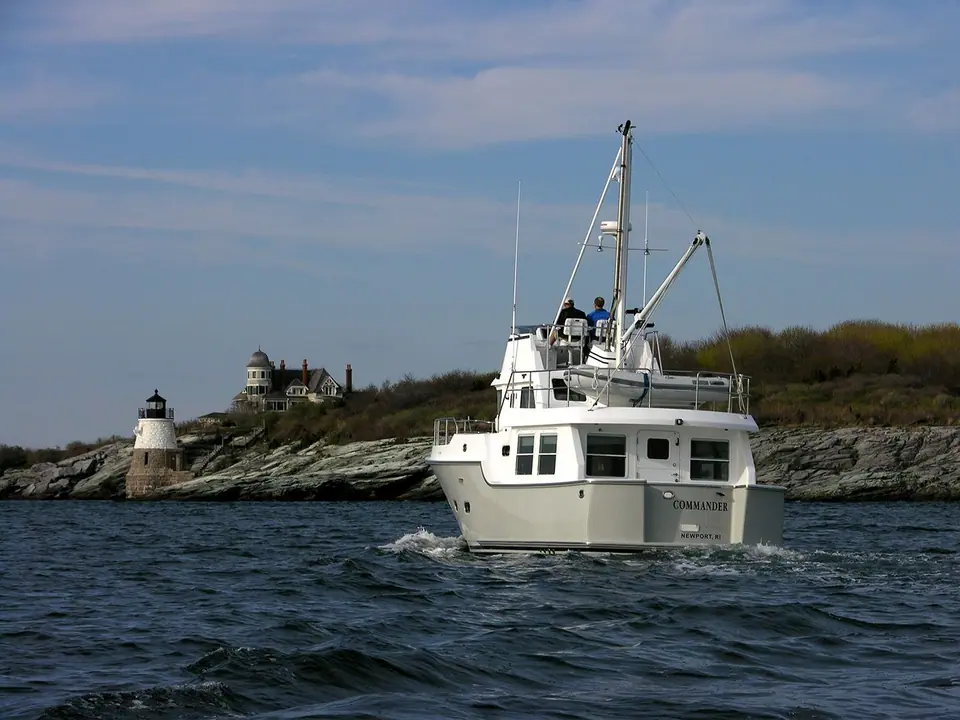
Nordhavn publishes figures from the fully stabilized Around The World boat in relatively calm conditions, and they are honest about the earlier, rosier numbers measured on a lightly loaded, unstabilized hull. At 1,300 rpm the 40 made 6 knots on 1.6 gph for a theoretical 3,450 nautical miles. At 1,600 rpm it made 7 knots on 2.6 gph for about 2,458 miles, and at 1,900 rpm 8 knots cost 4.0 gph, cutting range to roughly 1,840 miles.
Real passages vary. Running from California to Hawaii against contrary wind and current hurt the numbers, while in favorable Western Pacific seas the same boat made 7.4 knots on 2.6 gph. Nordhavn's overview puts a heavily loaded boat ready for an ocean crossing at more than 2,400 nautical miles at 7 knots on its 920 gallons.
Pilothouse, saloon and two cabins below
The 40 uses the classic Nordhavn three level plan. Aft, a watertight door leads from the cockpit into a saloon with an L-shaped settee and table to starboard and a bench or desk to port, with opening windows on both sides for cross ventilation. The galley sits forward of the saloon, and separate stairs lead up to the raised pilothouse and down to the cabins.
The pilothouse is the boat's best room: a helm with space for redundant electronics, a settee and table, and an off-watch berth so one person can sleep within earshot of the helm on passage. Below, a single head with stall shower sits off the companionway, the owner's cabin forward has a centerline queen, and the guest cabin has two bunks. On the listing for a 2000 boat called Dream, that guest cabin also houses the washer/dryer and access to the engine room.
There is one head. That is the compromise most buyers accept for a true ocean boat at 40 feet, and the full-time cruisers quoted by Power and Motoryacht said one head was fine with a visiting couple.
California hulls versus the 40 II from Xiamen
All 44 original Nordhavn 40s came from Pacific Seacraft over about four years. In 2004 PAE shipped the molds to South Coast Marine's then new factory in Xiamen, China, already the builder of the 43, 47 and 55, and production continued as the Nordhavn 40 II from hull 45. Nordhavn says the boat was technically unchanged, built to the same scantlings, but with a higher level of finish.
The 40 II brought granite counters in the galley and head, better teak and varnish, upgraded exterior stainless including a stainless rub rail, a redesigned hull to deck joint and noticeably larger pilothouse and saloon windows in half inch tempered glass. Jeff Leishman said he simply thought it was a better looking boat. Nordhavn also said the move to China lowered the base price of the first China-built hulls.
For buyers, the decision is mostly about budget and taste. The California boats are older and cheaper, and many have been heavily upgraded. The 40 II boats look more modern inside and command a premium. Neither should be judged by the year alone.
Single engine, dry stack and the get-home question
Like most Nordhavns of its era, the 40 runs a single keel-cooled diesel with a dry stack exhaust run up the mast, which keeps raw water pumps and wet exhaust components out of the main engine system. Nordhavn's specification lists a John Deere 4045AFM85 rated 160 hp at 2,400 rpm through a Twin Disc 3:1 gear, while the listing for the 2000 boat Dream shows a 105 hp Lugger LP668D, a common pairing on early hulls.
Many boats add a small wing engine on its own shaft as a get-home drive. Dream carries a Yanmar 3GM27 wing with very few hours, which is typical: you hope never to need it. Generators were optional, with space provided for up to 8 kW.
What a Nordhavn 40 costs to buy and keep in 2026
Nordhavn's own brokerage pages give the clearest market signal: a 2000 boat recently asked $349,000 and a 2002 boat $429,000, both on the Florida east coast. We estimate the broader 2026 range at about $300,000 to $600,000, with well-equipped 40 II hulls at the top. That is serious money for a 40 footer, and it reflects how rarely these boats come up and how well Nordhavns hold value.
Annual running costs are moderate because fuel burn is tiny. Budget roughly $25,000 to $50,000 a year for a 40 to 45 ft slip, insurance, a yearly haul, engine and generator service and a sinking fund for stabilizer seals, electronics and batteries. Long-range cruisers will spend more on spares and survey travel.
Nordhavn 40 specifications
| Length overall | 39.8 ft12.12 m |
|---|---|
| Waterline length | 35.4 ft10.8 m |
| Beam | 14.5 ft4.42 m |
| Draft | 5.2 ft1.57 m |
| Displacement | 50, lbs22,68 kg |
| Ballast | 4, lbs1,814 kg |
| Fuel capacity | 92 gal3,483 L |
| Fresh water | 22 gal833 L |
| Cabins | 2 (owner's queen forward, guest cabin with bunks), plus an off-watch berth in the pilothouse |
| Berths | 4 in cabins plus the pilothouse berth |
| Heads | 1, with stall shower |
| Standard engines | Single diesel; early California boats commonly Lugger 668D at 105 hp, later spec John Deere 4045AFM85 at 160 hp with Twin Disc MG5050 3:1 gear |
| Optional engines | Wing engine get-home drive (Yanmar 3GM on some boats), generator up to 8 kW, TPS paravanes or fin stabilizers |
| Maximum power | 160 hp |
| Cruise speed | 7 knots |
| Range | 2,458 nm |
| Hull type | Full displacement with long keel, moderate forefoot and protected rudder |
| Hull construction | Solid fiberglass hull with vinylester first laminations, cored deck and cabin, internal lead ballast |
| Builder | Pacific Seacraft (original 44 hulls); South Coast Marine, Xiamen (40 II from hull 45), USA, then China |
| Naval architect | Jeff Leishman (Pacific Asian Enterprises) |
| Other design credits | Concept developed with Jim Leishman |
| Production | 1999 to present |
| Status | Discontinued |
Figures come from builder documentation and independent tests where available. Displacement is usually quoted light, so a loaded cruising boat will weigh more. Compare these specs with another model.
Performance data
| RPM | Speed (kn) | Fuel (gph) | Range (nm) |
|---|---|---|---|
| 1300 | 6 | 1.6 | 3450 |
| 1600 | 7 | 2.6 | 2458 |
| 1900 | 8 | 4 | 1840 |
Nordhavn figures from the fully stabilized Around The World boat in relatively calm conditions. Range is Nordhavn's theoretical figure on the 920 gallon tankage.
How much does a Nordhavn 40 cost?
Nordhavn's own brokerage has recently listed a 2000 Nordhavn 40 at $349,000 and a 2002 boat at $429,000, both in North Palm Beach, which frames the market for California-built hulls. Later China-built 40 II boats, with bigger windows, granite and upgraded stainless, should sit above that. Engine hours, stabilizer type, electronics age and whether a wing engine is fitted move prices more than the model year does. These bands are estimates.
Estimate your yearly cost
A planning estimate using common rules of thumb: insurance near 1.5 percent of value, maintenance near 3 percent, haul out and bottom paint by length. Your marina, region and use will move these numbers. Open the full cost calculator.
Versions and options
- Nordhavn 40 (Pacific Seacraft, California)
- The original 44 hulls, including the 2001 to 2002 circumnavigator, typically with Lugger power on early boats.
- Nordhavn 40 II (South Coast Marine, China)
- From hull 45 after the molds moved in 2004: larger tempered glass windows, granite counters, stainless rub rail and refined joinery on the same hull.
Nordhavn 40 timeline
- 1998PAE selects Pacific Seacraft to build its new Nordhavn 40
- 2002Stock hull 21 completes a 26,000 mile circumnavigation in 27 weeks
- 2004Molds move to South Coast Marine in Xiamen, China
- 2006The Nordhavn 40 II makes its European debut at the Dusseldorf boat show
- 2019Nordhavn begins building the 41 in Turkey, billed as the replacement for the 40
Strengths and weaknesses
What owners like
- Proven ocean capability, including a stock-boat circumnavigation
- About 2,400 nautical miles of loaded range at 7 knots
- Very low fuel burn, around 2.6 gph at 7 knots
- Heavy, steady motion with 4,000 lb of internal ballast
- Strong Nordhavn resale and owner community
- Pilothouse off-watch berth for two person passages
What to weigh up
- Only one head
- Slow, with no meaningful speed reserve
- 5 ft 2 in draft limits some thin-water cruising
- Expensive for 40 ft compared with coastal trawlers
Used Nordhavn 40 buyer checklist
Take this list to a viewing. Your ticks are saved in this browser so you can come back to it.
Always commission an independent marine survey and an engine survey before you buy. How a marine survey works.
Rivals to consider
Nordhavn 43
The next size up, with more room and a second head, designed partly from lessons learned on the 40's circumnavigation.
Compare side by sideNordhavn 41
The twin engine successor built in Turkey, more modern inside but now also out of production.
Compare side by sideKadey-Krogen 42
A full displacement rival with a more traditional layout and a wider following on the US East Coast.
Compare side by sideSelene 43
A Chinese-built passagemaker with more volume for the money but less of the Nordhavn track record.
Our verdict on the Nordhavn 40
The Nordhavn 40 is the smallest boat most experienced cruisers would trust to cross an ocean under power, and its circumnavigation is not marketing, it is a logbook. You give up a second head, speed and some shallow anchorages, and you pay a Nordhavn premium. In return you get range measured in thousands of miles, a hull that stays calm when others do not and resale that tends to look after itself. For a couple who actually intends to go somewhere, a well-kept 40 or 40 II is one of the best small passagemakers ever built.
Nordhavn 40 questions answered
How much is a Nordhavn 40?
Recent Nordhavn brokerage listings asked $349,000 for a 2000 boat and $429,000 for a 2002 boat. We estimate most trade between about $300,000 and $600,000 in 2026.
What is the range of a Nordhavn 40?
Nordhavn quotes more than 2,400 nautical miles at 7 knots for a heavily loaded boat, and 3,450 miles at 6 knots in calm conditions on the 920 gallon tanks.
Is it Nordhaven 40 or Nordhavn 40?
The correct name is Nordhavn 40. Nordhaven is a common misspelling, and listings under either name refer to the same boat.
Who built the Nordhavn 40?
Pacific Seacraft in California built the first 44 hulls. From 2004 South Coast Marine in Xiamen, China, built the updated 40 II.
Has a Nordhavn 40 gone around the world?
Yes. Stock hull 21 circumnavigated in 27 weeks during 2001 and 2002, covering about 26,000 miles.
What replaced the Nordhavn 40?
The Nordhavn 41, which entered construction in Turkey in 2019, was billed as its replacement. PAE halted 41 production in 2026.
Nordhavn 40 photos
More trawlers & explorer yachts to explore
Mainship 390 Trawler
Trawlers & Explorer Yachts, 40 ft
Used $95K to $185K
Mainship 34 Trawler
Trawlers & Explorer Yachts, 39 ft
Used $35K to $200K
Targa 37
Trawlers & Explorer Yachts, 41 ft
Used $140K to $650K
Nordhavn 41
Trawlers & Explorer Yachts, 41 ft
Used $1.15M to $1.75M