Grand Banks Yachts Trawlers & Explorer Yachts
Grand Banks 42 Classic Buyer's Guide
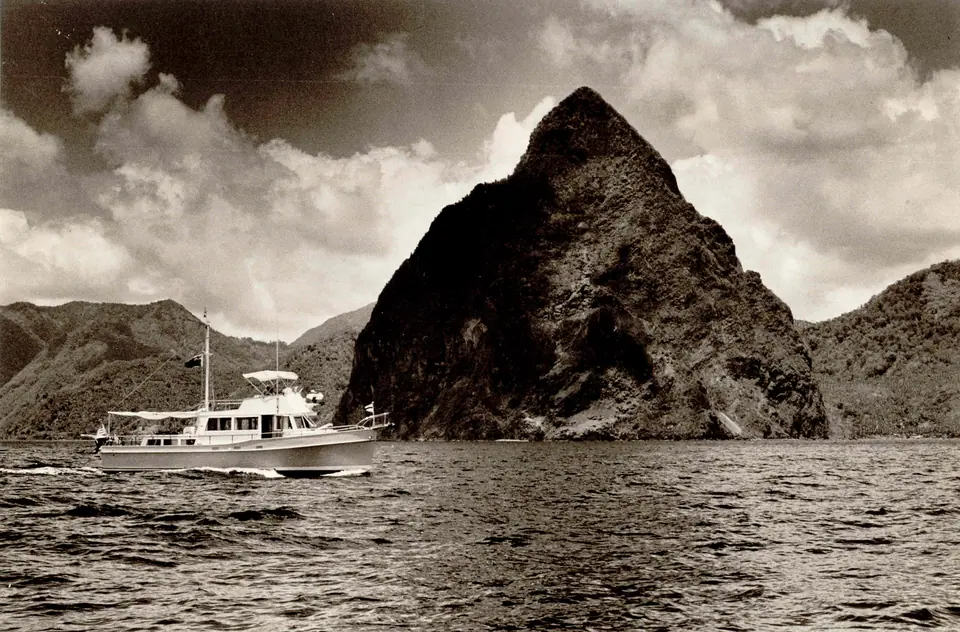
More than 1,500 built, cruised from Alaska to the West Indies, and still the trawler most brokers use as the yardstick for everything else.
- Length
- 43.3 ft13.17 m
- Beam
- 14.1 ft4.29 m
- Cruise
- 8.5 kn
- Cabins
- 2
- Used price
- $75K to $360K
On this page
- Overview
- The Grand Banks 42 is the trawler brokers measure against
- Classic, Europa or Motor Yacht
- Draft, hull form and how she runs
- Lehman, Caterpillar and the fuel equation
- Stabilizers and comfort
- Teak interior and the island queen question
- Great Loop, Alaska and the West Indies
- What goes wrong on an old Grand Banks
- Specifications
- Price and value
- Strengths and weaknesses
- Used buyer checklist
- Rivals
- Our verdict
- FAQ
The Grand Banks 42 is a semi-displacement single or twin diesel trawler built for four decades, first in wood and then fiberglass, in Classic, Europa and Motor Yacht versions. A Great Loop favorite with a 4 foot 2 inch draft.
- Great Loop cruisers
- Couples coastal cruising
- Buyers on a moderate budget
- Classic yacht enthusiasts
The Grand Banks 42 is the trawler brokers measure against
Ask a trawler broker to name the benchmark for a 40-foot coastal cruiser and most will say the Grand Banks 42 before you finish the question. More than 1,500 were built, which makes it one of the most produced yachts of its size, and the result is a deep, liquid used market where almost any budget from about $75,000 to $360,000 can find a boat.
The story starts in Hong Kong, where Robert Newton, an American running a bottling plant, began building boats with his sons John and Whit under the American Marine name. The company moved to Junk Bay in 1962 and became famous for teak-trimmed trawlers that looked like work boats and lived like yachts. Early 42s were built in wood, then the yard switched to fiberglass, and in 1995 production moved to a modern facility at Pasir Gudang in Malaysia.
Typical 42 buyers, brokers report, are experienced couples who want long range coastal cruising or the Great Loop, who keep the boat 10 to 15 years, and who value a home-like teak interior. That profile explains why the model has kept its following for decades.
Grand Banks 42 Classic by the numbers
- Speed to length ratio at cruise
- 1.33Cruises at displacement speed, the most fuel efficient way to cover long distances.
- Estimated range at cruise
- 765 nmUsing 90 percent of tank capacity at the cruise speed and fuel burn listed on this page.
- Fuel economy at cruise
- 1.42 nmpgNautical miles per gallon at cruise, both engines combined.
- Horsepower per ton
- 44 hpStrong power to weight for a planing hull.
- Length to beam ratio
- 3.07 : 1Moderate proportions.
Classic, Europa or Motor Yacht
The 42 was sold in three main versions. The Classic, the most common, has an open aft cockpit under the flybridge overhang and walkaround side decks. The Europa extends the flybridge aft over the cockpit and encloses the side decks with an overhang, giving shade and a covered walkway, which buyers in Florida and the Pacific Northwest both appreciate. The Motor Yacht version raises the aft deck over a larger aft stateroom.
If you are hunting for a Grand Banks 42 Europa for sale, expect to pay a premium of roughly 5 to 15 percent over a comparable Classic, and expect fewer choices. The Classic is the easiest to handle in locks because its side decks are open, but the Europa is the better liveaboard.
- Classic: open cockpit, walkaround decks, most numerous
- Europa: extended flybridge overhang and covered side decks
- Motor Yacht: raised aft deck and larger aft cabin
- Wooden early boats: restoration projects only
Draft, hull form and how she runs
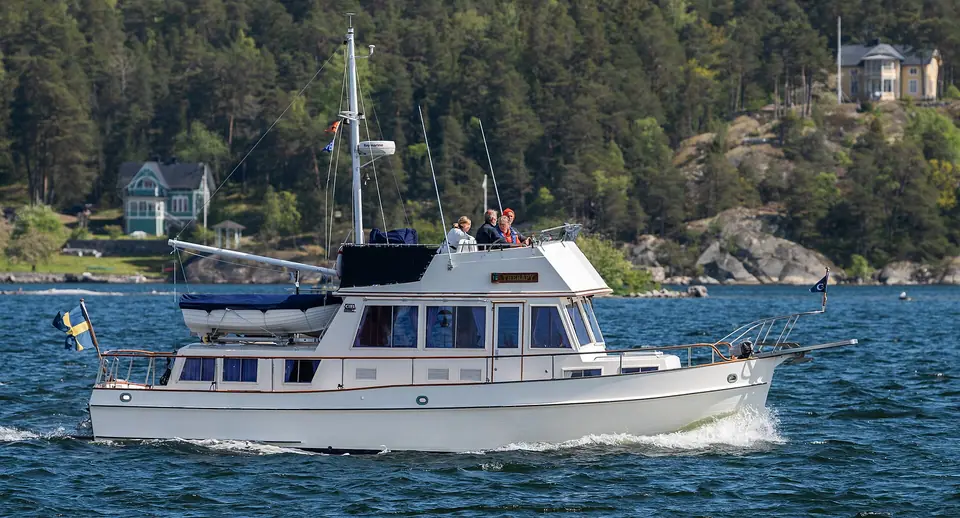
Grand Banks 42 Classic draft is about 4 feet 2 inches, one of the most important numbers on the spec sheet for East Coast and Loop cruisers. Grand Banks' own retired-model sheet lists the late 42 Classic at 43 feet 3 inches overall, 41 feet 1 inch on the waterline and 14 feet 1 inch in beam, with a 34,000 pound displacement, 600 gallons of fuel and 265 gallons of water. PowerBoat Guide notes that the hull was lengthened and widened by a few inches in 1991, so earlier boats measure about 42 feet 7 inches by 13 feet 7 inches. That depth lets the boat use most ICW anchorages, the Bahamas banks with sensible route planning, and the shallow Tenn-Tom and Trent-Severn sections of the Loop.
The hull is semi-displacement, with a deep keel forward and a flatter run aft. With the classic twin Lehman 120 or 135 hp diesels, a 42 is happiest at 8 to 9 knots. With the more powerful Caterpillar 3208TA engines rated at 375 hp each, the same boat can run in the mid teens when needed, and brokers describe that package as the most preferred, because it gives frugal displacement cruising most of the time and extra speed to beat weather.
The keel protects the running gear on grounding, which is common on the Loop. Twin engines make docking straightforward, and most boats now have a bow thruster.
Lehman, Caterpillar and the fuel equation
Most Grand Banks 42s carry 600 gallons of fuel. With twin Lehmans at 8 to 8.5 knots, a combined burn around 5 to 6 gallons per hour is typical, which works out to roughly 700 to 850 nautical miles of range with a reserve. With Caterpillar 3208TA engines at the same speed the burn is similar, but running at 14 to 16 knots raises it several fold and cuts range sharply.
The Lehman, a marinized Ford industrial engine, is simple, slow turning and loved by cruisers for its mechanical simplicity. Its weaknesses are age related: exhaust elbows, injection pumps, heat exchangers and oil leaks. Parts remain available through specialist suppliers. The Cat 3208 is a V8 with a strong reputation in naturally aspirated form; the turbocharged version is more highly stressed and needs careful maintenance history.
Late boats received Cummins or newer Caterpillar diesels with better fuel economy and lower emissions, which can be a selling point.
Stabilizers and comfort
Stabilizers were optional on the 42 and are found on many boats, usually Naiad or Wesmar fins. Brokers list them alongside bow thrusters as among the most desirable features. Without them, a GB42 rolls in a beam sea, like most semi-displacement trawlers. With them, the boat is comfortable for long coastal runs and Gulf crossings.
Check stabilizer service history. Seal replacement is a routine but expensive job, and older systems may need control unit upgrades.
Teak interior and the island queen question
The interior is pure Grand Banks: teak cabinetry, a saloon with a lower helm on many boats, a galley, a forward V-berth guest stateroom and an aft master. The most desirable layout has an island queen berth in the aft stateroom; the alternative split berths are less popular and can mean a lower price.
Two heads, a lower helm and a flybridge make the 42 practical for two couples on a week long trip, though most owners cruise as a couple. Headroom and storage are good for a 42-foot boat.
Great Loop, Alaska and the West Indies
The Grand Banks 42 may be the archetypal Great Loop boat. Shallow draft, twin engines, a protected keel and a manageable size make it ideal for the route. Air draft with the mast lowered must clear the 19 foot 1 inch Chicago bridge, and most 42s can when the mast and antennas fold down, but measure your boat.
Brokers report that owners have cruised 42s to Alaska, Canada, the East Coast and the West Indies. It is a coastal and near-offshore boat rather than an ocean passagemaker, but with good weather planning it handles Gulf crossings and Bahamas runs comfortably.
What goes wrong on an old Grand Banks
The hull is often described as close to bulletproof, but decks and tanks are not. Teak decks over cored structure leak through fastener holes as caulking fails, which leads to wet core and rot. Older boats used black iron fuel tanks that corrode from the outside and eventually leak; replacement is a major job that often involves cutting into the cabin sole. Teak window frames and hatches leak, and wiring on boats built before the 1990s should be checked carefully.
None of these is a reason to avoid a 42, but they are reasons to pay a surveyor and to price the repair into your offer.
Grand Banks 42 Classic specifications
| Length overall | 43.3 ft13.17 m |
|---|---|
| Waterline length | 41.1 ft12.53 m |
| Beam | 14.1 ft4.29 m |
| Draft | 4.2 ft1.27 m |
| Air draft | 22.5 ft6.86 m |
| Displacement | 34, lbs15,422 kg |
| Fuel capacity | 6 gal2,27 L |
| Fresh water | 265 gal1,003 L |
| Cabins | 2 |
| Berths | 4 to 6 |
| Heads | 2 |
| Standard engines | Single or twin Ford Lehman diesels on older boats (Soundings notes the single Lehman was favored early and many owners chose twins) |
| Optional engines | Twin Caterpillar 3208 (naturally aspirated or turbocharged up to 375 hp), Cummins and later Caterpillar diesels on late boats |
| Maximum power | 750 hp |
| Cruise speed | 8.5 knots |
| Hull type | Semi-displacement with hard chines aft and a full length keel protecting twin props |
| Hull construction | Wood on early boats, solid fiberglass hull with cored deck and superstructure on later boats |
| Builder | American Marine, later Grand Banks Yachts, Hong Kong, Singapore and Malaysia |
| Naval architect | Grand Banks (American Marine) in house design |
| Production | 1966 to 2004 |
| Status | Discontinued |
Figures come from builder documentation and independent tests where available. Displacement is usually quoted light, so a loaded cruising boat will weigh more. Compare these specs with another model.
How much does a Grand Banks 42 Classic cost?
Engines and decks drive Grand Banks 42 prices more than year. A late boat with Cat 3208TA power, a teak-free or recently relaid deck and replaced fuel tanks can double the value of a Lehman powered boat with original teak and tanks of uncertain age. Wooden hulls from the 1960s and early 1970s trade far below fiberglass boats and suit restoration enthusiasts only.
Estimate your yearly cost
A planning estimate using common rules of thumb: insurance near 1.5 percent of value, maintenance near 3 percent, haul out and bottom paint by length. Your marina, region and use will move these numbers. Open the full cost calculator.
Versions and options
- Grand Banks 42 Classic
- Open cockpit, walkaround side decks and a flybridge over the saloon. The most common version.
- Grand Banks 42 Europa
- Extended flybridge overhang covering the cockpit and side decks. Popular in hot and wet climates.
- Grand Banks 42 Motor Yacht
- Raised aft deck over a larger aft stateroom, giving more interior volume.
Grand Banks 42 Classic timeline
- 1950sRobert Newton starts building boats in Hong Kong under the American Marine name
- 1962Operations move to Junk Bay, Hong Kong
- 1966Grand Banks 42 introduced in wood, designed by Ken Smith
- 1973Production switches to fiberglass late in the year, launching the most popular era of the 42
- 1991Hull lengthened and widened by a few inches for more interior and engine room volume
- 1995Production moves to a new yard at Pasir Gudang, Malaysia
- 2004Final 42 Classic models are built after nearly four decades in production
Strengths and weaknesses
What owners like
- Shallow 4 ft 2 in draft for the Loop and Bahamas
- Large used market with boats at every price point
- Twin engines and protected running gear
- Classic teak interior and timeless styling
- Strong owner community and specialist knowledge
What to weigh up
- Teak decks and old fuel tanks can be costly to fix
- Rolls without stabilizers
- Older Lehmans need careful maintenance
- Modest fuel capacity compared with ocean trawlers
Used Grand Banks 42 Classic buyer checklist
Take this list to a viewing. Your ticks are saved in this browser so you can come back to it.
Always commission an independent marine survey and an engine survey before you buy. How a marine survey works.
Rivals to consider
Kadey-Krogen 42
Full displacement single engine with more range but less speed.
Compare side by sideMainship 390 Trawler
Newer, cheaper and roomier for the length, but without the Grand Banks finish or resale.
Compare side by sideGrand Banks 49 Classic
The bigger sister with more space and fuel for buyers who outgrow the 42.
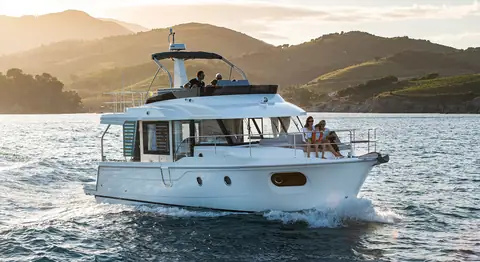
Compare side by sideBeneteau Swift Trawler 41
Modern, faster and brighter inside, but less traditional and with higher new costs.
Compare side by sideOur verdict on the Grand Banks 42 Classic
The Grand Banks 42 Classic remains the reference trawler for coastal cruising and the Great Loop. It is shallow, handsome and simple, and its huge production run means parts, expertise and resale are easy. Budget for the known weak points, especially teak decks and old fuel tanks, and favor a boat with stabilizers and documented engine care. Do that and you will own one of the most respected trawlers ever built.
Grand Banks 42 Classic questions answered
What is the draft of a Grand Banks 42 Classic?
About 4 feet 2 inches, which makes it well suited to the ICW, the Bahamas and the Great Loop.
How many Grand Banks 42s were built?
More than 1,500 were built across the wood and fiberglass eras and the Classic, Europa and Motor Yacht versions, and Soundings puts the total at about 1,650.
What is the difference between the Grand Banks 42 Classic and Europa?
The Europa extends the flybridge over the cockpit and covers the side decks, while the Classic has an open cockpit and walkaround decks.
How much does a Grand Banks 42 cost?
Used Grand Banks 42s typically ask about $75,000 to $360,000 depending on year, engines and condition.
How fast is a Grand Banks 42?
With twin Lehmans it cruises at 8 to 9 knots. With Caterpillar 3208TA engines it can run in the mid teens when needed.
Is the Grand Banks 42 good for the Great Loop?
Yes, it is one of the most popular Loop boats thanks to its shallow draft, twin engines and manageable size.
Grand Banks 42 Classic photos
More trawlers & explorer yachts to explore
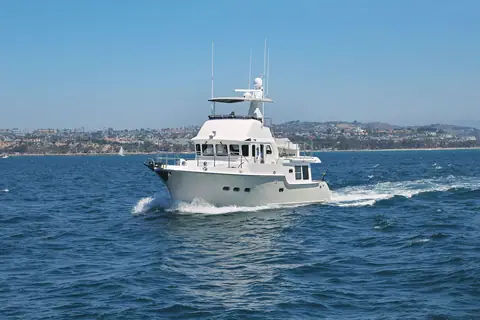
Nordhavn 43
Trawlers & Explorer Yachts, 43 ft
Used $420K to $760K
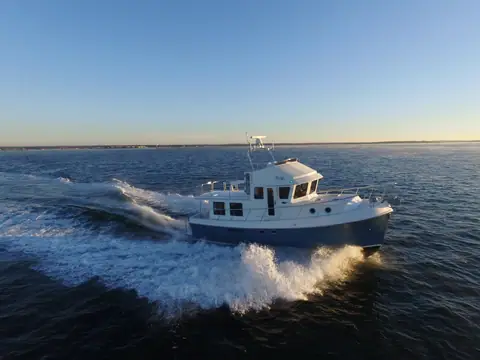
American Tug 435
Trawlers & Explorer Yachts, 44 ft
Used $330K to $1M
President 42
Trawlers & Explorer Yachts, 43 ft
Used $90K to $280K
Beneteau Swift Trawler 41
Trawlers & Explorer Yachts, 44 ft
Used $450K to $760K