Grand Banks Yachts Trawlers & Explorer Yachts
Grand Banks 32 Buyer's Guide, the Little Trawler That Burns 2.5 Gallons an Hour
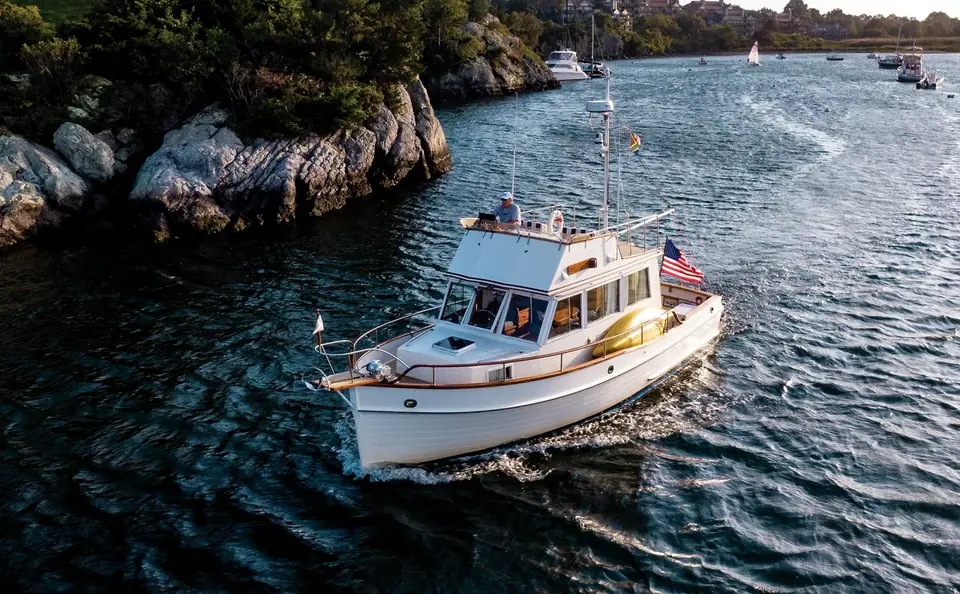
Thirty-two feet of teak, a single Ford Lehman and a long keel: the smallest classic Grand Banks and still one of the most sensible.
- Length
- 32 ft9.74 m
- Beam
- 11.5 ft3.51 m
- Cruise
- 8 kn
- Cabins
- 1 (forward V-berth cabin)
- Used price
- $30K to $125K
On this page
- Overview
- Grand Banks trawlers for sale, and the case for the smallest one
- A heavy hull for a small boat
- One Lehman, 8 knots and 2.5 gallons per hour
- Inside the GB32, teak everywhere
- The Achilles' heel, fuel tanks and teak decks
- Who the GB32 suits, and who should look at a 36
- Specifications
- Price and value
- Strengths and weaknesses
- Used buyer checklist
- Rivals
- Our verdict
- FAQ
The Grand Banks 32 is a single-cabin sedan trawler built for about three decades until 1996, with 861 hulls delivered. A single 120 or 135 hp Ford Lehman pushes its 17,000-pound semi-displacement hull at about 8 knots on 2.5 gallons per hour.
- Cruising couples on a budget
- Sailors moving to power
- ICW, Chesapeake and New England cruising
- Owners who enjoy hands-on maintenance
Grand Banks 32 by the numbers
- Speed to length ratio at cruise
- 1.44Runs in the semi-displacement range, faster than a trawler but thirstier per mile.
- Estimated range at cruise
- 720 nmUsing 90 percent of tank capacity at the cruise speed and fuel burn listed on this page.
- Fuel economy at cruise
- 3.20 nmpgNautical miles per gallon at cruise, both engines combined.
- Horsepower per ton
- 16 hpModest power to weight, efficiency over outright speed.
- Length to beam ratio
- 2.78 : 1A beamy hull with lots of volume for its length.
Grand Banks trawlers for sale, and the case for the smallest one
Most people browsing Grand Banks trawlers for sale start with the 36 or the 42. The Grand Banks 32 deserves a look first. It is the smallest of the classic American Marine trawlers, and for a couple it may be the most rational: one engine, one cabin, one head, and fuel burn so low that fill-ups become a once-a-season event.
Soundings' 2014 profile summed up the history in a few lines. The GB32 was in production for three decades, and when the last one was splashed in 1996, 861 had been built. Early boats were wood, with fiberglass taking over in the mid-1970s, and so little changed over the run that from a distance it is hard to tell a well-kept wooden boat from a later fiberglass one.
Ken Smith, designer of record for the early Grand Banks models from 32 to 42 feet, drew the lines. Grand Banks' own retired-model page called the boat the Grand Banks 32 Sedan, which explains the layout: a single-level salon, a cockpit aft, and one cabin forward.
A heavy hull for a small boat
At 17,000 pounds on a 32-foot hull, the GB32 is heavy for its length, and that is the point. Grand Banks described a deep forefoot, hard chine and long keel, a semi-displacement form that is seakindly and keeps going in conditions that send lighter boats home. Soundings' reviewer agreed, calling the hull capable of handling weather that would have other boats heading for port.
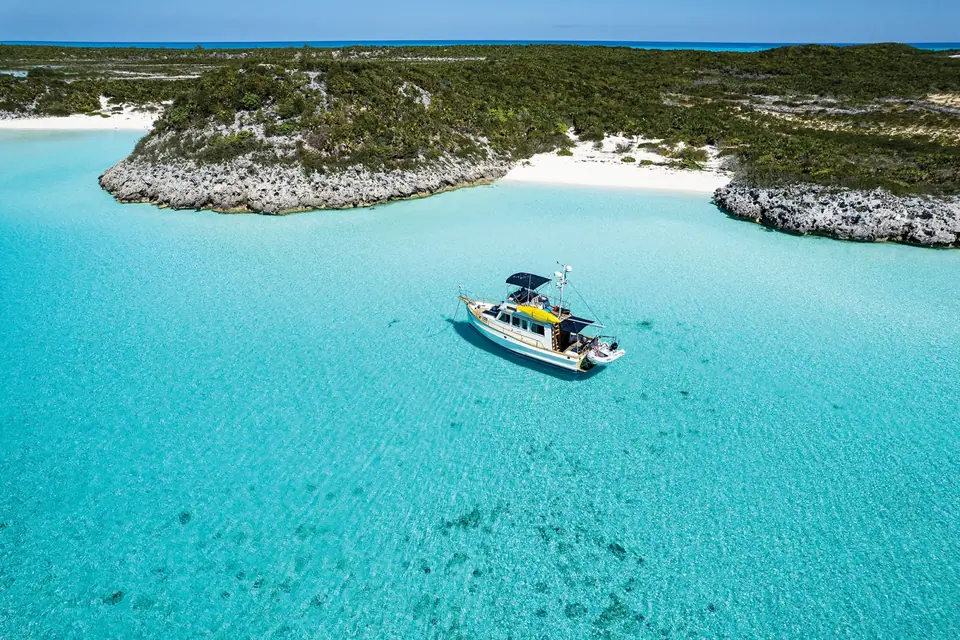
The builder's specification lists 31 feet 11.5 inches overall, 30 feet 9 inches on the waterline, an 11-foot-6-inch beam and 3 feet 8 inches of draft, with 250 gallons of fuel and 110 gallons of water. That draft and long keel make the boat at home on the ICW and in thin Bahamas water, while the keel protects the propeller if you misjudge a shoal.
Single-screw handling is straightforward for anyone used to it. Mark Corke, who bought a 1980s GB32 after a lifetime of sailing, wrote that a short burst of throttle kicks the stern around and the long keel keeps the boat from slipping sideways in a crosswind. His boat had a hydraulic stern thruster but no bow thruster, a common and useful retrofit.
One Lehman, 8 knots and 2.5 gallons per hour
Power comes from a single 6-cylinder, naturally aspirated Ford Lehman diesel of either 120 or 135 hp. Soundings put cruise in the 8-knot range at about 2.5 gallons per hour. Photographer Onne van der Wal, who refitted a 1986 GB32 in 2020, reported 8 to 8.5 knots all day in all conditions on the same 2.5 gph, from a Lehman with about 3,000 hours that he said functioned as if newly installed.
Corke ran his boat at about 1,800 rpm, roughly 80 percent of maximum for the 135 Lehman, for 7.5 to 8 knots, and found other owners settled on the same sweet spot. With 250 gallons aboard he estimated a cruising range of more than 1,500 miles.
The Lehman's appeal is simplicity: mechanical, well understood and supported by decades of parts and knowledge. Hinge-up and lift-out panels in the salon sole give good access to the engine, batteries and other machinery, and a single centerline engine makes routine service easy.
- Engine: single Ford Lehman diesel, 120 or 135 hp
- Cruise: about 8 knots at 2.5 gph (Soundings, owner reports)
- Fuel: 250 gallons in twin 125-gallon tanks under the side decks
- Owner-estimated range: more than 1,500 miles at 7.5 to 8 knots
Inside the GB32, teak everywhere
The layout is seamanlike rather than spacious. Instead of pushing the salon out to the hull sides, the GB32 keeps proper walkaround side decks with tall, secure rails, and a short bowsprit forward has room for two anchors.
Early boats had the galley toward the aft end of the salon; later boats moved it forward along the port side, with a deep stainless sink, under-counter refrigerator, oven and cooktop. Propane lives under a flybridge seat so any leak vents overboard. The lower helm sits to starboard with good visibility. Aft of the helm and galley, settees face each other across a drop-leaf table, and Grand Banks noted that the port settee slides out to a berth 3 feet 5 inches wide.
Three steps down forward, the cabin has a V-berth that becomes a huge single berth with the filler in place, and the head to starboard has an electric toilet, a vanity and a curtained shower that drains through a teak grate. Burmese teak parquet soles and joinery are everywhere; Soundings remarked that it was easy to forget the boat was fiberglass.
The Achilles' heel, fuel tanks and teak decks
Every GB32 survey should start with the tanks. Soundings called the fuel tanks the boat's Achilles' heel, with leaks a common topic among owners, and warned that replacing original tanks can be costly and difficult because they are tucked under the side decks. A boat with documented tank replacement is worth paying more for.
The second big item is teak. The cockpit, side decks and flybridge are teak overlaid, and Corke, who inspected many boats on the East Coast, found that some had issues with the teak decking or fuel tanks that would be time-consuming and expensive to fix. Leaking teak decks can wet the core beneath, so a moisture meter and a careful surveyor are essential.
Budget around $10,000 to $25,000 a year for a GB32 depending on slip costs and how much varnish and teak work you do yourself. Fuel is a small line item; maintenance of wood and systems is the big one.
Who the GB32 suits, and who should look at a 36
The GB32 is a couple's boat. Corke and his wife had initially dismissed it as too small and looked at GB36s and 42s from the 1980s, but chose the 32 because it had a sensibly sized cockpit, one head with less to go wrong, and a huge V-berth. They wanted a single engine, quality construction, moderate to heavy displacement, low running costs and a solid reputation, and the 32 ticked every box.
If you regularly cruise with guests, need two heads, or want an aft cabin, step up to a GB36 Classic or Sedan. If you want a boat that two people can run, maintain and afford for years, and you like the look of a proper little ship, the 32 is hard to beat. Designer Pim Dijksman, imagining a modern version for PassageMaker in 2023, said its proportions always spoke to him, and many owners say the same.
Grand Banks 32 specifications
| Length overall | 32 ft9.74 m |
|---|---|
| Waterline length | 30.8 ft9.37 m |
| Beam | 11.5 ft3.51 m |
| Draft | 3.7 ft1.12 m |
| Displacement | 17, lbs7,711 kg |
| Fuel capacity | 25 gal946 L |
| Fresh water | 11 gal416 L |
| Cabins | 1 (forward V-berth cabin) |
| Berths | V-berth for two (filler makes one large berth) plus a slide-out salon settee berth |
| Heads | 1 with stand-up shower |
| Standard engines | Single Ford Lehman 6-cylinder naturally aspirated diesel, 120 or 135 hp |
| Maximum power | 135 hp |
| Cruise speed | 8 knots |
| Hull type | Semi-displacement with deep forefoot, hard chine and long keel |
| Hull construction | Wood on early boats, fiberglass from the mid-1970s |
| Builder | American Marine (later Grand Banks Yachts), Hong Kong, then Singapore |
| Naval architect | Ken Smith |
| Status | Discontinued |
Figures come from builder documentation and independent tests where available. Displacement is usually quoted light, so a loaded cruising boat will weigh more. Compare these specs with another model.
How much does a Grand Banks 32 cost?
In 2014 Soundings said to expect about $100,000 for a late-1980s GB32, and a surveyor-buyer that year found two late-1980s boats on the Chesapeake listed just over $100,000. Condition of the teak decks and fuel tanks, engine hours and whether the boat has a generator and air conditioning drive the spread more than year. Wooden early boats sit at the bottom of the market.
Estimate your yearly cost
A planning estimate using common rules of thumb: insurance near 1.5 percent of value, maintenance near 3 percent, haul out and bottom paint by length. Your marina, region and use will move these numbers. Open the full cost calculator.
Grand Banks 32 timeline
- 1965First production Grand Banks 36 launches the Ken Smith-designed family that includes the 32
- 1970sGB32 construction moves from wood to fiberglass in the middle of the decade
- 1996Last Grand Banks 32 splashed; 861 built
- 2014Soundings puts a late-1980s GB32 at about $100,000
- 2023PassageMaker publishes a designer's reimagining of the GB32 for modern cruisers
Strengths and weaknesses
What owners like
- About 2.5 gph at an 8-knot cruise
- Heavy, seakindly long-keel hull
- Simple single Lehman with easy access
- Wide walkaround side decks and secure rails
- Usable cockpit, rare on small classic trawlers
- Holds value well
What to weigh up
- Fuel tank leaks are a known weakness
- Teak decks and brightwork are labor-intensive
- Only one cabin and one head
- No generator or air conditioning on many boats
- Slow by modern standards
Used Grand Banks 32 buyer checklist
Take this list to a viewing. Your ticks are saved in this browser so you can come back to it.
Always commission an independent marine survey and an engine survey before you buy. How a marine survey works.
Rivals to consider
Grand Banks 36 Sedan
Bigger GB with optional twin engines, two forward cabins in some layouts and more fuel.
Compare side by sideMainship 34 Trawler
Roomier American single-engine trawler with less teak and lower prices.
Compare side by sideNordic Tug 32
Faster semi-displacement tug with a pilothouse and modern fiberglass finish.
Compare side by sideAmerican Tug 34
Newer, more spacious tug with modern systems at a much higher price.
Compare side by sideOur verdict on the Grand Banks 32
The Grand Banks 32 is a lesson in proportion. It gives a couple a real little ship, with walkaround decks, a usable cockpit, a heavy long-keeled hull and one simple diesel that sips about 2.5 gallons an hour, in a package small enough to maintain and dock without stress. Its weak points are well known, mainly fuel tanks and teak decks, so the right purchase is the boat where those have already been dealt with. Find that boat and the GB32 offers classic Grand Banks character at the lowest cost of entry.
Grand Banks 32 questions answered
How many Grand Banks 32s were built?
Soundings reports 861 GB32s were built over about three decades, with the last one splashed in 1996.
What engine is in a Grand Banks 32?
A single 6-cylinder, naturally aspirated Ford Lehman diesel of 120 or 135 hp.
How much fuel does a Grand Banks 32 burn?
About 2.5 gallons per hour at an 8-knot cruise, according to Soundings and owner reports.
What is a Grand Banks 32 worth?
Soundings put a late-1980s boat at about $100,000 in 2014. Our 2026 estimates range from about $30,000 for early boats to about $125,000 for the best late examples.
What are common problems on a GB32?
Leaking fuel tanks are the best-known issue, followed by teak deck leaks and core moisture.
How many people can sleep on a Grand Banks 32?
Two in the forward V-berth and one or two more on the slide-out salon settee berth.
Grand Banks 32 photos
More trawlers & explorer yachts to explore
Nordic Tug 32
Trawlers & Explorer Yachts, 32 ft
Used $70K to $230K
Ranger Tugs R-27
Trawlers & Explorer Yachts, 32 ft
Used $85K to $285K
Beneteau Swift Trawler 30
Trawlers & Explorer Yachts, 33 ft
Used $170K to $260K
Greenline 33
Trawlers & Explorer Yachts, 33 ft
Used $125K to $290K