Nordhavn Trawlers & Explorer Yachts
Nordhavn 47 for Sale, Specs, Prices and Ocean Range
An 85,000 pound, single Lugger passagemaker that sold 22 hulls before the first one was launched, and still sets the bar for mid-size ocean trawlers.
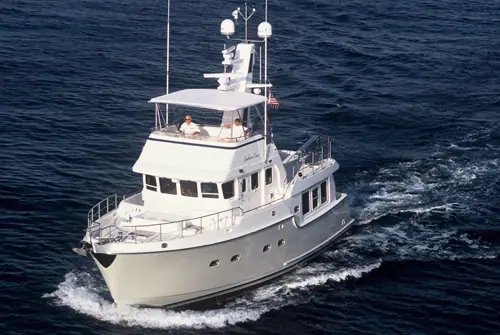
- Length
- 47.7 ft14.53 m
- Beam
- 16.1 ft4.9 m
- Cruise
- 8 kn
- Cabins
- 2 plus pilothouse berth
- Used price
- $520K to $900K
On this page
- Overview
- Twenty-two orders before anyone saw a Nordhavn 47
- Hull form, ballast and the numbers that matter
- The Lugger main and the Yanmar wing
- Range at displacement speed
- Naiad fins and the motion offshore
- Wheelhouse, saloon and two staterooms
- Great Loop and shallow water realities
- Nordhavn 47 or Nordhavn 475
- Specifications
- Price and value
- Strengths and weaknesses
- Used buyer checklist
- Rivals
- Our verdict
- FAQ
The Nordhavn 47 is a heavy, single engine ocean trawler from the early 2000s with 1,470 gallons of fuel, a Lugger diesel, wing engine backup, a dedicated wheelhouse and two staterooms.
- Couples planning ocean crossings
- Alaska and Pacific Northwest cruisers
- Liveaboards wanting storage and tankage
Nordhavn 47 by the numbers
- Speed to length ratio at cruise
- 1.22Cruises at displacement speed, the most fuel efficient way to cover long distances.
- Horsepower per ton
- 4 hpModest power to weight, efficiency over outright speed.
- Length to beam ratio
- 2.96 : 1A beamy hull with lots of volume for its length.
Twenty-two orders before anyone saw a Nordhavn 47
Nordhavn says it took 22 orders for the 47 sight unseen, which tells you how much trust the brand had earned by the early 2000s. Buyers were putting deposits on a design built around the lessons from the Nordhavn 40 circumnavigation, the earlier Nordhavn 46 and the bigger 57 and 62. Nordhavn went on to build 59 of them between 2002 and 2009 at its partner yard, South Coast Marine in Xiamen, China. The 47 was meant to be the boat that combined weeks of self-sufficient cruising with real offshore ability, at a size a couple could still handle.
Power and Motoryacht tested an early hull in 2003 at a price of about $860,000. Today, if you are searching for a Nordhavn 47 for sale, you will find that the best boats still ask much of that original number. Few trawlers hold value like this, and the reasons are on the spec sheet: 85,000 pounds of displacement, roughly 7,400 pounds of lead ballast, 1,470 gallons of diesel and a separate wing engine for backup.
Hull form, ballast and the numbers that matter
The 47 measures 47 feet 8 inches overall with a 43 foot 4 inch waterline and a 16 foot 1 inch beam. That waterline puts theoretical hull speed near 8.8 knots, and the boat's efficient band sits between 7 and 8 knots. Draft is listed by Nordhavn at 5 feet 11 inches, while Power and Motoryacht published 5 feet for its test boat, so measure the actual boat at half load if depth matters to your cruising grounds.
Construction uses fiberglass with vinylester resin, which resists osmotic blistering better than the orthophthalic polyester common in older trawlers. Internal lead ballast lowers the center of gravity and gives the boat a long, slow roll period that crew find far less tiring than the snappy motion of lighter hulls.
- Fuel 1,470 gallons, water 400 gallons
- Black water 120 gallons, gray water 110 gallons
- 24 volt DC system with a 510 amp hour house bank as delivered
- Generator options up to 16 kW
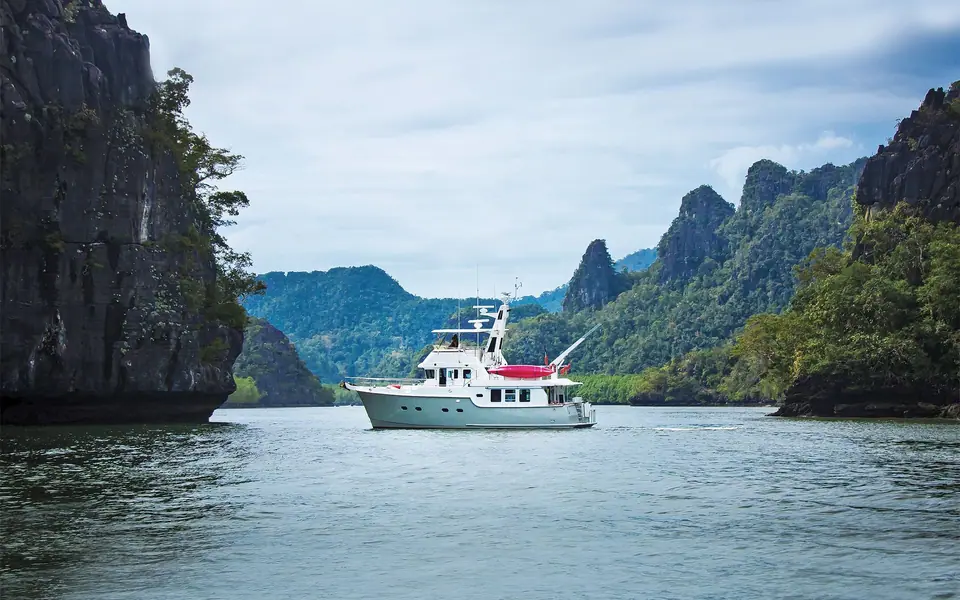
The Lugger main and the Yanmar wing
Early boats, including the 2003 test boat, carried a 174 hp Lugger LP668T inline six through a ZF gear at 3.96 to 1, swinging a 34 inch four-blade bronze propeller. Later boats listed a Lugger L1066T at 165 hp. Lugger engines are John Deere based, built by Northern Lights for long duty cycles at moderate loads, and they are a good match for a boat that may run 24 hours a day for a week.
The backup is a Yanmar wing engine (35 hp on the 2003 test boat, 40 hp on later boats) on its own V-drive, shaft and folding propeller. Yachting found it would push the boat at about 5 knots, enough to reach a harbor or hold a heading in weather. Power and Motoryacht's tester found the deep reduction gave enough low speed torque to make close quarters handling forgiving, and the turning circle tight for a heavy keel boat, aided by a Side Power bow thruster.
The engine room is insulated with two inch foam and is one of the quietest in its class. Standing headroom and good access to both sides of the main engine make routine service realistic for an owner operator.
Range at displacement speed
Nordhavn quotes a range of over 3,000 nautical miles for the 47, cruising efficiently at 8 to 9 knots, and Yachting repeated that figure. Neither the builder nor the 2003 Power and Motoryacht test published a fuel curve, so treat the number as a calm-water best case. Physics still applies: the hull's theoretical speed is near 8.8 knots, and slowing a knot or more below it stretches range far more than any tank upgrade. At 9 knots and above the range falls off quickly as the hull starts climbing its own bow wave.
That is enough for Hawaii from California, the Atlantic via Bermuda and the Azores, or a full season in British Columbia and Southeast Alaska without needing remote fuel docks. The type has built a solid reputation among long distance owners, which is reflected in how quickly well equipped boats sell.
Naiad fins and the motion offshore
The test boat carried Naiad stabilizers, which is typical for the model. The reviewer found them barely necessary on a calm test day, which says more about the weather than the boat. In a beam sea a heavily ballasted displacement hull without stabilizers will roll persistently, so treat the fins as essential equipment. Check actuator seals, the hydraulic pump and the control unit age on any boat you inspect, and ask when the system was last rebuilt.
For at anchor comfort, many owners add flopper stoppers or a paravane setup. A few have retrofitted zero speed fin systems, which work well but add cost and power demand.
Wheelhouse, saloon and two staterooms
The 47 has a true wheelhouse with a chart table and a pilothouse berth, so an off watch crew can sleep steps from the helm. That berth also counts as a third sleeping space when family visits. The saloon is finished in traditional teak with granite counters in the galley, and there is an office alcove, a feature that matters more now that many owners work remotely while cruising.
Below, the master stateroom and a guest stateroom each have access to a head with shower. Storage is excellent, as it should be on an 85,000 pound boat, and long term cruisers carry spares for nearly every critical system.
Great Loop and shallow water realities
Can you do the Great Loop on a Nordhavn 47? Yes, and some owners have, but the boat is not ideal for it. A draft in the 5 to 6 foot range limits anchorages in the Bahamas and on the Tenn-Tom, and air draft with the mast down has to fit beneath the Chicago railroad bridge, which allows just 19 feet 1 inch. The 47 is a better fit for the ICW, the Northeast and the Pacific Coast, where its weight and range are assets rather than burdens.
Nordhavn 47 or Nordhavn 475
Buyers often confuse the two. The 475 is a newer model based on the Nordhavn 43 hull, narrower at 14 feet 10 inches across, more modern in profile, 1,200 gallons of fuel and a single 180 hp John Deere 4045. The original 47 is beamier at 16 feet 1 inch, heavier, and carries more fuel and water. If you want the most volume and tankage for the money, the 47 wins. If you want a newer build and a more contemporary look, the 475 is the better choice.
Nordhavn 47 specifications
| Length overall | 47.7 ft14.53 m |
|---|---|
| Waterline length | 43.3 ft13.21 m |
| Beam | 16.1 ft4.9 m |
| Draft | 5.9 ft1.8 m |
| Displacement | 85, lbs38,56 kg |
| Ballast | 7,4 lbs3,357 kg |
| Fuel capacity | 1,47 gal5,565 L |
| Fresh water | 4 gal1,514 L |
| Cabins | 2 plus pilothouse berth |
| Berths | 4 to 6 |
| Heads | 2 |
| Standard engines | 1 x Lugger diesel (LP668T at 174 hp on early boats, later L1066T at 165 hp), Yanmar wing engine (35 hp on the 2003 test boat, 40 hp on later boats) |
| Maximum power | 174 hp |
| Cruise speed | 8 knots |
| Range | 3,000 nm |
| Hull type | Full displacement, single screw with ballasted full keel |
| Hull construction | Fiberglass with vinylester resin, internal lead ballast |
| Builder | Pacific Asian Enterprises (Nordhavn), built at South Coast Marine in Xiamen, China |
| Naval architect | Jeff Leishman (Nordhavn) |
| Other design credits | Pacific Asian Enterprises design team |
| Production | 2002 to 2009 |
| Status | Discontinued |
Figures come from builder documentation and independent tests where available. Displacement is usually quoted light, so a loaded cruising boat will weigh more. Compare these specs with another model.
How much does a Nordhavn 47 cost?
A Nordhavn 47 cost about $860,000 as tested in 2003, and in 2025 three boats were listed between $749,000 and $850,000, so well kept examples still ask close to their original price. The spread comes from electronics, stabilizer and Lugger service history, generator size, and whether the boat has proven offshore miles. Pacific Northwest and California boats with Alaska or Mexico experience usually sit at the top of the range.
Estimate your yearly cost
A planning estimate using common rules of thumb: insurance near 1.5 percent of value, maintenance near 3 percent, haul out and bottom paint by length. Your marina, region and use will move these numbers. Open the full cost calculator.
Nordhavn 47 timeline
- 2002Nordhavn 40 completes its circumnavigation as the first Nordhavn 47s are built
- 2003Nordhavn 47 tested by Power and Motoryacht at about $860,000, with 22 orders taken sight unseen
- 2005South Coast Marine's Xiamen yard expands to build the 47, 40 II and 55
- 2009Production ends after 59 hulls; the Lugger L1066T is the listed main engine by then
- LaterThe 475, based on the Nordhavn 43 hull, takes over the mid-size slot
Strengths and weaknesses
What owners like
- 1,470 gallons supports transoceanic legs
- Separate wing engine with its own shaft
- Quiet, accessible engine room
- True wheelhouse with pilothouse berth
- Vinylester laminate and lead ballast
- Holds value remarkably well
What to weigh up
- Draft of up to about 6 feet limits shallow cruising
- Heavy displacement means a modest 8 to 9 knot cruise at best
- Only two staterooms in 47 feet
- Expensive to haul and store because of weight
Used Nordhavn 47 buyer checklist
Take this list to a viewing. Your ticks are saved in this browser so you can come back to it.
Always commission an independent marine survey and an engine survey before you buy. How a marine survey works.
Rivals to consider
Nordhavn 43
Smaller, lighter and less thirsty, and the hull the current 475 is based on, at a lower purchase price.
Compare side by sideKadey-Krogen 44 AE
A full displacement single engine alternative with a wider body saloon and slightly less tankage.
Compare side by sideDeFever 49 Pilothouse
Twin engine coastal cruiser with more interior space but less offshore pedigree.
Compare side by sideNordhavn 57
The step up for buyers who want more tankage and a faster passage speed.
Compare side by sideOur verdict on the Nordhavn 47
The Nordhavn 47 remains one of the best ocean capable trawlers you can buy for under a million dollars. It is heavy, slow and expensive to haul, but those same qualities give it range, motion comfort and storage that lighter boats cannot match. Find one with a documented Lugger, working Naiads and a wing engine that runs, and you will own a boat that can go nearly anywhere.
Nordhavn 47 questions answered
How much is a Nordhavn 47 for sale?
Most listings ask between about $520,000 and $900,000. The best maintained, well equipped boats can approach the roughly $860,000 price quoted when new in 2003.
What is the range of a Nordhavn 47?
Nordhavn quotes over 3,000 nautical miles cruising at 8 to 9 knots on its 1,470 gallons. No independent fuel curve has been published, so treat that as a calm-water best case.
What engine does the Nordhavn 47 have?
A single Lugger diesel, either the 174 hp LP668T on early boats or the 165 hp L1066T later, with a Yanmar wing engine (35 to 40 hp) as backup.
Is the Nordhavn 47 the same as the Nordhavn 475?
No. The 475 is a newer model built on a lengthened Nordhavn 43 hull, narrower and lighter than the 47.
Does the Nordhavn 47 have stabilizers?
Yes, most boats have Naiad active fin stabilizers, which are essential on this round bilge hull.
Nordhavn 47 photos
More trawlers & explorer yachts to explore
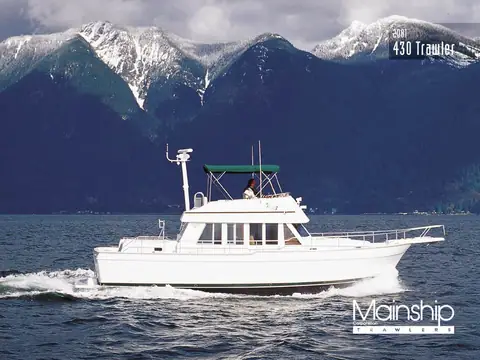
Mainship 430 Trawler
Trawlers & Explorer Yachts, 48 ft
Used $110K to $260K
Beneteau Swift Trawler 48
Trawlers & Explorer Yachts, 48 ft
Used $720K to $1.05M
Great Harbour GH47
Trawlers & Explorer Yachts, 47 ft
Used $280K to $500K
Kadey-Krogen 44 AE
Trawlers & Explorer Yachts, 49 ft
Used $650K to $1.1M