Great Harbour Trawlers Trawlers & Explorer Yachts
Great Harbor Trawlers for Sale, a Guide to the Great Harbour GH47
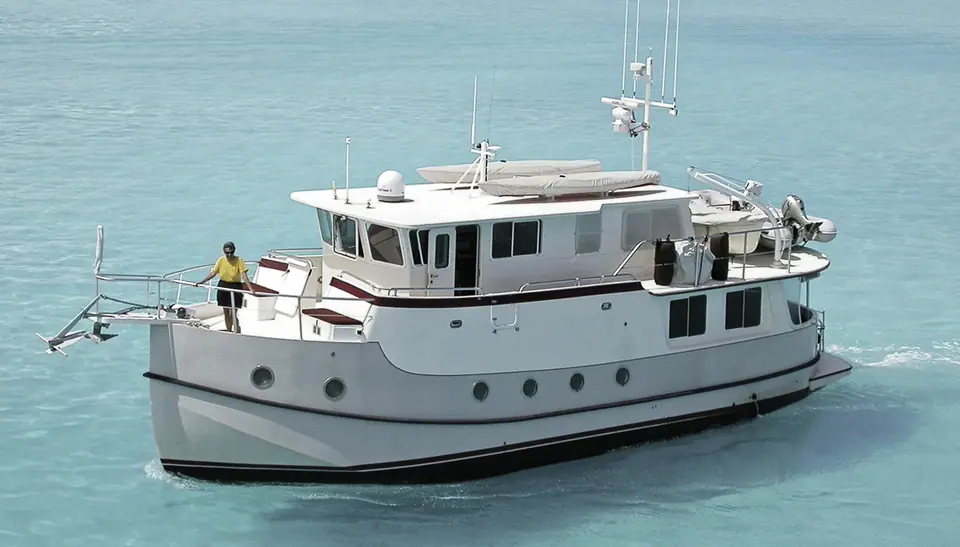
A 46-foot 10-inch full-displacement liveaboard trawler from Gainesville, Florida, with twin small diesels, a 2-foot 10-inch draft and a 3,500-mile range.
- Length
- 46.8 ft14.27 m
- Beam
- 15.8 ft4.83 m
- Cruise
- 8.25 kn
- Cabins
- 3 (forward master, guest or study, watch cabin aft of the pilothouse) plus convertible pilothouse settee
- Used price
- $280K to $500K
On this page
- Overview
- Great Harbor trawlers for sale, and why the GH47 draws the questions
- Ken Fickett, Lou Codega and a factory in Gainesville
- Seventy thousand pounds that floats in 34 inches
- Four levels of living space
- Eight knots on two small diesels
- Systems chosen for full-time liveaboards
- Owning a boat the builder no longer makes
- Shopping a used GH47
- Specifications
- Price and value
- Strengths and weaknesses
- Used buyer checklist
- Rivals
- Our verdict
- FAQ
The Great Harbour GH47 is a 46-foot 10-inch, 15-foot 10-inch beam full-displacement trawler built by Mirage Manufacturing in Florida from the mid-2000s. Twin small diesels cruise it at 8.25 knots with a 3,500 nm range on a 2-foot 10-inch draft.
- Full-time liveaboard couples
- Bahamas and Florida Keys cruising
- Great Loop and Intracoastal cruising
- Owners who value space over speed
Great Harbour GH47 by the numbers
- Speed to length ratio at cruise
- 1.22Cruises at displacement speed, the most fuel efficient way to cover long distances.
- Estimated range at cruise
- 3,218 nmUsing 90 percent of tank capacity at the cruise speed and fuel burn listed on this page.
- Fuel economy at cruise
- 2.75 nmpgNautical miles per gallon at cruise, both engines combined.
- Horsepower per ton
- 4 hpModest power to weight, efficiency over outright speed.
- Length to beam ratio
- 2.96 : 1A beamy hull with lots of volume for its length.
Great Harbor trawlers for sale, and why the GH47 draws the questions
Search for Great Harbor trawlers for sale and you will find a small, loyal market. The builder spells it Great Harbour, and the fleet is small: Mirage Manufacturing says more than 50 Great Harbour Trawlers have been built across all its models. The GH47 is the one that gets the most attention, because no other 47-foot trawler packs in as much living space or draws as little water.
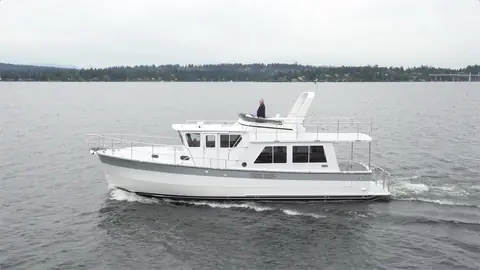
On paper it is a 46-foot 10-inch, 15-foot 10-inch beam full-displacement boat that displaces 70,000 pounds at full load, draws 2 feet 10 inches, and runs at 8.25 to 8.5 knots on twin small diesels. In practice it is a floating house for couples who live aboard, cruise the Bahamas and the Intracoastal, and want commercial-grade simplicity rather than yacht varnish.
Production of the GH47 is suspended. Mirage says it has devoted its resources to the TT35 trailerable trawler and its N-series boats, and it supports existing GH47 owners and the brokerage market. Every GH47 you can buy today is therefore used.
Ken Fickett, Lou Codega and a factory in Gainesville
Mirage Manufacturing was founded in 1971 by Ken Fickett in Gainesville, Florida, and first made its name building performance sailboats and sportfishing boats, and Fickett also applied his composites expertise to experimental aircraft through a separate company. In the late 1990s Fickett wanted a boat to take his young family cruising for a year. Plans for a 35-foot coastal cruiser did not suit full-time family life, so he enlisted naval architect Lou Codega, and together they developed the Great Harbour 37. Orders followed, and the line grew to include the GH47, N37 and N47.
Yachting's mid-2000s review of a new GH47 noted that Mirage had built and sold its first 47 the year before and then fine-tuned the design for production, and that the N37 shares the same Codega hull design concept. Boats were sold factory-direct, and owners were encouraged to customize; the tested boat had an office with file cabinets and a leather-topped desk, while the next hull on the line had a larger forward stateroom instead.
Seventy thousand pounds that floats in 34 inches
The GH47's defining number is its draft. At 2 feet 10 inches, it opens Bahamas banks, Florida Bay and Intracoastal side creeks that are off limits to most trawlers drawing 4 to 5 feet. Twin propellers sit behind large skegs and twin protective keels, so the boat can be dried out on her own bottom and can survive an inadvertent grounding better than most yachts.
Stability comes from the hull form rather than stabilizers. Mirage argues that its wide, hard-chined hull provides enough form stability that fins are unnecessary, and Yachting's tester, who had taken the related N37 to Bermuda, reported no stern kick in sloppy quartering seas. The trade-off is windage: the GH47 is tall and boxy, which Yachting acknowledged makes it better suited to island hopping and coastal cruising than to ocean passages.
Mirage also builds the boat to be unsinkable, using buoyant core material in the decks, superstructure and hull above the rub rail, with heavy solid fiberglass below. Exterior rails are brushed aluminum and decks use a commercial-grade painted nonskid, so there is no varnish or teak decking to maintain.
Four levels of living space
Mirage claims the GH47 offers more interior space than most 60 to 65-foot yachts, and a walk through explains why.
- Optional flybridge with centerline helm, built-in seating and room for a RIB on the aft boat deck
- Pilothouse with a commercial-style helm, chart and nav station and a raised settee for four that converts to a long double
- Watch cabin aft of the pilothouse with a double berth and its own day head, often used as an owner's retreat or office
- Main saloon with seating for six to eight, entertainment center, bookshelves and a hi-lo table, with large opening windows
- Galley with household appliances, including a front-loading or side-by-side refrigerator, ceramic or four-burner electric cooktop, convection microwave and even a dishwasher
- Dinette or utility and machinery room opposite the galley, housing the washer, dryer and engine room access
- Guest stateroom or study to port, guest head with a home-style bath to starboard
- Forward master with a queen island berth, three hanging lockers, built-in dressers and an en suite stall shower
Eight knots on two small diesels
Great Harbour gives the GH47 twin Yanmar 75 hp diesels in its current specification, while Yachting's tested boat had twin 71 hp naturally aspirated Westerbeke diesels, so engines vary by hull and should be confirmed for any boat you inspect. Either way, power is modest and fuel burn is low. The builder quotes a cruising speed of 8.25 to 8.5 knots and a range of 3,500 nautical miles with standard tankage, rising past 4,000 miles if a watermaker allows one of the water tanks to be converted to fuel.
Yachting's test boat carried 1,000 gallons of fuel for roughly 3,000 miles at 8 knots; the builder's current specification lists 1,300 gallons of fuel and 700 of water, though its detailed equipment sheet describes other tank arrangements, another reminder that these boats were built to order. Those range figures imply a fuel burn of roughly 3 gallons per hour for both engines at cruise. Twin engines give redundancy that many single-engine full-displacement trawlers lack, an advantage far from boatyards.
Systems chosen for full-time liveaboards
The equipment list reads like a checklist written by people who have lived aboard. The engine room has standing headroom and access to all sides of both engines, and a seawater chest eliminates all but one through-hull. The builder's specification sheet lists three 3,550 gph bilge pumps, hydraulic steering, counter-rotating three-blade bronze props, dripless shaft seals, a 20-gallon water heater, VacuFlush heads with a 140-gallon holding tank, 50-amp 240-volt shore power, a 3,000-watt inverter-charger and 8D batteries. Ground tackle is a 55-pound Delta and a 32-pound fluke on a dual-gypsy horizontal windlass.
Option packages covered air conditioning and a generator, extra AGM house batteries and high-output alternators, an oil change system and fuel polisher, a RIB with outboard, autopilot, Furuno electronics and flybridge controls. When shopping, check which packages each boat actually received.
Owning a boat the builder no longer makes
Because Mirage still exists and still builds trawlers, GH47 owners are not truly orphaned. The company says it supports current owners and keeps the most accurate records on each GH hull built, and its brokerage arm handles listings and buyer representation. Ask for the build file on any boat you are considering.
Annual costs are moderate for a 47-foot liveaboard but not small. Dockage for a 16-foot beam, insurance, haul-outs with bottom paint, twin-engine and generator service, and systems upkeep typically run $35,000 to $70,000 a year before fuel, which is low thanks to the small diesels.
Shopping a used GH47
Because so few were built, finding the right GH47 takes patience. Decide first whether you want a flybridge, which Yachting's reviewer felt spoiled the profile but which adds a superb vantage point and boat-deck tender storage, and which interior plan suits you: office, third stateroom or dinette. Then judge each boat on how it has been used. A GH47 that has been cruised regularly tends to have well-exercised systems; one that has sat at a dock may need engines, hoses and appliances refreshed.
Compare it with the Great Harbour N47, a lower-profile flush-deck sister on the same length with less windage, and with mainstream trawlers such as the Kadey-Krogen 44, which offer better resale liquidity but deeper draft and less volume.
Great Harbour GH47 specifications
| Length overall | 46.8 ft14.27 m |
|---|---|
| Waterline length | 46.1 ft14.05 m |
| Beam | 15.8 ft4.83 m |
| Draft | 2.8 ft0.86 m |
| Displacement | 70, lbs31,751 kg |
| Fuel capacity | 1,3 gal4,921 L |
| Fresh water | 7 gal2,65 L |
| Cabins | 3 (forward master, guest or study, watch cabin aft of the pilothouse) plus convertible pilothouse settee |
| Berths | Queen master, double in the watch cabin, settee berth in the guest or study, convertible double in the pilothouse |
| Heads | 3 (master with stall shower, guest with home-style bath, day head in the watch cabin) |
| Standard engines | Twin Yanmar 75 hp diesels (builder specification); early hulls had twin 71 hp Westerbeke diesels |
| Maximum power | 150 hp |
| Cruise speed | 8.25 knots |
| Range | 3,500 nm |
| Hull type | Full-displacement hard-chine hull with twin protective keels and skegs |
| Hull construction | Solid fiberglass below the rub rail, buoyant cored decks, superstructure and topsides |
| Builder | Mirage Manufacturing (Great Harbour Trawlers), United States |
| Naval architect | Lou Codega (hull design shared with the N37) |
| Other design credits | Ken Fickett, Mirage Manufacturing founder |
| Status | Discontinued |
Figures come from builder documentation and independent tests where available. Displacement is usually quoted light, so a loaded cruising boat will weigh more. Compare these specs with another model.
How much does a Great Harbour GH47 cost?
GH47s change hands rarely and almost always through specialist trawler brokers or the builder's own Great Harbour Brokerage, so pricing is boat-by-boat rather than a smooth market curve. Our range is an editorial estimate, not drawn from a large sample of listings. Layout (flybridge or not, office or third stateroom), engine hours, generator and air conditioning packages, electronics and how recently the boat has been cruised drive most of the spread.
Estimate your yearly cost
A planning estimate using common rules of thumb: insurance near 1.5 percent of value, maintenance near 3 percent, haul out and bottom paint by length. Your marina, region and use will move these numbers. Open the full cost calculator.
Versions and options
- GH47 without flybridge
- The original profile, lower windage and the look Yachting's reviewer preferred.
- GH47 with flybridge
- Adds a centerline upper helm, seating and RIB storage on the aft boat deck.
- Office layout
- Guest cabin replaced or complemented by an office with desk and file storage, as on the boat Yachting tested.
- Larger forward stateroom layout
- Builder-offered alternative without the office, reflecting factory-direct customization.
Great Harbour GH47 timeline
- 1971Ken Fickett founds Mirage Manufacturing in Gainesville, Florida
- Late 1990sFickett and naval architect Lou Codega develop the Great Harbour 37
- Mid-2000sFirst GH47 built and sold, followed by a refined production version reviewed by Yachting
- TodayBuilder lists GH47 production as suspended while it focuses on the TT35 and N-series
Strengths and weaknesses
What owners like
- 2-foot 10-inch draft for Bahamas and Intracoastal gunkholing
- Enormous interior volume for a 47-footer
- Twin diesels for redundancy
- 3,500 nautical mile range at about 8 knots
- Unsinkable construction and protected running gear
- Low-maintenance aluminum rails and painted nonskid
What to weigh up
- Tall, boxy profile with high windage
- Slow, with modest power
- Thin resale market and few boats for sale
- Not intended for ocean passages
- Specifications vary by hull, so documentation matters
Used Great Harbour GH47 buyer checklist
Take this list to a viewing. Your ticks are saved in this browser so you can come back to it.
Always commission an independent marine survey and an engine survey before you buy. How a marine survey works.
Rivals to consider
Kadey-Krogen 44
A more conventional full-displacement trawler with deeper draft, better ocean manners and a stronger resale market.
Compare side by sideSelene 49
A heavier, ocean-capable pilothouse trawler with a single engine and more traditional yacht finish.
Compare side by sideDeFever 49 Pilothouse
A classic liveaboard pilothouse trawler, deeper draft and older on the used market.
Compare side by sideGreat Harbour N47
The flush-deck sister from the same builder, lower profile with similar length, beam and draft.
Our verdict on the Great Harbour GH47
The Great Harbour GH47 is a specialist's boat, and for the right owner it has no real equal: a 47-foot trawler with the living space of a much larger yacht, a draft under three feet and the range to cruise for months. It is slow, tall and hard to resell quickly, and every hull must be judged on its own documentation. For couples who want to live aboard in the Bahamas, Florida and the Intracoastal, it remains one of the most practical homes afloat.
Great Harbour GH47 questions answered
Are Great Harbor trawlers still built?
Mirage Manufacturing still builds Great Harbour boats, but GH47 production is suspended while the company focuses on the TT35 and N-series models.
What is the draft of the Great Harbour GH47?
2 feet 10 inches, shallow enough for much of the Bahamas and the Intracoastal Waterway.
How far can a GH47 go?
The builder quotes 3,500 nautical miles at 8.25 knots with standard tankage and more than 4,000 miles with a watermaker-enabled tank conversion.
What engines does the GH47 have?
The builder specifies twin Yanmar 75 hp diesels; Yachting's tested boat had twin 71 hp Westerbeke diesels, so confirm the engines on each boat.
Who designed the Great Harbour GH47?
Mirage founder Ken Fickett and naval architect Lou Codega developed the Great Harbour line; the GH47 shares its Codega hull concept with the N37.
How many Great Harbour trawlers were built?
Mirage says more than 50 Great Harbour Trawlers have been built across all models; it does not publish a separate GH47 total.
More trawlers & explorer yachts to explore
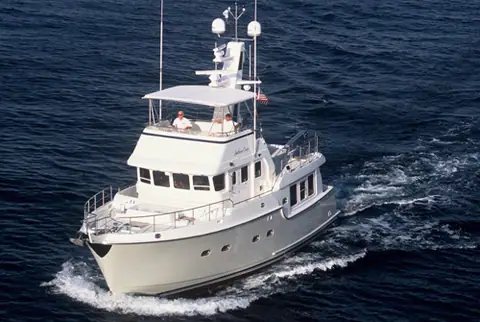
Nordhavn 47
Trawlers & Explorer Yachts, 48 ft
Used $520K to $900K
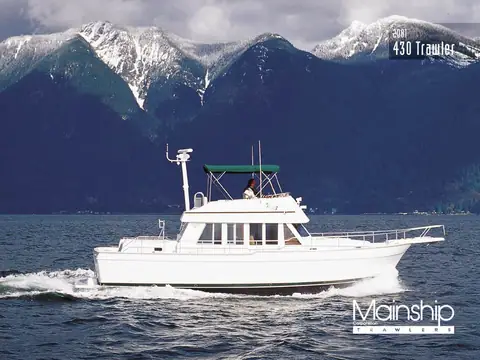
Mainship 430 Trawler
Trawlers & Explorer Yachts, 48 ft
Used $110K to $260K
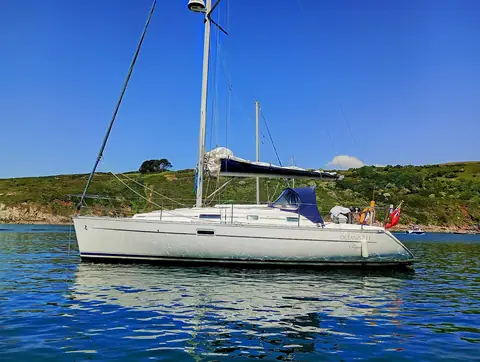
Beneteau Swift Trawler 44
Trawlers & Explorer Yachts, 46 ft
Used $250K to $440K
Helmsman Trawlers 43E Pilothouse
Trawlers & Explorer Yachts, 46 ft
Used $560K to $740K