Buying
Best Bluewater Sailboats for Ocean Crossings
Our shortlist of the best bluewater sailboats for ocean crossings, from $25,000 classics to million-dollar passagemakers, with the stability and motion ratios behind each pick and an honest look at refit costs.
On this page
- What earns a boat the bluewater label
- Reading the ratios without being fooled by them
- Proven classics under $100,000
- The sweet spot between $100,000 and $300,000
- Premium passagemakers that arrive nearly ready
- The multihull case, Outremer 51
- The refit math on an older bluewater boat
- Matching the boat to your actual plan
- FAQ
What earns a boat the bluewater label
Brokers use bluewater loosely, so start with what the ocean actually demands. A boat that crosses oceans has to survive the worst weather it is likely to meet, keep a tired crew of two safe and reasonably rested for weeks, carry enough water, fuel and spares to be self-sufficient, and be repairable far from a boatyard. Size helps with speed and comfort but is not a requirement; small boats have circumnavigated many times.
In practice the best bluewater sailboats share a set of traits: a strong hull-to-deck joint and well-supported chainplates, a protected rudder or very robust spade rudder, a keel structure that tolerates a grounding, a cockpit small enough to drain quickly, secure handholds throughout, sea berths with lee cloths, and a rig that can be reefed from the cockpit or a safe position on deck.
The CE design category A rating indicates a boat was designed for conditions beyond force 8 and significant wave heights above 4 meters, but it is a minimum, not a guarantee. Plenty of category A production coastal cruisers are poor choices for a trade wind circumnavigation because of motion, tankage or rudder design.
Reading the ratios without being fooled by them
Three numbers appear in every bluewater debate. The capsize screening formula (CSF), developed after the 1979 Fastnet race, divides beam by the cube root of displacement in cubic feet; a value below 2.0 is the traditional screening threshold for ocean boats. Ted Brewer's comfort ratio estimates how quickly a boat responds to waves; higher numbers mean slower, gentler motion, and values in the 30s and above are typical of offshore designs. The displacement to length ratio describes how heavy a boat is for its waterline; above roughly 300 is heavy, below 200 is light.
We calculated these from the specifications on our model pages. Treat them as a screen, not a verdict. They ignore hull shape, ballast placement, freeboard and the boat's condition, and a light modern boat with a low comfort ratio can be a safer ocean boat than a heavy classic with rotten chainplates.
| Boat | LOA | Displacement | Draft | CSF | Comfort ratio | Used price (est.) |
|---|---|---|---|---|---|---|
| Contessa 32 | 32 ft | 9,520 lb | 5.5 ft | 1.79 | 27.8 | $25,000 to $85,000 |
| Westsail 32 | 32 ft | 19,500 lb | 5.0 ft | 1.63 | 42.8 | $15,000 to $75,000 |
| Pacific Seacraft 34 | 34.1 ft | 13,500 lb | 4.9 ft | 1.68 | 34.0 | $65,000 to $220,000 |
| Cape Dory 36 | 36.1 ft | 16,100 lb | 5.0 ft | 1.69 | 35.7 | $35,000 to $95,000 |
| Tayana 37 | 36.7 ft | 22,500 lb | 5.7 ft | 1.63 | 41.1 | $30,000 to $110,000 |
| Pacific Seacraft 37 | 36.9 ft | 16,200 lb | 5.5 ft | 1.71 | 34.4 | $70,000 to $260,000 |
| Island Packet 380 | 39.6 ft | 21,000 lb | 4.6 ft | 1.91 | 30.6 | $125,000 to $215,000 |
| Passport 40 | 39.4 ft | 22,771 lb | 5.8 ft | 1.79 | 34.0 | $70,000 to $170,000 |
| Valiant 40 | 39.9 ft | 22,500 lb | 6.0 ft | 1.75 | 34.3 | $45,000 to $200,000 |
| Hallberg-Rassy 44 | 47.4 ft | 29,200 lb | 6.9 ft | 1.79 | 31.4 | $750,000 to $1,150,000 |
| Amel Super Maramu | 52.5 ft | 35,274 lb | 6.7 ft | 1.84 | 32.9 | $150,000 to $320,000 |
| Oyster 495 | 52.8 ft | 46,297 lb | 7.5 ft | 1.74 | 37.8 | $1,500,000 to $2,250,000 |
Proven classics under $100,000
This is where most first-time ocean sailors start, and where the best values hide. Every boat here is 35 to 55 years old, so the purchase price is the smaller part of the budget.
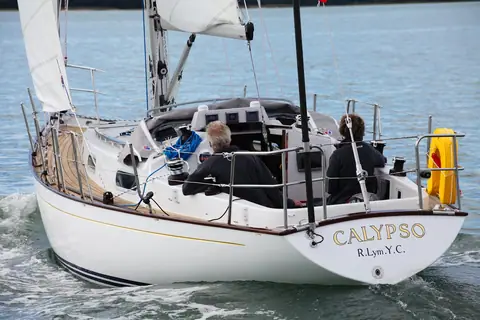
- Contessa 32. The only boat in its class to finish the 1979 Fastnet, when a storm killed 15 sailors, and still a reference point for small-boat seaworthiness. Narrow and wet by modern standards, with a lively motion its comfort ratio reflects, but extraordinarily stiff and forgiving.
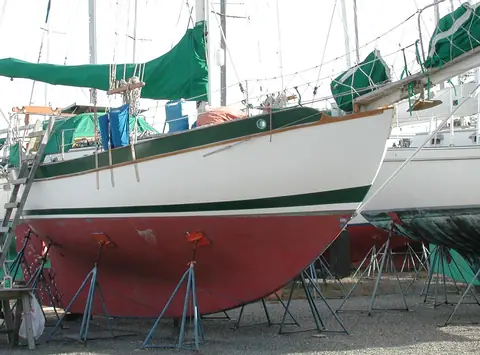
- Westsail 32. Heavy, slow and beloved. The full keel and outboard rudder track well under a wind vane, and the Westsail Satori famously came ashore essentially intact after being abandoned in the 1991 Perfect Storm. Expect to sail at 5 to 6 knots, and check the bowsprit, chainplates and deck core.
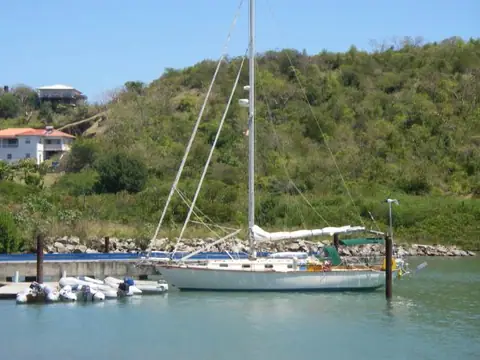
- Cape Dory 36. Carl Alberg's full-keel cutter is a gentle, conservative ocean boat with a high comfort ratio and a strong owner community. Interior volume is modest for a 36.
- Tayana 37. Robert Perry's double-ender has crossed every ocean in large numbers. Teak decks, iron or aging tanks and chainplates are the common refit items, and build quality varies by year.
- Tartan 37. Not a traditional heavy cruiser, but a strong Sparkman and Stephens design that many owners have taken offshore. A good choice if you want a better sailing boat and plan to beef up systems.
The sweet spot between $100,000 and $300,000
In this range you can buy a pedigreed bluewater boat that has already been refit, often with self-steering, solar and a recent rig. For many couples this is the smartest money in the bluewater market.
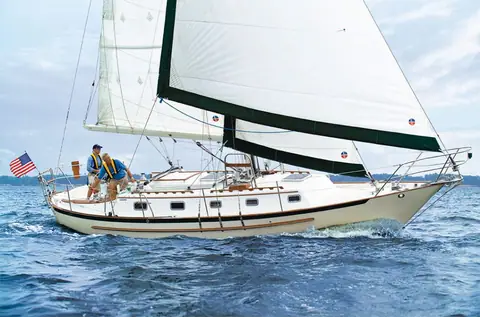
The Pacific Seacraft 34 and 37 are perhaps the most respected American offshore designs of their size. Bill Crealock's canoe sterns, skeg-hung rudders and solid construction give them balanced, predictable manners, and the 37 carries an angle of vanishing stability around 140 degrees. The 34 is one of the few genuinely ocean-capable boats a couple can handle and afford at that length.
The Valiant 40 is credited with launching the performance cruiser idea in the 1970s, a fin keel and skeg-hung rudder under a cruising hull. It sails noticeably better than full-keel rivals. Hulls 120 to 249 are associated with a well-documented blistering problem linked to fire-retardant resin, so match the hull number to the repair history before you go further.
The Passport 40, another Perry design built in Taiwan, offers similar performance with exceptional joinery. The Island Packet 380 trades some upwind ability for shoal draft, a cutter rig with a self-tacking staysail and a roomy interior, and its 1.91 CSF is the highest on our list, reflecting its generous beam. The Amel Super Maramu deserves special mention: a 52 foot ketch designed as a complete cruising system with electric furling, a protected center cockpit and watertight bulkheads, now often available in this price bracket at 20 to 35 years old.
The multihull case, Outremer 51
Monohull purists will note that the capsize screening formula does not apply to catamarans, and that a cat that capsizes stays upside down. That risk is real but rare in well-sailed performance cats, and the advantages for ocean couples are compelling: no heeling, faster passages, and a lot of living space.
The Outremer 51 is the cat most often recommended for serious ocean cruising. It is light for its length (about 24,250 pounds), uses daggerboards for upwind performance and shallow access, and can sustain 200 mile days in the trades. Its strong resale value reflects demand from circumnavigating couples. Read our best liveaboard catamarans guide for more multihull options.
The refit math on an older bluewater boat
The cheapest bluewater boat is rarely the cheapest way to go cruising. A $40,000 Westsail with original rigging, tanks and electrics can absorb $50,000 or more before it is ready for an ocean, while a $150,000 Pacific Seacraft that has already been refit may need little. The table shows typical refit items on a 32 to 40 foot boat, as rough 2026 estimates including professional labor.
| Item | When it is due | Rough cost on a 32 to 40 ft boat (estimate) |
|---|---|---|
| Standing rigging | Every 10 to 15 years, or immediately if unknown | $8,000 to $20,000 |
| Chainplates | Often original on boats from the 1970s and 1980s | $3,000 to $12,000 |
| Sails (main and headsail) | When stretched or UV damaged | $10,000 to $25,000 |
| Engine repower | Original engine with high hours or poor history | $20,000 to $45,000 |
| Wind vane self-steering | Essential for short-handed crossings | $5,000 to $10,000 |
| Electronics, AIS, satellite communication | Almost always | $5,000 to $15,000 |
| Tanks | Black iron or aluminum tanks of uncertain age | $3,000 to $15,000 |
| Liferaft, EPIRB, safety gear | Before any offshore passage | $5,000 to $12,000 |
Matching the boat to your actual plan
Most people buying bluewater sailboats never cross an ocean. They cruise the East Coast, the Bahamas and the Caribbean with the confidence that the boat can handle a gale. That is a perfectly good reason to own one, but it changes the trade-offs. A deep draft of 6.5 to 7.5 feet, like the Hallberg-Rassy 44 or Oyster 495, is no problem in the Pacific and a real restriction in the Bahamas and on the Intracoastal Waterway, where a 4.5 to 5 foot draft is far more useful.
Think about crew, too. Heavy full-keel boats like the Westsail and Tayana are forgiving but slow in light air, and many trade wind passages are light. A couple who will sail mostly downwind in the trades may be happier with a moderate-displacement fin-and-skeg boat such as the Valiant 40 or Pacific Seacraft 37 that keeps moving in 10 knots of wind.
- Trade wind circumnavigation for two: Pacific Seacraft 37, Valiant 40, Amel Super Maramu, Outremer 51
- High-latitude or heavy-weather sailing: Contessa 32, Hallberg-Rassy 44, Cape Dory 36
- East Coast and Bahamas with occasional offshore passages: Island Packet 380, Pacific Seacraft 34
- Single-handers: Bristol Channel Cutter, Pacific Seacraft 34, Contessa 32
Models mentioned in this guide
Contessa 32
Bluewater Sailboats, 32 ft
Used $25K to $85K
Westsail 32
Bluewater Sailboats, 32 ft
Used $15K to $75K
Cape Dory 36
Bluewater Sailboats, 36 ft
Used $35K to $95K

Tayana 37
Bluewater Sailboats, 37 ft
Used $30K to $110K

Pacific Seacraft 34
Bluewater Sailboats, 34 ft
Used $65K to $220K
Pacific Seacraft 37
Bluewater Sailboats, 37 ft
Used $70K to $260K
Frequently asked questions
What is the best bluewater sailboat for a couple?
For most couples the Pacific Seacraft 37, Valiant 40 and Amel Super Maramu offer the best balance of seaworthiness, handling and price, with the Hallberg-Rassy 44 the premium choice.
What is the smallest sailboat that can cross an ocean?
Very small boats have crossed oceans, but for comfort and safety most experienced sailors suggest 30 to 40 feet. Proven small choices include the Contessa 32, Westsail 32 and Bristol Channel Cutter.
What is the best bluewater sailboat under $100,000?
The Westsail 32, Contessa 32, Cape Dory 36 and Tayana 37 are proven choices, but budget for a significant refit because most examples are 35 to 55 years old.
What is a good capsize screening formula value?
A CSF below 2.0 is the traditional screening threshold for offshore boats. It is a rough indicator only and ignores hull shape, ballast placement and condition.
Is a full keel better for bluewater sailing?
Not necessarily. Full keels track well and protect the rudder, but modern fin-and-skeg designs such as the Valiant 40 sail faster and many have long ocean records.
Can a catamaran be a bluewater boat?
Yes. Performance cruising cats such as the Outremer 51 cross oceans routinely, trading the self-righting ability of a monohull for speed, comfort and living space.
Keep reading
Types of Sailboats and Rigs Explained
A buyer-focused guide to the types of sailboats, sorted four ways: by rig, by keel, by hull and by purpose, with real models…
BuyingBest Liveaboard Catamarans
Our picks for the best liveaboard catamarans on the US market, judged on tankage, storage, payload, draft and air draft rather…
BuyingHow to Buy a Used Yacht, Step by Step
A step-by-step walkthrough of buying a used yacht in the US, from setting a real budget to closing, documentation and the first…
BuyingMarine Surveys Explained, What a Surveyor Checks
What happens during a pre-purchase marine survey, what it costs, how to choose a surveyor, and how to turn the report into a…
BuyingCatamaran vs Monohull, Which Should You Buy?
An honest comparison of cruising catamarans and monohull sailboats for US buyers, covering comfort, safety, sailing ability…
KnowledgeBoat Hull Types Explained, Displacement, Planing and More
How the shape of a hull decides a boat's speed, ride, fuel burn and stability. Covers displacement, semi-displacement and…