Valiant Yachts Bluewater Sailboats
Valiant 40 Sailboat Guide by Hull Number, Specs and Price
The 1973 Bob Perry double-ender that invented the performance cruiser, and the one boat where the hull number matters more than the year.
- Length
- 39.9 ft12.17 m
- Beam
- 12.3 ft3.76 m
- Draft
- 6 ft1.83 m
- Cabins
- 2
- Used price
- $45K to $200K
On this page
- Overview
- Nathan Rothman's brief and the first performance cruiser
- Fin keel and skeg on a 34 foot waterline
- Read the hull number before anything else
- The ocean miles behind the reputation
- 160-mile days, and a weakness in steep chop
- Two interiors, and the one offshore sailors prefer
- Systems that age out on a 35 to 50 year old Valiant
- From Valiant 40 to Valiant 42
- Specifications
- Price and value
- Strengths and weaknesses
- Used buyer checklist
- Rivals
- Our verdict
- FAQ
A 40-foot fin keel, skeg rudder cutter built from 1973 to 1992, exactly 200 hulls numbered 101 to 300. Fast, proven offshore, and split into clear price tiers by its blister history.
- Couples planning ocean crossings
- Solo and short-handed offshore sailors
- Buyers wanting a cruiser that sails well
- Experienced sailors comfortable doing their homework on hull history
Valiant 40 by the numbers
- Sail area to displacement
- 15.5A cruising rig sized for comfort, so expect to motor in very light air.
- Displacement to length
- 256Moderate displacement, a classic cruising balance between load carrying and speed.
- Theoretical hull speed
- 7.8 knThe practical top speed of a displacement monohull under normal sailing, based on waterline length.
- Ballast ratio
- 34%A typical ballast ratio for a cruising monohull.
- Capsize screening
- 1.75Below 2.0, the traditional threshold for offshore suitability.
- Motion comfort ratio
- 34.3Moderate motion comfort, typical of modern cruisers.
- Length to beam ratio
- 3.24 : 1Moderate proportions.
Nathan Rothman's brief and the first performance cruiser
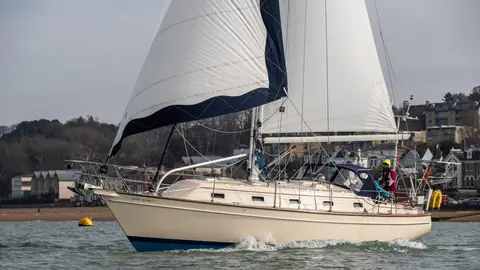
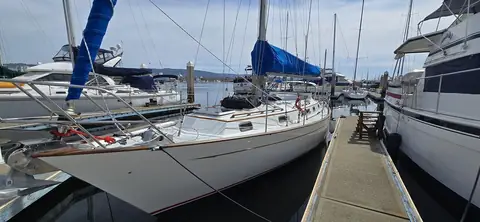
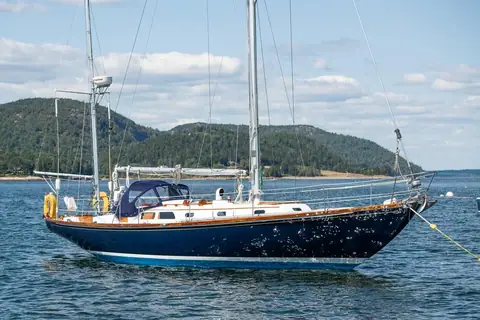
In 1972 Nathan Rothman asked a young Bob Perry to draw the ultimate cruising yacht. The Valiant 40 that resulted looked like a beamy, double-ended traditional cutter above the water, but underneath it had a fin keel and a separate rudder on a skeg, which no serious offshore cruising monohull had done before. The first hull was launched in 1973, built under contract by Uniflite in Bellingham, Washington.
That combination is why the Valiant 40 is credited with creating the performance cruiser category. It was named a cruising sailboat of the decade and inducted into the American Sailboat Hall of Fame in 1997. Perry kept refining the boat, with three keel versions developed with Dave Vacanti, and later boats are a little stiffer and faster than the early ones.
Fin keel and skeg on a 34 foot waterline
The boat measures 39 feet 11 inches overall on a 34 foot waterline, with 12 feet 4 inches of beam. Displacement is 22,500 pounds with 7,700 pounds of external lead, a displacement to length ratio of about 255, far lighter than the Westsail and Tayana generation. Sail area is about 772 square feet, a sail area to displacement ratio a little over 15, and hull speed is close to 7.8 knots.
The capsize screening number is about 1.75 and the comfort ratio about 34. The external lead is bolted with stainless steel. The skeg is a steel weldment inside a foam-filled fiberglass shell, and the 1.75 inch stainless rudder post runs in three bearings. Standard draft is 6 feet, with shoal versions available.
Read the hull number before anything else
No other boat in this class has its value so clearly tied to a production range. In 1976 the builder began using a fire-retardant resin sold as Hetron, originally developed to military specifications. Research later pointed to a reaction between the sizing on the glass strands and the fire-retardant resin. The result was severe non-osmotic blistering, some blisters as large as 10 inches across, on the hull, deck and cabin house of boats built between 1976 and 1981.
Lawsuits followed, and the episode helped push production to Texas. Rich Worstell, a successful Valiant dealer, bought the company in 1984 and moved the operation to Lake Texoma, switching to 100 percent isophthalic resin and matching gelcoat, about 21 mils of epoxy barrier coat below the waterline and Imron paint on the topsides.
- Hulls 101 to 119 (1973 to 1975): pre-Hetron boats, generally sound
- Hulls 120 to 249 (1976 to 1981): fire-retardant resin, blister history
- Hulls 250 to 266 (1981 to 1984): non fire-retardant resin, no blister issue
- Hulls 267 to 300 (1985 to 1992): Texas-built, isophthalic resin and epoxy barrier coat
The ocean miles behind the reputation
The Valiant 40 earned its name the hard way. Hull 107, Foreign Affair, took Bill and Mary Black around the world between 1975 and 1979. Francis Stokes sailed hull 122, Mooneshine, in the 1976 OSTAR to become the first American monohull finisher, and repeated the feat in 1980. Dan Byrne completed the 1982 to 1983 BOC Challenge in hull 101, Fantasy, and Mark Schrader sailed a Valiant 40 solo around the world in 1983.
Schrader later wrote that in over 30,000 miles of singlehanded sailing he never had to worry about the integrity of his boat. Patrick Childress, a devoted Valiant 40 owner and longtime Practical Sailor contributor, circumnavigated with his wife Rebecca and taught a generation of cruisers practical seamanship. Few production boats can point to that kind of record.
160-mile days, and a weakness in steep chop
On passage the Valiant 40 is quick for a cruiser. Cruising World reported consistent 165 mile days without demanding much from the crew, with typical speeds of 6.5 to 7.5 knots in a breeze. John Kretschmer has logged consecutive 160 mile days on a beam reach and praised its balanced helm in gales.
Its weak point is a steep, short chop to windward, where the beamy double-ended hull can pound and slow down. On reaches and broad reaches in heavy air it is powerful. The cutter rig puts the mast well aft, leaving a manageable mainsail of about 306 square feet and a large foretriangle. The staysail can be set or struck quickly, so the boat sails as either a sloop or a cutter.
Under power the easily driven hull makes about 6 knots at 2,400 rpm in flat water with the Volvo 2003 Turbo Practical Sailor tested, and fuel is 90 gallons in a single aluminum tank or 110 gallons in twin saddle tanks on boats with the generator option, and it handles well in tight quarters for a long-keel-era cruiser.
Two interiors, and the one offshore sailors prefer
Most boats have the traditional layout: V-berths forward, head to port, settees on both sides of the saloon with optional pilot berths, a drop-leaf dinette, a U-shaped galley aft to port with a four-burner stove, a large chart table to starboard and a double stateroom aft. Headroom is about 6 feet 2 inches throughout and the hull is lined with half-inch closed-cell foam above the waterline.
The alternative layout moves a quarter berth beside the companionway, puts the head where it is easier to reach from the cockpit, and turns the forepeak into a sail locker. For offshore sailing it is the better boat: the off-watch sleeps near the cockpit where motion is least, and wet gear stays out of the saloon. Finishes were oiled teak or white Formica with teak trim.
Systems that age out on a 35 to 50 year old Valiant
Even good hulls need attention to equipment. Aluminum water and fuel tanks aged poorly on early boats and many have been replaced. Early chainplates were undersized, and the subdeck around them can delaminate where water got in. Some boats were ordered with optional rod rigging, which needs inspection by a rigger who knows rod terminals.
Practical Sailor criticized the bronze seacocks threaded directly onto through-hulls, the small standard bilge pump, a PVC chain pipe that jams, staysail winches that block a dodger, and a mast-base reefing setup that sends crew forward. Engines over the years came from Westerbeke, Perkins and Volvo, including a 42 hp Volvo turbo on some later boats. A naturally aspirated four-cylinder of about 100 cubic inches is the preferred repower.
From Valiant 40 to Valiant 42
Worstell's Texas boats were semi-custom, with buyers invited to the factory several times during the build. In 1992 the 40 gave way to the Valiant 42, with a new deck, new keel and more ballast, and three interior choices. The 42 stayed in production until the company closed in 2011.
If your budget reaches a late Valiant 42, it is the more refined boat. If it does not, a well-documented Texas-built 40 delivers most of the same sailing and almost all of the reputation for less money.
Valiant 40 specifications
| Length overall | 39.9 ft12.17 m |
|---|---|
| Waterline length | 34 ft10.36 m |
| Beam | 12.3 ft3.76 m |
| Draft | 6 ft1.83 m |
| Displacement | 22,5 lbs10,206 kg |
| Ballast | 7,7 lbs3,493 kg |
| Sail area | 772 sq ft71.7 m² |
| Fuel capacity | 95 gal36 L |
| Fresh water | 12 gal454 L |
| Cabins | 2 |
| Berths | 6 |
| Heads | 1 |
| Standard engines | Diesel of about 40 hp (Westerbeke, Perkins or Volvo over the production run) |
| Optional engines | Volvo 2003 Turbo 42 hp on some late boats; Northern Lights 5 kW generator optional |
| Cruise speed | 6 knots |
| Hull type | Moderate displacement double-ender with fin keel and skeg-hung rudder |
| Keel | External lead fin keel, standard about 6 ft or shoal draft; revised three times during production |
| Rig | Masthead cutter, mast stepped well aft |
| Hull construction | Solid fiberglass hull, balsa-cored deck; isophthalic resin with epoxy barrier coat on Texas-built boats |
| Builder | Valiant Yachts (built by Uniflite in Bellingham, Washington, then in Texas from 1984), United States |
| Naval architect | Robert H. Perry |
| Other design credits | Dave Vacanti (later keel revisions with Perry) |
| Production | 1973 to 1992 |
| Status | Discontinued |
Figures come from builder documentation and independent tests where available. Displacement is usually quoted light, so a loaded cruising boat will weigh more. Compare these specs with another model.
How much does a Valiant 40 cost?
Hull number is the first price driver. Boats in the 120 to 249 range, built with fire-retardant resin, trade at the bottom unless they have documented, professional blister repairs, with recent asks between $45,000 and $85,000. Hulls 250 to 266 and the Texas-built 267 to 300 command the premium, with late boats asking $135,000 to $200,000 depending on rig, engine and electronics.
Estimate your yearly cost
A planning estimate using common rules of thumb: insurance near 1.5 percent of value, maintenance near 3 percent, haul out and bottom paint by length. Your marina, region and use will move these numbers. Open the full cost calculator.
Versions and options
- Deep fin keel
- About 6 feet of draft, the best pointing and the most stability, revised during production to pack more weight lower.
- Shoal draft keel
- Shallower for the Bahamas and East Coast cruising, at a cost in windward performance.
- Centerboard boats
- At least three Valiant 40s were built with centerboards.
Valiant 40 timeline
- 1973First Valiant 40, hull 101, built by Uniflite in Bellingham, Washington
- 1976Fire-retardant resin introduced, leading to blistering on hulls 120 to 249
- 1976Francis Stokes takes Mooneshine to first American monohull in the OSTAR, and repeats it in 1980
- 1983Mark Schrader completes a solo circumnavigation in a Valiant 40
- 1984Rich Worstell buys Valiant and moves production to Texas with isophthalic resin
- 1992Valiant 40 production ends at hull 300 as the Valiant 42 arrives
- 1997Inducted into the American Sailboat Hall of Fame
Strengths and weaknesses
What owners like
- Fast passagemaker, with 160 mile days routine for a capable crew
- Fin keel and skeg rudder track well yet maneuver better than full keels
- Proven ocean record including multiple solo circumnavigations
- Sea-friendly cutter rig with a small, manageable main
- Texas-built boats are solidly constructed with epoxy barrier coats
What to weigh up
- Hulls 120 to 249 carry a blister history that hurts value
- Can pound to windward in steep chop
- Tight cockpit, typical of a double-ender
- Early aluminum tanks and chainplates need replacement
- Late boats are expensive for a design from 1973
Used Valiant 40 buyer checklist
Take this list to a viewing. Your ticks are saved in this browser so you can come back to it.
Always commission an independent marine survey and an engine survey before you buy. How a marine survey works.
Rivals to consider
Tayana 37
Another Perry double-ender with a long keel, cheaper and more plentiful but slower and heavier to maintain.
Compare side by sidePacific Seacraft 37
Smaller, with a higher stability range and stronger resale but less speed and interior space.
Compare side by sidePassport 40
Perry-designed Taiwanese cutter with a transom stern and more interior volume, a natural cross-shop.
Compare side by sideCabo Rico 38
Costa Rican-built Crealock cutter with a heavier, more traditional feel and fine joinery.
Compare side by sideOur verdict on the Valiant 40
The Valiant 40 is still one of the best ocean boats you can buy around the $100,000 to $200,000 mark, as long as you shop by hull number. A Texas-built boat or one from hulls 250 to 266 is the safe choice. A blister-era boat with a properly documented repair is a value play for an informed buyer. Either way you are buying the design that taught the industry a cruising boat could also sail well.
Valiant 40 questions answered
Which Valiant 40 hull numbers have blister problems?
Hulls 120 to 249, built from 1976 to 1981 with fire-retardant resin. Hulls 250 and up do not share the problem.
How much is a Valiant 40 sailboat for sale?
Expect asks from about $45,000 for an unrepaired blister-era boat to $200,000 for a well-equipped Texas-built hull.
Who designed the Valiant 40?
Robert Perry designed it in 1972 and 1973 for Nathan Rothman, and it was built from 1973 to 1992.
How many Valiant 40s were built?
Exactly 200, numbered 101 to 300.
How fast is a Valiant 40?
Hull speed is about 7.8 knots and owners report 160 to 165 mile days on passage.