Shannon Yachts Bluewater Sailboats
Shannon 47/52 Review, Specs and Buying Guide
A semi-custom Bristol, Rhode Island voyager whose name tells you its two lengths: 47 ft 6 in on deck and 52 ft 7 in overall.

- Length
- 52.6 ft16.03 m
- Beam
- 14.3 ft4.34 m
- Draft
- 6.5 ft1.98 m
- Cabins
- 2 to 3, owner specified (typically owner's cabin forward and a guest cabin aft)
- Used price
- $325K to $650K
On this page
- Overview
- What the 47/52 in the name actually means
- A medium displacement hull, with or without a centerboard
- The Scutter rig and how the boat sails
- A liferaft in the transom and a cockpit you can sleep in
- No liner, no modules: interiors drawn for each owner
- Systems built for long-range independence
- The 52 RDP connection and buying on today's market
- Specifications
- Price and value
- Strengths and weaknesses
- Used buyer checklist
- Rivals
- Our verdict
- FAQ
The Shannon 47/52 is Walt Schulz's medium displacement offshore cruiser, introduced around 1999 to 2000 and built to order in Bristol, Rhode Island. It offered a keel or centerboard hull, cutter, ketch or Scutter rigs and a custom interior.
- Couples planning long-term liveaboard voyaging
- Owners who want shoal draft and offshore capability
- Experienced sailors who value custom joinery
- Buyers stepping up from an older Shannon
Shannon 47/52 by the numbers
- Sail area to displacement
- 15.6A cruising rig sized for comfort, so expect to motor in very light air.
- Displacement to length
- 205Moderate displacement, a classic cruising balance between load carrying and speed.
- Theoretical hull speed
- 8.7 knThe practical top speed of a displacement monohull under normal sailing, based on waterline length.
- Ballast ratio
- 38%A typical ballast ratio for a cruising monohull.
- Capsize screening
- 1.73Below 2.0, the traditional threshold for offshore suitability.
- Motion comfort ratio
- 35.0Moderate motion comfort, typical of modern cruisers.
- Length to beam ratio
- 3.69 : 1A slim, easily driven hull.
What the 47/52 in the name actually means
Shannon Yachts sold this boat as the Shannon 47 and later as the Shannon 47/52, and the two numbers are simply its lengths. The factory specification lists 47 ft 6 in on deck and 52 ft 7 in overall once the bow platform is counted. That matters when you compare it with other boats, because a 47/52 is a true 47 footer in hull volume with a 42 ft 7 in waterline and 14 ft 3 in of beam, priced and berthed like a boat over 50 feet.
Walter Schulz founded Shannon in Bristol, Rhode Island in 1975 and designed and built every boat himself. Blue Water Sailing reviewed hull No. 1 in January 2000 and called the 47 the newest and perhaps most technically complete member of the fleet, which places its debut around 1999 to 2000. The company says it built about 500 yachts in total, each semi-custom, before transitioning to marine technology development. It no longer builds boats but still runs a brokerage.
A medium displacement hull, with or without a centerboard
Schulz drew the 47/52 as a medium displacement voyager rather than a rating-rule boat. The specification lists 35,500 lb displacement and 13,500 lb of internal lead, a 38 percent ballast ratio, a displacement to length ratio of 202 and a sail area to displacement ratio of 17.8. Blue Water Sailing compared those figures with boats like the Swan 411 and Whitby 45 Mk II and praised a full, deep-sectioned underbody that tracks well and absorbs payload low without the drag of a traditional full keel.
The long, low-aspect molded keel carries its lead internally, cast in four pieces and glassed over to form a second bottom, so there are no keel bolts. It ends in a bustle and a hefty skeg that supports the rudder and protects the propeller. Buyers chose a fixed keel drawing 6 ft 6 in or a keel centerboard version drawing 5 ft 7 in board up and 9 ft 7 in down. Shannon said that 90 percent of its owners chose the centerboard and that it had seen no board failures compromising structural integrity. The board also lets the helmsman tune helm balance, as Blue Water Sailing found when it dropped the board fully to claw upwind.
The Scutter rig and how the boat sails
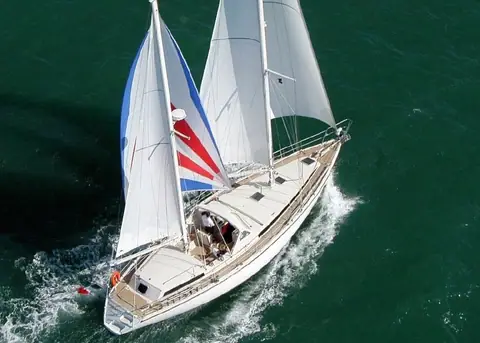
Rig choice was part of the order. Options were a cutter (1,050 sq ft), a classic double headsail ketch (1,127 sq ft), a Shannon ketch (1,173 sq ft) or Schulz's own Scutter (1,200 sq ft). Introduced in 1994, the Scutter carries two furling headsails: a high-clewed yankee on the end of the sprit and a 140 percent genoa on a stay about four feet aft at the stemhead. You sail on the genoa in light and moderate air, then furl it completely and unroll the yankee as the wind builds, moving the center of effort forward and keeping the bow powered. A detachable fractional inner forestay is available for a storm jib.
Blue Water Sailing tested a Scutter-rigged centerboard boat on Narragansett Bay in about 20 knots gusting into the high 20s. After switching from a reefed genoa to the yankee, the boat hit high eights upwind, then accelerated into the nines and 10s on a reach. The tester noted that the broad, skeg-hung rudder steered almost as smoothly as a balanced spade, a good sign for autopilot loads at sea.
A liferaft in the transom and a cockpit you can sleep in
The most distinctive feature is the reverse sheer transom, which Schulz designed around safety rather than style. It houses the liferaft canister in a locking well so the raft deploys through doors in the transom without lifting, and the same doors drop a swim ladder for boarding, swimming or recovering someone from the water.
The cockpit has 6 ft 7 in seats, long enough to lie on, with a deep sail locker to port that also gives access to the back of the engine, stuffing box and steering. Nine scuppers drain it, and a full-length emergency tiller fits directly on the rudder post. Shrouds and genoa tracks sit outboard at the teak toerail for clear side decks, and the molded diamond non-skid is a Shannon signature. The bow platform carries two large anchors on separate rodes into a divided chain locker, and the bobstay fitting is strong enough to moor from. Ventilation comes from four Dorade vents, twelve opening ports and four to seven deck hatches positioned to suit each interior.
No liner, no modules: interiors drawn for each owner
Because Shannon used no hull liner or molded pan, every 47/52 interior is different. Common choices included an owner's cabin forward with a centerline queen berth and a private head with stall shower, one or two guest cabins aft, a dedicated nav station and a big saloon with U-shaped dinette. Hull No. 1 had owner's quarters forward, a U-shaped galley, a starboard aft guest cabin with a second head and washer-dryer, and a port aft nav office with a pilot berth.
Joinery is built on transverse mahogany floors over full-length stringers, with bulkheads tabbed in epoxy and furniture assembled with mortise and tenon joints. Finishes were upscale: varnished cherry or teak, birdseye maple accents, solid teak and holly soles and chrome-plated brass hardware. When you view a used boat, judge the layout against how you will actually live, because changing a custom interior is expensive.
Systems built for long-range independence
Tankage varies by layout, but the factory describes a typical 47 with 130 gallons of fuel in two tanks, 230 gallons of water in three, and 50 gallons of waste. The sailaway package quoted 150 gallons of fuel and 250 of water. Standard power is an 82 hp Westerbeke W-82 with a high-output alternator, external regulator and gel-cell batteries.
Hull No. 1 shows what owners specified: three removable 316L stainless water tanks, a 170 gallon per day Sea Recovery watermaker, a 7.6 kW Westerbeke generator, zoned heating and air conditioning, Sea Frost refrigeration and twin aluminum fuel tanks. Blue Water Sailing praised how cleanly and accessibly it all fitted. On a used boat, that complexity means a long systems survey and a realistic budget for aging generators, watermakers and air conditioning.
Shannon 47/52 specifications
| Length overall | 52.6 ft16.03 m |
|---|---|
| Waterline length | 42.6 ft12.98 m |
| Beam | 14.3 ft4.34 m |
| Draft | 6.5 ft1.98 m |
| Air draft | 64 ft19.51 m |
| Displacement | 35,5 lbs16,1 kg |
| Ballast | 13,5 lbs6,124 kg |
| Sail area | 1,05 sq ft97.5 m² |
| Fuel capacity | 13 gal492 L |
| Fresh water | 23 gal87 L |
| Cabins | 2 to 3, owner specified (typically owner's cabin forward and a guest cabin aft) |
| Berths | Up to 9 depending on layout |
| Heads | 1 or 2, owner specified, often with a separate stall shower |
| Standard engines | Westerbeke W-82 diesel (82 hp) |
| Maximum power | 82 hp |
| Hull type | Medium displacement aft cockpit monohull with reverse transom |
| Keel | Long low-aspect molded keel with internal lead, fixed at 6 ft 6 in or keel centerboard drawing 5 ft 7 in up and 9 ft 7 in down; skeg-hung rudder |
| Rig | Owner's choice of cutter, ketch, double headsail ketch or Shannon Scutter (twin headstays) |
| Hull construction | Hand-laid one-piece fiberglass hull with Corecell PVC foam core in the topsides, solid bottom, vinylester outer laminate, internal lead ballast |
| Builder | Shannon Yachts (Schulz Boat Company), USA |
| Naval architect | Walter Schulz |
| Production | 1999 to present |
| Status | Discontinued |
Figures come from builder documentation and independent tests where available. Displacement is usually quoted light, so a loaded cruising boat will weigh more. Compare these specs with another model.
How much does a Shannon 47/52 cost?
Shannon's own specification page, still online in 2008, quoted a sailaway price of $853,000 with a custom interior, sails, electronics, an 82 hp engine and a 200 amp alternator. Because every Shannon 47/52 was built to an owner's specification and production was small, comparable sales are scarce and each boat must be valued on its equipment, refit history and rig choice. Shannon points to long ownership periods and strong resale for the brand, and well-kept boats with recent systems work sit at the top of the range.
Estimate your yearly cost
A planning estimate using common rules of thumb: insurance near 1.5 percent of value, maintenance near 3 percent, haul out and bottom paint by length. Your marina, region and use will move these numbers. Open the full cost calculator.
Versions and options
- Fixed keel
- 6 ft 6 in draft with internal lead and no keel bolts.
- Keel centerboard
- 5 ft 7 in board up, 9 ft 7 in board down; chosen by about 90 percent of Shannon owners.
- Scutter rig
- Schulz's twin-headstay rig of 1,200 sq ft with a furling genoa and a furling yankee.
- Ketch rigs
- Shannon ketch at 1,173 sq ft or double headsail ketch at 1,127 sq ft, with a 193 sq ft mizzen.
- Shannon 52 RDP
- A raised deck pilot center cockpit derivative built on the 47/52 hull.
Shannon 47/52 timeline
- 1975Walter Schulz founds Shannon Yachts in Bristol, Rhode Island
- 1994Schulz develops the Scutter twin-headstay rig
- 2000Blue Water Sailing tests Shannon 47 hull No. 1 and praises its systems and sailing
- 2008The Shannon 47/52 is listed with a sailaway price of $853,000
- 2010Shannon 52 RDP, based on the 47/52 hull, sea trialed in Bristol
Strengths and weaknesses
What owners like
- Semi-custom interiors built around each owner
- Internal lead ballast with no keel bolts
- Centerboard option gives shoal draft and helm tuning
- Liferaft well and boarding doors in the transom
- Large tankage and long-range systems
- Long, comfortable cockpit with excellent drainage
What to weigh up
- Very few boats on the market
- Custom layouts make comparisons and valuations difficult
- Complex systems are costly to maintain
- Long overall length raises marina costs
- Builder no longer produces new boats
Used Shannon 47/52 buyer checklist
Take this list to a viewing. Your ticks are saved in this browser so you can come back to it.
Always commission an independent marine survey and an engine survey before you buy. How a marine survey works.
Rivals to consider
Island Packet 45
A full-keel production cruiser with more standardized layouts and many more boats on the market.
Compare side by sideAmel 54
A French ketch with a fully enclosed doghouse and Amel's systems philosophy, at a similar price level.
Compare side by sideHallberg-Rassy 44
A newer Swedish center cockpit cruiser with factory consistency rather than custom layouts.
Compare side by sideOyster 495
A larger, more luxurious deck saloon cruiser with hydraulic sail handling.
Compare side by sideOur verdict on the Shannon 47/52
The Shannon 47/52 is the most evolved boat Walt Schulz built: a medium displacement voyager with clever answers to real offshore problems, from the transom liferaft well to the Scutter rig and the shoal-draft centerboard. Every boat is different, so you buy a specific yacht rather than a model, and the complex systems need careful survey. Find one whose layout suits you and whose equipment has been maintained, and you get an American-built bluewater cruiser with a quality and practicality few production boats match.
Shannon 47/52 questions answered
What does Shannon 47/52 mean?
The numbers are its lengths: 47 ft 6 in on deck and 52 ft 7 in overall including the bow platform.
How much does a Shannon 47/52 cost?
Used boats are likely to fall in roughly the $325,000 to $650,000 range in 2026 depending on equipment and refits. The factory listed a sailaway price of $853,000 around 2008.
Does the Shannon 47/52 have a centerboard?
It was offered with a fixed keel drawing 6 ft 6 in or a keel centerboard drawing 5 ft 7 in up and 9 ft 7 in down. Most Shannon owners chose the centerboard.
Who designed the Shannon 47/52?
Walter Schulz, founder of Shannon Yachts, designed and built it in Bristol, Rhode Island.
What is a Scutter rig?
It is Shannon's twin-headstay rig with a furling genoa on an inner stay and a furling yankee on the sprit, letting you switch headsails rather than reef a large genoa.
Is Shannon still building boats?
No. Shannon says it has shifted to marine technology development, though it still offers brokerage for Shannon yachts.