Pacific Seacraft Bluewater Sailboats
Pacific Seacraft 37 Review, Specs and Used Buying Guide
Bill Crealock's canoe-stern voyager, built in California and North Carolina since 1980 and still the benchmark for a two-person offshore 37.
- Length
- 36.9 ft11.25 m
- Beam
- 10.8 ft3.3 m
- Draft
- 5.5 ft1.68 m
- Cabins
- 2
- Used price
- $70K to $260K
On this page
- Overview
- The Crealock 37 began as a boat nobody would build
- A canoe stern drawn for running, not for looks
- Sloop, cutter or yawl, and why most buyers want the cutter
- Below decks, a two-person boat with a seventh berth on paper
- Passage numbers owners actually log
- Construction changes by year, and which ones matter
- Engine room access is the hidden selling point
- What a Pacific Seacraft 37 costs to buy and keep
- Specifications
- Price and value
- Strengths and weaknesses
- Used buyer checklist
- Rivals
- Our verdict
- FAQ
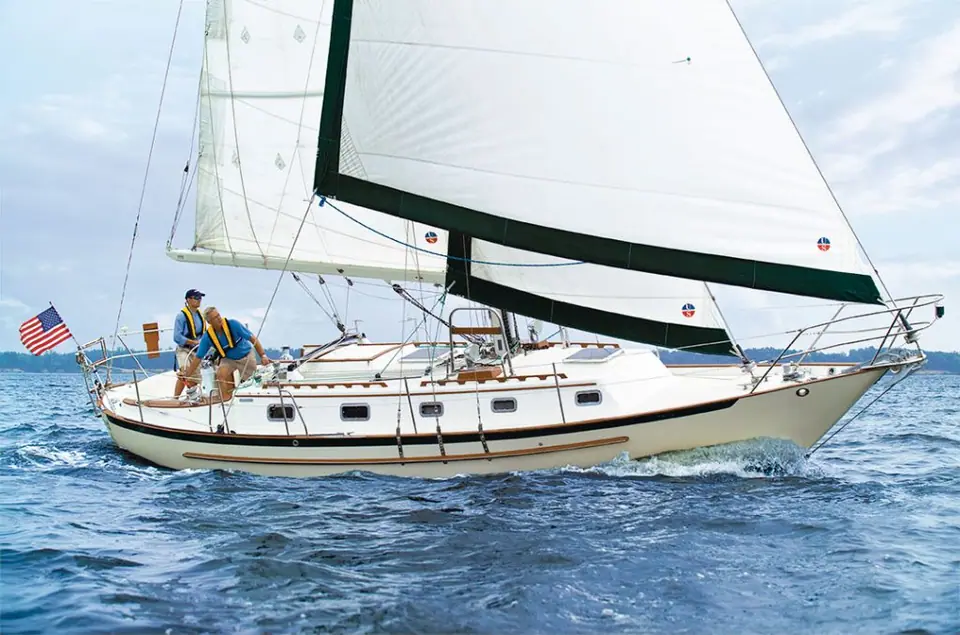
A 37-foot canoe-stern bluewater cruiser designed by W.I.B. Crealock, built since 1980 by Pacific Seacraft as a sloop, cutter or yawl, with a 140 degree stability range and strong resale values.
- Couples planning ocean passages
- Sailors who value motion comfort over cabin volume
- Buyers who want a boat that holds its value
- High-latitude cruising with insulated hulls
The Crealock 37 began as a boat nobody would build
The Pacific Seacraft 37 started life on the drawing board of W.I.B. Crealock, the British-born designer who had already converted William Atkin's double-ender into the fiberglass hull that became the Westsail 32. This time he was drawing for Clipper Marine, which intended to sell it as the Clipper Marine 37. Clipper folded before a single hull came out of the mold, and the tooling passed to Cruising Consultants of Newport Beach, California, which built 16 boats between 1977 and 1979 (Practical Sailor dates them 1978 and 1979).
Pacific Seacraft picked up the molds in 1980 and built the boat in Fullerton, California, for 27 years. Search listings under both Crealock 37 and Pacific Seacraft 37. Crealock said he drew the 37 for himself rather than a client, nimble for local sailing yet able to make fast, safe ocean passages, and above all well balanced.
When production in Fullerton ended in 2007, Stephen Brodie bought the company and moved it to Washington, North Carolina, where the 37 has been offered as a build-to-order boat (it was still in production in 2020). The design was inducted into the American Sailboat Hall of Fame in 2002, with the citation praising its honesty of design and its ABS and CE Category A offshore credentials. Very few 1970s designs have been laid up new this long, and that continuity is a big reason this boat holds its value.
Pacific Seacraft 37 by the numbers
- Sail area to displacement
- 15.5A cruising rig sized for comfort, so expect to motor in very light air.
- Displacement to length
- 338Heavy displacement. Slow to accelerate but steady and sea kindly with a full load.
- Theoretical hull speed
- 7.1 knThe practical top speed of a displacement monohull under normal sailing, based on waterline length.
- Ballast ratio
- 38%A typical ballast ratio for a cruising monohull.
- Capsize screening
- 1.71Below 2.0, the traditional threshold for offshore suitability.
- Motion comfort ratio
- 34.4Moderate motion comfort, typical of modern cruisers.
- Length to beam ratio
- 3.41 : 1Moderate proportions.
A canoe stern drawn for running, not for looks
Crealock gave the 37 a raked stem, a moderately long fin keel, a skeg-hung rudder and a raised canoe stern that lifts clear of the water at rest. Unlike the barrel-sterned double-enders of the same era, the stern carries enough buoyancy to resist being shoved around by a following sea.
The numbers describe a moderate, seakindly offshore boat. Displacement is published at 16,000 to 16,200 pounds with 6,200 pounds of external lead ballast, which works out to a displacement to length ratio of about 335 on a 27 foot 9 inch waterline. The capsize screening number is about 1.72, comfortably below the 2.0 threshold, and the comfort ratio is around 34. Hull speed is roughly 7.1 knots.
Stability is the headline. Published figures put the angle of vanishing stability near 140 degrees, with maximum righting moment around 75 degrees. Owners say the boat heels quickly to about 20 degrees and then stiffens, rarely going past 35. Narrow beam (10 feet 10 inches) is the price, and you feel it below.
- Displacement to length ratio about 335
- Ballast ratio about 38 percent, all external lead
- Angle of vanishing stability about 140 degrees
- Capsize screening value about 1.72
Sloop, cutter or yawl, and why most buyers want the cutter
Pacific Seacraft offered three rigs on the same hull. The masthead sloop carries about 573 square feet with a 100 percent foretriangle, the cutter roughly 708 square feet once the staysail is counted, and the rare yawl about 619 square feet. The yawl was seldom ordered and is now a curiosity on the used market. Current production boats go out as sloops or cutters.
For offshore work the cutter is the one to buy. The inner forestay lets you roll away the genoa and sail on a staysail and reefed main in 25 knots without changing anything on the foredeck, and the sail area to displacement ratio climbs from about 14.4 on the sloop to nearly 18 on the cutter, which helps a heavy boat in light air. The sloop is the simpler coastal choice and tacks more easily through a narrow channel.
Most boats carry LeFiell spars and a short, manageable 272 square foot main, which is why couples keep sailing these boats into their seventies.
Below decks, a two-person boat with a seventh berth on paper
The brochure says the boat sleeps up to seven. Real cruisers treat it as a couple's boat with room for occasional guests. Forward is an offset double berth pushed to starboard, which frees space for a seat and lockers. The head with shower sits forward to starboard, the saloon has settees on both sides with a dinette that drops to a double, and aft you find a nav station to port and a quarter berth that is roomy for one but too narrow for two.
Headroom is about 6 feet 4 inches in the main cabin and over 6 feet forward. The galley has a double sink, a three-burner stove with oven and a top-loading icebox. Pacific Seacraft interiors are built on a molded structural pan with mahogany-veneered bulkheads, while the 16 Cruising Consultants hulls were stick-built with mahogany ceilings and an oak overhead.
The compromises are real. Narrow beam and a pinched stern give noticeably less volume than a modern 37, and the galley sink drains can back-flood on port tack unless you add a check valve.
Passage numbers owners actually log
On paper a boat with a 335 displacement to length ratio should be a plodder. The 37 sails faster than its numbers suggest. Owners regularly report 150 mile days on long passages, and surfing runs of 10 knots or better in big following seas are part of the boat's reputation. Two Crealock 37s raced in the Singlehanded Transpac posted corrected times in the fastest 10 percent of finishers.
Close hauled, expect about 40 degrees apparent with good sails, slightly wider with the Scheel shoal keel. The motion is the real selling point: the fine entry goes through a head sea rather than slamming on it, and the boat tracks well enough for a small wind vane to steer it.
Under power, Practical Sailor estimated about 250 miles of range from the 40 gallon tank, so serious cruisers carry jerry cans or add a tank.
Construction changes by year, and which ones matter
The hull has always been solid hand-laid fiberglass, but the details changed several times, and those changes drive used prices more than cosmetics do.
- 1978 to 1979: Cruising Consultants hulls with plywood-cored decks and a Volvo saildrive ahead of the skeg
- 1980 onward: Pacific Seacraft hulls with a conventional shaft and prop in an aperture
- 1988 onward: vinylester resin in the outer laminate to resist blistering
- 1993 onward: stitched biaxial fabrics replace mat and woven roving
- Mid 1990s onward: balsa-cored decks with plywood inserts under hardware, plus a Kevlar layer for impact resistance on later boats
Engine room access is the hidden selling point
The smallest engine ever fitted, a 24 hp Volvo, is widely considered underpowered for a 16,000 pound boat punching into a harbor entrance. Universal diesels followed, and from the late 1980s the standard engine became a four-cylinder Yanmar of about 50 hp, the naturally aspirated 4JH series. If you find an early boat still running its original small Volvo, price in a repower at $25,000 to $35,000 installed.
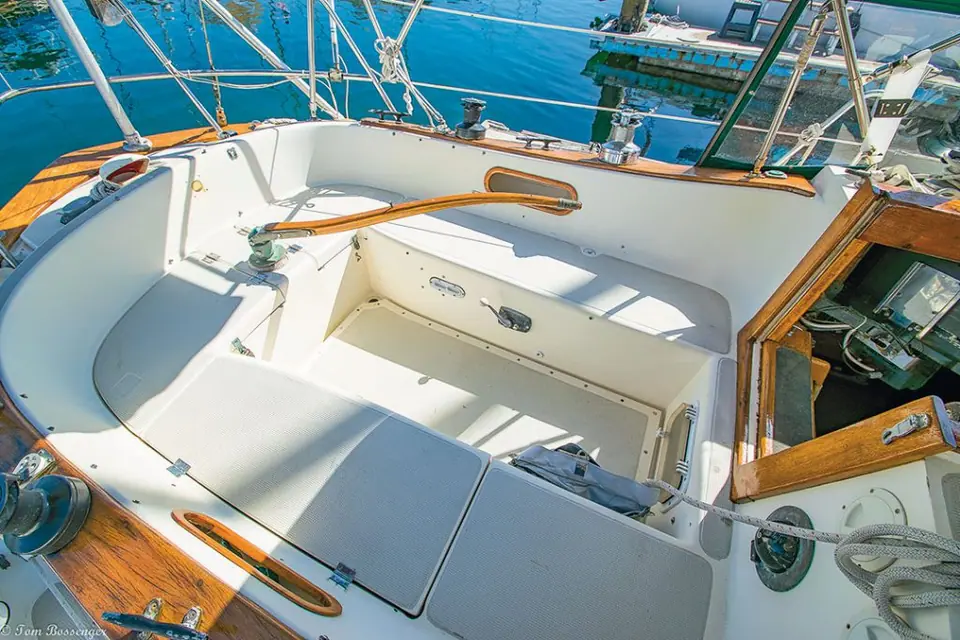
Access is superb. The cockpit sole unbolts and lifts out through a 2 by 2 foot hatch, and you can also reach the engine from the companionway and a port-side panel. On some early wheel-steered boats the pedestal had to come off first.
Two systems need attention on most used boats. The 40 gallon aluminum fuel tank sits in the bilge and corrodes over time, although it is reasonably accessible for replacement. The original electrical package, two 120 amp-hour batteries and a 55 amp alternator, was barely adequate even when new. Most cruising boats now carry a larger house bank, a high-output alternator with an external regulator and solar on a stern arch.
What a Pacific Seacraft 37 costs to buy and keep
Asking prices on the US market run from about $70,000 for a tired 1980s boat to $250,000 and more for a late hull with a fresh refit, and the occasional near-new boat goes higher still. Recent examples include a 1985 boat asking $89,000, a 1990 boat at $135,000 and a 1997 boat at $148,000. Compared with lighter production cruisers of the same age, these numbers have held up remarkably well.
Annual running costs for a well-kept boat land around $8,000 to $18,000 in most US regions, covering insurance, a 37 to 40 foot slip, haul-out, bottom paint and engine service.
The real budget item is the refit cycle: standing rigging every 10 to 15 years, sails every 8 to 10 years of cruising, and the fuel tank on older boats. Buy the best example you can afford, because finishing a project 37 usually costs more than the price gap.
Pacific Seacraft 37 specifications
| Length overall | 36.9 ft11.25 m |
|---|---|
| Waterline length | 27.8 ft8.46 m |
| Beam | 10.8 ft3.3 m |
| Draft | 5.5 ft1.68 m |
| Displacement | 16,2 lbs7,348 kg |
| Ballast | 6,2 lbs2,812 kg |
| Sail area | 621 sq ft57.7 m² |
| Fuel capacity | 4 gal15 L |
| Fresh water | 95 gal36 L |
| Cabins | 2 |
| Berths | 5 to 7 |
| Heads | 1 |
| Standard engines | Yanmar 4JH series diesel, about 50 hp (4JH2E rated 51 hp), standard since the late 1980s |
| Optional engines | Early boats used a 24 hp Volvo or Universal diesels |
| Maximum power | 51 hp |
| Range | 250 nm |
| Hull type | Moderate displacement monohull with raised canoe stern |
| Keel | Long-chord fin keel with external lead ballast (5 ft 6 in), or Scheel shoal keel (about 4 ft 5 in) |
| Rig | Masthead sloop, cutter or yawl |
| Hull construction | Solid hand-laid fiberglass hull, vinylester outer layers from 1988; plywood-cored deck, balsa-cored from the mid 1990s |
| CE design category | A |
| Builder | Pacific Seacraft (16 earlier hulls by Cruising Consultants), United States |
| Naval architect | W.I.B. (Bill) Crealock |
| Production | 1978 to present |
| Status | Limited production |
Figures come from builder documentation and independent tests where available. Displacement is usually quoted light, so a loaded cruising boat will weigh more. Compare these specs with another model.
How much does a Pacific Seacraft 37 cost?
New 37s have been built to order in Washington, North Carolina, and Good Old Boat put a new 2020 boat at nearly $500,000; ask the builder for current pricing. Used prices follow construction changes, so post-1988 vinylester hulls and post-1993 biaxial boats sell at a clear premium. A repower, new rigging and a replaced fuel tank add real money, while a tired original Volvo or a damp deck can knock $20,000 or more off.
Estimate your yearly cost
A planning estimate using common rules of thumb: insurance near 1.5 percent of value, maintenance near 3 percent, haul out and bottom paint by length. Your marina, region and use will move these numbers. Open the full cost calculator.
Versions and options
- Cruising Consultants Crealock 37 (1978 to 1979)
- Sixteen hulls with stick-built interiors, plywood-cored decks and a Volvo saildrive. Rare, and priced as older boats.
- Pacific Seacraft 37 cutter
- The most sought-after configuration, about 708 square feet with the staysail and the best offshore sail plan.
- Pacific Seacraft 37 sloop
- About 573 square feet with a 100 percent foretriangle. Simpler and easier to tack, preferred by coastal sailors.
- Scheel shoal keel
- Cuts draft to roughly 4 feet 5 inches for Bahamas and Chesapeake cruising, at a small cost in pointing ability.
Pacific Seacraft 37 timeline
- 1978Cruising Consultants begins building the Crealock 37 in Newport Beach after Clipper Marine's collapse
- 1980Pacific Seacraft acquires the molds and starts production in Fullerton, California
- 1988Vinylester resin added to the outer laminate to prevent blistering
- 2002Inducted into the American Sailboat Hall of Fame
- 2007California production ends and Stephen Brodie moves the company to Washington, North Carolina
- 2020Still in production in North Carolina; Good Old Boat puts a new 37 at nearly $500,000
Strengths and weaknesses
What owners like
- Roughly 140 degree stability range and a gentle, predictable motion at sea
- Sails faster than its displacement suggests, with 150 mile days common
- Excellent engine access through a removable cockpit sole
- External, inspectable chainplates and solid hand-laid hull
- Strong resale values and an active owner community
- Built new for four decades, so parts knowledge and factory support exist
What to weigh up
- Narrow beam and canoe stern make the interior small for a 37
- Only 40 gallons of fuel limits motoring range
- Aluminum fuel tank in the bilge corrodes on older boats
- Expensive compared with production cruisers of the same age
- Early small Volvo engines are underpowered
Used Pacific Seacraft 37 buyer checklist
Take this list to a viewing. Your ticks are saved in this browser so you can come back to it.
Always commission an independent marine survey and an engine survey before you buy. How a marine survey works.
Rivals to consider
Pacific Seacraft 34
Crealock's smaller sister on the same philosophy, cheaper to buy and berth but with less tankage and a tighter interior.
Compare side by sideValiant 40
Longer waterline and more speed and space, but blister history on hulls 120 to 249 demands careful selection.
Compare side by sideCape Dory 36
Full-keel Alberg cutter at a lower price, slower and less close-winded but very steady.
Compare side by sideTartan 37
A faster Sparkman and Stephens centerboard or keel cruiser with more volume, aimed more at coastal sailing than ocean voyaging.
Compare side by sideOur verdict on the Pacific Seacraft 37
The Pacific Seacraft 37 is the boat many brokers point to when a couple asks for a proven offshore 37 they can sail themselves and sell later without losing their shirt. It gives up cabin volume and motoring range, and good ones are not cheap, but a 140 degree stability range, an easy motion, honest construction and a builder that has kept it in production for decades are very hard to match. Buy a post-1988 cutter with documented tank, rigging and deck work.
Pacific Seacraft 37 questions answered
Is the Pacific Seacraft 37 the same as the Crealock 37?
Yes. Crealock 37 is the design name, and Pacific Seacraft has built it since 1980. Sixteen earlier hulls were built by Cruising Consultants in 1978 and 1979.
How much is a Pacific Seacraft 37 for sale?
Used boats typically ask $70,000 to $260,000 depending on year and refit history. Good Old Boat put a new 2020 boat at nearly $500,000.
Is the Pacific Seacraft 37 a bluewater boat?
Yes. It carries CE Category A rating, an angle of vanishing stability around 140 degrees and a long record of ocean crossings and circumnavigations.
Should I buy the cutter or the sloop?
Buy the cutter for offshore work, because the staysail gives you an easy heavy weather sail plan. The sloop is simpler and fine for coastal cruising.
What engine does a Pacific Seacraft 37 have?
Most boats from the late 1980s on have a Yanmar four-cylinder of about 50 hp. Early boats used a 24 hp Volvo or Universal diesels, and many have been repowered.
How fast is a Pacific Seacraft 37?
Hull speed is about 7.1 knots, and owners report 150 mile days on passage and surfing bursts over 10 knots in big following seas.
Pacific Seacraft 37 photos
More bluewater sailboats to explore
Hallberg-Rassy 36
Bluewater Sailboats, 37 ft
Used $75K to $165K
Alberg 37
Bluewater Sailboats, 37 ft
Used $20K to $65K
Tayana 37
Bluewater Sailboats, 37 ft
Used $30K to $110K
Hallberg-Rassy 372
Bluewater Sailboats, 37 ft
Used $200K to $430K