Island Packet Yachts Bluewater Sailboats
The Original Island Packet 38, a Liveaboard Cutter at a Five-Figure Price
Bob Johnson's 1986 flagship cutter: 38 ft on deck, 41 ft 6 in with the bowsprit, 157 gallons of water and just 5 ft of draft.

- Length
- 41.5 ft12.65 m
- Beam
- 12.7 ft3.86 m
- Draft
- 5 ft1.52 m
- Cabins
- 2 (forward cabin and aft cabin)
- Used price
- $75K to $135K
On this page
- Overview
- When the 38 was Island Packet's big boat
- Heavy, stiff and shoal: the numbers behind the motion
- 157 gallons of water and the case for living aboard
- Sailing a 1980s cutter on a long keel
- Repower arithmetic on a 1980s Packet
- Known Packet weak spots to survey
- How to tell a 38 from a 37 or a 380
- Specifications
- Price and value
- Strengths and weaknesses
- Used buyer checklist
- Rivals
- Our verdict
- FAQ
The Island Packet 38 was the company's big cutter from 1986 to about 1993, 188 built. Heavy, stiff and shoal-draft with large water tanks, it now sells for roughly $75,000 to $135,000, well below the later IP 380.
- Liveaboard couples on a budget near $100,000
- Bahamas and Caribbean cruising where water matters
- Sailors who prefer stability and tracking to speed
- Buyers willing to take on a refit for a proven hull
When the 38 was Island Packet's big boat
In 1986 Island Packet was a three-year success story built on the 31 and the 27. The Island Packet 38 took Bob Johnson's formula of beam, shoal draft and a cutter rig up to a size where a couple could live aboard, and it became the company's flagship until the 44 arrived in 1991. Sailboatdata records 188 boats built between 1986 and 1993; the model list on Island Packet's Wikipedia page runs the dates to 1995, so a late hull or two may exist, but 1993 is the usual cutoff for listings.
People who type island packet 38 into a search bar often mean the later 380, which began in 1998. This page is about the original. It shares the 380's DNA but not its hull, so specs, prices and inspection priorities differ, and the gap in price is the main reason to consider one.
Island Packet 38 by the numbers
- Sail area to displacement
- 18.0Balanced power for coastal and offshore cruising.
- Displacement to length
- 267Moderate displacement, a classic cruising balance between load carrying and speed.
- Theoretical hull speed
- 7.7 knThe practical top speed of a displacement monohull under normal sailing, based on waterline length.
- Ballast ratio
- 47%A high ballast ratio, so the boat stands up well to a breeze.
- Capsize screening
- 1.82Below 2.0, the traditional threshold for offshore suitability.
- Motion comfort ratio
- 31.8Moderate motion comfort, typical of modern cruisers.
- Length to beam ratio
- 3.28 : 1Moderate proportions.
Heavy, stiff and shoal: the numbers behind the motion
The hull is 38 ft on deck with a 33 ft waterline, and the bowsprit and pulpit take overall length to 41 ft 6 in. Beam is 12 ft 8 in. At 21,500 lb, with 10,000 lb of ballast, the ballast ratio is about 46 percent and the displacement to length ratio around 267, firmly in moderate-to-heavy territory. Draft is just 5 ft with the fixed keel; the keel and centerboard version draws 4 ft up and 7 ft 7 in with the board down.
Those figures predict a stiff, slow-rolling boat that carries a big payload without sinking far on her lines, which is what liveaboards want. They also predict modest light-air speed. Island Packet's published sail area of 870 sq ft counts the staysail; using the main and a 100 percent foretriangle only, sailboatdata calculates a sail area to displacement ratio of about 15.3, the same conservative figure seen across the company's late 1980s cutters. Theoretical hull speed is 7.7 knots.
157 gallons of water and the case for living aboard
The standout figure on the spec sheet is tankage. Sailboatdata lists 157 gallons of water and 57 of diesel. Many modern 40 footers carry less water than that. For a couple anchoring out for weeks in the Bahamas or the Abacos, it is the difference between topping up every few days and every couple of weeks, and it leaves room to avoid a watermaker or to treat one as a convenience rather than a necessity.
The layout is a two-cabin plan, with a cabin in the bow, an aft cabin and the saloon between. Equipment varies by boat: a 1992 example listed in 2026 carries two heads with showers plus a cockpit shower, so do not assume a single head. Headroom is listed at about 6 ft 4 in. Expect the teak joinery, molded liner and creamy gelcoat that define Island Packets of the period, and walk through any boat you are considering, since 35-plus years of owner modifications mean no two are quite alike.
Sailing a 1980s cutter on a long keel
The rig is a masthead cutter: genoa on the headstay, staysail inside and a mainsail that is usually on slab reefing or, on modified boats, an in-mast or boom furler. The same rules apply as on the smaller Packets. Reaching in a breeze is where the boat shines; tacking through narrow channels with a big genoa passing the inner stay is hard work; and light air calls for the engine or a reaching sail. The long keel keeps her tracking, and owners of Johnson's boats consistently report that they balance well and are stiff.
The 1992 boat on the market shows how owners typically develop the winch package, with two-speed self-tailers for the genoa and mainsheet and a separate winch for the staysail. Check that sheet leads, furlers and the staysail stay fittings have been maintained, because they carry real loads when the boat is reefed down to staysail and main in heavy weather.
Repower arithmetic on a 1980s Packet
Sailboatdata lists original engines of 44 or 50 hp. On a boat this age the engine is the single biggest swing item in a purchase. A professionally installed modern 50 hp diesel with shaft, stern gland and fuel filtration, like the 2019 Beta installation on the Greek boat above, can easily cost $30,000 to $40,000 in a US yard. A boat that has already had that work done is worth much of that difference, as long as the installation is documented.
If the original engine is still running, do not dismiss it, but budget for it. Get an engine survey with compression and oil analysis, inspect the exhaust elbow, heat exchanger and engine mounts, and assume a repower within a few years if hours are high or parts are hard to source. Price your offer accordingly rather than hoping.
Known Packet weak spots to survey
Several issues documented on Island Packets of this era apply here. Practical Sailor notes that early Island Packets had chainplates embedded in the laminate, where stainless deprived of oxygen can corrode out of sight, and that many owners have refit external chainplates bolted to glassed pads. Jack Hornor, writing for SpinSheet, called rudder delamination and separation quite common on a number of older Island Packet models. And the PolyCore deck, while immune to balsa rot, can show minor laminate separation with age.
None of these are reasons to walk away, but they belong on the survey list with the usual items for a boat of 33 to 40 years: standing rigging age, deck hardware bedding, port and hatch seals, tank condition, wiring and through-hulls. On centerboard boats add the board, pivot and pennant. A boat with records for all of it is worth paying up for.
How to tell a 38 from a 37 or a 380
Three Packets of similar size share listings. The original 38 (1986 to 1993) has the long bowsprit that takes it to 41 ft 6 in overall, a plumb transom and the lowest prices. The Island Packet 37 followed from 1994 to 1998; sailboatdata counts only 60 built, with a 31 ft waterline and 18,500 lb displacement, so it is a smaller and lighter boat rather than a renamed 38. The 380 of 1998 to 2004 is the evolution most buyers know, with a shortened sprit, more overhang at the bow, a swim step aft and a 56 hp Yanmar.
The quickest checks are the hull identification number, which carries the build year, and the stern: a 38 has no integral swim platform. If your budget tops out near $120,000 and you want maximum water capacity and a proven heavy hull, the 38 is the rational choice; if you can reach $175,000 or more, a 380 buys you a newer interior and systems.
Island Packet 38 specifications
| Length overall | 41.5 ft12.65 m |
|---|---|
| Waterline length | 33 ft10.06 m |
| Beam | 12.7 ft3.86 m |
| Draft | 5 ft1.52 m |
| Displacement | 21,5 lbs9,752 kg |
| Ballast | 10, lbs4,536 kg |
| Sail area | 87 sq ft80.8 m² |
| Fuel capacity | 57 gal216 L |
| Fresh water | 157 gal594 L |
| Cabins | 2 (forward cabin and aft cabin) |
| Heads | 1 or 2 depending on the boat |
| Standard engines | Diesel inboard, 44 or 50 hp (original equipment per sailboatdata) |
| Maximum power | 50 hp |
| Hull type | Heavy-displacement monohull with full-foil long keel and keel-attached rudder |
| Keel | Full-foil long keel, 5 ft 0 in draft; keel and centerboard version 4 ft 0 in board up, 7 ft 7 in board down |
| Rig | Masthead cutter with headsail, staysail and mainsail |
| Hull construction | Solid fiberglass hull with encapsulated ballast and an Island Packet PolyCore cored deck |
| Builder | Island Packet Yachts (Traditional Watercraft Inc.), Largo, Florida, USA |
| Naval architect | Robert K. (Bob) Johnson |
| Production | 1986 to 1993 |
| Status | Discontinued |
Figures come from builder documentation and independent tests where available. Displacement is usually quoted light, so a loaded cruising boat will weigh more. Compare these specs with another model.
How much does a Island Packet 38 cost?
Original IP 38s are scarce on the market and each is priced on its refit history. A 1992 boat repowered with a 50 hp Beta in 2019, with standing rigging from 2017 and a 2016 to 2024 electronics suite, was asking 108,000 euros in Greece in 2026, about $117,000. Expect $75,000 for a boat with original engine and tired systems and up to about $135,000 for a fully refit example, roughly $50,000 to $80,000 below a comparable Island Packet 380.
Estimate your yearly cost
A planning estimate using common rules of thumb: insurance near 1.5 percent of value, maintenance near 3 percent, haul out and bottom paint by length. Your marina, region and use will move these numbers. Open the full cost calculator.
Versions and options
- Fixed full-foil keel
- 5 ft 0 in draft; the more common configuration and simpler to maintain.
- Keel and centerboard
- 4 ft 0 in board up and 7 ft 7 in board down for very shallow cruising grounds.
Island Packet 38 timeline
- 1986Island Packet 38 introduced as the company's largest model
- 1991Island Packet 44 arrives above it in the range
- 1993Last model year recorded by sailboatdata, after about 188 boats
- 1994Island Packet 37 takes over the size slot until 1998
- 1998Island Packet 380 launched as the modern successor
Strengths and weaknesses
What owners like
- Very large water capacity of about 157 gallons
- Stiff, heavy hull with a 46 percent ballast ratio
- Shoal 5 ft draft, or 4 ft with the centerboard up
- Cutter rig gives easy sail reduction in heavy weather
- Costs far less than an Island Packet 380
- Proven Island Packet build and owner support network
What to weigh up
- Slow in light air and unhandy tacking in tight channels
- Bowsprit means a 41 ft 6 in slip for a 38 ft boat
- Original engines are now old; repowers are expensive
- Embedded chainplates and rudder delamination need checking
- Few boats on the market, mostly older interiors
Used Island Packet 38 buyer checklist
Take this list to a viewing. Your ticks are saved in this browser so you can come back to it.
Always commission an independent marine survey and an engine survey before you buy. How a marine survey works.
Rivals to consider
Island Packet 380
The 1998 to 2004 successor, roomier and newer, at roughly $50,000 to $80,000 more.
Compare side by sideTayana 37
Taiwan-built Perry double-ender, deeper and better upwind, with much more teak to maintain.
Compare side by sideMorgan 384
Lighter, faster fin-keel cruiser from the same era and region, with less tankage.
Compare side by sideBristol 40
Older, narrower Alberg-style long keeler with classic looks and a much smaller interior.
Compare side by sideOur verdict on the Island Packet 38
The original Island Packet 38 is a sensible boat for a sensible buyer. It will not win races or impress on light summer afternoons, but it carries a couple's life aboard, with big water tanks, a heavy, stiff hull and a draft that opens the Bahamas banks. The risks are age-related and well documented: chainplates, rudder, deck core and an old engine. Buy one with those addressed, or price them into your offer, and you get much of the 380 experience for a lot less money.
Island Packet 38 questions answered
What is the difference between the Island Packet 38 and the 380?
The 38 is the original 1986 to 1993 design with a long bowsprit and plumb transom. The 380 is a 1998 evolution with a reworked bow, a swim step, a 56 hp Yanmar and more interior volume, and it costs more.
How much is an Island Packet 38 worth?
Most trade between about $75,000 and $135,000 depending on refit history. A repowered 1992 boat was asking 108,000 euros, about $117,000, in 2026.
How many Island Packet 38s were built?
About 188, from 1986 to 1993 according to sailboatdata.
What is the draft of the Island Packet 38?
5 ft 0 in with the fixed keel, or 4 ft 0 in board up and 7 ft 7 in board down on the centerboard version.
How much water does an Island Packet 38 carry?
About 157 gallons of water and 57 gallons of diesel.
More bluewater sailboats to explore
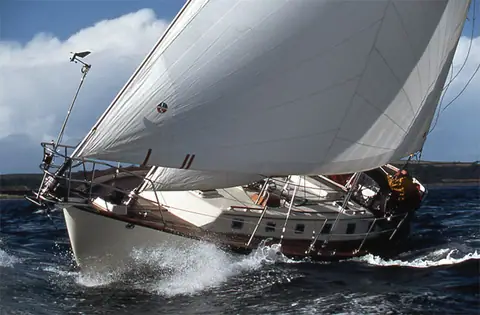
Pacific Seacraft 40
Bluewater Sailboats, 42 ft
Used $190K to $400K
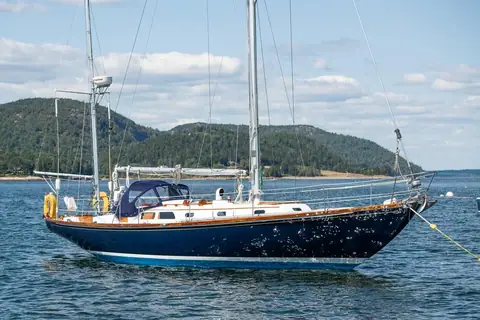
Hinckley Bermuda 40
Bluewater Sailboats, 41 ft
Used $60K to $260K
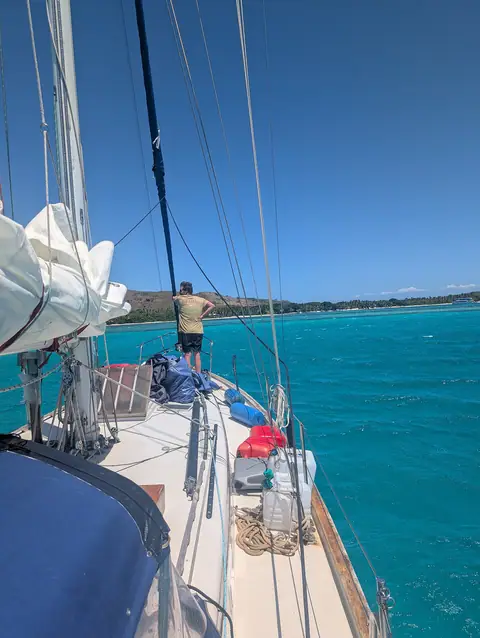
Valiant 40
Bluewater Sailboats, 40 ft
Used $45K to $200K
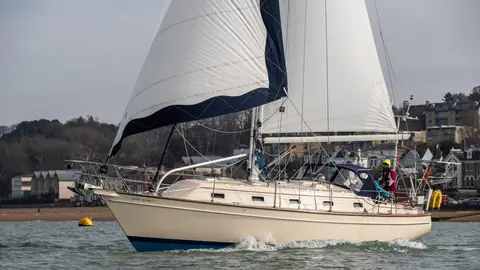
Island Packet 380
Bluewater Sailboats, 40 ft
Used $125K to $215K