Pacific Seacraft Bluewater Sailboats
Pacific Seacraft 40 Voyagemaker, Specs and Buying Guide
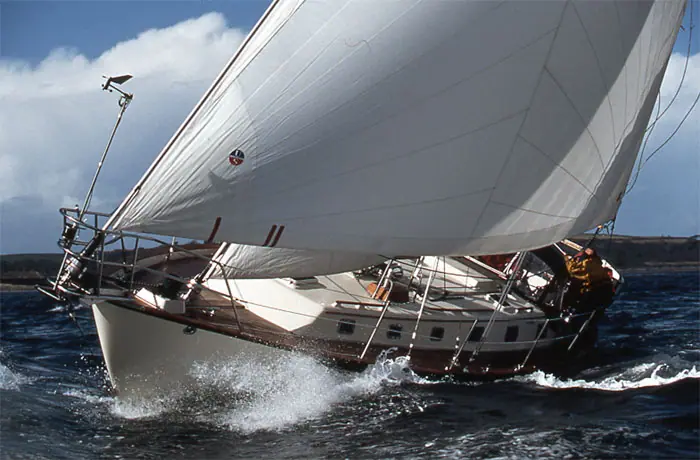
Bill Crealock's largest canoe-stern cutter in the classic Pacific Seacraft line, built for a couple to take anywhere without exhaustion.
- Length
- 42.2 ft12.85 m
- Beam
- 12.4 ft3.78 m
- Draft
- 6.1 ft1.85 m
- Cabins
- 2 (forward island or V-berth cabin, aft double cabin)
- Used price
- $190K to $400K
On this page
- Overview
- The Voyagemaker brief: a 40 footer a couple can sail hard
- Split underbody, canoe stern and 141 degrees of stability
- A cutter rig set up for two
- An interior laid out for sea, not the boat show
- Yanmar 4JH3E, 122 gallons of water and real tankage
- Construction, then and now
- Buying a used Pacific Seacraft 40 in the US
- Specifications
- Price and value
- Strengths and weaknesses
- Used buyer checklist
- Rivals
- Our verdict
- FAQ
The Pacific Seacraft 40 is a W.I.B. Crealock designed cutter launched in 1996, built in Fullerton, California and since 2008 in Washington, North Carolina. It carries 24,000 lb, a skeg-hung rudder and a canoe stern.
- Couples planning ocean crossings or a circumnavigation
- Sailors who value seakindliness over speed
- Buyers who want a builder that still exists
- High-latitude and trade wind cruising
Pacific Seacraft 40 by the numbers
- Sail area to displacement
- 16.3Balanced power for coastal and offshore cruising.
- Displacement to length
- 351Heavy displacement. Slow to accelerate but steady and sea kindly with a full load.
- Theoretical hull speed
- 7.5 knThe practical top speed of a displacement monohull under normal sailing, based on waterline length.
- Ballast ratio
- 36%A typical ballast ratio for a cruising monohull.
- Capsize screening
- 1.72Below 2.0, the traditional threshold for offshore suitability.
- Motion comfort ratio
- 37.5A slow, easy motion in a seaway, kind to crews on long passages.
- Length to beam ratio
- 3.40 : 1Moderate proportions.
The Voyagemaker brief: a 40 footer a couple can sail hard
Pacific Seacraft called its 40 the Voyagemaker, and Bill Crealock's own design notes explain the name. He wanted an offshore cruiser that a small crew could sail to its full potential without exhaustion, arguing that speed on passage is a different thing from speed around the buoys and that the passage itself should be relaxing. He also said that in the 40 the beam proportion had come close to the practical limit, adding beam a little at a time so balance and handling were never threatened.
SAIL tested the new boat on Chesapeake Bay in its May 1996 issue, which dates the launch, and Wikipedia describes it as produced since 1996. It sits above the 31, 34 and 37 in the classic Crealock range and below the 44. When Steve Brodie bought Pacific Seacraft out of bankruptcy in 2007, the 40 was one of the four models he set out to keep building, and SAIL reported that a new 40 would debut at the fall 2008 shows from the North Carolina yard.
Split underbody, canoe stern and 141 degrees of stability
Outwardly the 40 resembles its sisters, but Crealock reshaped each model. The 40 keeps his split underbody: a fin keel, a ventral fin between keel and skeg, and a large skeg that supports the rudder and protects the propeller aperture. The skeg has a half inch steel spine encased in filled resin and a heavy bronze gudgeon at its base. The lead keel is external, on ten 1 inch bolts with stainless backing plates bedded in epoxy, so a grounding marks lead rather than fiberglass.
The factory specification lists 42 ft 2 in overall including the bow platform, 40 ft 2 in on deck, 31 ft 3 in on the waterline, 12 ft 5 in of beam and a half-load displacement of 24,000 lb. Draft is 6 ft 1 in with 8,600 lb of ballast or 5 ft 2 in with the shoal keel, which carries 8,880 lb. Pacific Seacraft quotes an angle of positive stability greater than 141 degrees, and the structure went through ABS plan certification and CE Category A certification.
Crealock noted that owners of other boats in the line reported surfing in heavy weather at speed to length ratios over 2 with easy control, and that the canoe stern's fair run gives a clean exit for the water, unlike a wide transom drawn for interior volume.
A cutter rig set up for two
The rig is a masthead cutter with Forespar spars, two spreaders and 1x19 wire rigging on external tangs for easy inspection. Sail area is 846 sq ft with a 100 percent foretriangle, or 978 sq ft including the 132 sq ft staysail. The masthead stands 55 ft above the waterline. Both headsails roll up, lazy jacks are standard and the staysail is double-sheeted, because the factory preferred no spars at deck level in the foretriangle.
Winches are all two-speed self-tailers, with 53.2 primaries on the coamings and a dedicated 44.2 for the mainsheet so it is never shared with a rope clutch. In SAIL's test the boat tacked through about 90 degrees, sailed steadily on all points, tracked well with a solid if not racing-sensitive wheel, and turned in slightly more than a boat length under power. Measured saloon noise at cruising speed was 78 dB.
An interior laid out for sea, not the boat show
Crealock slanted the accommodation toward offshore use, with settee corners kept tight for support at heel and a galley that braces the cook. The head and separate stall shower sit right at the foot of the companionway, so wet gear comes off before anyone reaches the cabins; the shower, with its own overhead hatch, doubles as a wet locker on passage. The large forward-facing nav station is to port, with a slanted chart table and room for instruments outboard.
Opposite is a U-shaped galley with the double sink near the centerline so it drains on either tack, a three-burner Force 10 stove with oven, Corian counters and optional Sea Frost or Technautics refrigeration. The saloon has a U-shaped settee whose dinette table lowers to form a berth. Forward is either an island berth with drawers or a V-berth, plus a cedar-lined hanging locker; aft is a double berth cabin. Interior joinery is varnished Burmese teak, and light and air come through four hatches, fourteen bronze opening ports and two Dorade vents.
Yanmar 4JH3E, 122 gallons of water and real tankage
The standard engine in the 2003 specification is a naturally aspirated Yanmar 4JH3E rated at 56 hp, with a 2.62:1 reduction gear, a straight 1.25 inch Aquamet shaft and an 18 by 12 inch three-blade propeller. SAIL noted the cockpit sole lifts out for engine access and even engine removal, a detail that matters on a boat expected to be repowered at some point in a long life.
Fuel capacity is 63 gallons standard with an optional 22 gallon tank, and three water tanks total 122 gallons, with 19 gallons of holding. The 12 volt system came with group 31 AGM batteries, an 80 amp alternator and an optional 2,000 watt inverter-charger. Older sailboatdata records list different tank figures, so confirm what a specific boat actually carries.
Construction, then and now
The California boats used a biaxial layup with vinylester resin in the outer skin, solid laminate below the waterline and Baltek balsa core in the topsides and deck. The hull-to-deck area is surrounded by deep bulwarks that support 32 inch stanchions and give real footing. Deck hardware is chrome-plated cast bronze, every fitting has a backing plate, and the stainless bow platform is engineered for loads beyond 3/8 inch chain.
Brodie's North Carolina yard has since switched to all-vinylester hulls, 316 stainless for exterior and structural metal, CNC waterjet cut chainplates and hard-panel headliners. Those changes came from lessons learned refitting older hulls, and they tell a buyer where older boats need attention: chainplates, cored deck areas around hardware, and headliner access to wiring and backing plates.
Buying a used Pacific Seacraft 40 in the US
Pacific Seacraft 40 for sale listings draw a lot of attention, partly thanks to Sailing Project Atticus, a YouTube channel with more than a quarter-million subscribers filmed aboard a 1997 PS40 that the factory had worked on. Brodie credits the couple with bringing new attention to the brand. Expect competition for well-kept boats, especially those already set up with watermakers, solar, windvanes and modern electronics.
Budget roughly $16,000 to $34,000 a year in the US to keep one properly, covering a 42 to 45 ft slip, insurance (higher for offshore cruising), haul-out, bottom paint, engine and rigging maintenance and varnish. Set aside further reserves for standing rigging replacement, sails and electronics, which on a boat of this size and quality run well into five figures each time.
Pacific Seacraft 40 specifications
| Length overall | 42.2 ft12.85 m |
|---|---|
| Waterline length | 31.3 ft9.53 m |
| Beam | 12.4 ft3.78 m |
| Draft | 6.1 ft1.85 m |
| Air draft | 55 ft16.76 m |
| Displacement | 24, lbs10,9 kg |
| Ballast | 8,6 lbs3,901 kg |
| Sail area | 846 sq ft78.7 m² |
| Fuel capacity | 63 gal238 L |
| Fresh water | 122 gal462 L |
| Cabins | 2 (forward island or V-berth cabin, aft double cabin) |
| Berths | 4 in cabins plus convertible saloon dinette |
| Heads | 1 with separate stall shower |
| Standard engines | Yanmar 4JH3E diesel, 56 hp |
| Maximum power | 56 hp |
| Hull type | Moderate to heavy displacement canoe-stern monohull with split underbody |
| Keel | External lead fin keel on ten 1 inch bolts, 6 ft 1 in standard or 5 ft 2 in shoal; ventral fin and large skeg ahead of the rudder |
| Rig | Masthead cutter with roller-furling genoa and staysail, Forespar double-spreader spars |
| Hull construction | Hand-laid fiberglass, solid below the waterline, balsa-cored topsides and deck, vinylester outer skin, external lead keel |
| CE design category | A |
| Builder | Pacific Seacraft (Fullerton, California; Washington, North Carolina since 2007), USA |
| Naval architect | W.I.B. (Bill) Crealock |
| Production | 1996 to present |
| Status | Limited production |
Figures come from builder documentation and independent tests where available. Displacement is usually quoted light, so a loaded cruising boat will weigh more. Compare these specs with another model.
How much does a Pacific Seacraft 40 cost?
SAIL quoted a price of $285,000 FOB Fullerton, with sails and basic electronics, when it tested the new Pacific Seacraft 40 in 1996. Today's North Carolina builds start well above that: owner Steve Brodie told Cruising World that a classic Pacific Seacraft 37 is about an $800,000 build, so a new 40 sits higher still. On the used market the late California boats with modern electronics, rigging and an updated Yanmar bring the strongest money, and the popularity of the Sailing Project Atticus YouTube channel, filmed aboard a 1997 PS40, has kept buyer interest high.
Estimate your yearly cost
A planning estimate using common rules of thumb: insurance near 1.5 percent of value, maintenance near 3 percent, haul out and bottom paint by length. Your marina, region and use will move these numbers. Open the full cost calculator.
Versions and options
- Standard keel
- 6 ft 1 in draft with 8,600 lb of lead, the better choice for offshore windward work.
- Shoal keel
- 5 ft 2 in draft with 8,880 lb of lead for the Bahamas, Florida and the Chesapeake.
- Low-maintenance deck specification
- Aluminum toerail, stainless handrails and synthetic hatch trim in place of the standard teak caprails, eyebrows and handrails.
- Pacific Seacraft Pilothouse 40
- A related pilothouse model listed by sailboatdata and on the builder's former website.
Pacific Seacraft 40 timeline
- 1996Pacific Seacraft 40 launched; SAIL tests it and lists a price of $285,000 FOB Fullerton
- 2003Detailed Voyagemaker specification issued with Yanmar 4JH3E power and 122 gallons of water
- 2007Steve Brodie buys Pacific Seacraft at auction and moves production to North Carolina
- 2008First North Carolina 34, 37 and 40 models prepared for the fall shows
Strengths and weaknesses
What owners like
- Proven Crealock offshore hull with protected rudder and propeller
- Positive stability beyond 141 degrees
- Cutter rig easy for two to handle
- Sea-going layout with head and shower by the companionway
- Generous water and fuel capacity
- Builder still supports and refits the boats
What to weigh up
- Heavy and slow in light air compared with modern 40 footers
- Moderate beam limits interior volume
- Teak trim adds maintenance
- Strong demand keeps used prices high
Used Pacific Seacraft 40 buyer checklist
Take this list to a viewing. Your ticks are saved in this browser so you can come back to it.
Always commission an independent marine survey and an engine survey before you buy. How a marine survey works.
Rivals to consider
Valiant 40
Brodie's own named head-to-head rival, a Perry double-ender with a faster reputation and different interior.
Compare side by sidePassport 40
A Perry-designed Taiwan-built cruiser with more teak and a beamier, roomier interior.
Compare side by sideHinckley Bermuda 40
A classic centerboard yawl with superb finish, better suited to coastal cruising and shoal water.
Compare side by sideCabo Rico 38
Another heavy traditional cutter that Brodie names as a former direct competitor.
Compare side by sideOur verdict on the Pacific Seacraft 40
The Pacific Seacraft 40 is one of the most complete short-handed ocean cruisers ever built in the US. Its numbers are old-school heavy, but the split underbody, protected rudder, sea-going layout and sensible cutter rig make it a boat that looks after its crew when conditions turn. It will not win races and costs more than most used 40 footers, yet a well-maintained example holds its value and the factory is still there to support it. If ocean passages are the goal, few used boats in this size deserve a higher place on the shortlist.
Pacific Seacraft 40 questions answered
How much does a Pacific Seacraft 40 cost?
Used boats generally sell for about $190,000 to $400,000 in the US in 2026. In 1996 SAIL listed the new boat at $285,000 FOB Fullerton, and new builds today cost far more.
Is the Pacific Seacraft 40 still built?
It remains in the build-to-order range of the North Carolina company, which builds boats from 31 to 61 feet in small numbers.
What is the draft of the Pacific Seacraft 40?
6 ft 1 in with the standard keel or 5 ft 2 in with the shoal keel.
What engine does the Pacific Seacraft 40 have?
The 2003 specification lists a naturally aspirated Yanmar 4JH3E rated at 56 hp.
Which boat does Sailing Project Atticus sail?
The YouTube channel documents life aboard a 1997 Pacific Seacraft 40.
How does the 1998 Pacific Seacraft 40 differ from later boats?
The hull and rig are the same design; later California boats followed the 2003 specification, and North Carolina builds added all-vinylester hulls and 316 stainless fittings. Equipment and refit history matter more than the exact year.
Pacific Seacraft 40 photos
More bluewater sailboats to explore
Island Packet 38
Bluewater Sailboats, 42 ft
Used $75K to $135K
Hinckley Bermuda 40
Bluewater Sailboats, 41 ft
Used $60K to $260K
Valiant 40
Bluewater Sailboats, 40 ft
Used $45K to $200K
Island Packet 420
Bluewater Sailboats, 45 ft
Used $185K to $295K