Westsail 32 Buyer's Guide, History and Prices
The 19,500 pound double-ender that sold the cruising dream to a generation of Americans, half of them finished at home from a bare hull.
- Length
- 32 ft9.75 m
- Beam
- 11 ft3.35 m
- Draft
- 5 ft1.52 m
- Cabins
- 1 (open plan with forward V-berth)
- Used price
- $15K to $75K
On this page
- Overview
- From Colin Archer's rescue boats to a California sales phenomenon
- Built like a tank, and what that means today
- Half the fleet came from a kit, and that changes how you shop
- How a 19,500 pound double-ender actually sails
- Satori, the Perfect Storm and a reputation earned the hard way
- Eleven feet of beam inside a 32 foot hull
- Wood on the ends: bowsprit, boomkin and chainplates
- Tanks under the engine and other mechanical realities
- Why prices stay low and what the good ones fetch
- Specifications
- Price and value
- Strengths and weaknesses
- Used buyer checklist
- Rivals
- Our verdict
- FAQ
A heavy full-keel cutter built in California from 1971 to 1980, about 830 hulls including roughly 400 kits. Slow in light air, famously tough, and one of the cheapest proven offshore boats you can buy.
- Budget bluewater cruisers
- Heavy weather and high latitude sailing
- Owners who enjoy hands-on refits
- Liveaboards wanting a big 32
Westsail 32 by the numbers
- Sail area to displacement
- 13.9A cruising rig sized for comfort, so expect to motor in very light air.
- Displacement to length
- 419Heavy displacement. Slow to accelerate but steady and sea kindly with a full load.
- Theoretical hull speed
- 7.0 knThe practical top speed of a displacement monohull under normal sailing, based on waterline length.
- Ballast ratio
- 36%A typical ballast ratio for a cruising monohull.
- Capsize screening
- 1.63Below 2.0, the traditional threshold for offshore suitability.
- Motion comfort ratio
- 42.8A slow, easy motion in a seaway, kind to crews on long passages.
- Length to beam ratio
- 2.91 : 1A beamy hull with lots of volume for its length.
From Colin Archer's rescue boats to a California sales phenomenon
The Westsail 32 traces back to the Norwegian pilot and rescue boats Colin Archer drew in the 19th century. In 1928 William Atkin adapted that type into Eric, a 32-foot gaff-rigged double-ender, later redrawn with a Bermuda rig as Thistle. In 1969 Californian Larry Kendall asked W.I.B. Crealock to turn the Atkin lines into a fiberglass production boat. Crealock reportedly told him he might sell ten or a dozen. The Kendall 32 sold modestly and the company went under within two years.
In February 1971 engineer Snyder Vick and his wife Lynne bought the Kendall molds, had Crealock redraw the deck and interior, and launched the Westsail 32. The first three boats sold for $15,000 to $20,000. What the Vicks really sold was a lifestyle: their quarterly magazine Windbag passed 5,000 subscribers, and owner boat shows turned proud owners into a volunteer sales force.
Cash flow, not demand, killed the company. Westsail collected payment on delivery, so every extra boat widened the gap between costs and income, and launching the Westsail 42 and 43 in 1974 made it worse. The firm filed for bankruptcy in early 1977, restarted under new management and closed for good around 1980 to 1981, after about 830 Westsail 32s.
Built like a tank, and what that means today
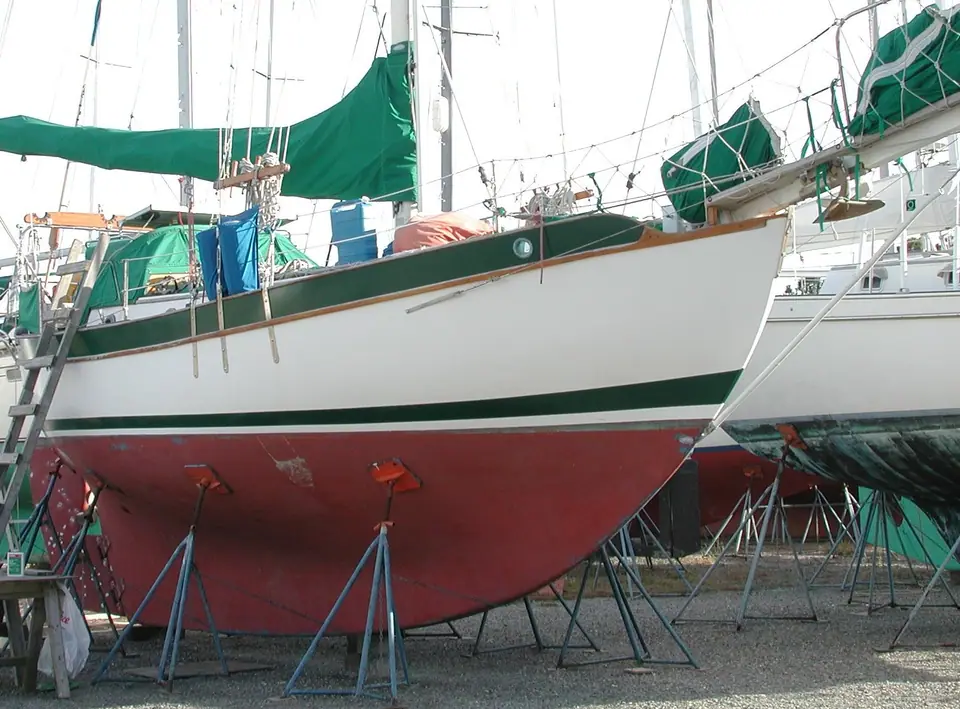
The hull is 12 alternating layers of woven roving and chopped strand mat in polyester resin, from about half an inch thick to nearly an inch. Ballast is 7,000 pounds inside the keel cavity and glassed over, so there are no keel bolts to worry about. Early boats used a mix of lead and iron; later boats used lead only. The deck is half-inch plywood sheathed in fiberglass.
Fifty years on, the hull is almost never the problem. The plywood deck core is. Every stanchion base, deck fill, chainplate slot and mast partner is a potential path for water, and a saturated core is common on survey. Re-coring a whole deck runs into five figures at a yard, which on a $25,000 boat is the whole budget.
Half the fleet came from a kit, and that changes how you shop
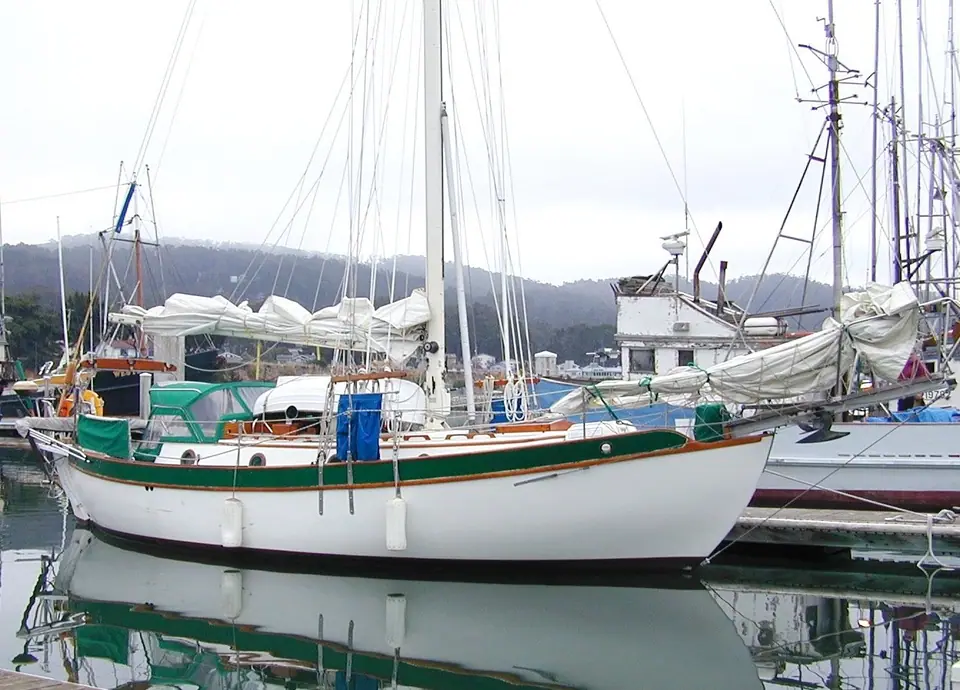
About 400 Westsail 32s left the factory as kits: a finished hull, ballast installed and the deck bonded on, with interior, engine, plumbing, wiring and rig left to the buyer. Ferenc Mate wrote From a Bare Hull to support the program, and the book is still a standard boatbuilding reference.
Some kit boats are better finished than factory boats, built over years by skilled owners. Others have garden-hose plumbing, automotive wiring and bulkheads tabbed in with too little glass. Ask for documentation of whether the boat is factory or owner-finished, and judge a kit boat entirely on the work you can see.
- Check bulkhead tabbing to the hull on both faces
- Trace the wiring and look for marine-grade tinned wire and proper fusing
- Confirm seacocks are true marine seacocks, not gate valves
- Ask the Westsail Owners Association whether the hull is known to them
How a 19,500 pound double-ender actually sails
The old line is that the Westsail 32 is built like a tank and sails like one too. It is half true. The displacement to length ratio is about 419, very heavy by any standard, and the sail area to displacement ratio sits around 15.6 with the full cutter plan. Hull speed is about 7 knots, and in moderate wind a typical cruising pace is 6 to 6.5 knots.
Below 10 knots of true wind it is slow, and to windward it does not point. Above 20 knots it comes into its own: the long keel tracks without effort, the motion is easy and the boat stands up to its canvas. A Westsail 32 named Saraband won the 1988 Pacific Cup on corrected time, in light wind no less, and placed third in 1990.
Owners who are happy with the boat usually do three things: buy modern cruising sails, carry a large drifter or code zero for light air, and fit a feathering or folding prop. Those changes alone can add a knot in the conditions where the boat is weakest.
Satori, the Perfect Storm and a reputation earned the hard way
In October 1991 the crew of the Westsail 32 Satori was taken off by the Coast Guard during the storm later made famous as the Perfect Storm. The boat was abandoned, later came ashore, and was found essentially undamaged. The film version changed the story considerably, but sailors drew their own conclusion: the boat outlasted the conditions that frightened its crew off.
That episode, plus decades of ocean crossings by ordinary couples, is why the Westsail 32 is still called the epitome of a seaworthy small cruiser. Its success spawned a wave of imitators, among them the Baba, Tashiba, Hans Christian and Pacific Seacraft lines, many built in Taiwan with sleeker underbodies to fix the performance complaint.
Eleven feet of beam inside a 32 foot hull
Beam is 11 feet and the double-ended hull keeps that width well aft, so the interior feels larger than the length suggests. Headroom is about 6 feet 2 inches. The typical arrangement has a V-berth forward, a head, a saloon with settees and a drop-leaf or dinette table, the galley aft and a quarter berth, but on kit boats almost anything is possible.
Factory interiors are traditional wood and can feel dark by modern taste. The upside is a cabin full of handholds and short distances between them, which is what you want in a seaway. Water capacity is about 80 gallons, and fuel is quoted anywhere from 42 gallons (sailboatdata) to 60 gallons (Cole Brothers) depending on year and source.
Wood on the ends: bowsprit, boomkin and chainplates
The rig is a Bermuda cutter with a 6-foot bowsprit and a boomkin, taking sparred length to about 40 feet. That matters for slip fees, since many US marinas bill on overall length, and for the survey, because these extremities carry the headstay and backstay loads.
Wooden bowsprits and boomkins rot from the inside, often invisibly. The original boomkin stay tangs were narrow enough that several boats lost their entire rigs when they failed. The external stainless strap chainplates suffer crevice corrosion on the face against the hull, and cracks can grow from the square carriage bolt holes. If no one has replaced the chainplates, tangs and bowsprit hardware, budget for it.
Tanks under the engine and other mechanical realities
Factory boats left with small Volvo diesels, typically the MD2B or the MD3B, or a Perkins 4-107. Parts for the old Volvos are scarce and expensive, and most surviving boats have been repowered with a Beta, Yanmar or Westerbeke of 30 to 40 hp. A professional repower runs $20,000 to $30,000 installed.
Fuel tanks are the notorious item. Some production used steel tanks set in a wet area under the engine, where they develop pinhole leaks, and on many boats the engine must come out to reach them. Ask when the tank was last replaced. If the answer is never, treat it as a near-term repower-scale job and negotiate accordingly.
Why prices stay low and what the good ones fetch
With roughly 830 boats built, there is almost always a Westsail 32 for sale somewhere on the West Coast, in Florida or in New England. Asking prices typically run $15,000 to $45,000, with exceptional, fully refit boats reaching $60,000 to $75,000. Kit or factory build matters more than year.
Running costs are modest: expect $5,000 to $12,000 a year for insurance, a slip, haul-out and maintenance. The trap is buying cheap and refitting expensive. A boat that has already had its deck, chainplates, tanks and engine done is worth paying up for.
Westsail 32 specifications
| Length overall | 32 ft9.75 m |
|---|---|
| Waterline length | 27.5 ft8.38 m |
| Beam | 11 ft3.35 m |
| Draft | 5 ft1.52 m |
| Displacement | 19,5 lbs8,845 kg |
| Ballast | 7, lbs3,175 kg |
| Sail area | 629 sq ft58.4 m² |
| Fresh water | 8 gal303 L |
| Cabins | 1 (open plan with forward V-berth) |
| Berths | Up to 7 |
| Heads | 1 |
| Standard engines | Volvo diesels (MD2B or MD3B on many boats) or Perkins 4-107; sailboatdata lists 36 hp |
| Optional engines | Perkins 4-107 diesel; many boats since repowered |
| Hull type | Heavy displacement double-ended monohull |
| Keel | Full keel with internal encapsulated ballast (lead and iron on early boats, lead later) |
| Rig | Bermuda cutter with 6 ft bowsprit and boomkin, about 40 ft sparred length |
| Hull construction | Solid hand-laid fiberglass, 12 alternating layers of mat and woven roving; plywood-cored deck |
| Builder | Westsail Corporation, United States |
| Naval architect | W.I.B. (Bill) Crealock (fiberglass adaptation) |
| Other design credits | Lineage from Colin Archer's Norwegian rescue boats via William Atkin's Eric (1928) |
| Production | 1971 to 1980 |
| Status | Discontinued |
Figures come from builder documentation and independent tests where available. Displacement is usually quoted light, so a loaded cruising boat will weigh more. Compare these specs with another model.
How much does a Westsail 32 cost?
Recent US listings cluster around $19,000 to $30,000, with a 1976 boat in California asking $27,000. Factory-finished boats with documented deck, chainplate, tank and engine work sell toward the top of the range, while owner-finished kits with unknown wiring and joinery sit at the bottom. Because a refit can cost more than the boat, the purchase price matters less than the condition of the expensive bits.
Estimate your yearly cost
A planning estimate using common rules of thumb: insurance near 1.5 percent of value, maintenance near 3 percent, haul out and bottom paint by length. Your marina, region and use will move these numbers. Open the full cost calculator.
Westsail 32 timeline
- 1928William Atkin draws Eric, a 32-foot double-ender based on Colin Archer rescue boats
- 1969Larry Kendall commissions Bill Crealock to adapt the design to fiberglass as the Kendall 32
- 1971Snyder and Lynne Vick buy the molds and launch the Westsail 32
- 1977Westsail files for bankruptcy and restarts under new management
- 1980Production of the 32 ends at about 830 hulls
- 1988Saraband wins the Pacific Cup on corrected time
- 1991Satori is abandoned in the Perfect Storm and comes ashore intact
Strengths and weaknesses
What owners like
- Massively built solid hull with encapsulated ballast and no keel bolts
- Easy, forgiving motion and excellent tracking in heavy weather
- Big interior for 32 feet thanks to 11 feet of beam carried aft
- Very affordable entry into a proven offshore design
- Large, active owner community and good parts knowledge
What to weigh up
- Slow in light air and poor to windward
- Plywood deck core is prone to rot around fittings
- Fuel tanks can require engine removal to replace
- Kit boats vary wildly in finish quality
- Sparred length near 40 feet raises marina costs
Used Westsail 32 buyer checklist
Take this list to a viewing. Your ticks are saved in this browser so you can come back to it.
Always commission an independent marine survey and an engine survey before you buy. How a marine survey works.
Rivals to consider
Tayana 37
Bob Perry's faster, more refined double-ender with a much longer waterline, at a higher price and with its own tank and teak deck issues.
Compare side by sideBristol Channel Cutter 28
Smaller and better built, with a yacht-quality interior, but far rarer and two to four times the price.
Compare side by sideCape Dory 36
An Alberg full keel with more length and a better interior finish, slightly quicker but still conservative.
Compare side by sideHans Christian 33
Taiwan-built double-ender inspired by the Westsail, with richer joinery and similar teak and tank maintenance.
Our verdict on the Westsail 32
The Westsail 32 is not a fast boat and never will be, but it is one of the cheapest ways to go to sea in a hull that has proved itself in conditions most sailors never see. Buy it for what it is: a strong, comfortable, slow passagemaker. Ignore the year and focus on the deck core, chainplates, bowsprit, tanks and engine, and pay extra for a boat where someone has already done that work.
Westsail 32 questions answered
How much does a Westsail 32 cost?
Most Westsail 32s for sale ask between $15,000 and $45,000, with fully refit examples reaching $60,000 to $75,000.
How many Westsail 32s were built?
About 830 were built between 1971 and 1980, and roughly 400 of them were sold as kits for owners to finish.
Is the Westsail 32 a good bluewater boat?
Yes. Its heavy displacement, full keel and encapsulated ballast make it very seaworthy, though it is slow in light air.
How fast does a Westsail 32 sail?
Hull speed is about 7 knots, and typical cruising speed in moderate wind is 6 to 6.5 knots. It is slow below about 10 knots of wind.
Was the Satori in The Perfect Storm a Westsail 32?
Yes. Satori was abandoned during the 1991 storm and later came ashore essentially undamaged.
What should I check on a Westsail 32 interior?
Check bulkhead tabbing, wiring and plumbing quality, especially on kit-finished boats, and look for leaks around chainplates and deck fittings.