Passport Yachts Bluewater Sailboats
Passport 40 Sailboat Specs, Price and Ownership Guide
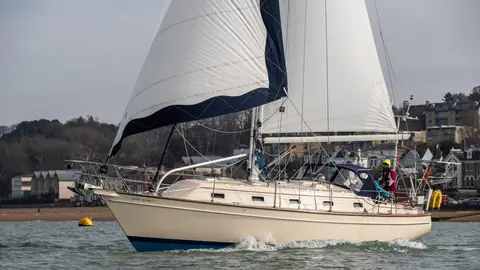
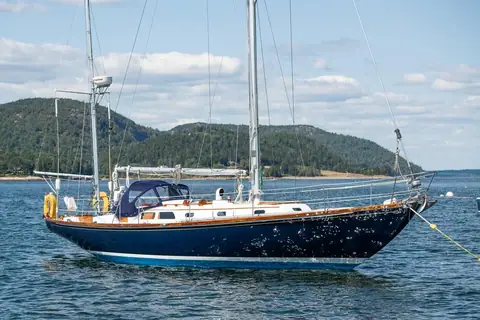
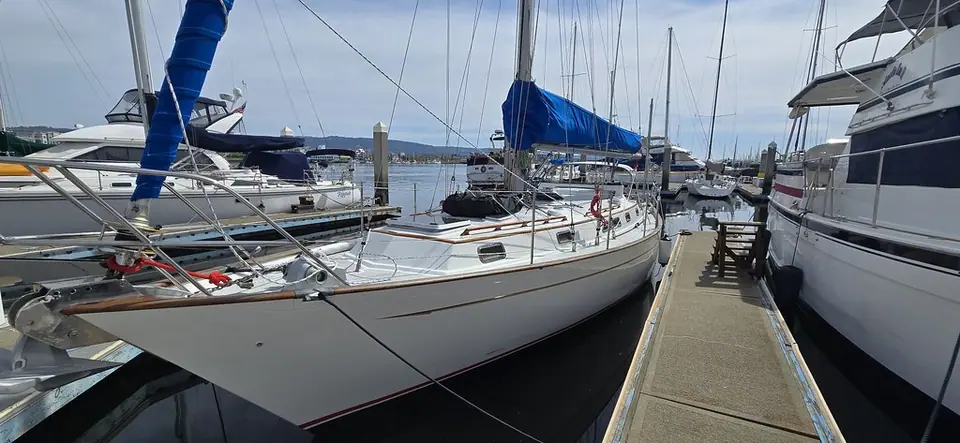
Robert Perry's fin-and-skeg answer to the heavy Taiwan cruiser, with joinery that still stops people on the dock.
- Length
- 39.4 ft12.02 m
- Beam
- 12.7 ft3.86 m
- Draft
- 5.8 ft1.75 m
- Cabins
- 2
- Used price
- $70K to $170K
On this page
- Overview
- Why a Passport 40 sails better than it looks
- Passport 40 sailboat data and what the ratios say
- On the helm, upwind and in a blow
- Pullman berth forward or classic V-berth
- The three big Passport 40 refit items
- Hull layup, ballast and blister history
- Ownership costs and how the market treats the Passport 40
- Specifications
- Price and value
- Strengths and weaknesses
- Used buyer checklist
- Rivals
- Our verdict
- FAQ
A 40-foot Robert Perry cruising sloop built in Taiwan from 1980 to 1991, about 148 hulls. Fin keel, skeg rudder, superb teak interior, and a reputation for sailing far better than its looks suggest.
- Liveaboard couples
- Coastal and bluewater cruising on a mid-range budget
- Sailors who value joinery and traditional style
- Pacific Northwest and California cruisers
Passport 40 by the numbers
- Sail area to displacement
- 15.2A cruising rig sized for comfort, so expect to motor in very light air.
- Displacement to length
- 272Moderate displacement, a classic cruising balance between load carrying and speed.
- Theoretical hull speed
- 7.7 knThe practical top speed of a displacement monohull under normal sailing, based on waterline length.
- Ballast ratio
- 37%A typical ballast ratio for a cruising monohull.
- Capsize screening
- 1.79Below 2.0, the traditional threshold for offshore suitability.
- Motion comfort ratio
- 34.0Moderate motion comfort, typical of modern cruisers.
- Length to beam ratio
- 3.11 : 1Moderate proportions.
Why a Passport 40 sails better than it looks
At first glance the Passport 40 looks like every other teak-heavy Taiwan cruiser of the early 1980s: traditional sheer, wooden toerails, a doghouse and acres of varnish. Underneath, it is something else. Robert Perry, who had already rewritten the rules with the Valiant 40, gave developer Wendell Renken a modified fin keel and a skeg-hung rudder rather than a full keel, and that one decision explains why owners keep using words like nimble and swift.
The Passport 40 launched in 1980 and stayed in production until 1991, with 148 hulls built. Sailing Magazine traces its basic underwater shape to the Valiant 40, and Perry paired that modified fin and skeg with a traditional deck and the goal that the boat could be sailed under main alone and singlehanded. It is a cruising yacht first, but one designed by a man who hated slow boats.
If you are shopping Passport 40 sailboats for sale today, you are buying a boat at least 35 years old. That is not a criticism. It is a reminder that the hull design is the constant and everything else, from tanks to teak decks to rigging, is a variable you must check.
Passport 40 sailboat data and what the ratios say
Published sailboat data lists the Passport 40 at 39 feet 5 inches overall, a 33 foot 5 inch waterline, a 12 foot 8 inch beam and about 22,771 pounds of displacement with 8,500 pounds of ballast. Standard draft is about 5 feet 9 inches, and the shoal keel takes 6 inches off that, to about 5 feet 3 inches. Sail area for the masthead sloop rig is listed near 762 square feet, and Sailing Magazine gives total working sail area as 771.
Run those numbers and you get a displacement to length ratio of roughly 272 and a sail area to displacement ratio near 15. That places the boat squarely in moderate-heavy cruising territory: not a light-air flyer, but comfortable, stiff and able to carry a cruising payload without sinking to its boot stripe. Theoretical hull speed is about 7.7 knots.
Note that some sources list the boat at 40 feet, 21,000 pounds and 10,000 pounds of ballast. Spec sheets for Taiwan-built yachts were never consistent. We use the figures repeated most often in the sailboat data references and recommend weighing any boat you plan to sail offshore.
- Displacement to length ratio about 272
- Sail area to displacement ratio about 15
- Ballast ratio near 37 percent on the most common figures
- Hull speed about 7.7 knots
On the helm, upwind and in a blow
Owners consistently describe the Passport 40 as predictable, sea-kindly and quicker than expected. The fin keel lets it tack crisply and point well for a cruiser of this weight, while the skeg protects the rudder and helps it track on long passages. It makes way in light going but really thrives when the wind perks up, and most owners reef the main at around 20 knots. A loaded cruising Passport still benefits from a large genoa or a code zero in the lightest air.
Almost all boats now carry an inner forestay, usually removable, turning the sloop into a working cutter with a staysail for heavy weather. That is the configuration we prefer for offshore work, because it gives a balanced, low-centered sail plan when the breeze passes 25 knots. Under power, the Perkins 4-108 pushes the boat at roughly 5 to 6 knots at 1,800 to 2,000 rpm, according to owners, and most boats have since swapped the original fixed three-blade prop for a feathering one.
Pullman berth forward or classic V-berth
Passport built the 40 in two principal interiors, split roughly half and half. One moves the head forward and fits an offset Pullman double, which is the better sleeping cabin for a couple living aboard. The other keeps a traditional V-berth forward with a separate shower compartment, which suits families with children or crew who want two distinct sleeping areas.
Both layouts share a saloon with a U-shaped or L-shaped settee, a double quarter cabin aft, a galley with two stainless sinks and a top-loading icebox, and a proper navigation station. The joinery is the main event: hand-fitted teak throughout, with the kind of detailing that would cost a fortune to replicate today. The downside is maintenance. Varnish everywhere, inside and out, takes real hours each season, and some buyers paint the exterior brightwork or remove teak trim to cut the workload.
The three big Passport 40 refit items
First, fuel tanks. Early Passport 40s used black iron tanks encapsulated in fiberglass, with total capacity given by Sailing Magazine as 105 gallons, although sailboatdata.com lists 70; later boats had aluminum tanks. Those tanks rust from the outside when bilge water sits against them, and failure often goes unnoticed until diesel appears in the bilge. Replacement with aluminum or polyethylene is a big but well understood job. A boat that has already had it done is worth noticeably more.
Second, decks. Five-eighths inch teak side decks were standard, fastened with thousands of screws into a cored deck. Early boats used marine plywood as the core material, later boats Airex foam. Every screw is a potential leak, and wet plywood core is expensive to fix, although Sailing Magazine noted the decks were laid in plenty of Thiokol and old Passport 40s rarely turn up with delaminated subdecks. Look for soft spots, black staining around bungs and evidence of past repairs.
Third, chainplates and standing rigging. Stainless chainplates that pass through the deck can develop crevice corrosion invisible from outside. Pull at least one for inspection before any ocean passage and replace the standing rigging if its age is unknown.
Hull layup, ballast and blister history
Sailing Magazine describes the hull as solid fiberglass laid up with 24-ounce woven roving and 1.5-ounce mat in polyester resin. That is heavy, simple and repairable construction, and owners report the boats have been more blister resistant than many of their Taiwan contemporaries.
Sailing Magazine's detailed review says the ballast is iron encapsulated in the keel cavity, as on most Taiwan boats of the period, although some listings describe lead. Encapsulated ballast avoids keel bolt issues entirely, but iron can swell and crack the encapsulation if water reaches it. Ask the seller, check the build documentation if any exists, and have the surveyor sound the keel stub and look for weeping or cracks at the bottom of the keel.
Ownership costs and how the market treats the Passport 40
Annual costs for a Passport 40 typically run $9,000 to $20,000, before major refits, covering a 40-foot slip outside premium harbors, insurance, haul-out, bottom paint and engine service. The variable is brightwork. Paying a yard to varnish the exterior can add several thousand dollars a year on its own.
On the market, Passport 40s hold value well because the supply is small, the reputation is strong and the boats have a cult following among liveaboard cruisers. Recent asking prices run from the high $70,000s for an East Coast boat needing work to around $150,000 for refitted examples in Maryland, Washington and California. They rarely appear as true bargains, and the good ones sell through word of mouth among owners.
Passport 40 specifications
| Length overall | 39.4 ft12.02 m |
|---|---|
| Waterline length | 33.4 ft10.19 m |
| Beam | 12.7 ft3.86 m |
| Draft | 5.8 ft1.75 m |
| Displacement | 22,771 lbs10,329 kg |
| Ballast | 8,5 lbs3,856 kg |
| Sail area | 762 sq ft70.8 m² |
| Fresh water | 13 gal492 L |
| Cabins | 2 |
| Berths | 6 |
| Heads | 1 or 2 |
| Standard engines | Perkins 4-108 diesel |
| Optional engines | Yanmar diesel on later boats |
| Cruise speed | 5.5 knots |
| Hull type | Moderate-heavy displacement monohull |
| Keel | Fin keel with skeg-hung rudder, standard 5 ft 9 in or shoal about 5 ft 3 in; encapsulated iron ballast |
| Rig | Masthead sloop, almost all fitted with a (usually removable) staysail stay for cutter use |
| Hull construction | Solid fiberglass hull, cored deck (plywood on early boats, Airex foam later) |
| Builder | Passport Yachts (built under contract in Taiwan), Taiwan |
| Naval architect | Robert H. Perry |
| Other design credits | Wendell Renken (commissioning developer) |
| Production | 1980 to 1991 |
| Status | Discontinued |
Figures come from builder documentation and independent tests where available. Displacement is usually quoted light, so a loaded cruising boat will weigh more. Compare these specs with another model.
How much does a Passport 40 cost?
Passport 40 prices track refit history far more than year. Boats with replaced fuel tanks, rebuilt or removed teak decks, new chainplates and recent rigging list from about $125,000 to $170,000, while original-condition boats with teak deck leaks start near $70,000. West Coast and Pacific Northwest boats tend to ask more than East Coast examples, and well-equipped boats in Australia show up regularly.
Estimate your yearly cost
A planning estimate using common rules of thumb: insurance near 1.5 percent of value, maintenance near 3 percent, haul out and bottom paint by length. Your marina, region and use will move these numbers. Open the full cost calculator.
Versions and options
- Layout A, head forward with Pullman
- Offset double berth forward with the head moved forward. Favored by liveaboard couples.
- Layout B, V-berth with separate shower
- Traditional V-berth forward and a dedicated shower compartment. Better for families or crew.
- Standard and shoal keel
- Standard draft 5 ft 9 in; the shoal keel takes about 6 inches off.
- Passport 41
- A 1987 to 1989 variant on the same hull, 41 ft 4 in overall with about 832 sq ft of sail; only about 9 were built.
Passport 40 timeline
- 1980Passport 40 launched, a Robert Perry design commissioned by Wendell Renken
- 1980sDeck core changes from marine plywood on early boats to Airex foam later; Yanmar engines and aluminum tanks replace the Perkins and black iron on later boats
- 1987The Passport 41, a longer variant on the same hull, appears; about 9 are built through 1989
- 1991Production ends after about 148 boats
- 2020sRefitted examples trade at $120,000 to $170,000 as demand for proven bluewater cruisers stays strong
Strengths and weaknesses
What owners like
- Fin keel and skeg rudder sail far better than full-keel Taiwan contemporaries
- Exceptional teak joinery inside
- Two well thought-out layouts for couples or families
- Easy to handle short-handed, especially as a cutter
- Strong reputation keeps resale firm
- Solid fiberglass hull with good blister record
What to weigh up
- Black iron fuel tanks on early boats are a near certain replacement item
- Teak decks and cored deck invite leaks and rot
- Heavy varnish workload
- Light-air performance needs extra sail when loaded
- Small production run means few boats on the market at once
Used Passport 40 buyer checklist
Take this list to a viewing. Your ticks are saved in this browser so you can come back to it.
Always commission an independent marine survey and an engine survey before you buy. How a marine survey works.
Rivals to consider
Valiant 40
Perry's other famous 40, a canoe stern bluewater boat with a slightly faster underbody and its own blister history.
Compare side by sideTayana 37
Smaller, heavier, full-keel Perry cutter that is cheaper but slower and more cramped.
Compare side by sidePacific Seacraft 37
American-built offshore canoe stern with better resale but a tighter interior.
Compare side by sideCabo Rico 38
A heavier Crealock cutter with similar teak character and more tankage.
Compare side by sideOur verdict on the Passport 40
The Passport 40 is the Taiwan cruiser for people who actually like to sail. Perry's fin and skeg underbody makes it far livelier than the full-keel boats it is usually compared with, and the interior craftsmanship is as good as anything from the era. The catch is age: fuel tanks, teak decks and chainplates decide whether you are buying a finished cruiser or a two-year project. Pay up for one that has already been through those jobs and you will have a capable, beautiful bluewater boat that holds its value.
Passport 40 questions answered
How much does a Passport 40 cost?
Used Passport 40s typically list from about $70,000 to $170,000. Boats with replaced tanks, sound decks and new rigging sit at the top of the range.
Who designed the Passport 40?
Robert Perry designed it for developer Wendell Renken, and it was built in Taiwan from 1980 to 1991.
Is the Passport 40 a bluewater boat?
Yes. Many have crossed oceans, and the moderate-heavy displacement, skeg rudder and cutter-capable rig suit offshore work once tanks, chainplates and rigging are sorted.
How many Passport 40s were built?
Passport built 148 Passport 40s between 1980 and 1991, plus about 9 of the Passport 41 variant on the same hull.
What is the Passport 40 draft?
5 feet 9 inches with the standard keel and about 5 feet 3 inches with the shoal option.
What engine is in a Passport 40?
Early boats got a Perkins 4-108 diesel and later boats Yanmars, and many have since been repowered.