Pacific Seacraft Bluewater Sailboats
Pacific Seacraft 31 Review and Ownership Guide
Bill Crealock's Crealock 37 formula shrunk to 31 feet, with a broader beam, a longer waterline and a surprisingly modern interior.
- Length
- 31.8 ft9.7 m
- Beam
- 9.8 ft3 m
- Draft
- 4.9 ft1.5 m
- Cabins
- 2 (V-berth forward, double berth aft to port)
- Used price
- $50K to $145K
On this page
- Overview
- How Pacific Seacraft shrank the Crealock 37 into a 31
- From Fullerton to Washington, North Carolina
- Underbody, ballast and rig choices
- The Joseph Artese interior
- Build details that justify the price
- Engine, tanks and electrics
- Buying a used Pacific Seacraft 31
- Specifications
- Price and value
- Strengths and weaknesses
- Used buyer checklist
- Rivals
- Our verdict
- FAQ
The Pacific Seacraft 31 is a W.I.B. Crealock designed canoe-stern cruiser introduced in 1987. About 100 were built in California; it was paused in 1999, revived in 2002 and is still listed as a build-to-order model in North Carolina.
- Couples or solo sailors planning offshore cruising on a budget
- Owners who value build quality over space
- Sailors stepping down from a larger cruiser
- Shoal-draft cruising grounds with the Scheel keel
Pacific Seacraft 31 by the numbers
- Sail area to displacement
- 15.7A cruising rig sized for comfort, so expect to motor in very light air.
- Displacement to length
- 348Heavy displacement. Slow to accelerate but steady and sea kindly with a full load.
- Theoretical hull speed
- 6.6 knThe practical top speed of a displacement monohull under normal sailing, based on waterline length.
- Ballast ratio
- 40%A high ballast ratio, so the boat stands up well to a breeze.
- Capsize screening
- 1.77Below 2.0, the traditional threshold for offshore suitability.
- Motion comfort ratio
- 30.6Moderate motion comfort, typical of modern cruisers.
- Length to beam ratio
- 3.24 : 1Moderate proportions.
How Pacific Seacraft shrank the Crealock 37 into a 31
By the mid 1980s Pacific Seacraft had built its reputation on Bill Crealock's canoe-stern 37 and 34. The company wanted a smaller boat in the same mold, and according to Wikipedia it commissioned Crealock in 1984 for a scaled-down 37. He first drew a 34 foot adaptation before condensing the idea into the 31, introduced in 1987. The factory described the result as born of the same wisdom as its forebears, with a very similar hull, rig and underbody but a proportionately broader beam and longer waterline.
Those proportions matter. On a 31 ft 10 in overall length (30 ft 6 in on deck), the waterline is 24 ft 2 in and the beam 9 ft 10 in, which gives the 31 a little more form stability and interior width than a straight scale-down would. Sailboatdata records about 100 built. The model was retired in 1999, reintroduced in 2002 and is still among the sizes the revived company says it builds.
From Fullerton to Washington, North Carolina
Pacific Seacraft was founded in 1975 to 1976 in Southern California by Henry Mohrschladt and Mike Howarth, who later left to start Cabo. After several ownership changes the company entered Chapter 11 in 2007, and Steve Brodie, a marine archaeologist from Washington, North Carolina, bought the name, molds and in-process hulls at a September 2007 auction. Cruising World reported that he immediately planned to offer the 31, 34, 37 and 40.
Brodie's yard now builds from 31 to 61 feet and does a lot of refit work on the classic models. Changes he described to Cruising World include 100 percent vinylester hulls against blistering, hard-panel headliners for access, CNC waterjet cut 316 stainless chainplates and other fittings. For a used-boat buyer the most useful consequence is a factory that still knows the boat, supplies parts and advice, and refits older hulls.
Underbody, ballast and rig choices
Like the larger Crealocks, the 31 has a long fin keel and a skeg-hung rudder rather than a full keel. The 2005 factory specification lists 11,000 lb displacement, 4,400 lb of solid lead ballast cast with stainless keel bolts and bedded in epoxy, and 485 sq ft of sail in the 100 percent foretriangle. Draft is 4 ft 11 in with the standard keel or 4 ft with the optional Scheel shoal keel, a $2,025 option in 2005, and the shoal boat carries a smaller 17 gallon fuel tank. Mast clearance is 44 ft.
The standard boat is a masthead sloop on a bowsprit platform, with a cutter rig available as an option. Most buyers looking for an offshore 31 want the cutter, because an inner staysail is a far better heavy-weather sail than a deeply furled genoa. Sailboatdata's ratios for the 31 show a displacement to length ratio around 348, a sail area to displacement ratio near 15.8 and a comfort ratio of about 30.6: a heavy, seakindly small cruiser rather than a fast one.
The Joseph Artese interior
The 31's interior came from Joseph Artese Design, a yacht interior specialist known for larger projects, and the factory pitched it as a fresh departure from earlier cruising interiors. Headroom is 6 ft 1 in. Forward is a 6 ft 6 in V-berth with drawers beneath and a slide-out dining table that stows under it. The saloon has 6 ft 10 in settee berths on both sides, a teak navigator's table with an icebox under its lift top, and a tilt-out chart locker.
The head is enclosed, with a separate wet hanging locker, and aft to port is a 6 ft 6 in double berth with drawers and a hanging locker. The galley has a gimbaled two-burner propane stove with oven, double stainless sinks, poured-foam insulated icebox and food lockers. The interior is a structural fiberglass, plywood and gelcoat module bonded into the hull, with primary bulkheads glassed to hull and deck and then bolted. Ventilation comes from six large and four small Hood opening ports, a large Bomar hatch and two Dorade vents.
Build details that justify the price
Pacific Seacraft's specification sheet reads like an offshore checklist. The hull-to-deck joint is bedded in polyurethane adhesive and through-bolted with stainless fasteners. Chainplates and backing plates are through-bolted to the hull, every cleat, winch and stanchion has a backing plate, and the bow platform carries two anchor rollers above a divided chain locker for two rodes. There is a stern anchor locker too. The cockpit has 7 ft seats, three lockers, two 1.5 inch drains and an Edson rack and pinion pedestal with an emergency tiller.
This attention to detail is why the 31 and its siblings command premiums over production boats of the same age. It is also why a buyer should examine the details closely: backing plates, sealant and bronze fittings that were excellent in 1990 may need rebedding today.
Engine, tanks and electrics
The 2005 boats used a three-cylinder Yanmar 3YM30 of 27 hp with freshwater cooling and a 55 amp alternator, turning a two-blade bronze propeller. Sailboatdata lists the earlier Yanmar 3GM30F as original equipment. The removable fiberglass fuel tank holds 23 gallons, two water tanks hold about 65 gallons, and the holding tank 16 gallons. Electrical systems were 12 volt with two group 27 batteries.
Those figures are modest for long passages, so most owners heading offshore add a larger battery bank and solar, jerry jugs or a watermaker, and refrigeration. If you are looking at a 1980s boat with an original 3GM30F, budget for a repower or at least a thorough engine survey.
Buying a used Pacific Seacraft 31
With only about 100 built, Pacific Seacraft 31 for sale listings are not common, and good boats tend to sell fast to sailors who have already decided they want a small Crealock. Expect to pay noticeably more than for a production 31 of the same age. The best value is often a 1990s boat with recent rigging, sails and engine work rather than a cosmetic gem with original systems.
Annual running costs in the US are moderate, about $6,500 to $14,000 for slip, insurance, haul-out, bottom paint and maintenance, with teak trim and bright work adding hours or yard bills. Resale is strong because the brand is still alive, parts are available and the canoe-stern Crealock look has a loyal following.
Pacific Seacraft 31 specifications
| Length overall | 31.8 ft9.7 m |
|---|---|
| Waterline length | 24.2 ft7.36 m |
| Beam | 9.8 ft3 m |
| Draft | 4.9 ft1.5 m |
| Air draft | 44 ft13.41 m |
| Displacement | 11, lbs4,99 kg |
| Ballast | 4,4 lbs1,996 kg |
| Sail area | 485 sq ft45 m² |
| Fuel capacity | 23 gal87 L |
| Fresh water | 65 gal246 L |
| Cabins | 2 (V-berth forward, double berth aft to port) |
| Berths | 6 |
| Heads | 1 enclosed |
| Standard engines | Yanmar 3YM30 diesel, 27 hp (2005 specification); early boats Yanmar 3GM30F |
| Hull type | Moderate to heavy displacement canoe-stern monohull |
| Keel | Long fin keel with skeg-hung rudder, 4 ft 11 in standard; Scheel shoal keel 4 ft 0 in |
| Rig | Masthead sloop with bowsprit platform; cutter rig optional |
| Hull construction | Hand-laminated fiberglass with vinylester first laminate, external lead ballast |
| Builder | Pacific Seacraft (Fullerton, California; Washington, North Carolina since 2007), USA |
| Naval architect | W.I.B. (Bill) Crealock |
| Other design credits | Interior by Joseph Artese Design |
| Production | 1987 to present |
| Status | Limited production |
Figures come from builder documentation and independent tests where available. Displacement is usually quoted light, so a loaded cruising boat will weigh more. Compare these specs with another model.
How much does a Pacific Seacraft 31 cost?
The 2005 factory price sheet listed a Pacific Seacraft 31 base price of $150,000 FOB Fullerton, before sails, roller furling or electronics. Today the North Carolina yard builds to order, and owner Steve Brodie has said new builds start at about $600,000 for the smallest models. Used boats from the original California run are the realistic market for most buyers; condition, the cutter option, recent repowers and offshore gear separate the cheaper 1980s boats from the late, well-equipped examples.
Estimate your yearly cost
A planning estimate using common rules of thumb: insurance near 1.5 percent of value, maintenance near 3 percent, haul out and bottom paint by length. Your marina, region and use will move these numbers. Open the full cost calculator.
Versions and options
- Standard keel sloop
- 4 ft 11 in draft, 23 gallon fuel tank, the most common configuration.
- Scheel shoal keel
- 4 ft draft for thin-water cruising, with a 17 gallon fuel tank.
- Cutter rig
- Optional inner forestay and staysail, preferred for offshore work.
- North Carolina build (2008 onward)
- Built to order by the revived company with all-vinylester hulls, 316 stainless fittings and updated interior details.
Pacific Seacraft 31 timeline
- 1984Pacific Seacraft asks Bill Crealock for a smaller version of the Crealock 37
- 1987Pacific Seacraft 31 introduced with a Joseph Artese interior
- 1999The 31 is retired from the range
- 2002The 31 is reintroduced
- 2005Factory base price listed at $150,000 FOB Fullerton
- 2007Steve Brodie buys Pacific Seacraft at auction and moves it to Washington, North Carolina
Strengths and weaknesses
What owners like
- Proven Crealock hull with skeg-hung rudder
- Strong, well-documented construction details
- Clever, light interior for a small canoe-stern boat
- Shoal keel and cutter options
- Builder still exists for parts, advice and refits
- Holds value well
What to weigh up
- Small fuel tank and modest water for long passages
- Expensive for its size, new or used
- Few boats on the market
- Heavy displacement makes it slow in light air
Used Pacific Seacraft 31 buyer checklist
Take this list to a viewing. Your ticks are saved in this browser so you can come back to it.
Always commission an independent marine survey and an engine survey before you buy. How a marine survey works.
Rivals to consider
Pacific Seacraft 34
The next size up from the same designer, with more room and tankage and many more boats on the market.
Compare side by sideWestsail 32
A heavier full-keel double-ender with a famous offshore record and lower prices, but slower and more work.
Compare side by sideBaba 30
A Perry-designed, Taiwan-built canoe-stern cruiser with more teak and a traditional interior.
Compare side by sideContessa 32
A faster, narrower British classic with a legendary offshore reputation and less interior volume.
Compare side by sideOur verdict on the Pacific Seacraft 31
The Pacific Seacraft 31 is a properly engineered small ocean cruiser with a better interior than its looks suggest. It is not fast, its tankage is modest, and it costs more than most boats its size, but the structure, the Crealock underbody and a still-active builder make it one of the safest bets in the under-32-foot bluewater class. Look for a cutter-rigged boat with refreshed rigging and engine, and expect it to hold its value when you sell.
Pacific Seacraft 31 questions answered
How much is a Pacific Seacraft 31 for sale?
Used boats generally run from about $50,000 to $145,000 in 2026, depending on age and condition. A new build from the North Carolina yard starts around $600,000.
Is the Pacific Seacraft 31 a bluewater boat?
Yes. It shares the Crealock 37's canoe stern, long fin keel and skeg-hung rudder concept and was built with offshore-grade hardware and backing plates.
Who designed the Pacific Seacraft 31?
W.I.B. (Bill) Crealock designed the hull and rig, and Joseph Artese Design created the interior.
Is the Pacific Seacraft 31 a sloop or a cutter?
It was standard as a masthead sloop with cutter rigging as an option. Many offshore owners prefer the cutter.
How many Pacific Seacraft 31s were built?
Sailboatdata records about 100, most built in California between 1987 and 1999.
Is Pacific Seacraft still in business?
Yes. Steve Brodie bought the company in 2007 and builds and refits Pacific Seacraft boats in Washington, North Carolina.
More bluewater sailboats to explore
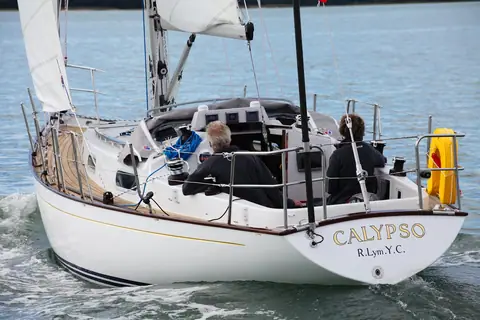
Contessa 32
Bluewater Sailboats, 32 ft
Used $25K to $85K
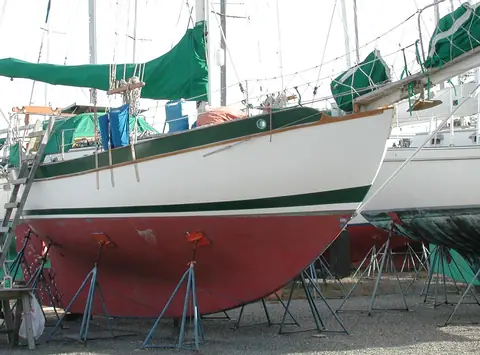
Westsail 32
Bluewater Sailboats, 32 ft
Used $15K to $75K

Baba 30
Bluewater Sailboats, 30 ft
Used $30K to $75K
Pacific Seacraft 34
Bluewater Sailboats, 34 ft
Used $65K to $220K