Island Packet Yachts Bluewater Sailboats
Island Packet 38 and 380 Review, Specs and Used Prices
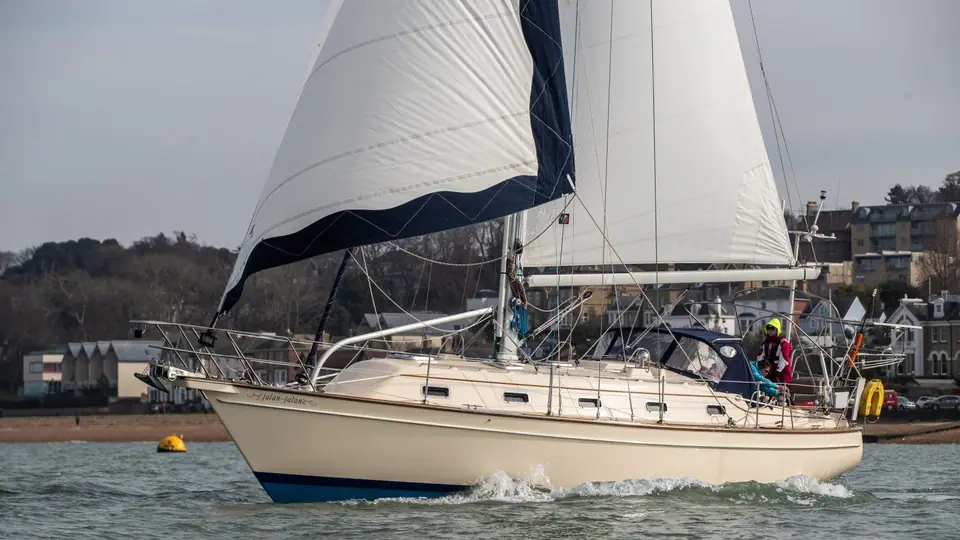
Bob Johnson's full-foil keel cutter, refined for couples who want a 42-foot interior on a 38-foot hull and a boat that forgives mistakes.
- Length
- 39.6 ft12.06 m
- Beam
- 13.2 ft4.01 m
- Draft
- 4.6 ft1.4 m
- Cabins
- 2 (standard) or 1 (two head option)
- Used price
- $125K to $215K
On this page
- Overview
- From the Island Packet 38 to the 380, and why buyers search for both
- The full-foil keel and what it costs you in light air
- A true cutter with a club-footed staysail
- Below decks: the forward island berth and the athwartships aft cabin
- Motoring with the 56 hp Yanmar 4JH3-E
- Where the survey money goes on a 25-year-old Packet
- Pricing an Island Packet 380 in 2026
- Specifications
- Price and value
- Strengths and weaknesses
- Used buyer checklist
- Rivals
- Our verdict
- FAQ
The Island Packet 380 is a 1998 to 2004 full-keel cutter from Largo, Florida. About 169 were built. Heavy, stiff and roomy, it is one of the most popular liveaboard cruisers on the US brokerage market.
- Liveaboard couples
- Bahamas and ICW cruisers
- Sailors moving up from a 30 to 34 footer
- Owners who value comfort over speed
Island Packet 380 by the numbers
- Sail area to displacement
- 18.6Balanced power for coastal and offshore cruising.
- Displacement to length
- 286Moderate displacement, a classic cruising balance between load carrying and speed.
- Theoretical hull speed
- 7.6 knThe practical top speed of a displacement monohull under normal sailing, based on waterline length.
- Ballast ratio
- 43%A high ballast ratio, so the boat stands up well to a breeze.
- Capsize screening
- 1.91Below 2.0, the traditional threshold for offshore suitability.
- Motion comfort ratio
- 30.6Moderate motion comfort, typical of modern cruisers.
- Length to beam ratio
- 3.01 : 1Moderate proportions.
From the Island Packet 38 to the 380, and why buyers search for both
Most people typing "island packet 38" into a search bar are really shopping a family of boats. The original Island Packet 38 was built from 1986 to 1993, 188 hulls in all, with a prominent bowsprit, a short overhang and the U-shaped hull and full-foil keel that Bob Johnson had patented for his company in Largo, Florida. It earned Island Packet its reputation for stiff, dry, forgiving cruisers that couples could live on.
The Island Packet 380 arrived in 1998, after the short-lived IP 37 (1994 to 1998) had filled the gap, as the grown-up version of the 38 concept. Johnson kept the full keel and the beamy, high-volume hull but reworked the bow: the bowsprit shrank to a stub and the stem gained overhang, which gave more usable foredeck and more volume below while sharpening the entry. Bob Perry, reviewing the design for Sailing Magazine in December 1998, predicted it would be drier and probably faster than its predecessor. Island Packet built about 169 of them before the IP 370 took over the slot in 2004.
Against an older 38, the 380 is noticeably bigger inside, with a better galley, head and aft cabin plus a swim step. The 38 costs much less and shares the same structural DNA, so most of the inspection advice below applies to both.
The full-foil keel and what it costs you in light air
Island Packet's full-foil keel is not a cut-away long keel of the old Colin Archer type. It is a long, shallow foil section with the lead ballast encapsulated inside the hull molding and a rudder hung on its trailing edge, protected below by a skeg. At 4 ft 7 in of draft the 380 can poke into the Bahamas, the Chesapeake's creeks and the Intracoastal Waterway without much drama, and a grounding is usually a non-event.
The numbers explain the character. A displacement of 21,000 lbs on a 32 ft waterline gives a displacement to length ratio of about 286, firmly heavy. Ballast is 9,000 lbs, a 43 percent ratio, and the Brewer comfort ratio of about 30.6 is right where a moderate offshore cruiser should sit. Sail area to displacement is roughly 18.7 with the reported sail area.
In practice that means the 380 wakes up at 12 to 15 knots of true wind and stays composed well beyond 25. Yachting Monthly's test recorded 5.5 to 6 knots upwind at 50 to 55 degrees apparent in Force 4, 6.5 to 7 knots reaching in Force 6, and 3.5 to 4 knots in 6 to 8 knots of breeze. Owners who sail in light-air venues such as Long Island Sound in August or the Gulf Coast in summer usually add a furling code zero or an asymmetric, or they accept more engine hours.
A true cutter with a club-footed staysail
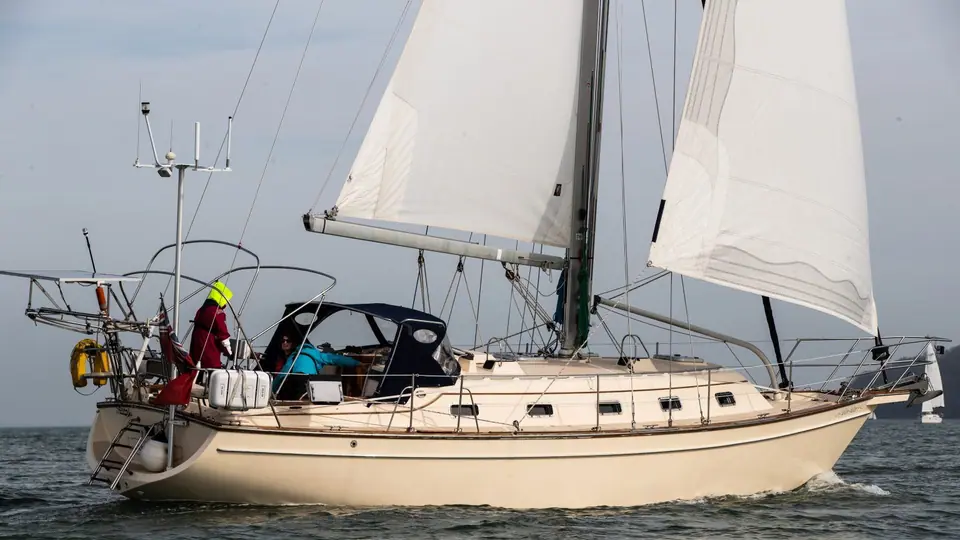
The 380 is rigged as a proper masthead cutter with the mast stepped well aft, leaving room for a roller furling Yankee or genoa on the headstay and a staysail on an inner forestay. The staysail sets on a self-tacking club boom in the style Garry Hoyt popularized, so short tacking up a channel under staysail and main is a one-person job. In 25 knots, rolling away the big headsail and sailing under staysail and a reefed main moves the center of effort inboard and low, which is exactly what you want offshore.
The cockpit is deep and secure, with rack-and-pinion wheel steering that feels direct and heavy. Teak is limited to caprails and handrails, wide side decks and a high bulwark make going forward easy, and the new bow created a useful platform for anchor work. The usual complaints are a wide sprayhood that blocks forward vision and a chart table with no backrest or fiddle.
- Single spreader masthead rig with forward and aft lower shrouds
- Staysail on a self-tacking club; headsail on a roller furler
- Most halyards and reefing lines led aft on later boats
- Mast height of about 54 ft above the waterline clears the 65 ft ICW bridges with room to spare
Below decks: the forward island berth and the athwartships aft cabin
The headline of the 380 is volume. With 13 ft 2 in of beam carried well forward and aft, plus a tall coachroof and about 6 ft 5 in of headroom, the saloon feels closer to a 42 footer. The standard arrangement has an owner's cabin forward with an island double, a single head with two doors (one from the forward cabin, one from the saloon) and a separate shower stall behind folding acrylic doors, a U-shaped galley with a double sink and top-loading refrigeration, and a big athwartships double aft.
A less common alternative trades the aft cabin for a second head, aimed at couples who never host overnight guests and want a dedicated shower room. It is rare on the brokerage market and narrows your resale audience, so think carefully before falling for one. Perry's only real quibble with the standard layout was that two friends of the same sex would have to share the forward island berth or the aft double, which is fair: this is a boat for two couples who know each other well, or a couple with an occasional guest.
Tankage backs up the liveaboard brief. With 170 gallons of fresh water and about 40 gallons of holding, a couple can sit at anchor in the Bahamas for weeks without a watermaker, and the lockers swallow spares and provisions without filling the aft cabin.
Motoring with the 56 hp Yanmar 4JH3-E
Power is a four cylinder Yanmar 4JH3-E rated at 56 hp turning a three blade propeller, often a Max Prop feathering unit. That sounds generous for the displacement, but the full keel's wetted surface and the boat's windage take their share. Yachting Monthly needed about 2,500 rpm to make 6 knots in calm water. Plan on 6 knots at a comfortable cruise. Fuel burn at that speed is modest for a 56 hp diesel, and published owner references put the motoring range from the 85 gallon tank at about 500 miles at 6 knots; check the boat's own log before counting on it.
Close-quarters handling is the long-keel learning curve everyone warns you about. The 380 carries its way, turns in a wider circle than a fin keeler and is unreliable when backing until it has real sternway. Many boats now carry a bow thruster. If yours does not, practice backing into your slip on a calm day before you need to do it in a crosswind.
Where the survey money goes on a 25-year-old Packet
Island Packet built solid boats, but the 380's construction has three areas that deserve a specialist's eye. The first is the ballast. The lead ingots sit in a lean sand and cement mix inside the keel molding, and UK surveyor Ben Sutcliffe-Davies has reported that after a hard grounding, water can find its way into the keel void and soften that mix. Fixing it is slow and expensive. Ask for grounding history, look for repaired gelcoat along the keel shoe, and have the surveyor take moisture readings and sound the keel with a hammer.
The second is the chainplates. They are welded and braced stainless frames tied into the hull-to-deck joint, which makes them strong but hard to inspect. Any history of leaks at the shroud bases, rust staining inside lockers or delaminated caprail around the chainplates should trigger a deeper look. The third is the cored deck around winches, hatches and portlights, where decades of fastener movement can let water into the core.
The skeg fastening can also weep into the keel void, and the off-white hull color is hard to match after repairs. None of this is unusual for the age, but the problems hide where a casual walk-through never looks, so a full survey with moisture meter and keel inspection is non-negotiable.
Pricing an Island Packet 380 in 2026
Island Packets hold value better than almost any other production cruiser of their era because the buyer pool is loyal and the boats are easy to understand. Recent asking prices for 1999 to 2003 boats sit between about $135,000 and $210,000 in the US, with Florida, the Chesapeake and the Carolinas holding most of the inventory. Expect to land 8 to 12 percent below asking on a well-presented boat and more on one that needs rigging and canvas.
Budget around $9,000 to $18,000 a year to keep a 380 in good order on the East Coast, covering insurance, a slip or mooring, haul-out and bottom paint, engine service and a sinking fund for sails and rigging. Standing rigging older than 12 to 15 years should be priced into your offer, and a set of quality cruising sails for a cutter runs well into five figures.
Island Packet 380 specifications
| Length overall | 39.6 ft12.06 m |
|---|---|
| Waterline length | 32 ft9.75 m |
| Beam | 13.2 ft4.01 m |
| Draft | 4.6 ft1.4 m |
| Air draft | 54.3 ft16.54 m |
| Displacement | 21, lbs9,525 kg |
| Ballast | 9, lbs4,082 kg |
| Sail area | 885 sq ft82.2 m² |
| Fuel capacity | 85 gal322 L |
| Fresh water | 17 gal644 L |
| Cabins | 2 (standard) or 1 (two head option) |
| Berths | 5 to 6 |
| Heads | 1 with separate shower stall (2 on the alternative layout) |
| Standard engines | Yanmar 4JH3-E 56 hp diesel |
| Maximum power | 56 hp |
| Cruise speed | 6 knots |
| Hull type | Heavy displacement monohull with full-foil long keel |
| Keel | Full-foil encapsulated long keel with lead ballast; keel-hung rudder. A keel/centerboard version drew 3.92 ft up and 7.58 ft down |
| Rig | Masthead cutter, single spreader, staysail on a self-tacking club boom |
| Hull construction | Solid fiberglass hull, Polycore cored deck |
| Builder | Island Packet Yachts, United States |
| Naval architect | Bob Johnson (Robert K. Johnson) |
| Production | 1998 to 2004 |
| Status | Discontinued |
Figures come from builder documentation and independent tests where available. Displacement is usually quoted light, so a loaded cruising boat will weigh more. Compare these specs with another model.
How much does a Island Packet 380 cost?
Asking prices for Island Packet 380s on the US market cluster between about $135,000 and $210,000, with the spread driven far more by refit history than by model year. A boat with recent standing rigging, a documented keel and chainplate inspection, newer canvas and an updated electrical system can ask $40,000 more than a tired sister with original gear. Centerboard versions and the two head layout are rare and sell to a narrow audience.
Estimate your yearly cost
A planning estimate using common rules of thumb: insurance near 1.5 percent of value, maintenance near 3 percent, haul out and bottom paint by length. Your marina, region and use will move these numbers. Open the full cost calculator.
Versions and options
- Island Packet 38
- The 1986 to 1993 forerunner (188 built) with a longer bowsprit, less volume and a lower price.
- 380 standard
- Two cabins and one head with a separate shower stall. By far the most common.
- 380 two head layout
- One cabin and two heads. Rare, and a narrower resale audience.
- Keel and centerboard
- Draws 3.92 ft up and 7.58 ft down. Better pointing, more maintenance.
Island Packet 380 timeline
- 1979Bob Johnson founds Island Packet Yachts in Largo, Florida
- 1986Island Packet 38 introduced; 188 are built through 1993
- 1994The IP 37 bridges the gap until 1998, with about 60 built
- 1998Island Packet 380 launched with a reworked bow and longer overhang; Bob Perry reviews it in Sailing Magazine
- 2004Production ends after about 169 hulls as the IP 370 replaces it
- 2017Darrell and Leslie Allen take over Island Packet Yachts, keeping parts and owner support alive for older boats
Strengths and weaknesses
What owners like
- Very stiff and forgiving with a 43 percent ballast ratio
- Shallow 4 ft 7 in draft for the Bahamas and the ICW
- Interior volume of a much larger boat
- Large water tankage for extended anchoring
- Easy to handle cutter rig with self-tacking staysail
- Loyal owner community and strong resale demand
What to weigh up
- Slow in light air without a code zero or asymmetric
- Backing and close-quarters handling take practice
- Ballast and keel void can be expensive to repair after a grounding
- Glassed-in chainplates are hard to inspect
- Chart table is impractical at sea
Used Island Packet 380 buyer checklist
Take this list to a viewing. Your ticks are saved in this browser so you can come back to it.
Always commission an independent marine survey and an engine survey before you buy. How a marine survey works.
Rivals to consider
Pacific Seacraft 37
Narrower, faster and better upwind with a fin and skeg underbody, but noticeably smaller inside and deeper drafted.
Compare side by sideTayana 37
A traditional Taiwanese double-ender with more teak to maintain, often cheaper, and with more variable build quality.
Compare side by sideCabo Rico 38
A prettier, more traditional Crealock design with a lovely interior, but tighter accommodation and rarer on the market.
Compare side by sideValiant 40
A genuine offshore performer with a better turn of speed and a deeper draft, aimed at sailors crossing oceans rather than living at anchor.
Compare side by sideOur verdict on the Island Packet 380
The Island Packet 380 is one of the most rational buys in the US used cruising market. It is not fast, it does not point like a fin keeler and it asks for patience in a marina, but it gives a couple a stiff, dry, shoal-draft home with the tankage to stay away for weeks. Buy the best documented example you can afford, have a surveyor who knows Island Packets look hard at the keel void, chainplates and deck core, and the resale market will rarely disappoint you.
Island Packet 380 questions answered
What is the difference between the Island Packet 38 and the 380?
The 38 was built from 1986 to 1993; the 380 (1998 to 2004) followed the IP 37 in the lineup and brought a reworked bow, a shorter bowsprit, more overhang and a larger interior. Both share Bob Johnson's full-foil keel, but the 380 is roomier and generally commands a higher price.
How much is an Island Packet 380 worth?
Most US asking prices fall between about $135,000 and $210,000 in 2026. Condition and refit history matter more than model year.
Is the Island Packet 380 a bluewater boat?
Yes, with a heavy displacement, a 43 percent ballast ratio and a capsize screening value of about 1.9, it is suited to ocean passages, though it is slower than modern fin keel cruisers and best in moderate to fresh trade winds.
How many Island Packet 380s were built?
About 169 were built between 1998 and 2004 at Island Packet Yachts in Largo, Florida.
What engine does the Island Packet 380 have?
A Yanmar 4JH3-E four cylinder diesel rated at 56 hp. Expect about 6 knots at roughly 2,500 rpm in calm water.
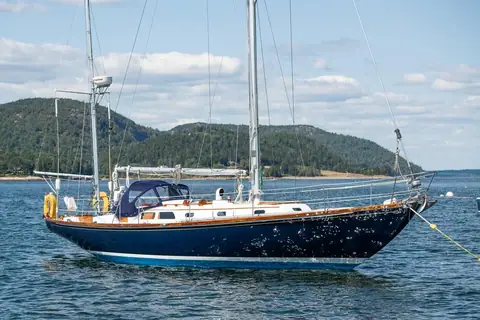
Island Packet 380 photos
More bluewater sailboats to explore
Passport 40
Bluewater Sailboats, 39 ft
Used $70K to $170K
Valiant 40
Bluewater Sailboats, 40 ft
Used $45K to $200K
Hinckley Bermuda 40
Bluewater Sailboats, 41 ft
Used $60K to $260K

Cabo Rico 38
Bluewater Sailboats, 38 ft
Used $55K to $190K