Pacific Seacraft Bluewater Sailboats
Dana 24 Specs, Prices and Used Buyer's Guide
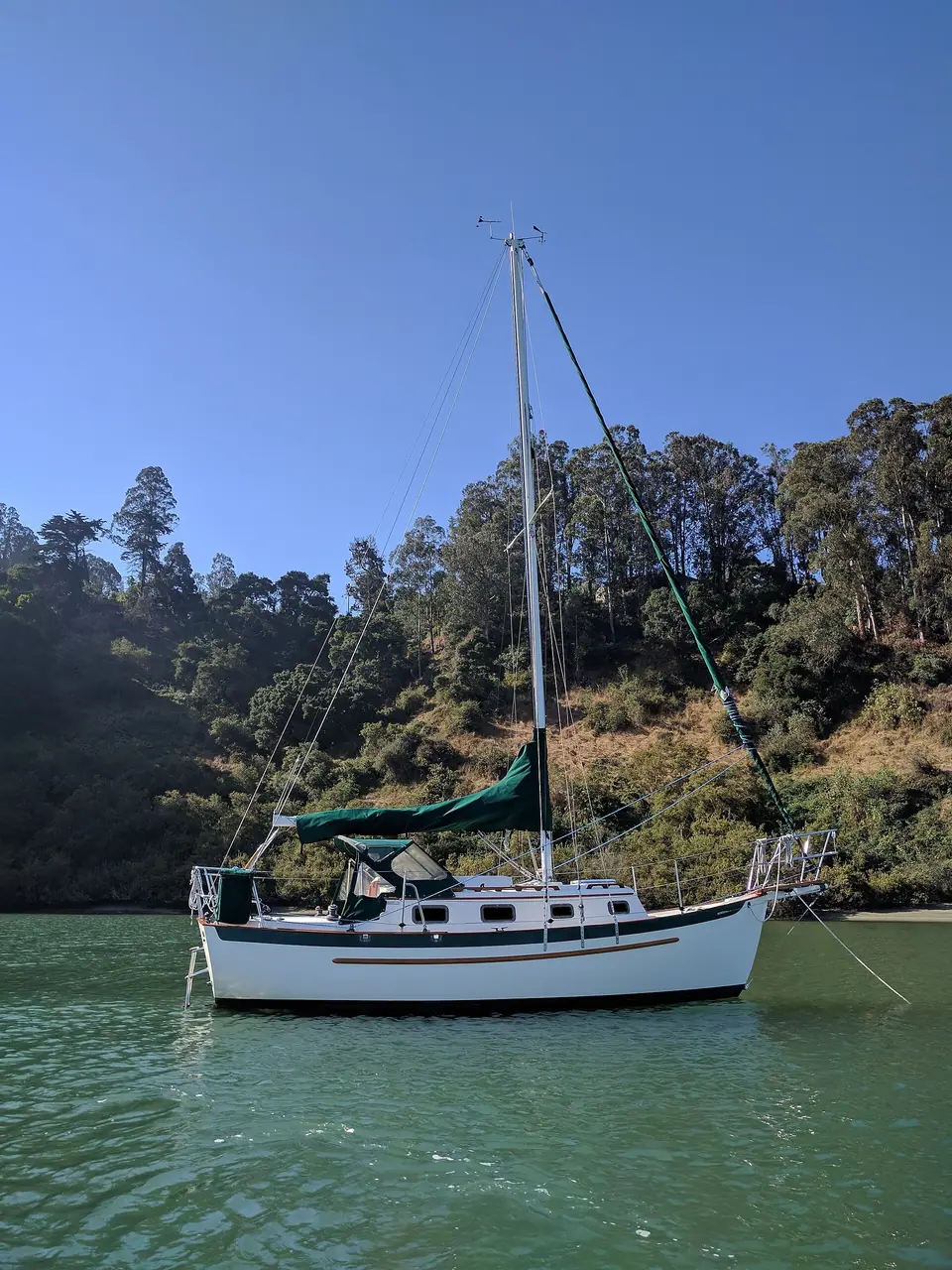
Bill Crealock's answer to the smallest boat a couple could safely cruise offshore, with six feet of headroom and a trailer hitch.
- Length
- 27.3 ft8.31 m
- Beam
- 8.6 ft2.62 m
- Draft
- 3.8 ft1.17 m
- Cabins
- 1 (open plan with enclosed head)
- Used price
- $35K to $120K
On this page
- Overview
- The Dana 24 brief, offshore safety in a trailerable package
- Two production runs and why the later boats cost more
- How a Dana 24 is built
- A cockpit long enough to sleep in
- Six feet of headroom on 24 feet
- Sailing numbers from a blustery San Francisco Bay test
- Dana 24 for sale, what to inspect and what it costs to keep
- Specifications
- Price and value
- Strengths and weaknesses
- Used buyer checklist
- Rivals
- Our verdict
- FAQ
The Pacific Seacraft Dana 24 is a 24-foot, 8,000 lb long-keel cutter or sloop designed by W.I.B. Crealock and built from 1984 to 1998 and again from 2001 to 2007. More than 250 were built.
- Couples who cruise small
- Single-handers
- Trailer cruisers
- Sailors wanting offshore capability on a small budget
The Dana 24 brief, offshore safety in a trailerable package
Bill Crealock drew the Dana 24 in the early 1980s, and he described the target precisely: the smallest boat in which a couple could cruise offshore in safety and reasonable comfort, with an enclosed head, enough volume to carry real tankage and supplies, and no apologies for displacement, because in his words nothing eases motion more. The result is a 24 ft 2 in hull with a 21 ft 5 in waterline, 8 ft 7 in of beam and 8,000 lbs of displacement, of which 3,200 lbs is lead.
Pacific Seacraft launched the Dana 24 in 1984 alongside its larger Crealock designs, the PS 34 and 37, and it shares their clean sheer, bronze ports and seagoing details. Practical Sailor called it a pricey, seaworthy, two-person cruiser with a seagoing rather than dockside layout, which is still the best one-line summary of the boat. Several have completed circumnavigations, and at 3 ft 10 in of draft it can also be trailered home at the end of the season.
Pacific Seacraft Dana 24 by the numbers
- Sail area to displacement
- 14.3A cruising rig sized for comfort, so expect to motor in very light air.
- Displacement to length
- 363Heavy displacement. Slow to accelerate but steady and sea kindly with a full load.
- Theoretical hull speed
- 6.2 knThe practical top speed of a displacement monohull under normal sailing, based on waterline length.
- Ballast ratio
- 40%A high ballast ratio, so the boat stands up well to a breeze.
- Capsize screening
- 1.72Below 2.0, the traditional threshold for offshore suitability.
- Motion comfort ratio
- 30.5Moderate motion comfort, typical of modern cruisers.
- Length to beam ratio
- 3.18 : 1Moderate proportions.
Two production runs and why the later boats cost more
The Dana had a bumpy life. After a successful run from 1984 to 1998, Pacific Seacraft benched it because its factory was stretched building a new 40-foot sailboat and trawlers. Production restarted in 2001 and continued until the company went bankrupt in 2007 and was bought by Steve Brodie, who moved Pacific Seacraft to Washington, North Carolina. The Dana design went its own way: Wikipedia records that Seacraft Yachts acquired it and began building again from serial number 351.
Early boats were semi-custom, with owners allowed wide latitude on interior details, gear and colors. The later run moved closer to standard production with fewer options, and newer boats use rectangular ports with better seals than the eight round bronze portlights of the 1980s. The 2001 to 2007 boats are rarer, newer and command a premium of $30,000 to $50,000 over a comparable early boat on today's market.
How a Dana 24 is built
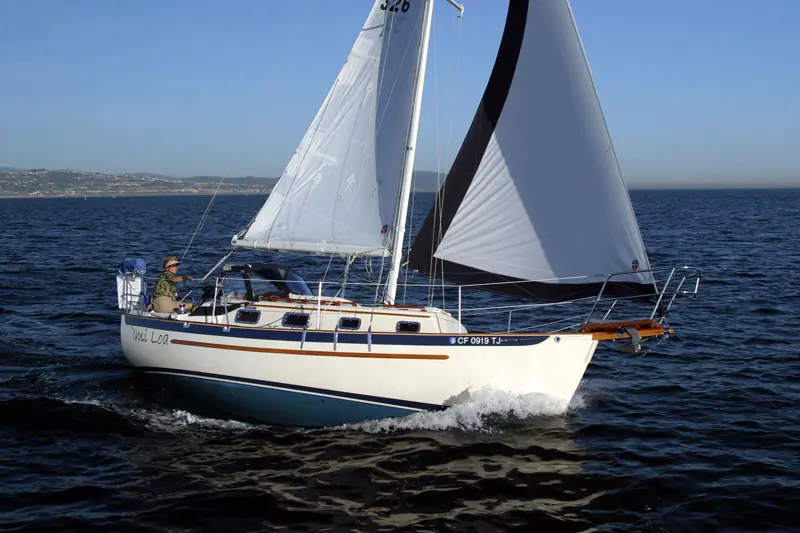
Practical Sailor detailed the layup: an ISO-NPG gelcoat, a 3 oz mat skin coat in vinylester resin to resist blistering, then three layers of 2415 biaxial roving, with extra layers at the keel, rudder post and chainplates. The bottom is 5/8 in thick. The hull is solid glass, the transom is plywood-cored to stiffen it for a ladder or wind vane, and the 3,200 lbs of ballast is pre-cast lead bonded inside the keel.
The deck is cored with 1/2 in balsa with plywood under hardware. Hull and deck flanges meet to form a bulwark, bedded in polyurethane, through-bolted and capped with an aluminum toerail. The interior is a fiberglass and plywood matrix bonded to the hull, which keeps it stiff while still allowing access behind cabinetry. Every piece of deck hardware came from the same suppliers Pacific Seacraft used on its bigger boats, from Lewmar winches to bronze ports and turnbuckles.
A cockpit long enough to sleep in
Crealock gave the Dana long cockpit seats at the expense of interior space on purpose, so crew could sleep outside on hot nights. The seats are 6 ft 3 in long, the footwell is 51 in long and 20 in wide for bracing at heel, and the traveler sits on the transom out of the way. Large scuppers and high coamings keep the cockpit dry in a following sea, and the removable, watertight cockpit sole lifts out to give access to the engine and steering, a Crealock signature.
The aluminum mast is deck-stepped on a compression post, which offshore purists dislike but which makes lowering it for bridges or trailering simple. Halyards are external to mast winches, chainplates are through-bolted with backing plates, and the jib sheets lead to tracks on the 5 in bulwark, with an inboard track for a staysail. A 36 in bowsprit carries the anchor and adds about three feet to the overall length.
Six feet of headroom on 24 feet
Pacific Seacraft claimed the Dana had 50 percent more space below than any boat of similar length, and Practical Sailor found no evidence to the contrary. There is about 6 ft 1 in of headroom in the saloon and 8 ft 6 in from the foot of the companionway to the V-berth, which sleeps two adults up to 6 ft 2 in. The 4 ft 6 in settees extend under the V-berth to become 6 ft 6 in berths, and the dining table slides out from beneath the V-berth around the mast compression post.
The galley gets a two-burner gimbaled stove (kerosene on early boats, propane later), a deep sink and a well-insulated icebox of about 3.5 cubic feet. The enclosed head is to starboard and is cramped at 32 by 21 in. A 30 gallon stainless water tank sits under the V-berth (sailboatdata lists 40 gallons and notes an additional 30 gallon option), and the 18 gallon fuel tank is under the cabin sole. The navigation desk is tiny, so most owners navigate from a tablet.
Sailing numbers from a blustery San Francisco Bay test
Practical Sailor tested hull number 39, a 1986 sloop, in 12 to 15 knots on San Francisco Bay under full main and a 110 percent jib. Close-hauled with sheets just eased it made 5.7 to 5.9 knots over the ground, and hardened up further it held 5.2 to 5.4 knots at 20 degrees of heel. Broad reaching in 13.5 knots it reached 6.8 knots over the ground. In light air on a beam reach it dropped to 3.5 to 4 knots and felt its weight.
The owner reefed only at 18 to 20 knots, at which point the boat develops excess weather helm. Hull speed is 6.2 knots and the PHRF average is about 221. For light-air venues, a larger genoa or an asymmetric tacked to the bowsprit makes a real difference. Under power, the Yanmar pushes the boat at hull speed into a chop at about three-quarters throttle.
Dana 24 for sale, what to inspect and what it costs to keep
Most issues are age-related. Check the balsa deck core around stanchion bases (Practical Sailor noticed one brace bedded on top of the nonskid), the mast step and compression post, and the wiring loop at the mast base that Pacific Seacraft left for trailer sailors to disconnect. The fuel fill on the companionway step invites spills, and the hawsepipe should be sealed offshore. Older round ports often weep and are worth rebedding or replacing.
Annual costs are modest: roughly $4,000 to $9,000 for a slip or trailer storage, insurance, haul-out, bottom paint and diesel service. A good trailer adds value and flexibility, letting owners cruise the Sea of Cortez one year and the San Juans the next.
Pacific Seacraft Dana 24 specifications
| Length overall | 27.3 ft8.31 m |
|---|---|
| Waterline length | 21.4 ft6.53 m |
| Beam | 8.6 ft2.62 m |
| Draft | 3.8 ft1.17 m |
| Air draft | 37.3 ft11.37 m |
| Displacement | 8, lbs3,629 kg |
| Ballast | 3,2 lbs1,452 kg |
| Sail area | 358 sq ft33.3 m² |
| Fuel capacity | 18 gal68 L |
| Fresh water | 4 gal151 L |
| Cabins | 1 (open plan with enclosed head) |
| Berths | 4 |
| Heads | 1 enclosed |
| Standard engines | Yanmar 2GM20F 18 hp diesel (about 16 hp Yanmar on early boats) |
| Maximum power | 18 hp |
| Top speed | 6.2 knots |
| Hull type | Moderate to heavy displacement long keel monohull, 24 ft 2 in on deck |
| Keel | Long keel with cut-away forefoot and internal lead ballast, keel-hung rudder |
| Rig | Deck-stepped masthead sloop or cutter with 36 in bowsprit |
| Hull construction | Solid fiberglass hull with vinylester skin coat, balsa-cored deck, plywood-cored transom |
| Builder | Pacific Seacraft, United States |
| Naval architect | William I. B. Crealock |
| Production | 1984 to 2007 |
| Status | Discontinued |
Figures come from builder documentation and independent tests where available. Displacement is usually quoted light, so a loaded cruising boat will weigh more. Compare these specs with another model.
How much does a Pacific Seacraft Dana 24 cost?
New Dana 24s cost $70,000 to $100,000 in the first production run, and in 2001 the base price was $70,000, rising to about $80,000 with furling, vang, shore power and instruments. Used prices split clearly into two groups: 1984 to 1998 boats mostly between about $35,000 and $70,000, and the scarcer 2001 to 2007 boats between roughly $80,000 and $120,000. Rectangular ports, a recent diesel overhaul and a dry deck add real money.
Estimate your yearly cost
A planning estimate using common rules of thumb: insurance near 1.5 percent of value, maintenance near 3 percent, haul out and bottom paint by length. Your marina, region and use will move these numbers. Open the full cost calculator.
Versions and options
- Early Dana 24 (1984 to 1998)
- Semi-custom interiors, eight round bronze ports, kerosene stove and a 16 hp Yanmar on early boats.
- Later Dana 24 (2001 to 2007)
- More standardized build, rectangular ports, propane galley and the 18 hp Yanmar 2GM20F.
- Sloop or cutter
- Both rigs offered; the cutter adds a staysail and 448 sq ft of total sail area.
Pacific Seacraft Dana 24 timeline
- 1984Dana 24 introduced by Pacific Seacraft
- 1998Production paused as the factory focuses on larger boats
- 2001Dana 24 reintroduced at a base price of $70,000
- 2007Pacific Seacraft enters bankruptcy and production ends; the design later passes to Seacraft Yachts
- 2009Designer Bill Crealock dies
Strengths and weaknesses
What owners like
- Genuinely seaworthy and stiff with a 40 percent ballast ratio
- Six feet of headroom and an enclosed head
- Pacific Seacraft quality hardware and joinery
- Trailerable with a 3 ft 10 in draft
- Long cockpit seats for sleeping outside
- Strong resale and loyal following
What to weigh up
- Expensive for its length
- Sluggish in light air
- Cramped head and tiny chart table
- Deck-stepped mast is less robust offshore
Used Pacific Seacraft Dana 24 buyer checklist
Take this list to a viewing. Your ticks are saved in this browser so you can come back to it.
Always commission an independent marine survey and an engine survey before you buy. How a marine survey works.
Rivals to consider
Pacific Seacraft Flicka 20
The little sister: cheaper and cuter but slower and smaller inside.
Compare side by sideBristol Channel Cutter
Lyle Hess's 28-footer is more boat and more money, with a gaff-era look and much more teak.
Compare side by sideCape Dory 25D
A conventional full-keel pocket cruiser at a much lower price, with less headroom.
Our verdict on the Pacific Seacraft Dana 24
The Dana 24 is the best-built small cruiser of its generation and still one of the few 24-footers you could sensibly take offshore. It is heavy, slow in light air and expensive for its size, but it delivers six feet of headroom, a real head, an ocean-worthy hull and Pacific Seacraft detailing in a package you can tow. Buy an early boat for value or a 2001 to 2007 boat for condition, check the deck core and you will own a pocket cruiser that holds its price.
Pacific Seacraft Dana 24 questions answered
How much is a Dana 24 worth?
Early 1984 to 1998 boats generally sell for about $35,000 to $70,000, while 2001 to 2007 boats range from about $80,000 to $120,000.
Is the Dana 24 trailerable?
Yes, with a suitable trailer and tow vehicle. It displaces about 8,000 lbs and draws 3 ft 10 in, and the deck-stepped mast is easy to lower.
Can a Dana 24 sail offshore?
Yes. Several Dana 24s have completed circumnavigations, and the design was intended for two people sailing offshore.
How many Dana 24s were built?
More than 250 were built by Pacific Seacraft between 1984 and 2007.
What is the headroom in a Dana 24?
About 6 ft 1 in in the saloon, unusual for a 24-foot boat.
Where can I find a Dana 24 for sale?
California, the Pacific Northwest, Florida and the Chesapeake have the most boats. Owner associations and brokers specializing in Pacific Seacraft are good places to look.
Pacific Seacraft Dana 24 photos
More bluewater sailboats to explore

Nor'Sea 27
Bluewater Sailboats, 27 ft
Used $35K to $85K
Bristol Channel Cutter 28
Bluewater Sailboats, 28 ft
Used $60K to $175K
Cape Dory 28
Bluewater Sailboats, 28 ft
Used $12K to $40K
Contessa 26
Bluewater Sailboats, 26 ft
Used $8K to $40K