Nautor's Swan Bluewater Sailboats
Swan 65, the Whitbread Winner as a Cruising Yacht Today
Sayula II won the first Whitbread in one, and fifty years on the Sparkman and Stephens Swan 65 is still the benchmark classic ocean ketch.
- Length
- 64.6 ft19.68 m
- Beam
- 16.3 ft4.98 m
- Draft
- 9.5 ft2.9 m
- Cabins
- 4
- Used price
- $320K to $1.1M
On this page
- Overview
- Sayula II and the race that made the Swan 65 famous
- Sparkman and Stephens lines and the numbers that matter
- Ketch or sloop, and why most owners chose the mizzen
- Four cabins, twelve berths and a proper aft stateroom
- What a Swan 65 refit really involves
- The 2019 Frers Swan 65 shares only the name
- Running costs and the classic Swan 65 market
- Specifications
- Price and value
- Strengths and weaknesses
- Used buyer checklist
- Rivals
- Our verdict
- FAQ
A 65-foot Sparkman and Stephens ketch or sloop built by Nautor in Finland from 1972 to 1989, 41 hulls. Whitbread winner, true ocean cruiser and blue-chip classic. A new Frers Swan 65 followed in 2019.
- Classic yacht racing
- Long-range ocean cruising with crew
- Buyers who value pedigree and history
- Owners planning a major refit project
Sayula II and the race that made the Swan 65 famous
In 1973 a Mexican businessman named Ramon Carlin entered a brand new Swan 65 in the first Whitbread Round the World Race. Sayula II, hull number 3, was a production cruising yacht with a family crew, racing against purpose-built ocean racers. It won outright in 133 days and 13 hours. That result made Nautor's reputation and defined the Swan 65 for the next half century.
The boat kept proving the point. In the 1977 to 1978 Whitbread, King's Legend finished second, Disque d'Or fourth and ADC Accutrac fifth, the latter skippered by Clare Francis, the first woman to skipper a Whitbread entry. Xargo III finished sixth in 1981 to 1982. Few production yachts of any size have a record like that.
Today the Swan 65 is a blue-chip classic. Of the 41 hulls Nautor built between 1972 and 1989, the large majority are still sailing, many after multiple refits, and the type has its own following at Swan regattas from Porto Cervo to Newport.
Swan 65 by the numbers
- Sail area to displacement
- 16.9Balanced power for coastal and offshore cruising.
- Displacement to length
- 301Heavy displacement. Slow to accelerate but steady and sea kindly with a full load.
- Theoretical hull speed
- 9.2 knThe practical top speed of a displacement monohull under normal sailing, based on waterline length.
- Ballast ratio
- 33%A typical ballast ratio for a cruising monohull.
- Capsize screening
- 1.58Below 2.0, the traditional threshold for offshore suitability.
- Motion comfort ratio
- 50.4A slow, easy motion in a seaway, kind to crews on long passages.
- Length to beam ratio
- 3.96 : 1A slim, easily driven hull.
Sparkman and Stephens lines and the numbers that matter
Sparkman and Stephens drew the 65 to the IOR Mk III rule, basing it on the firm's aluminum yacht Dora IV, as a fast, seaworthy ocean yacht with a fin keel, a skeg-hung rudder, moderate overhangs and a powerful masthead rig. It measures 64 feet 7 inches overall on a 47-foot waterline, with a 16 foot 4 inch beam and 9 feet 6 inches of draft. Light displacement is about 31,800 kilograms, or 70,100 pounds, on the first 19 hulls.
From hull 20 onward Nautor increased ballast from about 10,400 to 13,900 kilograms, raising displacement to roughly 35,300 kilograms and the ballast ratio from about 31 to 39 percent. That change made later boats noticeably stiffer, and serious buyers ask which group a hull belongs to.
Both ketch and sloop versions carry roughly 1,800 square feet of working sail on keel-stepped aluminum spars. The sloop mast stands about 80 feet above the water, the ketch about 75 feet. The mainsail alone is about 840 square feet and the masthead spinnaker more than 3,600, which is why a modern Swan 65 owner usually invests in powered winches.
- Hulls 1 to 19: about 10,400 kg ballast, 31 percent ratio
- Hull 20 onward: about 13,900 kg ballast, 39 percent ratio
- Draft 2.9 m (9 ft 6 in), limiting some anchorages
- Sloop air draft about 24.4 m (80 ft)
Ketch or sloop, and why most owners chose the mizzen
Most Swan 65s were delivered as ketches because they were bought to cruise the world, and only a handful left the factory as masthead sloops. The ketch splits the sail plan into smaller, more manageable pieces, lets the boat balance under jib and mizzen in a blow, and gives a mizzen staysail for reaching in light air. The sloop is faster upwind and simpler to race, but every sail is bigger and heavier.
For a family or a couple with a paid hand, the ketch is the more practical boat. For a racing program on the classic circuit, the sloop is the one to want, and sloops command a premium for that reason.
Four cabins, twelve berths and a proper aft stateroom
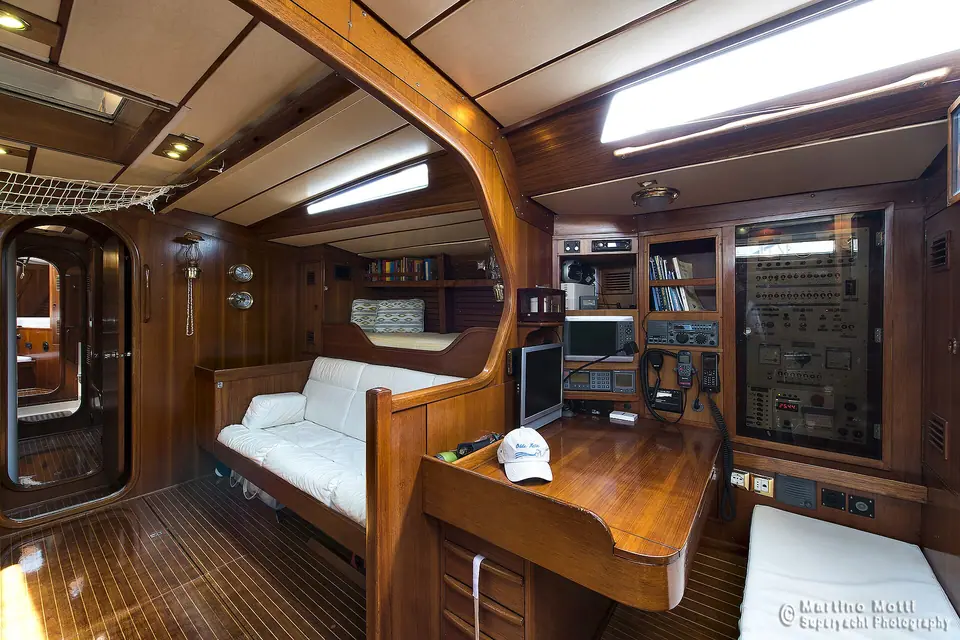
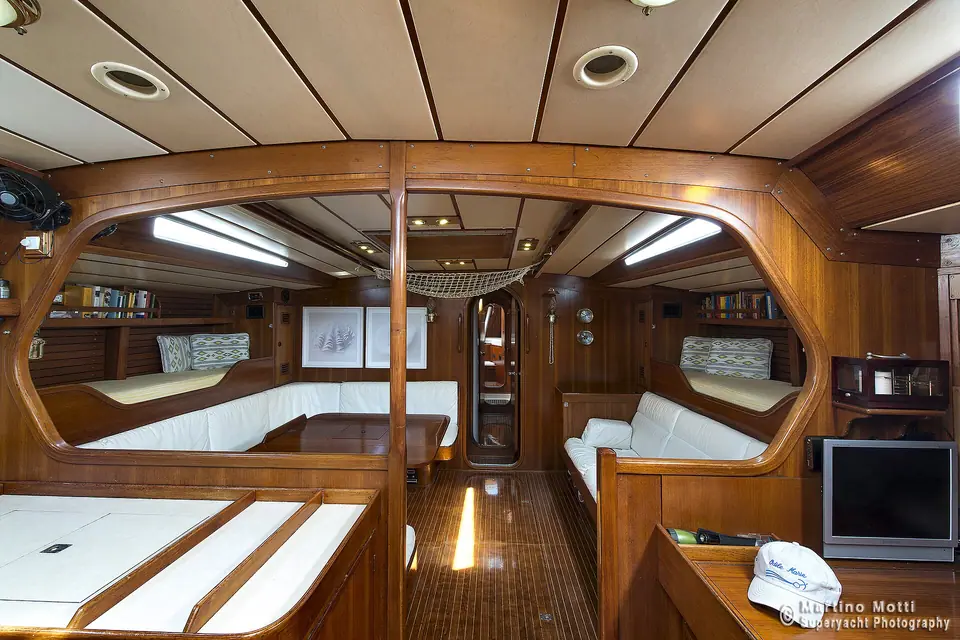
The original layout sleeps up to 12 in four cabin spaces: two pipe cots in the forecastle for crew, two forward guest cabins with upper and lower berths, pilot berths and a convertible settee in the saloon, and an aft owner's cabin with a single and a double berth. There are three heads in total. Headroom is good throughout, and the deep, narrow hull gives the kind of handholds and sea berths that modern wide-transom yachts lack.
Interiors are teak, built in Pietarsaari by Nautor's joiners, and their condition varies enormously. Many 65s have had partial or full interior refits, some by Nautor itself, and a few owners have reconfigured the boats for charter or for a smaller crew with fewer, larger cabins.
What a Swan 65 refit really involves
Every classic Swan 65 is now between about 37 and 54 years old, and the purchase price is only part of the cost. A full refit typically touches the teak deck, standing and running rigging, engine, generator, electrical system, plumbing, tanks, winches and sails. On a 65-foot yacht those numbers add up fast. Budget planners commonly assume a full refit can match or exceed the purchase price of an unrefitted boat.
Engines tell part of the story. Nautor used the 89 hp Volvo Penta MD32 early, then the 115 hp Perkins H6.354M, and later the 148 hp Volvo Penta TMD41A. Many boats have since been repowered with modern diesels. Original Norseman-terminated stainless standing rigging, original Lewmar and Barlow winches and old teak decks are the other big items to price.
The upside is that the hull itself, hand-laid fiberglass built to Lloyd's standards, is extremely durable. A Swan 65 with a solid hull and a well-documented recent refit is often the better buy even at twice the price of a tired example.
The 2019 Frers Swan 65 shares only the name
Around 2018 to 2019 Nautor reused the name for an entirely new yacht from German Frers, with interiors by Heini Gustafsson. It is a modern performance cruiser: hull length 20.11 meters (about 66 feet), a 60-foot waterline, an 18 foot 5 inch beam, twin rudders, a carbon rig with in-boom furling and either a fixed keel at 3.5 meters or an APM telescopic keel ranging from 2.8 to 4.2 meters.
Light displacement is 27,250 kilograms, actually less than the classic, with 6,570 kilograms of ballast. Power is a 150 hp diesel, with 1,200 liters of fuel and 1,000 liters of water. In Yachting World's test off Barcelona the boat averaged 10.5 to 11.5 knots in 15 to 18 knots of true wind, and in 18 to 22 knots it surged past 13 knots on a wave.
Pricing is in another league. The test boat was quoted at about 2.95 million euros ex VAT, and brokerage listings for 2019 to 2023 hulls range from roughly 3 to more than 4 million euros. If you search for a Swan 65 for sale, check which boat you are looking at before you call.
Running costs and the classic Swan 65 market
A classic Swan 65 is a big yacht with big-yacht costs. Expect $60,000 to $150,000 per year for a Mediterranean or US East Coast berth, insurance, haul-outs, varnish, sail replacement, engine and generator service and, often, a part-time or full-time captain. Racing the classic circuit adds sails, crew and travel.
Most of the active market is in Europe, with boats in France, Italy, Spain and occasionally Asia. Recent asking prices have ranged from about $320,000 for a 1975 hull needing work to around $1 million for refitted 1973 boats. Hull history matters: Whitbread veterans and boats with continuous ownership records sell faster and at stronger prices.
Swan 65 specifications
| Length overall | 64.6 ft19.68 m |
|---|---|
| Waterline length | 47 ft14.33 m |
| Beam | 16.3 ft4.98 m |
| Draft | 9.5 ft2.9 m |
| Air draft | 80 ft24.38 m |
| Displacement | 70,107 lbs31,8 kg |
| Ballast | 22,928 lbs10,4 kg |
| Sail area | 1,8 sq ft170 m² |
| Cabins | 4 |
| Berths | Up to 12 |
| Heads | 3 |
| Standard engines | Volvo Penta MD32 diesel, 89 hp (early hulls) |
| Optional engines | Perkins H6.354M 115 hp or Volvo Penta TMD41A 148 hp on later hulls |
| Maximum power | 148 hp |
| Hull type | Fin keel monohull with skeg-hung rudder |
| Keel | Fixed fin keel with lead ballast, 9 ft 6 in draft |
| Rig | Masthead ketch (most hulls) or masthead sloop, keel-stepped aluminum spars |
| Hull construction | Hand-laid solid fiberglass hull (no core), foam-cored fiberglass deck and deckhouse, built to Lloyd's Register standards |
| Builder | Oy Nautor Ab (Nautor's Swan), Finland |
| Naval architect | Sparkman and Stephens |
| Production | 1972 to 1989 |
| Status | Discontinued |
Figures come from builder documentation and independent tests where available. Displacement is usually quoted light, so a loaded cruising boat will weigh more. Compare these specs with another model.
How much does a Swan 65 cost?
Classic Swan 65 values depend almost entirely on refit history. Hulls needing a full systems refit can be found in the low $300,000s in Europe, while boats that have had rigs, engines, teak decks and interiors redone ask $900,000 to over $1 million. Race pedigree adds a premium, and Whitbread veterans attract collectors. The 2019-onward Frers Swan 65 is a separate market, with launch pricing around 2.95 million euros ex VAT and resale listings between roughly 3 and 4 million euros.
Estimate your yearly cost
A planning estimate using common rules of thumb: insurance near 1.5 percent of value, maintenance near 3 percent, haul out and bottom paint by length. Your marina, region and use will move these numbers. Open the full cost calculator.
Versions and options
- Swan 65 ketch (S&S)
- The most common configuration, with a mizzen for balance and easier sail handling on long passages.
- Swan 65 sloop (S&S)
- A small number built as masthead sloops, preferred for racing on the classic circuit.
- Later ballast hulls
- From hull 20, ballast increased to about 13,900 kg, raising stiffness and displacement.
- Swan 65 (Frers, 2019 onward)
- A completely new 66-foot performance cruiser with twin rudders, carbon rig and optional telescopic keel.
Swan 65 timeline
- 1972Nautor begins building the Sparkman and Stephens Swan 65, based on the aluminum S&S yacht Dora IV; first deliveries in 1973
- 1974Sayula II wins the first Whitbread Round the World Race
- 1978King's Legend second, Disque d'Or fourth and ADC Accutrac, skippered by Clare Francis, fifth in the Whitbread
- 1982Xargo III finishes sixth in the third Whitbread
- 1989Production ends after 41 hulls
- 2019Nautor launches a new Frers-designed Swan 65 under the same name
Strengths and weaknesses
What owners like
- Proven ocean racer and cruiser with a Whitbread win
- Durable hand-laid hull built to Lloyd's standards
- Ketch rig is manageable for a small crew
- Sea berths and handholds suited to real passages
- Strong class following and blue-chip classic status
- Later hulls carry more ballast and stand up well
What to weigh up
- Refit costs can rival the purchase price
- 9 ft 6 in draft rules out many anchorages
- Teak decks and original systems are aging
- Interior volume is modest by modern 65-foot standards
- Most boats are in Europe, adding transport or import costs
Used Swan 65 buyer checklist
Take this list to a viewing. Your ticks are saved in this browser so you can come back to it.
Always commission an independent marine survey and an engine survey before you buy. How a marine survey works.
Rivals to consider
Swan 48
The smaller S&S Swan of the same era, a Bermuda Race winner and far cheaper to own.
Compare side by sideSwan 651
Frers' early-1980s successor in the same size range, faster and more modern under the water.
Amel Super Maramu
A smaller, modern ketch designed around easy short-handed cruising rather than racing heritage.
Compare side by sideOyster 495
A much smaller modern deck saloon cruiser for buyers who want comfort over classic lines.
Compare side by sideOur verdict on the Swan 65
The classic Swan 65 is one of the most important production yachts ever built, and it is still a superb ocean boat. It is also a 65-foot yacht built between 1972 and 1989, which means the purchase is the easy part. Buy the best-documented, most recently refitted hull you can afford, ideally a later boat with the increased ballast, and you will own a piece of sailing history that can still cross oceans and win classic regattas. If you want modern volume and speed, the Frers Swan 65 is a remarkable yacht, but it is a different purchase entirely.
Swan 65 questions answered
How much does a Swan 65 cost?
Classic S&S Swan 65s typically list from about $320,000 to over $1 million depending on refit history. The modern Frers Swan 65 sells for roughly 3 to 4 million euros.
How many Swan 65s were built?
Nautor built 41 of the Sparkman and Stephens Swan 65.
Which Swan 65 won the Whitbread?
Sayula II, hull number 3, skippered by Ramon Carlin, won the first Whitbread Round the World Race in 1973 to 1974.
Is the Swan 65 a ketch or a sloop?
Most were ketches, with a small number built as masthead sloops.
What is the draft of a Swan 65?
The classic S&S Swan 65 draws about 9 feet 6 inches. The modern Frers version draws 3.5 meters fixed or 2.8 to 4.2 meters with the telescopic keel.
Is the new Swan 65 related to the classic one?
Only by name. The 2019 Swan 65 is a new German Frers design with twin rudders and a carbon rig.
Swan 65 photos
More bluewater sailboats to explore

Amel 64
Bluewater Sailboats, 64 ft
Used $1.1M to $1.9M
Amel 60
Bluewater Sailboats, 62 ft
Used $1.5M to $2.3M
CNB 66
Bluewater Sailboats, 68 ft
Used $1.85M to $2.6M
Hylas H60
Bluewater Sailboats, 59 ft
Used $1.5M to $2.3M