CNB Yachts Bluewater Sailboats
CNB 76 Sailing Yacht, a Production-Built Superyacht Examined
Groupe Beneteau's industrial know-how applied to a 76 ft raised saloon yacht, with a separate crew quarter aft and 32 owners who bought into the idea.

- Length
- 76 ft23.17 m
- Beam
- 20 ft6.1 m
- Draft
- 9.8 ft3 m
- Cabins
- 3 guest and owner cabins (owner's suite forward, double or twin to port, Pullman to starboard) plus a crew cabin aft; second crew cabin option
- Used price
- $1.9M to $2.9M
On this page
- Overview
- A 76 footer built on a production timetable
- Four modules, one cradle and a 10 mm tolerance
- Ten knots on a close reach and speed in light air
- Four keels in one trunk
- Crew aft, owner forward, and a raised saloon between
- The 3.85 m tender garage and an 1,800 mile engine
- Who bought the 76, and how they rig them
- Not every CNB 76 is the Briand raised saloon
- Specifications
- Price and value
- Strengths and weaknesses
- Used buyer checklist
- Rivals
- Our verdict
- FAQ
The CNB 76 is a 23.17 m Philippe Briand raised saloon sloop built by CNB in Bordeaux from 2013 to 2022. With 32 sold, it was CNB's best seller. Used boats ask about $1.9 to $2.9 million.
- Owners who want a crewed sailing yacht without custom prices
- Mediterranean cruising with occasional ocean passages
- Charter-minded owners who need separate crew space
- Buyers stepping up from a 60 ft cruiser
CNB 76 by the numbers
- Sail area to displacement
- 25.0Racing level power, needs active reefing as the breeze builds.
- Displacement to length
- 118Ultralight. Built for speed, keep payload to a minimum.
- Theoretical hull speed
- 11.4 knThe practical top speed of a displacement monohull under normal sailing, based on waterline length.
- Ballast ratio
- 33%A typical ballast ratio for a cruising monohull.
- Capsize screening
- 1.73Below 2.0, the traditional threshold for offshore suitability.
- Motion comfort ratio
- 38.8A slow, easy motion in a seaway, kind to crews on long passages.
- Length to beam ratio
- 3.80 : 1A slim, easily driven hull.
A 76 footer built on a production timetable
The CNB 76 started from an unusual premise. CNB had built dozens of custom yachts in Bordeaux before joining Beneteau in 1992, then proved with the Bordeaux 60 of 2009 that a semi-custom boat could sell in numbers. For the 76, launched in 2013, the group's engineers devised a modular build that let them deliver a 23 m yacht in five to six months instead of a year. Yachting World's Toby Hodges called the result superyacht styling and engineering at a serial production price.
It worked commercially. CNB's own history lists 32 CNB 76s sold, making it the best seller in its class, and the model ran until the CNB 78 replaced it after Solaris bought the yard in 2021. Anyone searching for a CNB 76 today is looking at a small, well documented fleet of Briand raised saloon sloops, almost all of them in the Mediterranean.
Four modules, one cradle and a 10 mm tolerance
Yachting World pieced together the method: the hull is resin infused in one shot around a PVC foam core with carbon reinforcement, which CNB said made it the largest yacht infused in a single operation. The hull then sits in a metal cradle that holds it rigid while the interior is built in four separate modules, including the engine room. The modules are lowered in with less than 10 mm of tolerance. Building hull and interior at the same time is what halves the build time.
The approach drew one criticism that buyers should know. On the early boat, the tester heard creaks from the forward twin cabin and elsewhere; CNB attributed them to wooden spacers behind deck and hull linings rather than the modular bonding. A decade later, CNB's UK agent told Yachting World that the 76's fundamentals were excellent but it lacked the finish of the Solaris-built 78, which returned to laminated-in bulkheads. On a survey, listen for noises under load and check lining fixings.
Ten knots on a close reach and speed in light air
The first boat, Leo, was splashed in August 2013 and sent on a six-month sea trial from Bordeaux to Turkey. Yachting World sailed her out of Palma on a close reach in a Force 4 to 5 and held a consistent 10.5 to 11 knots, and the boat matched wind speed up to about 9 knots of breeze. In only 4 to 6 knots of true wind she still sailed half a knot to a knot faster than the wind with sheets slightly cracked. Under an asymmetric she passed 11 knots, though the swell made the motion uncomfortable on that angle.
Close-hauled into a short sea she felt stable and powerful, settling onto her chine without trying to round up, and the twin rudders give a light, almost neutral helm that suits an autopilot. The keel bulb carries winglets to cut tip vortex drag. Briand's sail plan offers 311 m2 with a 100 percent foretriangle; the brochure lists a 160 m2 main, 144 m2 genoa and 79 m2 staysail on the standard rig.
Four keels in one trunk
A keel trunk molded into the structure lets owners choose draft to suit their cruising ground. CNB's brochure lists a standard keel of 3.00 m (9 ft 8 in), a shallow 2.50 m (8 ft 2 in), a deep 3.50 m (11 ft 5 in) and a lifting keel ranging from 2.10 to 4.00 m (6 ft 9 in to 13 ft 1 in). Standard ballast is about 15 tonnes on a light displacement of 45 tonnes. CNB argued that offering a single interior layout saved owners money they could spend on keel and rig choices, so expect real variety between boats on the brokerage market.
Crew aft, owner forward, and a raised saloon between
CNB describes the 76 as the only raised saloon in its class that separates the owner's area forward from the crew area aft. The galley is enclosed for safe cooking at sea, fitted with Miele appliances and Corian surfaces, and sits beside a comfortable crew double with en suite; butterfly doors close off the galley and crew zone from the saloon, and an escape hatch gives the crew their own route to the cockpit. A second crew cabin with bunks can be specified.
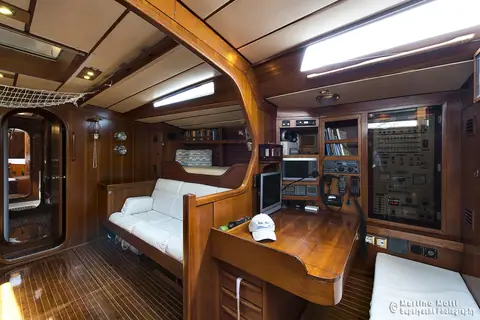
The deck saloon is the showpiece, with low coachroof glazing that keeps end-to-end visibility outside and gives five-star views inside. Sofas to starboard are locked with electromagnets and can swivel together in port, tables to port seat eight, and an aft-facing nav station sits by the companionway. Forward, the owner's cabin hides its berth behind a half-bulkhead and has a large head and shower. Guests get a Pullman to starboard and a double or twin to port, each with en suite access.
The 3.85 m tender garage and an 1,800 mile engine
The bathing platform doubles as the garage door, and CNB says the 3.85 m tender stows in under a minute; Yachting World watched a jet tender launched fuss-free at anchor in Cabrera. A large sail locker forward adds stowage for water toys and spares.
Power is a single Volvo Penta D4 of 180 hp at 2,800 rpm, which looks modest for 45 tonnes but suits a sailing yacht that motors at delivery speed. Leo's skipper calculated about 1,800 miles of range at 8 knots from roughly 2,500 liters of fuel; the brochure lists 2,550 liters of diesel and 1,550 liters of water. The engine room module leaves good space around machinery, and CNB's long focus on noise meant the genset was hard to hear. Bow and stern thrusters with joystick control handle docking with the twin rudders.
Who bought the 76, and how they rig them
Two of the first five owners were first-time buyers, which CNB credited to the price: Yachting World compared the 76's roughly 2 million euro start with a Hallberg-Rassy 64, X-65, Oyster 625 or Amel 64 of similar cost. Later reporting adds useful market color: more than 90 percent of CNB 76s are Mediterranean-based, and 13 owners chose in-mast furling so that reefing could be a one-person job. Two of the first CNB 78 orders came from 76 owners stepping up, a sign of loyalty to the concept.
Not every CNB 76 is the Briand raised saloon
Before the production 76, CNB built custom aluminum yachts, and at least one 1993 aluminum CNB 76 with a Yanmar engine and five cabins is on the market in Italy at about 690,000 euros. It is a different boat entirely. The Briand production model dates from 2013 or later, is GRP with a single Volvo D4, and lists at about 1.98 million euros for a 2016 example in Palma. Use the build year and hull material to filter search results before comparing prices.
CNB 76 specifications
| Length overall | 76 ft23.17 m |
|---|---|
| Waterline length | 72.1 ft21.98 m |
| Beam | 20 ft6.1 m |
| Draft | 9.8 ft3 m |
| Air draft | 116.4 ft35.47 m |
| Displacement | 99,208 lbs45, kg |
| Ballast | 33,069 lbs15, kg |
| Sail area | 3,348 sq ft311 m² |
| Fuel capacity | 674 gal2,55 L |
| Fresh water | 41 gal1,55 L |
| Cabins | 3 guest and owner cabins (owner's suite forward, double or twin to port, Pullman to starboard) plus a crew cabin aft; second crew cabin option |
| Heads | 4 en suite, including the crew head |
| Standard engines | Volvo Penta D4 180 hp diesel |
| Maximum power | 180 hp |
| Cruise speed | 8 knots |
| Range | 1,800 nm |
| Hull type | Moderate displacement monohull with chines, raised saloon and twin rudders |
| Keel | Keel trunk allows standard 3.00 m, shallow 2.50 m, deep 3.50 m or lifting 2.10 to 4.00 m keels; winglets on the bulb |
| Rig | Solent sloop with staysail; aluminum mast standard, Hall Spars carbon performance mast about 3 m taller optional; in-mast furling option |
| Hull construction | Resin-infused PVC foam sandwich reinforced with carbon, modular interior |
| Builder | CNB (Construction Navale Bordeaux), Groupe Beneteau, France |
| Naval architect | Philippe Briand |
| Other design credits | Interior by Jean-Marc Piaton and Rafael Bonet |
| Production | 2013 to 2022 |
| Status | Discontinued |
Figures come from builder documentation and independent tests where available. Displacement is usually quoted light, so a loaded cruising boat will weigh more. Compare these specs with another model.
How much does a CNB 76 cost?
CNB started the 76 at about 2 million euros, and the yard told Yachting World a typical boat came to around 2.5 million euros, roughly half what it would charge for a custom yacht of the same size. In 2026 a 2016 CNB 76 in Palma asks about 1.98 million euros, down from 2.5 million euros. Carbon rig, keel choice, crew cabin configuration and a fresh refit drive the spread; most boats are Mediterranean-based and VAT status matters.
Estimate your yearly cost
A planning estimate using common rules of thumb: insurance near 1.5 percent of value, maintenance near 3 percent, haul out and bottom paint by length. Your marina, region and use will move these numbers. Open the full cost calculator.
CNB 76 timeline
- 1992CNB, founded in Bordeaux in 1987, becomes part of Beneteau
- 2009Bordeaux 60 launched, CNB's first semi-custom model
- 2013First CNB 76 splashed in August and sent on a six-month sea trial to Turkey
- 2021Solaris acquires CNB and moves production to Italy
- 2023First CNB 78 launched as the 76's replacement, after 32 CNB 76s sold
Strengths and weaknesses
What owners like
- Huge amount of yacht for a production price
- Fast and consistent, 10.5 to 11 knots on a close reach in a Force 4 to 5
- Proper crew quarters aft, separated from the owner's suite
- Choice of four keels including a lifting keel
- Tender garage and long motoring range
- Popular model with 32 sold, so comparable sales exist
What to weigh up
- Finish and creaks drew criticism compared with the later 78
- Single interior layout
- Light, neutral helm feel from the twin rudders
- Running costs of a 76 ft yacht with crew
- Most boats are in Europe; US buyers face import and VAT questions
Used CNB 76 buyer checklist
Take this list to a viewing. Your ticks are saved in this browser so you can come back to it.
Always commission an independent marine survey and an engine survey before you buy. How a marine survey works.
Rivals to consider
Oyster 745
A British deck saloon flagship with stronger brand resale and higher prices.
Swan 60
A faster performance cruiser; Yachting World noted the 76 cost about 500,000 euros less.
Hallberg-Rassy 64
Smaller, center cockpit and couple-oriented, at a similar starting price when new.
Jeanneau 64
Another Briand design from the Beneteau group, smaller and far cheaper, aimed at owner-operators.
Our verdict on the CNB 76
The CNB 76 is the boat that showed a 76 ft raised saloon yacht could be built on an industrial timetable without looking or sailing like one. It is quick, handsome and laid out for a professional crew to look after an owner's party in comfort. The early finish was not up to custom standards and the running costs are those of a big yacht, but with 32 built and a successor that confirmed the concept, a well kept CNB 76 remains a strong value against new 70 footers.
CNB 76 questions answered
How much does a CNB 76 cost?
New, CNB started it at about 2 million euros and typical boats came to about 2.5 million euros. Used boats ask roughly $1.9 million to $2.9 million; a 2016 boat lists at about 1.98 million euros.
How many CNB 76s were built?
CNB says 32 were sold between the 2013 launch and the arrival of the CNB 78.
What replaced the CNB 76?
The CNB 78, built by Solaris in Italy, with the first boat launched in 2023.
What keels are available on the CNB 76?
Standard 3.00 m, shallow 2.50 m, deep 3.50 m, or a lifting keel from 2.10 to 4.00 m.
Does the CNB 76 need a crew?
It was designed with crew quarters aft, and Yachting World's rule of thumb is that 60 ft plus yachts need crew, though in-mast furling makes reefing a one-person job.
What engine is in the CNB 76?
A single Volvo Penta D4 of 180 hp, with about 1,800 miles of range at 8 knots.
More bluewater sailboats to explore

CNB 66
Bluewater Sailboats, 68 ft
Used $1.85M to $2.6M
Swan 65
Bluewater Sailboats, 65 ft
Used $320K to $1.1M
Amel 64
Bluewater Sailboats, 64 ft
Used $1.1M to $1.9M
Amel 60
Bluewater Sailboats, 62 ft
Used $1.5M to $2.3M